

Get all the data you need about the real estate market in Durban
SUMMARY
We analyzed apartment rental yields in Durban, as of 2026, for residential apartment buyers using the raw Durban dataset provided. The work compares estimated purchase prices, achievable monthly rents, gross yields, and net yields across Durban neighborhoods and apartment types.
This article is designed for foreign beginner buyers who want a practical view of rental income in Durban rather than a generic property overview. We update this tracker regularly, so the figures should be read as a current May 2026 snapshot of the Durban apartment market.
The strongest income signals in the dataset are in Overport, Glenwood, North Beach, Umhlanga Ridge, and Morningside. These areas combine attractive rent-to-price ratios with real tenant demand rather than only cheap purchase prices.
Overport studios show the highest estimated net yield in the table at 8.4%, while Glenwood studios follow closely at 8.2%. North Beach studios and 1-bedroom apartments are both estimated at 8.0% net yield, and Umhlanga Ridge 1-bedroom apartments also reach 8.0% net yield.
The weakest pure income profile is in La Lucia and Point Waterfront. These are attractive lifestyle and coastal areas, but high purchase prices reduce the rental-income efficiency, especially for 2-bedroom apartments.
Studios and 1-bedroom apartments usually produce the best return for the lowest total investment in Durban. Two-bedroom apartments can work, but they need a clear tenant story because the larger purchase price often reduces the yield.
For stable rental income rather than maximum yield, Morningside, Musgrave, Windermere, Glenwood, and Umhlanga Ridge are the most convincing areas. Their yields are not always the absolute highest, but tenant depth, livability, and resale logic are stronger.
The main risk in Durban is that a high gross yield can disappear inside a weak building. Levies, special levies, lift repairs, security costs, vacancy, arrears, and maintenance can turn an attractive central or beachfront apartment into a poor investment.
The practical takeaway is simple. A beginner buyer should usually focus on a well-managed studio or 1-bedroom apartment in Glenwood, Umhlanga Ridge, Morningside, Windermere, or selected North Beach buildings before chasing the cheapest apartment in Durban Central or South Beach.
Get fresh and reliable information about the market in Durban
Don't base significant investment decisions on outdated data. Get updated and accurate information.

Neighborhoods and apartment rental yields in Durban in 2026
This table compares apartment rental yields in Durban by neighborhood and apartment size. It covers studios, 1-bedroom apartments, and 2-bedroom apartments across the main areas included in the raw Durban dataset.
For each area, the table shows estimated purchase price, estimated monthly rent, gross rental yield, and net rental yield. The raw dataset does not provide separate annual fees, occupancy, time-to-rent, demand, risk, or investment-profile columns, so this HTML table keeps the factual columns that are actually available.
Finally, please note you'll find much more detailed data in our real estate pack about Durban.
| Neighborhood | Studio average purchase price | Studio average monthly rent | Studio gross rental yield | Studio net rental yield | 1-bedroom average purchase price | 1-bedroom average monthly rent | 1-bedroom gross rental yield | 1-bedroom net rental yield | 2-bedroom average purchase price | 2-bedroom average monthly rent | 2-bedroom gross rental yield | 2-bedroom net rental yield |
|---|---|---|---|---|---|---|---|---|---|---|---|---|
| Berea | R620,000 | R5,200 | 10.1% | 7.5% | R850,000 | R7,200 | 10.2% | 7.5% | R1,150,000 | R9,300 | 9.7% | 7.1% |
| Durban Central | R430,000 | R4,100 | 11.4% | 7.8% | R620,000 | R5,600 | 10.8% | 7.4% | R820,000 | R7,200 | 10.5% | 7.0% |
| Essenwood | R760,000 | R6,100 | 9.6% | 7.1% | R1,020,000 | R8,200 | 9.6% | 7.1% | R1,450,000 | R10,500 | 8.7% | 6.3% |
| Glenwood | R590,000 | R5,400 | 11.0% | 8.2% | R820,000 | R7,300 | 10.7% | 8.0% | R1,120,000 | R9,100 | 9.8% | 7.3% |
| La Lucia | R1,250,000 | R9,000 | 8.6% | 6.0% | R1,800,000 | R13,000 | 8.7% | 6.1% | R2,700,000 | R18,500 | 8.2% | 5.7% |
| Morningside | R720,000 | R6,300 | 10.5% | 7.8% | R1,050,000 | R8,900 | 10.2% | 7.5% | R1,450,000 | R11,500 | 9.5% | 7.0% |
| Musgrave | R690,000 | R6,000 | 10.4% | 7.7% | R980,000 | R8,100 | 9.9% | 7.3% | R1,350,000 | R10,500 | 9.3% | 6.8% |
| North Beach | R560,000 | R5,200 | 11.1% | 8.0% | R780,000 | R7,200 | 11.1% | 8.0% | R1,050,000 | R9,300 | 10.6% | 7.5% |
| Overport | R500,000 | R4,700 | 11.3% | 8.4% | R720,000 | R6,500 | 10.8% | 8.0% | R980,000 | R8,300 | 10.2% | 7.4% |
| Point Waterfront | R1,100,000 | R8,500 | 9.3% | 6.5% | R1,650,000 | R12,500 | 9.1% | 6.4% | R2,400,000 | R17,000 | 8.5% | 5.9% |
| South Beach | R420,000 | R3,900 | 11.1% | 7.6% | R600,000 | R5,400 | 10.8% | 7.3% | R780,000 | R7,000 | 10.8% | 7.2% |
| Umhlanga Ridge | R850,000 | R7,800 | 11.0% | 7.9% | R1,250,000 | R11,500 | 11.0% | 8.0% | R1,800,000 | R15,500 | 10.3% | 7.3% |
| Windermere | R700,000 | R6,200 | 10.6% | 7.9% | R1,000,000 | R8,500 | 10.2% | 7.5% | R1,350,000 | R11,000 | 9.8% | 7.1% |
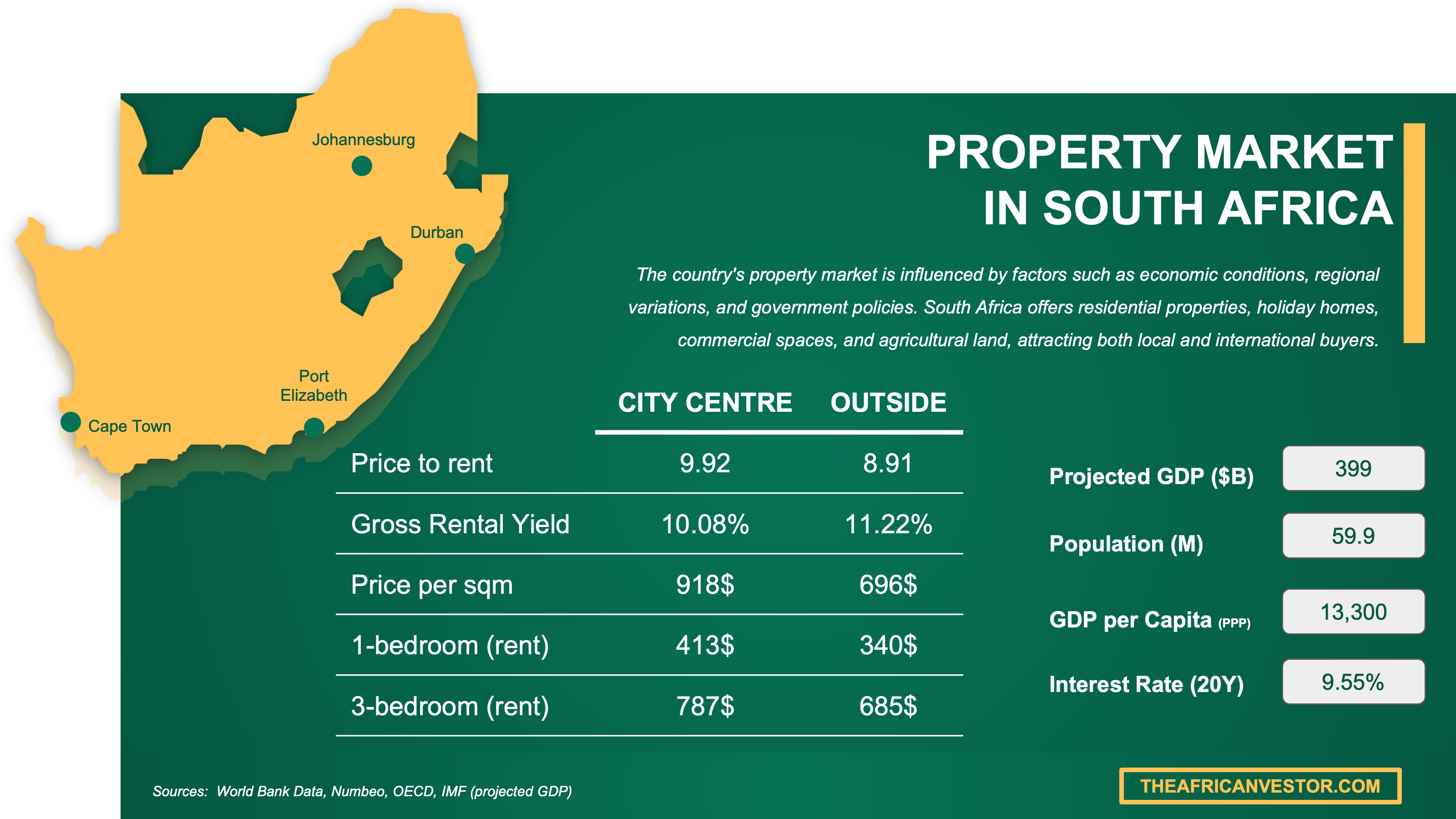
We have made this infographic to give you a quick and clear snapshot of the property market in South Africa. It highlights key facts like rental prices, yields, and property costs both in city centers and outside, so you can easily compare opportunities. We’ve done some research and also included useful insights about the country’s economy, like GDP, population, and interest rates, to help you understand the bigger picture.
Which neighborhoods offer the best net yield among areas people actually want to live in Durban?
The best net-yield neighborhoods among livable Durban apartment areas are Glenwood, Umhlanga Ridge, North Beach, Morningside, Windermere, and Overport. These areas combine above-average estimated net yields with real renter demand.
The strongest numbers are in Overport, Glenwood, North Beach, and Umhlanga Ridge. Overport studios show about 8.4% net yield, Glenwood studios about 8.2%, North Beach studios and 1-bedroom apartments about 8.0%, and Umhlanga Ridge 1-bedroom apartments about 8.0%.
The reason these yields are credible is that the rent is not only driven by low purchase prices. Glenwood benefits from the University of KwaZulu-Natal, hospitals, older walkable apartment stock, and access to the Berea.
Umhlanga Ridge has a different rental logic. Its appeal comes from offices, Gateway, secure modern buildings, and corporate tenants, which makes the 1-bedroom format especially strong for rental income in Durban.
Morningside and Windermere are slightly more expensive, but their estimated net yields around 7.5% to 7.9% are still attractive. Tenants pay for lifestyle, Florida Road access, Moses Mabhida proximity, and stronger perceived livability than the inner CBD.
The honest interpretation is that Overport and North Beach give stronger yields, while Morningside and Windermere give cleaner tenant and resale logic. For a beginner buyer, Glenwood and Umhlanga Ridge are the easiest to understand because the tenant story is strong and the numbers still work.
Where can I find apartments with above-average yields and below-average entry prices in Durban?
The best Durban areas for above-average yields and below-average entry prices are Glenwood, Overport, North Beach, South Beach, and Durban Central. The safest of these for a beginner are Glenwood and selected parts of North Beach.
The entry price is materially lower than in La Lucia, Point Waterfront, and premium northern coastal stock. In the table, a studio costs about R590,000 in Glenwood, R500,000 in Overport, R560,000 in North Beach, R420,000 in South Beach, and R430,000 in Durban Central.
The yield spread is meaningful. Glenwood studios are estimated at 8.2% net yield, Overport studios at 8.4% net yield, and North Beach studios at 8.0% net yield, compared with 6.0% in La Lucia and 6.5% in Point Waterfront.
The reason prices are lower is not the same in every area. Glenwood is cheaper because much of the stock is older and less polished for international buyers, while Overport is cheaper because it is less prestigious and less tourist-facing.
Durban Central and South Beach are cheaper for a more serious reason. Building-management issues, safety perception, vacancy risk, and maintenance backlogs can reduce the actual net income even when the gross yield looks strong.
The practical takeaway is not to buy the cheapest apartment. The better value opportunity is a low-priced apartment in a building with good levies, clean financials, strong security, working lifts, and evidence of actual tenant demand.
Where does the rent level justify the purchase price most clearly in Durban?
The rent level justifies the purchase price most clearly in Umhlanga Ridge, Glenwood, North Beach, and Morningside. These areas have enough rent pressure to support the purchase price without relying only on speculation.
Umhlanga Ridge is the clearest example for 1-bedroom apartments. A R1.25 million 1-bedroom apartment renting for about R11,500 per month gives an estimated 11.0% gross yield and 8.0% net yield.
Glenwood also looks rational. A R820,000 1-bedroom apartment renting for R7,300 per month produces around 10.7% gross yield and 8.0% net yield, supported by student, medical, and young-professional demand around Berea and Glenwood.
North Beach has strong rent-to-price ratios because beachfront access still matters to tenants, while many older buildings trade below northern coastal prices. The risk is that poor building management can make a high-yield unit expensive to own.
Morningside is slightly less cheap, but the rent is supported by lifestyle demand around Florida Road, Windermere, and the Berea. The Durban logic is that renters pay a premium for walkability, lifestyle, and shorter access to employment and leisure nodes.
We have actually built the our real estate pack about Durban to make sure you won’t buy in the wrong area. Check it out.
Make a profitable investment in Durban
Better information leads to better decisions. Save time and money. Download our data.
Where is the best place to buy if I want stable rental income rather than maximum yield in Durban?
The best Durban areas for stable rental income are Morningside, Musgrave, Windermere, Glenwood, and Umhlanga Ridge. They are not always the absolute highest-yield areas, but their tenant depth is stronger.
Morningside 1-bedroom apartments show about 7.5% net yield, Windermere 1-bedroom apartments about 7.5%, Musgrave 1-bedroom apartments about 7.3%, and Umhlanga Ridge 1-bedroom apartments about 8.0%.
The stability comes from Durban-specific renter behavior. Morningside and Windermere attract lifestyle renters, young professionals, and tenants wanting access to Florida Road, Moses Mabhida, and the Berea.
Musgrave attracts renters who value established buildings, schools, hospitals, and central access. That makes it less exciting than the highest-yield areas, but more understandable for a cautious foreign buyer.
Umhlanga Ridge is different. Its stability is corporate and convenience-led, with offices, Gateway, secure apartment blocks, and access to the northern corridor supporting a liquid 1-bedroom rental market.
The trade-off is that Durban Central and South Beach may show similar or higher gross yields, but they are more exposed to vacancy, tenant quality, building condition, and resale liquidity risk.
Which apartment type gives the best return for the lowest total investment in Durban?
The best apartment type for the lowest total investment in Durban is usually the studio apartment, followed closely by the 1-bedroom apartment. The 2-bedroom apartment gives higher rent, but usually weaker yield per rand invested.
In the table, studios often achieve 10.5% to 11.4% gross yields in mid-market and central areas. Net yields are strongest in Overport, Glenwood, North Beach, Umhlanga Ridge, and Windermere.
Studios work because Durban has many renters who are price-sensitive but location-sensitive. Students, junior professionals, single workers, and people wanting central access often prefer a smaller apartment if the location and building are practical.
In Glenwood, North Beach, and Umhlanga Ridge, this demand is deep enough to support small-unit rents. Glenwood studios rent for about R5,400 per month on an estimated R590,000 purchase price, while Umhlanga Ridge studios rent for about R7,800 on an estimated R850,000 purchase price.
One-bedroom apartments are often the best beginner compromise. They cost more than studios, but they attract singles, couples, corporate renters, and longer-stay tenants, and they are often easier to resell than very small studios.
Two-bedroom apartments make sense in family or sharer markets. They work best in Umhlanga Ridge, Morningside, Windermere, and La Lucia where tenants pay for location, security, parking, and lifestyle.
We give you more details in the our real estate pack about Durban.
Which neighborhoods offer strong rental income with the lowest vacancy risk in Durban?
The Durban neighborhoods that combine strong rent with lower vacancy risk are Umhlanga Ridge, Morningside, Windermere, Musgrave, and Glenwood. They have both rental income and durable demand pools.
Umhlanga Ridge has the highest 1-bedroom rent in the table at about R11,500 per month, with an estimated 8.0% net yield. Morningside and Windermere 2-bedroom apartments rent around R11,500 and R11,000 per month, respectively.
These rents are supported by local demand. Umhlanga Ridge has business, retail, and modern secure stock, while Morningside and Windermere have lifestyle appeal and central access.
Musgrave has hospitals, schools, and established apartment buildings. Glenwood has student and medical-worker demand, which helps support rents even when the buildings are older.
The risk is different in expensive coastal areas. La Lucia and Point Waterfront have high rents, but the tenant pool is narrower because rents and purchase prices are higher.
For stable income, a well-priced 1-bedroom apartment in Umhlanga Ridge, Morningside, Windermere, or Glenwood is usually better than chasing the highest gross yield in a weaker building.
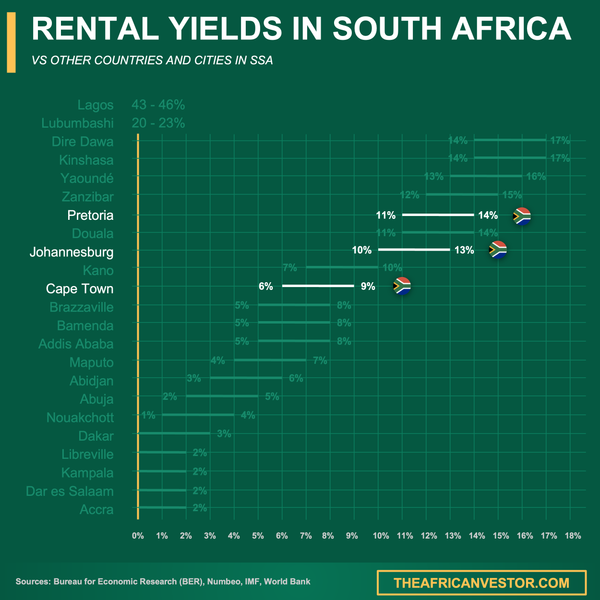
We did some research and made this infographic to help you quickly compare rental yields of the major cities in South Africa versus those in neighboring countries. It provides a clear view of how this country positions itself as a real estate investment destination, which might interest you if you’re planning to invest there.
Which areas look overpriced relative to their rental income in Durban?
The areas that look most overpriced relative to rental income are La Lucia and Point Waterfront, with parts of premium Umhlanga Central also requiring caution. They are excellent lifestyle areas, but weaker pure rental-yield plays.
La Lucia 2-bedroom apartments in the table cost about R2.7 million and rent for about R18,500 per month, giving only 8.2% gross yield and 5.7% net yield.
Point Waterfront 2-bedroom apartments cost about R2.4 million and rent for R17,000 per month, giving 8.5% gross yield and 5.9% net yield. The rent is high, but the capital required is also high.
These are not bad neighborhoods. The problem is that buyers pay for scarcity, lifestyle, sea access, security, prestige, and modern buildings, and rental income does not always rise enough to match that purchase-price premium.
This is common in Durban’s coastal and northern-market logic. Owner-occupiers and lifestyle buyers often set the price, while tenants still compare monthly rent against income and alternatives.
A beginner rental investor should separate good place to live from good yield investment. La Lucia and Point Waterfront may make sense for capital preservation or lifestyle, but they are weaker for income-first buyers.
Which neighborhoods should I avoid even if the rental yield looks attractive in Durban?
Beginner investors should be careful with Durban Central, South Beach, and weaker buildings in North Beach even when the yield looks attractive. The issue is not the rent-to-price ratio, it is execution risk.
Durban Central studios show about 11.4% gross yield and 7.8% net yield, while South Beach studios show about 11.1% gross yield and 7.6% net yield. Those numbers look good on paper.
The problem is that net yield is fragile in older central and beachfront buildings. Levies, special levies, lift repairs, security costs, arrears, tenant turnover, and vacancy can reduce the actual cash return quickly.
North Beach is not an avoid area overall. It can work well, especially when a studio or 1-bedroom apartment is in a secure and well-managed block.
The avoid category is badly managed buildings. Beachfront demand will not save a block with poor maintenance, weak security, high arrears, or a special-levy risk that the buyer did not price in.
The Durban rule is simple. Buy the building before you buy the yield, because a slightly lower yield in Glenwood or Morningside can be safer than a high-yield unit in a distressed block.
Which neighborhoods look risky even though the rental yield is high in Durban?
The riskiest high-yield Durban areas are Durban Central, South Beach, and lower-quality Overport or North Beach buildings. They can produce strong yields, but the risk-adjusted return may be weaker.
The headline numbers are attractive. Overport studios show about 8.4% net yield, Durban Central studios about 7.8% net yield, and South Beach studios about 7.6% net yield.
The risk comes from different sources. In Durban Central and South Beach, the main risk is building condition, security perception, vacancy, and weaker resale liquidity.
In Overport, the risk is more about building age, parking, tenant depth, and block-by-block differences. A small clean unit in a practical building is very different from a large awkward unit in a tired block.
These risks are specific to Durban because the city has a wide gap between well-managed sectional-title buildings and poorly maintained older stock. Two buildings in the same neighborhood can produce very different investment outcomes.
A safer comparison is Glenwood or Morningside. The yield may be similar or slightly lower, but the tenant base is broader and the resale story is usually cleaner.
Get to know the market before buying a property in Durban
Better information leads to better decisions. Get all the data you need before investing a large amount of money.
What neighborhoods should I avoid when buying a rental apartment in Durban?
For beginner rental investors, the main Durban avoid list is Durban Central, South Beach, and poor-quality North Beach buildings. These areas are not automatically bad, but they are harder for a first-time investor to manage.
Durban Central should be avoided by beginners unless the building has strong security, clean financials, working lifts, and proven rental demand. The high yield can be offset by tenant churn, repairs, and vacancy.
South Beach should be approached carefully because low purchase prices can hide weak building management and seasonal or lower-income tenant risk. It may work for experienced cash buyers, but it is less forgiving for beginners.
North Beach should not be avoided completely. The avoid category is badly managed buildings, especially where levies, arrears, or maintenance backlogs are visible during due diligence.
Overport is not a blanket avoid, but beginners should avoid large or awkward-layout units unless the rent is clearly supported. Smaller, clean, well-located units are safer.
The practical rule is to avoid any Durban apartment where the only attractive feature is the low purchase price. A cheap unit in a weak block can be more expensive than it looks.
Which neighborhoods are seeing rental demand weaken, and why, in Durban?
Rental demand appears most vulnerable in older Durban Central and South Beach stock, plus some premium coastal units where rents are too high for the tenant pool. This is more a quality-and-price problem than a citywide collapse.
The evidence is indirect rather than a perfect neighborhood vacancy series. The raw dataset notes that KZN tenants in good standing were only 76.81%, which matters because payment risk affects actual net income.
In Durban Central and South Beach, demand weakens when tenants have better-managed alternatives in Glenwood, Morningside, Berea, or Umhlanga Ridge. Renters may accept a smaller unit if the building is safer and more reliable.
In premium coastal areas, the weakness is different. Units can sit longer if asking rents exceed what corporate or expat tenants are willing to pay, especially when there are alternatives in Umhlanga Ridge.
This is not necessarily structural decline everywhere. It is a warning that old buildings, weak security, and overpriced premium rentals are becoming harder to justify.
For a foreign buyer, the practical takeaway is to look beyond the neighborhood name. The building’s condition, security, levy history, tenant profile, and rent realism are what determine whether the demand is durable.
Which neighborhoods are seeing new developments that could create stronger rental demand in Durban?
The Durban areas where new development could support stronger apartment demand are Umhlanga Ridge, the Cornubia and Sibaya corridor, Point Waterfront, and selected central regeneration nodes. The strongest near-term rental case is still Umhlanga Ridge.
Umhlanga Ridge benefits most directly because development there adds offices, retail, secure apartment blocks, and daily convenience. This deepens demand for studios and 1-bedroom apartments.
The raw Durban dataset also points to eThekwini planning around urban core areas, densification corridors, mixed-use nodes, investment nodes, coastal corridor areas, and transport networks. That matters because rental demand usually follows jobs, retail, transport, and mixed-use activity.
Sibaya is more speculative for a beginner apartment investor. It can create future demand through residential, commercial, hospitality, and green-space components, but prices may already include much of the story.
Point Waterfront has lifestyle and regeneration appeal, but investors must separate demand-creating development from supply-heavy development. More apartments do not automatically mean better yields if new stock competes for the same tenant pool.
The practical recommendation is to favor places where development adds tenants, not just units. Umhlanga Ridge looks stronger because the tenant base is already visible.

We created this infographic to give you a simple idea of how much it costs to buy property in different parts of South Africa. As you can see, it breaks down price ranges and property types for popular cities in the country. We hope this makes it easier to explore your options and understand the market.
Which neighborhoods are becoming more attractive to renters because of recent infrastructure or transport changes in Durban?
The neighborhoods becoming more attractive because of infrastructure and access logic are Umhlanga Ridge, Cornubia-adjacent areas, Point Waterfront, and parts of the Berea corridor. The most investable of these today is Umhlanga Ridge.
Umhlanga Ridge gains from the northern corridor’s office, retail, road, and mixed-use concentration. Renters pay for shorter commutes to northern employment nodes, Gateway access, secure buildings, and lower-friction daily living.
Cornubia is becoming more relevant because retail and infrastructure investment expand the northern urban corridor. For apartment investors, however, it is still important to avoid paying too much for a future story before rental demand is visible.
Point Waterfront benefits from waterfront and tourism-linked infrastructure, but the purchase price is high. That means the transport and lifestyle improvement is partly already priced in.
Berea, Glenwood, Morningside, and Windermere benefit less from new mega-projects and more from established access. Their advantage is that tenants already understand the location.
The real signal is not whether an area has a development story. The real signal is whether new access, jobs, retail, or safety improvements create tenants who can pay the rent required by the purchase price.
Which neighborhoods have become less attractive for apartment investors over the last 12 months in Durban?
The areas that have become less attractive for rental-income investors are La Lucia, Point Waterfront, and weaker inner-city beachfront stock. The reasons are different: price pressure at the top end and risk pressure in older stock.
La Lucia and Point Waterfront remain desirable, but their estimated net yields are only around 5.7% to 6.5% for many apartment types. If prices rise faster than rents, the income case weakens.
La Lucia 2-bedroom apartments are the clearest example. The estimated purchase price is R2.7 million, the estimated rent is R18,500 per month, and the estimated net yield is 5.7%.
Point Waterfront 2-bedroom apartments show a similar pattern. The table estimates R2.4 million purchase price, R17,000 monthly rent, and 5.9% net yield.
Older central and beachfront stock has become less attractive where levies, maintenance, and tenant-payment risk reduce net income. KZN’s weaker tenant good-standing figure makes this risk more important than the gross yield suggests.
The recommendation is not to avoid these areas completely. Buy La Lucia or Point Waterfront only at a yield-disciplined price, and buy central or beachfront stock only after deep building due diligence.
Which apartment types are becoming harder to rent in Durban, and in which neighborhoods?
The apartment types becoming harder to rent in Durban are overpriced 2-bedroom apartments in premium coastal areas, poorly maintained studios in central buildings, and large older units with high levies in weaker blocks.
Studios are still liquid in Glenwood, North Beach, Umhlanga Ridge, and Morningside when they are clean, secure, and well priced. The problem is not the studio format itself, but poor building quality or unrealistic rent.
One-bedroom apartments remain the most balanced Durban rental product. They work across Umhlanga Ridge, Morningside, Glenwood, Windermere, and Musgrave because the tenant pool includes singles, couples, and corporate renters.
Two-bedroom apartments are more selective. They work well where families, sharers, or higher-income tenants want the area, such as Umhlanga Ridge, Morningside, Windermere, and La Lucia.
They become harder when the rent is too close to townhouse or house alternatives. A tenant looking at a high-rent 2-bedroom apartment in a premium area may compare it with more space elsewhere.
For a beginner, the safest Durban rule is to buy a studio or 1-bedroom apartment in a strong building first. Buy a 2-bedroom apartment only where the tenant profile clearly supports it.
Don't buy the wrong property, in the wrong area of Durban
Buying real estate is a significant investment. Don't rely solely on your intuition. Gather the right information to make the best decision.
INSIGHTS
These insights are drawn from the Durban apartment rental yield dataset, with a focus on what a foreign individual buyer should understand before buying a residential apartment to rent out.
You’ll find even more insights in our our real estate pack about Durban.
- Durban studios often beat 2-bedroom apartments because small units keep rent high relative to purchase price. For a beginner buyer, this means a smaller apartment can be more efficient than a larger unit with a higher headline rent.
- Overport studios show the highest estimated net yield in the Durban dataset at 8.4%. The number is attractive, but building quality, parking, layout, and tenant depth still need careful checking.
- Glenwood studios are one of the strongest balance points in the dataset. The estimated R590,000 purchase price and R5,400 monthly rent support an 8.2% net yield while the area still has student, medical, and young-professional demand.
- Umhlanga Ridge 1-bedroom apartments look unusually strong because corporate and convenience-led rents support higher monthly income. A R1.25 million 1-bedroom apartment renting for R11,500 per month is one of the cleanest rent-to-price examples in the table.
- North Beach yields are high, but the building matters more than the neighborhood label. A well-managed beachfront block can work, while a weak block can turn a strong gross yield into a maintenance problem.
- La Lucia rents are high, but purchase prices reduce rental-income efficiency. This is especially clear in 2-bedroom apartments, where the estimated net yield is only 5.7% despite an R18,500 monthly rent.
- Point Waterfront is more lifestyle-led than yield-led. The area has appeal, but the estimated R2.4 million price for a 2-bedroom apartment compresses the income case.
- Morningside 1-bedroom apartments are a safer Durban rental product than larger prestige apartments. The 7.5% estimated net yield is supported by lifestyle demand, central access, and a broader tenant pool.
- Musgrave gives stable demand, but the yields are slightly weaker than Glenwood or Overport. That trade-off may still suit a cautious buyer who wants hospitals, schools, established buildings, and central access.
- South Beach looks cheap, but Durban vacancy and maintenance risk can erase the yield advantage. A R420,000 studio with 7.6% net yield is only attractive if the building is operationally sound.
- Berea is a practical middle ground. It does not have the highest yield in the dataset, but the area offers moderate prices, steady rents, and broad tenant depth.
- Durban Central gross yields look strong, but net yields fall once vacancy, management costs, arrears, and maintenance are included. The city-center discount exists for a reason.
- Two-bedroom Durban apartments work best where families or sharers pay for location, security, and parking. They are less compelling when the higher purchase price is not matched by a strong tenant profile.
- Umhlanga Ridge beats La Lucia for rental yield because prices are lower and tenant depth is broader. That makes it more useful for income buyers, even if La Lucia feels more premium.
- The best Durban beginner product is usually a well-managed studio or 1-bedroom apartment. The buyer should treat the body corporate, levy history, security, lifts, and maintenance records as part of the yield calculation.
Don't lose money on your property in Durban
100% of people who have lost money there have spent less than 1 hour researching the market. We have reviewed everything there is to know. Grab our guide now.

OUR METHODOLOGY TO BUILD THIS TRACKER
To estimate purchase price, monthly rent, and rental yield in different Durban neighborhoods, we built the analysis manually from the ground up by neighborhood and apartment type. For each area, we looked separately at studios, 1-bedroom apartments, and 2-bedroom apartments, using comparable residential apartment samples wherever possible.
We manually researched current residential sale and rental listings across major real estate platforms relevant to Durban, including Property24, Private Property, and Pam Golding Properties. We did not reuse a third-party yield dataset.
For each neighborhood and apartment type covered in the tracker, we collected comparable sale listings ourselves, then cleaned, filtered, normalized, and interpreted the sample. Duplicate listings, incomplete listings, luxury outliers, distressed assets, serviced-style offers, unrealistic asking prices, and non-comparable properties were removed.
On the sale side, we kept only reasonably comparable properties based on location, property type, size, condition, building quality, and listing quality. We used the median price as the main reference where possible, or the average only when the sample was clean enough to make the average meaningful.
We then built the rental side of the dataset separately. For the same neighborhood and apartment type, we manually collected rental listings, removed outliers and non-comparable listings, and estimated a realistic monthly rent using the median rent where possible.
Purchase prices and rents were researched separately, then matched by neighborhood and property type to estimate gross rental yield. The gross rental yield was calculated as annual rent divided by estimated purchase price.
To estimate net rental yield, we did not apply one flat discount to every Durban apartment. The deduction was adjusted by neighborhood and property type because a small central apartment, a modern Umhlanga Ridge unit, an older beachfront flat, and a premium coastal apartment do not have the same operating-cost profile.
The net yield adjustment considers the costs and risks that matter in Durban, including levies, rates, insurance, vacancy risk, maintenance, repairs, management fees, letting fees, bad-debt risk, building costs, lift and security costs, special levies, and other operating costs when relevant.
Each estimate is assigned a practical confidence level based on the quality and size of the comparable listing sample. A sample of 30 to 40 comparable listings gives higher confidence, 20 to 30 comparable listings is usable but less robust, and fewer than 20 comparable listings is directional only unless the comparable area is widened.
These estimates are structured market estimates, not guarantees of future rental income. Honesty, quality, and rigor are central to our work, and they are also what you will find in our real estate pack about Durban.
