
Authored by the expert who managed and guided the team behind the South Africa Property Pack

Everything you need to know before buying real estate is included in our South Africa Property Pack
If you are reading this, you are probably thinking about buying a property in Pretoria, and you want to know what could go wrong.
That is exactly why we wrote this guide: to give you the insider knowledge about scams, grey areas, and the pitfalls that specifically target foreign buyers in this South African capital.
We constantly update this blog post to keep the information fresh and reliable.
And if you're planning to buy a property in this place, you may want to download our pack covering the real estate market in Pretoria.

How risky is buying property in Pretoria as a foreigner in 2026?
Can foreigners legally own properties in Pretoria in 2026?
As of early 2026, foreigners can legally buy and own residential property in Pretoria, South Africa, with no restrictions based on nationality or residency status.
Unlike some countries that impose quotas or nationality-based limits, South Africa treats all foreign buyers equally, whether you are from the United States, the United Kingdom, China, or any other country, and the same ownership rights apply to residential and commercial real estate.
Direct ownership is the standard structure for foreigners in Pretoria, meaning you do not need to set up a local company or use a nominee arrangement, though you must comply with exchange control regulations when bringing funds into South Africa and later repatriating proceeds from a sale.
The only proposed limitations involve agricultural land, which has faced discussion but has not been enacted as of early 2026, so residential property remains fully accessible to international buyers in Pretoria.
Something to keep in mind: owning property in Pretoria does not automatically give you residency rights, so if you plan to live in South Africa long-term, you will need to apply for a residence permit separately.
What buyer rights do foreigners actually have in Pretoria in 2026?
As of early 2026, once you become the registered owner at the deeds registry in Pretoria, you have the same legal rights as any South African property owner, meaning your ownership is fully protected by law.
If a seller breaches a contract in Pretoria, you can enforce your rights through the South African courts, which have a functioning civil justice system, though delays and backlogs mean you should not count on quick resolutions.
The most common right that foreigners mistakenly assume they have in Pretoria is protection before registration happens, when in reality, your biggest vulnerability is during the transaction phase when money changes hands and documents are exchanged, before you officially become the owner.
If you are buying into a sectional title scheme or a gated estate, which is very common in Pretoria East areas like Silver Lakes, Mooikloof, and Faerie Glen, you also inherit a governance ecosystem with body corporate rules, levies, and potential disputes, so reading the scheme documentation is critical.
How strong is contract enforcement in Pretoria right now?
Contract enforcement in Pretoria is relatively strong compared to many emerging markets, with functioning courts and a mature legal system, though it is slower and less predictable than what you might expect in countries like the United States, the United Kingdom, or Germany.
The main weakness foreigners should be aware of in Pretoria is the timeline: court backlogs and procedural delays mean that even if you have a strong case, resolving a dispute can take months or years, so your best protection is preventing problems through tight contracts and thorough due diligence rather than relying on winning a legal battle later.
By the way, we detail all the documents you need and what they mean in our property pack covering Pretoria.
Buying real estate in Pretoria can be risky
An increasing number of foreign investors are showing interest. However, 90% of them will make mistakes. Avoid the pitfalls with our comprehensive guide.

Which scams target foreign buyers in Pretoria right now?
Are scams against foreigners common in Pretoria right now?
Real estate scams targeting foreigners in Pretoria are not everywhere, but they are common enough that you should assume you will attract attempts if you look like a remote buyer who is in a hurry and willing to pay deposits quickly to secure a deal.
The type of property transaction most frequently targeted by scammers in Pretoria is high-value residential purchases, especially in sought-after areas like Waterkloof, Brooklyn, Menlo Park, Lynnwood, and Silver Lakes, where large transfers create attractive targets for criminals.
The profile of foreign buyer most commonly targeted in Pretoria is someone who is coordinating the purchase remotely, across time zones, and who does not know what "normal" looks like in South African property transactions, making them vulnerable to fake urgency and manipulation.
The single biggest warning sign that a deal may be a scam in Pretoria is the "rush plus secrecy" combination, where you are told the owner is overseas, the deal must close today, and you should not involve lawyers yet, which is a classic setup for fraud.
What are the top three scams foreigners face in Pretoria right now?
The top three scams that foreigners most commonly face when buying property in Pretoria are deposit diversion fraud (where criminals intercept emails and send fake banking details), fake professional impersonation (where someone poses as a legitimate agent or conveyancer), and title or document fraud (where forged powers of attorney or identity theft are used to sell properties illegally).
The most common scam, deposit diversion, typically unfolds like this in Pretoria: you receive an email that looks legitimate, often from a near-identical email address, with "updated banking details" for your deposit or transfer funds, and once you pay, the money goes to criminals rather than the real conveyancer's trust account.
The single most effective way to protect yourself from deposit diversion in Pretoria is to never change banking details based on email or WhatsApp and always verify via a known phone number; for fake professionals, you should verify the agent's Fidelity Fund Certificate directly on the FFC verification portal; and for document fraud, you should insist on a deeds registry search through your conveyancer rather than trusting any PDF or screenshot.
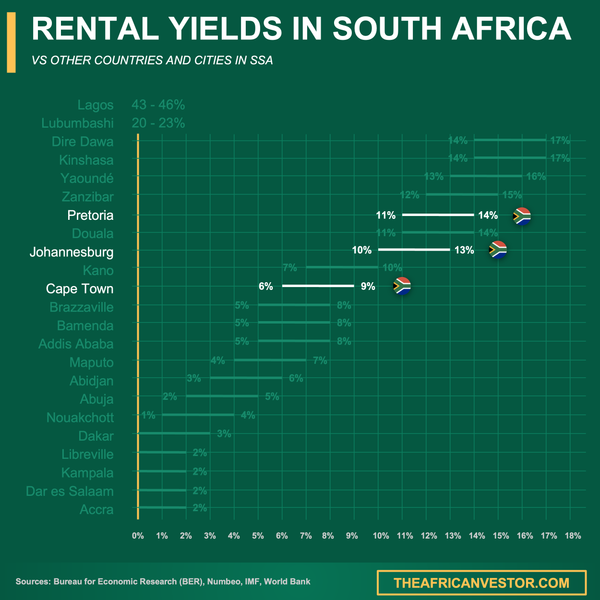
We did some research and made this infographic to help you quickly compare rental yields of the major cities in South Africa versus those in neighboring countries. It provides a clear view of how this country positions itself as a real estate investment destination, which might interest you if you’re planning to invest there.
How do I verify the seller and ownership in Pretoria without getting fooled?
How do I confirm the seller is the real owner in Pretoria?
The standard verification process in Pretoria is to have your conveyancer conduct a deeds registry search, which confirms the registered owner's name, ID or company number, and property description, rather than relying on any documents the seller provides directly.
The official document foreigners should check to verify ownership in Pretoria is the deeds registry record, which your conveyancing attorney can obtain and which serves as the definitive source of truth under South African law.
The most common trick fake sellers use to appear legitimate in Pretoria is providing convincing-looking scanned title deeds, municipal bill screenshots, or WhatsApp photos of ID documents, which happens often enough that you should never treat these as proof of ownership without independent verification.
Where do I check liens or mortgages on a property in Pretoria?
The official registry where you check liens or mortgages on a property in Pretoria is the deeds registry, where any mortgage is registered as a "bond" against the title, and your conveyancer will conduct this search as part of the transfer process.
When checking for liens in Pretoria, you should specifically request confirmation of whether any bonds, interdicts, or endorsements appear on the deeds registry printout, and ask your conveyancer to confirm this in writing.
The type of lien or encumbrance most commonly missed by foreign buyers in Pretoria is municipal debt, because outstanding rates, water, or electricity charges can block registration and delay your transfer, so always ensure municipal clearance is confirmed early in the process.
It's one of the aspects we cover in our our pack about the real estate market in Pretoria.
How do I spot forged documents in Pretoria right now?
The most common type of forged document used in property scams in Pretoria is a fake title deed or power of attorney, and while outright forgery is relatively rare in mainstream transactions, it sometimes happens, especially when dealing with informal intermediaries or "too good to be true" deals.
Specific red flags that indicate a document may be forged in Pretoria include inconsistent fonts or formatting, pressure to skip professional verification, sellers who insist on communicating only via WhatsApp, and any situation where you are asked to make decisions based solely on PDFs without independent confirmation.
The official verification method you should use to authenticate documents in Pretoria is to have your conveyancer check the deeds registry directly and to verify agent credentials through the Fidelity Fund Certificate verification portal rather than accepting screenshots or forwarded files.
Get the full checklist for your due diligence in Pretoria
Don't repeat the same mistakes others have made before you. Make sure everything is in order before signing your sales contract.
What "grey-area" practices should I watch for in Pretoria?
What hidden costs surprise foreigners when buying a property in Pretoria?
The three most common hidden costs that foreigners overlook when buying property in Pretoria are transfer duty (ranging from 0% to 13% depending on property value, with properties under R1,210,000 or about 67,000 USD or 62,000 EUR exempt), conveyancing and deeds office fees (typically 15,000 to 50,000 ZAR or about 830 to 2,780 USD or 770 to 2,570 EUR depending on property price), and municipal clearance charges (which can require advance payments and vary by outstanding balances).
The hidden cost most often deliberately concealed by sellers or agents in Pretoria is special levies or maintenance backlogs in sectional title schemes and estates, which sometimes happens, especially in older complexes, so you should always request written confirmation that levies are current and no special assessments are pending.
If you want to go into more details, we also have a blog article detailing all the property taxes and fees in Pretoria.
Are "cash under the table" requests common in Pretoria right now?
Cash under the table requests in property transactions in Pretoria are not the norm in mainstream deals, but you may still encounter them, typically framed as "discount for cash" or suggestions to understate the purchase price on paper.
The typical reason sellers give for requesting undeclared cash payments in Pretoria is to reduce their transfer duty liability or avoid capital gains tax, often presented as a way to make the deal cheaper for both parties.
The legal risks foreigners face if they agree to an undeclared cash payment in Pretoria include FICA violations (since you need clean banking trails for source-of-funds compliance), future complications when you try to repatriate sale proceeds, and potential tax penalties, so your hard rule should be to treat any off-ledger payment request as a deal-killer.
Are side agreements used to bypass rules in Pretoria right now?
Side agreements to bypass official rules in Pretoria property transactions sometimes happen, particularly around undisclosed defects, "furniture included" arrangements to manipulate price allocation, or promises to fix unapproved building work after the sale.
The most common type of side agreement used to circumvent regulations in Pretoria involves unapproved building additions, where sellers promise to regularize garage conversions, extra rooms, or boundary wall changes "later," which the City of Tshwane specifically flags as a compliance priority.
The legal consequences foreigners face if a side agreement is discovered by authorities in Pretoria include voided or unenforceable terms, municipal enforcement action requiring you to demolish unapproved structures, and potential fines, so anything that matters (repairs, inclusions, compliance certificates) should be in the signed agreement or an annexure drafted by the conveyancer.

We made this infographic to show you how property prices in South Africa compare to other big cities across the region. It breaks down the average price per square meter in city centers, so you can see how cities stack up. It’s an easy way to spot where you might get the best value for your money. We hope you like it.
Can I trust real estate agents in Pretoria in 2026?
Are real estate agents regulated in Pretoria in 2026?
As of early 2026, real estate agents in Pretoria, known as property practitioners, are regulated through the Property Practitioners Regulatory Authority (PPRA), which sets licensing standards, education requirements, and consumer protection rules.
The official certification a legitimate real estate agent should have in Pretoria is a valid Fidelity Fund Certificate (FFC), which must be renewed annually and confirms the agent is registered and compliant with regulatory requirements.
Foreigners can verify whether an agent is properly licensed in Pretoria by using the Fidelity Fund Certificate verification portal or the PPRA search function to check the agent's registration status directly, rather than accepting screenshots or verbal assurances.
Please note that we have a list of contacts for you in our property pack about Pretoria.
What agent fee percentage is normal in Pretoria in 2026?
As of early 2026, the normal agent fee percentage in Pretoria is around 5% of the sale price plus VAT (15%), which means the effective commission is about 5.75% of the purchase price.
The typical range of agent fee percentages that covers most residential transactions in Pretoria is 5% to 7.5% plus VAT, with the exact rate depending on property segment, mandate type, and negotiation between the seller and agent.
In Pretoria, the seller typically pays the agent commission, not the buyer, unless you specifically agree otherwise in writing, so if an "agent" asks you as a buyer for a large upfront deposit just to view properties, treat it as suspicious.
Get the full checklist for your due diligence in Pretoria
Don't repeat the same mistakes others have made before you. Make sure everything is in order before signing your sales contract.
What due diligence actually prevents disasters in Pretoria?
What structural inspection is standard in Pretoria right now?
Unlike some countries with mandatory pre-sale inspections, there is no single standard structural inspection required for property purchases in Pretoria, so the safe approach is to arrange your own independent inspection covering the elements you care about.
A qualified inspector in Pretoria should check the roof (for leaks and structural integrity), walls (for cracks and damp), foundations, plumbing systems, and electrical installations, especially important given the load-shedding era modifications many homes have undergone with solar panels and inverters.
The type of professional qualified to perform structural inspections in Pretoria is a registered building inspector, structural engineer, or accredited home inspector, and you should also ensure an electrical compliance certificate (CoC) is provided if required by your contract.
The most common structural issues that inspections reveal in properties in Pretoria are damp and roof leaks (often cosmetically painted over), unapproved building alterations, and substandard electrical work from DIY solar and inverter installations.
How do I confirm exact boundaries in Pretoria?
The standard process for confirming exact property boundaries in Pretoria is to request the property description from the title deed through your conveyancer, which includes the legal boundaries and any servitudes or endorsements registered against the property.
The official document that shows the legal boundaries of a property in Pretoria is the surveyor general's diagram (SG diagram), which is attached to the title deed and defines the cadastral boundaries as registered with the deeds office.
The most common boundary dispute that affects foreign buyers in Pretoria involves fences or walls that do not match the legal boundary, or additions that were built over servitudes, which is particularly common in older freehold properties or estates with internal rules.
The professional you should hire to physically verify boundaries on the ground in Pretoria is a registered land surveyor, who can compare the SG diagram to physical markers and identify any encroachments or discrepancies.
What defects are commonly hidden in Pretoria right now?
The top three defects that sellers frequently conceal from buyers in Pretoria are damp and roof leaks (commonly hidden with fresh paint, which is common), unapproved building alterations (like garage conversions and extra rooms, which sometimes happen), and electrical shortcuts from solar and inverter installations (which is increasingly common since load-shedding prompted many DIY modifications).
The inspection technique that helps uncover hidden defects in Pretoria includes using moisture meters for damp detection, thermal imaging for roof and insulation issues, and having a qualified electrician inspect the distribution board and any alternative power installations.
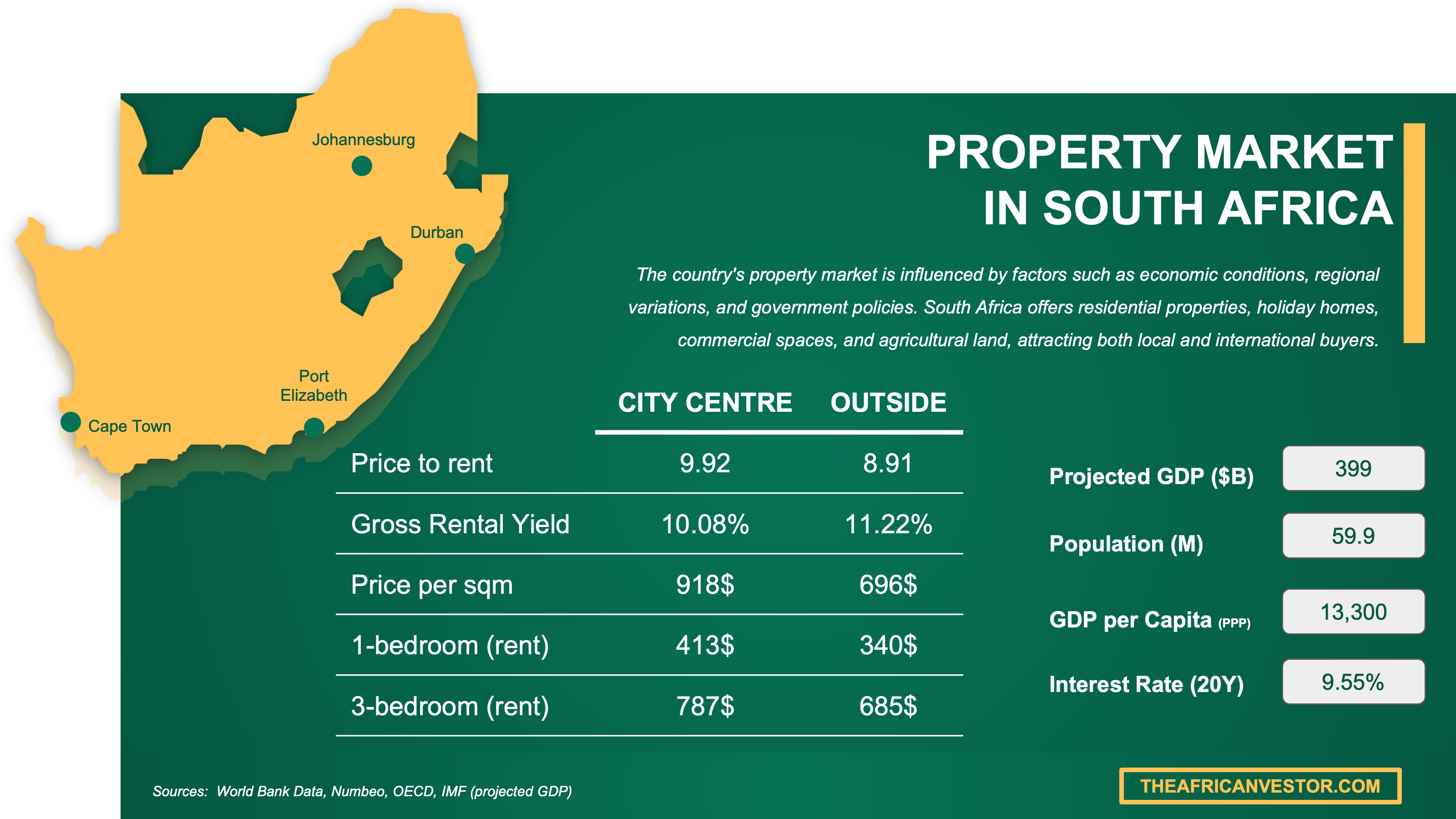
We have made this infographic to give you a quick and clear snapshot of the property market in South Africa. It highlights key facts like rental prices, yields, and property costs both in city centers and outside, so you can easily compare opportunities. We’ve done some research and also included useful insights about the country’s economy, like GDP, population, and interest rates, to help you understand the bigger picture.
What insider lessons do foreigners share after buying in Pretoria?
What do foreigners say they did wrong in Pretoria right now?
The most common mistake foreigners say they made when buying property in Pretoria is trusting emails or WhatsApp messages for payment details without independently verifying the banking information, which led to deposit diversion fraud.
The top three regrets foreigners most frequently mention after buying in Pretoria are skipping independent verification of the agent's Fidelity Fund Certificate, focusing on the house while ignoring system paperwork like municipal clearance and scheme rules, and trying to move too fast because Pretoria prices seemed cheap compared to their home market.
The single piece of advice experienced foreign buyers most often give to newcomers in Pretoria is to never change banking details based on email alone and to always verify by calling a phone number you sourced independently, not one provided in the email.
The mistake foreigners say cost them the most money or caused the most stress in Pretoria was buying into a sectional title scheme or estate without reading the levy history and governance documents, which led to surprise special levies or body corporate disputes after transfer.
What do locals do differently when buying in Pretoria right now?
The key difference in how locals approach buying property in Pretoria compared to foreigners is that locals are calmer about the property itself but stricter about the process, instinctively asking "Is the agent FFC-valid?" and "Who is the conveyancer?" before paying anything.
The verification step locals routinely take that foreigners often skip in Pretoria is demanding the levy and scheme documents early when buying in estates or sectional title complexes in areas like Silver Lakes, Mooikloof, Boardwalk, and the Olympus area, because locals know that is where ugly financial surprises hide.
The local knowledge advantage that helps locals get better deals in Pretoria is their understanding of which conveyancers and agents operate in specific suburbs and their reputation for clean transactions, plus knowing that FICA document requests are normal and should go through official channels rather than random WhatsApp numbers.
Don't buy the wrong property, in the wrong area of Pretoria
Buying real estate is a significant investment. Don't rely solely on your intuition. Gather the right information to make the best decision.

What sources have we used to write this blog article?
Whether it's in our blog articles or the market analyses included in our property pack about Pretoria, we always rely on the strongest methodology we can … and we don't throw out numbers at random.
We also aim to be fully transparent, so below we've listed the authoritative sources we used, and explained how we used them and the methods behind our estimates.
| Source | Why it's authoritative | How we used it |
|---|---|---|
| South African Government - Deeds Registries Act | Official government entry for the law governing title registration | We used it to define what ownership legally means in Pretoria. We also used it to explain why the deeds registry is the source of truth. |
| SARS - Transfer Duty | The tax authority's definitive guidance on transfer duty | We used it to list the buyer tax rates and exemption thresholds. We also used it to quantify hidden costs foreigners often underestimate. |
| PPRA - Fidelity Fund Certificate Portal | Statutory regulator for property practitioners in South Africa | We used it to explain how to verify agent legitimacy. We used it to show where foreigners can check compliance before paying. |
| Fidelity Fund Certificate Verification | Direct verification interface for FFC numbers and names | We used it to turn "check the agent" into a specific action step. We used it to reduce reliance on screenshots from agents. |
| World Justice Project - Rule of Law Index | International benchmark on rule of law and contract enforcement | We used it to measure enforcement strength objectively. We used it to compare South Africa with other markets. |
| Financial Intelligence Centre - Reference Guide | Official FIC guidance on compliance duties and expectations | We used it to explain normal document requests in property deals. We used it to help spot when compliance is weaponized. |
| City of Tshwane - Building Plan Enforcement | Local authority for Pretoria setting enforcement priorities | We used it to tailor the unapproved building risk to Pretoria. We used it to justify asking for approved plans. |
| CSOS Act - Community Schemes | Governing law for sectional title and HOA disputes | We used it to explain scheme governance risks in Pretoria estates. We used it to point to a credible dispute resolution channel. |
| Law Society of South Africa - Conveyancing Fee Guidelines | National professional body providing fee benchmarks | We used it to explain how conveyancing fees are calculated. We used it to help foreigners spot inflated invoices. |
| NHBRC - Warranty Cover | Statutory body for homebuilder registration and warranty | We used it to explain new-build consumer protection risks. We used it to give a simple check for newly built homes. |

We created this infographic to give you a simple idea of how much it costs to buy property in different parts of South Africa. As you can see, it breaks down price ranges and property types for popular cities in the country. We hope this makes it easier to explore your options and understand the market.
Related blog posts
