
Authored by the expert who managed and guided the team behind the South Africa Property Pack

Yes, the analysis of Stellenbosch's property market is included in our pack
Stellenbosch offers foreign investors a compelling combination of university-driven rental demand, Winelands tourism appeal, and one of South Africa's most accessible property ownership frameworks.
This guide covers everything you need to know about renting out property in Stellenbosch as a foreigner in 2026, from legal requirements to realistic yields and neighborhood performance.
We constantly update this blog post with fresh data and market insights to keep it accurate and useful.
And if you're planning to buy a property in this place, you may want to download our pack covering the real estate market in Stellenbosch.
Insights
- Stellenbosch University can only house about 30% of its students on campus, creating persistent rental demand that keeps vacancy rates near zero for well-located units.
- Stellenbosch rents grew approximately 8% year-over-year in 2026, outpacing the Western Cape average of 7% thanks to chronic undersupply.
- Student apartments near campus in Stellenbosch can yield up to 14.5% gross annually, roughly double the typical residential yield in South African metros.
- The Stellenbosch short-term rental market has around 2,336 active listings with 59% average occupancy, signaling meaningful competition for new Airbnb hosts.
- Foreign buyers in South Africa can borrow up to 50% of the property value from local banks, with the balance needing to come from overseas funds.
- Stellenbosch property prices have increased by approximately 6% from January 2025 to January 2026, outperforming most Western Cape areas.
- Peak season for Stellenbosch short-term rentals is January with the highest earnings, while June typically sees the lowest occupancy and revenue.
- Sectional title properties in Stellenbosch often have body corporate rules that restrict short-term rentals, so checking conduct rules before buying is essential for rental investors.
Can I legally rent out a property in Stellenbosch as a foreigner right now?
Can a foreigner own-and-rent a residential property in Stellenbosch in 2026?
As of early 2026, foreigners can legally own and rent out residential property in Stellenbosch without any nationality-based restrictions, enjoying the same property rights as South African citizens.
The most common ownership structure for foreign investors in Stellenbosch is individual freehold ownership registered through the Deeds Office, though you can also purchase through a company or trust if that suits your tax planning.
The main practical limitation for foreign landlords in Stellenbosch is not legal but financial: South African banks will only lend up to 50% of the property value to non-residents, meaning you need to fund the rest from overseas.
Do I need residency to rent out in Stellenbosch right now?
No, you do not need South African residency to own or rent out property in Stellenbosch, as non-residents have the same ownership and landlord rights as locals.
However, you will need a South African tax number from SARS to legally declare your rental income, since South African-source income is taxable regardless of where you live.
While a local bank account is not strictly required, most foreign landlords in Stellenbosch use one or work through a letting agent's trust account because it simplifies rent collection and expense payments.
Managing a Stellenbosch rental remotely is very common and practical, with most foreign owners using a professional letting agent who handles tenant placement, maintenance, and inspections on their behalf.
Thinking of buying real estate in Stellenbosch?
Acquiring property in a different country is a complex task. Don't fall into common traps – grab our guide and make better decisions.

What rental strategy makes the most money in Stellenbosch in 2026?
Is long-term renting more profitable than short-term in Stellenbosch in 2026?
As of early 2026, the more profitable rental strategy in Stellenbosch depends on your risk tolerance: short-term rentals can generate higher gross income but come with more volatility, higher costs, and regulatory uncertainty, while long-term rentals offer steadier net returns.
A well-managed long-term rental in Stellenbosch typically earns R12,000 to R18,000 per month ($650 to $1,000 USD or about 600 to 900 EUR), while a comparable short-term rental might gross R25,000 to R35,000 monthly ($1,350 to $1,900 USD or 1,250 to 1,750 EUR) but with higher expenses eating into that.
Properties in central Stellenbosch near tourist attractions and restaurants, or unique Winelands estates with views, tend to favor short-term renting because they attract higher nightly rates and strong seasonal demand from visitors.
What's the average gross rental yield in Stellenbosch in 2026?
As of early 2026, the average gross rental yield for residential properties in Stellenbosch ranges from about 6.5% to 8.5%, with smaller units near the university typically achieving the higher end of that range.
The realistic low-to-high gross rental yield range covering most Stellenbosch residential properties is 5% for larger family homes in premium estates up to 14% or more for optimally positioned student accommodation.
Studios and one-bedroom apartments close to Stellenbosch University campus consistently achieve the highest gross yields in Stellenbosch because purchase prices are relatively lower while demand from students keeps rents strong.
By the way, we have much more granular data about rental yields in our property pack about Stellenbosch.
What's the realistic net rental yield after costs in Stellenbosch in 2026?
As of early 2026, the average net rental yield after all costs for professionally managed residential properties in Stellenbosch falls in the range of 4.5% to 6% for long-term rentals.
The realistic low-to-high net yield range that most Stellenbosch landlords actually experience is about 3.5% for high-levy estates with premium management up to 8% or more for efficiently run student properties with minimal vacancy.
The three main cost categories that reduce gross yield to net yield in Stellenbosch specifically are body corporate levies (which can be substantial in security estates), letting and management fees of 8% to 12%, and the cost of backup power solutions that tenants increasingly expect due to load shedding.
What monthly rent can I get in Stellenbosch in 2026?
As of early 2026, typical monthly rents in Stellenbosch are around R10,000 ($550 USD or 510 EUR) for a studio, R13,000 ($720 USD or 660 EUR) for a 1-bedroom, and R17,500 ($970 USD or 900 EUR) for a 2-bedroom apartment.
A realistic entry-level monthly rent for a decent studio in Stellenbosch ranges from R8,000 to R12,000 per month ($440 to $660 USD or 410 to 610 EUR), depending on location and condition.
For a typical 1-bedroom apartment in Stellenbosch, you can expect mid-range monthly rents between R10,500 and R15,500 ($580 to $860 USD or 540 to 790 EUR), with units closer to the university commanding the higher prices.
A typical 2-bedroom apartment in Stellenbosch rents in the mid-to-high range of R14,500 to R22,000 per month ($800 to $1,220 USD or 740 to 1,130 EUR), with luxury units in Stellenbosch Central or estates like De Zalze sometimes exceeding this.
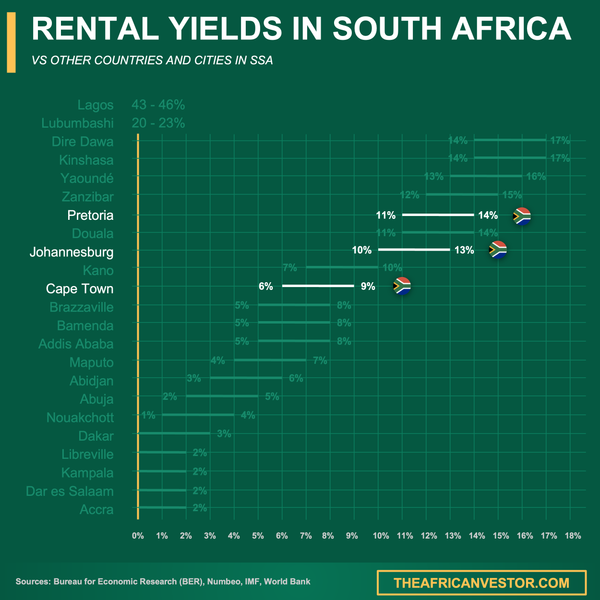
We did some research and made this infographic to help you quickly compare rental yields of the major cities in South Africa versus those in neighboring countries. It provides a clear view of how this country positions itself as a real estate investment destination, which might interest you if you’re planning to invest there.
What are the real numbers I should budget for renting out in Stellenbosch in 2026?
What's the total "all-in" monthly cost to hold a rental in Stellenbosch in 2026?
As of early 2026, the total all-in monthly cost to hold and maintain a typical rental property in Stellenbosch ranges from about R4,000 to R10,000 ($220 to $550 USD or 205 to 510 EUR), excluding any mortgage payments.
A realistic low-to-high monthly cost range covering most standard rental properties in Stellenbosch is R3,500 for a simple apartment with low levies up to R12,000 or more ($190 to $660 USD or 180 to 610 EUR) for a house in a premium security estate.
In Stellenbosch specifically, body corporate levies and security estate fees tend to be the largest single contributor to monthly holding costs, often running R1,500 to R4,500 per month and sometimes higher in estates like De Zalze or Welgevonden.
What's the typical vacancy rate in Stellenbosch in 2026?
As of early 2026, the typical vacancy rate for rental properties in Stellenbosch is around 4% to 8% annually, which translates to roughly half a month to one month of vacancy per year on average.
A landlord in Stellenbosch should realistically budget for about 0.5 to 1 month of vacancy per year because even in a high-demand market, there is always some turnover time between tenants for cleaning, repairs, and re-marketing.
The main factor causing vacancy rates to vary between Stellenbosch neighborhoods is proximity to Stellenbosch University, with units within walking distance of campus experiencing near-zero vacancy while suburban family homes may take longer to fill.
The highest tenant turnover and vacancy in Stellenbosch typically occurs around December to February when the academic year ends and students leave, followed by a surge of new leases in January and February as the new semester begins.
We have a whole part covering the best rental strategies in our pack about buying a property in Stellenbosch.
Get fresh and reliable information about the market in Stellenbosch
Don't base significant investment decisions on outdated data. Get updated and accurate information.
Where do rentals perform best in Stellenbosch in 2026?
Which neighborhoods have the highest long-term demand in Stellenbosch in 2026?
As of early 2026, the top three neighborhoods with the highest overall long-term rental demand in Stellenbosch are Stellenbosch Central, Die Boord, and Dennesig, all benefiting from proximity to the university and town amenities.
For families specifically, the strongest long-term rental demand in Stellenbosch is found in Paradyskloof, Welgevonden Estate, and Dalsig, which offer larger homes, good schools access, and a safe suburban feel.
Students in Stellenbosch concentrate their rental demand in Stellenbosch Central, Dennesig, Onder Papegaaiberg, and Uniepark, where they can walk or shuttle easily to campus.
Expats and international professionals looking for long-term rentals in Stellenbosch typically prefer De Zalze Winelands Golf Estate, Welgevonden, and premium units in Stellenbosch Central, valuing security, modern finishes, and lifestyle amenities.
Which neighborhoods have the best yield in Stellenbosch in 2026?
As of early 2026, the top three neighborhoods with the best rental yield in Stellenbosch are Dennesig, Die Boord (particularly older buildings), and Onder Papegaaiberg, where purchase prices are more modest relative to the rents they command.
The estimated gross rental yield range for those top-yielding Stellenbosch neighborhoods is about 7% to 10% for standard apartments, with well-optimized student properties sometimes reaching 12% or higher.
The main characteristic that allows these neighborhoods to achieve higher yields than others in Stellenbosch is that they sit close enough to campus to attract strong student demand but have not yet experienced the price inflation seen in premium estates or central luxury buildings.
We cover a lot of neighborhoods and provide a lot of updated data in our pack about real estate in Stellenbosch.
Where do tenants pay the highest rents in Stellenbosch in 2026?
As of early 2026, the top three neighborhoods where tenants pay the highest rents in Stellenbosch are De Zalze Winelands Golf Estate, Welgevonden Estate, and upper-end Stellenbosch Central, where monthly rents can exceed R25,000 to R35,000 ($1,400 to $1,900 USD or 1,280 to 1,780 EUR) for quality units.
The typical monthly rent range for a standard apartment in these premium Stellenbosch neighborhoods is R18,000 to R30,000 ($1,000 to $1,650 USD or 920 to 1,530 EUR), with larger homes and villas commanding significantly more.
These neighborhoods command the highest rents in Stellenbosch because they offer a combination of 24-hour security, estate lifestyle amenities like golf courses and clubhouses, and proximity to both the town center and scenic Winelands landscapes.
The typical tenant profile renting in these highest-rent Stellenbosch neighborhoods includes senior university staff, wine industry executives, visiting international academics, and affluent professionals who value security, space, and a premium living environment.

We created this infographic to give you a simple idea of how much it costs to buy property in different parts of South Africa. As you can see, it breaks down price ranges and property types for popular cities in the country. We hope this makes it easier to explore your options and understand the market.
What do tenants actually want in Stellenbosch in 2026?
What features increase rent the most in Stellenbosch in 2026?
As of early 2026, the top three property features that increase monthly rent the most in Stellenbosch are backup power capability (inverter or solar), secure parking with controlled access, and fiber internet connectivity, all reflecting the practical realities of South African living.
Backup power solutions can add a rent premium of 10% to 20% in Stellenbosch because tenants are willing to pay significantly more for properties where they can work and live comfortably during load shedding.
One commonly overrated feature that landlords invest in but tenants do not pay much extra for in Stellenbosch is high-end kitchen appliances, since most tenants prioritize security, power, and location over premium finishes they may not fully use.
One affordable upgrade that provides a strong return on investment for Stellenbosch landlords is installing prepaid electricity meters, which simplify billing, reduce disputes, and appeal to both students and professionals.
Do furnished rentals rent faster in Stellenbosch in 2026?
As of early 2026, furnished apartments in Stellenbosch typically rent about 1 to 2 weeks faster than unfurnished ones because they attract students, visiting academics, and professionals who want to move in immediately without buying furniture.
Furnished apartments in Stellenbosch command a rent premium of approximately 15% to 25% over unfurnished units, though this comes with higher wear-and-tear costs and more management intensity for the landlord.
Get to know the market before buying a property in Stellenbosch
Better information leads to better decisions. Get all the data you need before investing a large amount of money.
How regulated is long-term renting in Stellenbosch right now?
Can I freely set rent prices in Stellenbosch right now?
Landlords in Stellenbosch have substantial freedom to set initial rent prices at market rates, as South Africa does not operate a blanket rent control system like some European countries.
Rent increases during a tenancy are not formally capped in Stellenbosch, but tenants can challenge what they believe is an exorbitant increase through the Western Cape Rental Housing Tribunal, so increases should be reasonable and preferably agreed in the lease.
What's the standard lease length in Stellenbosch right now?
The standard lease length for residential rentals in Stellenbosch is typically 12 months for a fixed-term agreement, often converting to month-to-month after the initial period ends.
The maximum security deposit a landlord can legally require in Stellenbosch is not formally capped by law, but common practice is 1 to 2 months' rent (R10,000 to R35,000 or $550 to $1,900 USD or 510 to 1,780 EUR depending on the property).
At the end of a tenancy in Stellenbosch, the landlord must conduct an outgoing inspection, compare it to the incoming inspection report, and return the deposit within 14 days (or 21 days if repairs are needed), with any deductions itemized and supported by quotes or invoices.

We made this infographic to show you how property prices in South Africa compare to other big cities across the region. It breaks down the average price per square meter in city centers, so you can see how cities stack up. It’s an easy way to spot where you might get the best value for your money. We hope you like it.
How does short-term renting really work in Stellenbosch in 2026?
Is Airbnb legal in Stellenbosch right now?
Airbnb-style short-term rentals are generally legal in Stellenbosch, but they can be constrained by municipal zoning rules, sectional title body corporate restrictions, or homeowners association conduct rules depending on your specific property.
There is no formal license or permit required at the national level to operate a short-term rental in Stellenbosch, but you should verify that your property's zoning allows "tourist accommodation" use and that your body corporate or estate rules permit it.
Stellenbosch currently has no strict annual night limits or caps on how many days per year you can rent out a property short-term, unlike some European cities, though this could change if future regulations are introduced.
The most common consequence for operating a non-compliant short-term rental in Stellenbosch is receiving complaints from neighbors or body corporate that lead to fines, legal action from the HOA, or being required to cease operating.
What's the average short-term occupancy in Stellenbosch in 2026?
As of early 2026, the average annual occupancy rate for short-term rentals in Stellenbosch is approximately 45% to 59%, depending on the data source and how well individual properties are optimized.
The realistic low-to-high occupancy rate range that most Stellenbosch short-term rentals experience is about 35% for underperforming or poorly located listings up to 80% or more for top-tier properties with excellent reviews and dynamic pricing.
The highest occupancy rates for short-term rentals in Stellenbosch occur during the summer months of December and January, when domestic and international tourists flock to the Winelands for holidays and harvest season events.
The lowest occupancy rates for short-term rentals in Stellenbosch typically fall in the winter months of June and July, when tourist traffic drops significantly and many hosts struggle to maintain bookings.
Finally, please note that you can find much more granular data about this topic in our property pack about Stellenbosch.
What's the average nightly rate in Stellenbosch in 2026?
As of early 2026, the average nightly rate for short-term rentals in Stellenbosch is approximately R3,400 ($185 to $190 USD or about 175 EUR), reflecting the town's appeal as a premium Winelands destination.
A realistic low-to-high nightly rate range covering most Stellenbosch short-term rental listings is R1,200 to R5,500 per night ($65 to $300 USD or 60 to 280 EUR), with basic apartments at the low end and luxury villas or wine estate cottages at the top.
The typical nightly rate difference between peak season and off-season in Stellenbosch is about 30% to 50%, meaning a property charging R3,500 per night in January might drop to R2,000 to R2,500 in June to maintain bookings.
Is short-term rental supply saturated in Stellenbosch in 2026?
As of early 2026, the short-term rental market in Stellenbosch is moderately competitive with around 2,336 active listings, representing meaningful supply that new hosts must differentiate against rather than a wide-open market.
The current trend in active short-term rental listings in Stellenbosch is growing, with approximately 3% to 8% more listings year-over-year, indicating that supply continues to expand as more owners test the STR strategy.
The most oversaturated areas for short-term rentals in Stellenbosch are central locations near Dorp Street and the main tourist strip, where competition is intense and only well-reviewed, well-priced listings consistently perform.
Neighborhoods in Stellenbosch that still have room for new short-term rental supply include the outer Winelands areas near wine estates, Jonkershoek valley, and properties offering unique experiences like farm stays or mountain views that differentiate from the central apartment stock.
Don't lose money on your property in Stellenbosch
100% of people who have lost money there have spent less than 1 hour researching the market. We have reviewed everything there is to know. Grab our guide now.

What sources have we used to write this blog article?
Whether it's in our blog articles or the market analyses included in our property pack about Stellenbosch, we always rely on the strongest methodology we can and we don't throw out numbers at random.
We also aim to be fully transparent, so below we've listed the authoritative sources we used, and explained how we used them and the methods behind our estimates.
| Source | Why it's authoritative | How we used it |
|---|---|---|
| South African Government - Rental Housing Act 50 of 1999 | Official national law governing residential renting in South Africa. | We used it as the baseline legal rulebook for leases, deposits, inspections, and unfair practices. We relied on it to explain what's national law versus local discretion. |
| Western Cape Government - Rental Housing Tribunal | Provincial body that handles landlord-tenant disputes in the Western Cape. | We used it to explain where you go when something goes wrong with deposits, maintenance, or unfair practice complaints. We anchored the dispute process in the correct province for Stellenbosch. |
| PayProp Rental Index Q1 2025 | Large transactional dataset and widely cited rental market benchmark in South Africa. | We used it to anchor Western Cape rent levels and growth using a consistent methodology. We applied it as a province-level reality check before tailoring estimates to Stellenbosch. |
| AirDNA MarketMinder - Stellenbosch | Global STR analytics provider with standardized Airbnb metrics and time series. | We used it for Stellenbosch short-term rental occupancy, ADR, supply, and annual revenue benchmarks. We quantified seasonality and saturation risk from their data. |
| Stellenbosch Municipality - Tourist Accommodation Guideline | Local municipality describing how tourist accommodation is treated from a land-use perspective. | We used it to ground the STR discussion in municipal land-use logic. We emphasized checking zoning and scheme rules before assuming Airbnb is frictionless. |
| Property24 | Major national property portal with current listings and market data. | We used it to verify current asking rents, listing features, and market activity in Stellenbosch. We cross-referenced their data with other sources for accuracy. |
| Snymans Conveyancers | Established conveyancing firm with expertise in foreign property ownership. | We used their guidance to confirm the legal framework for foreign buyers. We referenced their explanations of financing and tax requirements. |
| Hostaway - Airbnb Rules in South Africa 2026 | Vacation rental management software provider with regulatory compliance expertise. | We used it to understand the layered regulatory framework for short-term rentals. We referenced their compliance checklist for operational requirements. |
| AirROI - Stellenbosch STR Data | STR analytics platform with revenue and occupancy benchmarks. | We used it to cross-check AirDNA data and establish occupancy ranges. We referenced their seasonality analysis for peak and low season patterns. |
| Adams & Adams | Leading South African law firm with property law expertise. | We used their guidance on exchange control, financing, and tax obligations for non-resident buyers. We referenced their fraud prevention advice. |
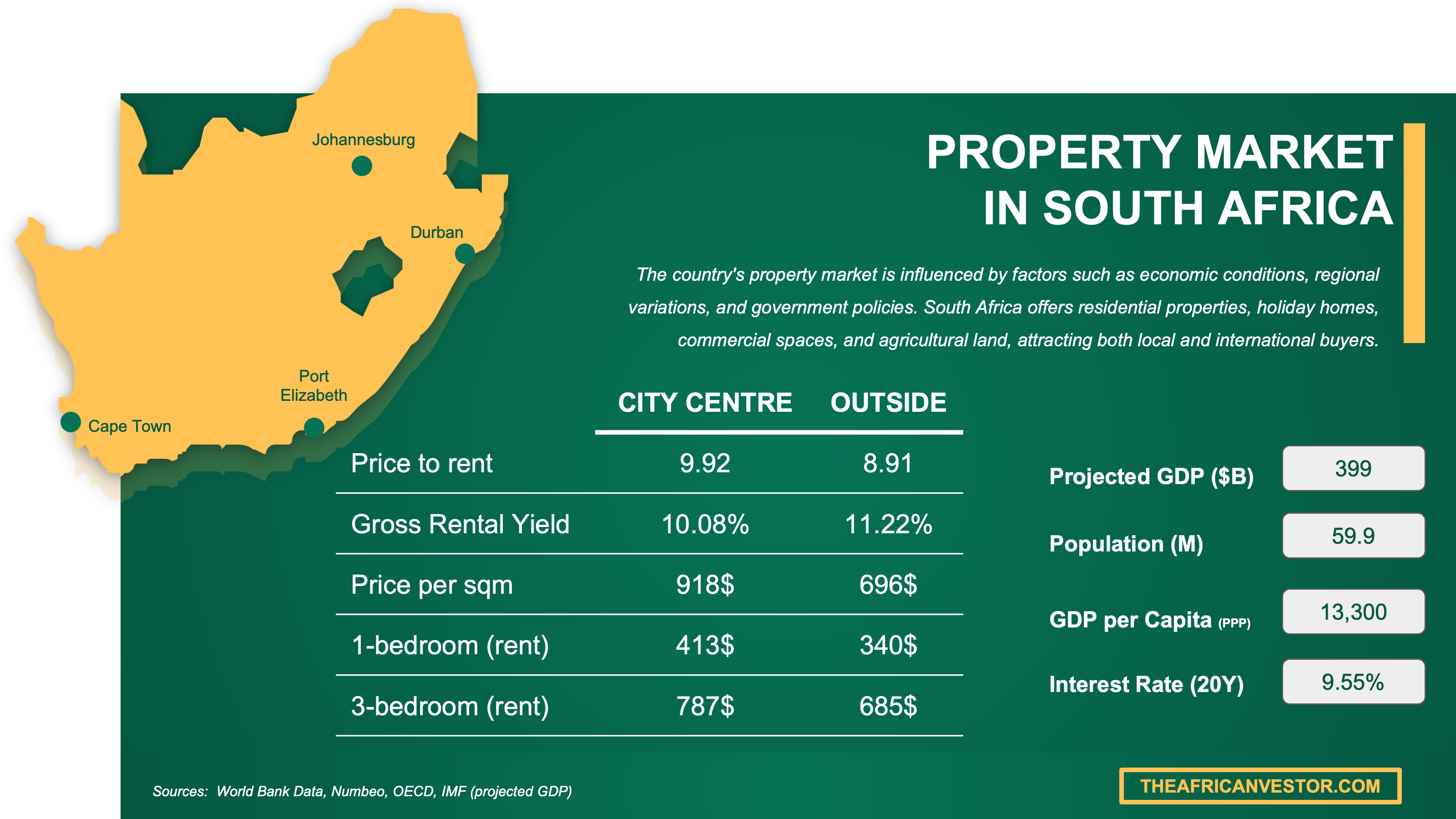
We have made this infographic to give you a quick and clear snapshot of the property market in South Africa. It highlights key facts like rental prices, yields, and property costs both in city centers and outside, so you can easily compare opportunities. We’ve done some research and also included useful insights about the country’s economy, like GDP, population, and interest rates, to help you understand the bigger picture.
