
Authored by the expert who managed and guided the team behind the Ivory Coast Property Pack
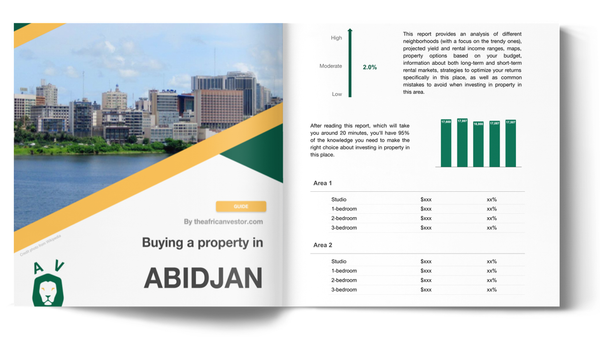
Get all the data you need about the real estate market in Abidjan
Airbnb in Abidjan can work in 2026, but the best results usually come from secure, well-managed apartments in areas like Cocody, Marcory, Zone 4, Plateau and Biétry.
This article looks at current housing prices in Abidjan, Airbnb income, occupancy, legal rules, expenses and neighborhood-level demand.
We constantly update this blog post with fresh Abidjan Airbnb data, tourism rules, market figures and real estate information.
And if you’re planning to buy a property in this place, you may want to download our pack covering the real estate market in Abidjan.
Insights
- An average Airbnb listing in Abidjan in 2026 can gross about 400,000 to 485,000 FCFA per month, but only well-located and reliable units tend to beat this range.
- Abidjan Airbnb demand is not only tourist demand, because business travelers, diaspora visitors, consultants and event guests create bookings throughout the year.
- Cocody has the deepest Airbnb supply in Abidjan, so a basic furnished apartment in Riviera, Angré or Deux Plateaux needs strong photos and clear comfort advantages.
- Plateau can charge the highest nightly prices in Abidjan, but the supply of residential apartments is smaller and guests usually expect a very practical business setup.
- Marcory, Zone 4 and Biétry are useful Airbnb areas because they connect nightlife, restaurants, airport access and expat demand in one simple guest journey.
- The most crowded Abidjan Airbnb price band is around 23,000 to 46,000 FCFA per night, which means new hosts often need better quality rather than lower prices.
- In Abidjan, air conditioning, fast Wi-Fi, backup power, security and clean bathrooms matter more than decorative luxury for Airbnb reviews and repeat bookings.
- The 2026 night tax makes compliance more important for furnished residences in Abidjan, especially for hosts who want to run multiple listings seriously.
- One-bedroom apartments get the broadest Airbnb demand in Abidjan, while two-bedroom apartments can work better for families, colleagues and longer diaspora stays.


Can I legally run an Airbnb in Abidjan in 2026?
Is short-term renting allowed in Abidjan in 2026?
As of early 2026, short-term renting is allowed in Abidjan, but a serious Airbnb host should treat it as a regulated furnished tourist accommodation activity rather than a casual private rental.
The main framework is Côte d’Ivoire’s Code du Tourisme, which defines a “meublé de tourisme” as a furnished room, apartment, villa or studio rented by the day, week or month to guests who do not live there permanently.
The most important condition is that Airbnb-style hosts in Abidjan should expect tourism authorization, tax registration and basic operating compliance if the property is run as a real accommodation business.
Other practical rules can include classification, guest statistics, insurance, price display, hygiene, safety, nuisance control and respect for building or co-ownership rules.
Operating outside the tourism framework can expose an Abidjan Airbnb host to sanctions, closure risk or tax issues, especially if the property is visible online and rented regularly.
For a more general view, you can read our article detailing what exactly foreigners can own and buy in Ivory Coast.
If you are an American, you might want to read our blog article detailing the property rights of US citizens in Ivory Coast.
Are there minimum-stay rules and maximum nights-per-year caps for Airbnbs in Abidjan as of 2026?
As of early 2026, we found no public Abidjan Airbnb minimum-stay rule and no annual cap like the 120-night limit used in some European cities.
This appears to be true for apartments, studios, villas, duplexes and townhouses across Abidjan, and we found no different annual cap based on host residency status.
That said, a building in Cocody, Marcory, Plateau or Biétry can still impose private limits through co-ownership rules, lease terms, security procedures or landlord permission.
Do I have to live there, or can I Airbnb a secondary home in Abidjan right now?
An Airbnb host in Abidjan does not appear to need to live inside the property to rent it as furnished tourist accommodation.
This means a secondary home or investment apartment in Abidjan can be used for short-term rental, provided the owner follows tourism, tax, safety and building rules.
For non-primary homes, the main extra step is not owner occupancy, but formal operation through authorization, registration, insurance and proper guest handling where required.
In practical terms, the rules for a primary residence and a secondary home in Abidjan are less about where the owner sleeps and more about whether the unit is run professionally and legally.
Get fresh and reliable information about the market in Abidjan
Don't base significant investment decisions on outdated data. Get updated and accurate information.

Can I run multiple Airbnbs under one name in Abidjan right now?
A host can appear to run multiple Airbnb listings in Abidjan, but several units make the activity look much more like a professional accommodation business.
We found no clear public maximum number of Abidjan Airbnb properties that one person or company can list in 2026.
However, a multi-listing Airbnb operator in Abidjan should expect stronger pressure to formalize through business registration, tax reporting, tourism authorization, insurance and staff or management procedures.
The main regulatory logic is simple: when an Abidjan host operates several furnished apartments, the activity becomes easier for authorities to classify as a commercial tourism activity.
Do I need a short-term rental license or a business registration to host in Abidjan as of 2026?
As of early 2026, a compliant Airbnb host in Abidjan should expect tourism authorization or classification where applicable, plus business and tax formalization if the rental is regular.
The practical route is usually to clarify the business form through CEPICI or local advisers, then align the furnished accommodation with tourism and tax obligations before scaling the listing.
Typical documents can include owner identity, business registration details, property information, insurance, safety information and documents showing that the operator can legally use the unit.
Public sources do not show one simple fixed Airbnb license fee for Abidjan, so hosts should budget for registration, professional advice, tax setup and possible classification or inspection costs.
Are there neighborhood bans or restricted zones for Airbnb in Abidjan as of 2026?
As of early 2026, we found no public neighborhood ban on Airbnb in Abidjan for Cocody, Marcory, Plateau, Treichville, Port-Bouët, Koumassi, Bingerville or Yopougon.
The stricter places are usually specific buildings and secure residences in areas like Cocody Riviera, Deux Plateaux, Zone 4, Biétry and Plateau, where guards, syndics and co-owners may limit guest access.
These restrictions are usually about security, noise, parking, elevators, visitor identity and neighbor comfort rather than a citywide Abidjan Airbnb zoning ban.
Get to know the market before buying a property in Abidjan
Better information leads to better decisions. Get all the data you need before investing a large amount of money.
How much can an Airbnb earn in Abidjan in 2026?
What's the average and median nightly price on Airbnb in Abidjan in 2026?
As of early 2026, the average nightly price for an Airbnb listing in Abidjan is about 37,000 FCFA, or $65, or €56, while the median is closer to 31,000 FCFA, or $55, or €47.
A realistic nightly price range for most Abidjan Airbnb listings is about 20,000 to 80,000 FCFA, or $35 to $140, or €30 to €120.
The single biggest pricing factor in Abidjan is location quality, because Plateau, Zone 4, Biétry and prime Cocody can charge much more than outer or less connected areas.
By the way, you will find much more detailed rent ranges in our property pack covering the real estate market in Abidjan.
How much do nightly prices vary by neighborhood in Abidjan in 2026?
As of early 2026, Abidjan nightly prices vary from about 20,000 FCFA in Yopougon, or $35, or €30, to about 65,000 FCFA in Plateau, or $115, or €100.
The three highest average Airbnb nightly prices in Abidjan are usually Plateau at about 65,000 FCFA, Marcory and Zone 4 at about 52,000 FCFA, and Cocody at about 45,000 FCFA.
The three lower-price areas are usually Yopougon, Koumassi and parts of Bingerville, and guests still choose them when they need cheaper stays, family access or easier links to specific local districts.
What's the typical occupancy rate in Abidjan in 2026?
As of early 2026, the typical Airbnb occupancy rate in Abidjan is about 40% to 42%, which means around 12 to 13 booked nights per month.
Most Abidjan Airbnb listings sit somewhere between 28% and 55% occupancy, depending on location, reviews, pricing, reliability and whether the host accepts longer stays.
Compared with many mature global Airbnb cities, Abidjan occupancy is moderate, but it is still strong for an emerging African STR market with uneven supply quality.
The biggest factor behind above-average occupancy in Abidjan is trust, because guests pay more often for secure access, clean rooms, strong Wi-Fi, air conditioning and responsive communication.
Make a profitable investment in Abidjan
Better information leads to better decisions. Save time and money. Download our data.
What's the average monthly revenue per listing in Abidjan in 2026?
As of early 2026, average monthly revenue for an Airbnb listing in Abidjan is about 440,000 FCFA, or $775, or €675, before operating expenses.
A realistic monthly revenue range for most Abidjan Airbnb listings is about 285,000 to 625,000 FCFA, or $500 to $1,100, or €435 to €950.
Top Airbnb listings in Abidjan can reach about 570,000 to 855,000 FCFA per month, or $1,000 to $1,500, or €870 to €1,300, especially in Plateau, Zone 4, Biétry and prime Cocody.
A quick calculation is simple: 37,000 FCFA per night multiplied by 12 booked nights gives about 445,000 FCFA per month.
Finally, note that we give here all the information you need to buy and rent out a property in Abidjan.
What's the typical low-season vs high-season monthly revenue in Abidjan in 2026?
As of early 2026, a normal Abidjan Airbnb can make about 255,000 to 340,000 FCFA in a weaker month and 570,000 to 800,000 FCFA in a strong event or high-demand month.
Low season often appears around quieter business or travel periods such as parts of May, June and October, while stronger periods include April during MASA, July and August in some areas, and major trade-show months at the Parc des Expositions.
What's a realistic Airbnb monthly expense range in Abidjan in 2026?
As of early 2026, a realistic monthly operating expense range for an Abidjan Airbnb is about 155,000 to 330,000 FCFA, or $275 to $575, or €235 to €500, excluding mortgage payments.
The largest monthly cost is often electricity and utilities, which can reach about 50,000 to 125,000 FCFA, or $90 to $220, or €75 to €190, because air conditioning is essential in Abidjan.
Most Abidjan Airbnb hosts should expect operating expenses to absorb around 35% to 65% of gross revenue, depending on cleaning, laundry, repairs, management and power use.
If you want to go into more details, we also have a blog article detailing all the property taxes and fees in Abidjan.
What's realistic monthly net profit and profit per available night for Airbnb in Abidjan in 2026?
As of early 2026, a realistic Abidjan Airbnb can net about 140,000 to 255,000 FCFA per month, or $250 to $450, or €215 to €390, equal to about 4,500 to 8,500 FCFA per available night.
Most listings in Abidjan should expect monthly net profit between break-even and about 340,000 FCFA, or $0 to $600, or €0 to €520, once repairs, utilities and cleaning are included.
Typical Abidjan Airbnb net margins are about 25% to 45% for a well-run owned unit, but a financed property can be much lower after debt service.
A typical break-even occupancy rate is around 25% to 32% if the unit is owned outright, but it can move above 45% when rent, financing or high management fees are added.
In our property pack covering the real estate market in Abidjan, we explain the best strategies to improve your cashflows.
Don't buy the wrong property, in the wrong area of Abidjan
Buying real estate is a significant investment. Don't rely solely on your intuition. Gather the right information to make the best decision.
How competitive is Airbnb in Abidjan as of 2026?
How many active Airbnb listings are in Abidjan as of 2026?
As of early 2026, the best estimate is around 2,000 active Airbnb listings in Abidjan, with a broader Airbnb and Vrbo universe that can appear closer to 4,000 depending on the data provider.
Compared with the previous year, Abidjan supply appears to be growing, but the long trend is still an emerging market where many listings are intermittent, duplicated or not consistently professional.
Which neighborhoods are most saturated in Abidjan as of 2026?
As of early 2026, the most saturated Airbnb neighborhoods in Abidjan are Cocody, Riviera, Angré, Deux Plateaux, Marcory, Zone 4, Biétry and Plateau.
These areas are saturated because they combine stronger purchasing power, expat services, restaurants, embassies, offices, hospitals, nightlife or safer residential buildings that hosts can convert into furnished rentals.
Relatively less saturated opportunities may exist in Bingerville, Port-Bouët near the airport corridor, selected parts of Koumassi and well-connected edges of Yopougon, but only when security and access are strong.
What local events spike demand in Abidjan in 2026?
As of early 2026, the main Abidjan Airbnb demand spikes come from MASA 2026, trade shows at the Parc des Expositions, business conferences, cultural events, diaspora visits and airport-linked professional travel.
During major events, strong Abidjan Airbnb listings can often lift bookings and nightly rates by about 15% to 40%, with the biggest gains near Plateau, Marcory, Zone 4, Biétry, Cocody and Port-Bouët.
Hosts should usually adjust prices and minimum rules 4 to 8 weeks before major Abidjan events, because better guests often book earlier when hotels become expensive or full.
What occupancy differences exist between top and average hosts in Abidjan in 2026?
As of early 2026, top-performing Airbnb hosts in Abidjan can reach about 55% to 65% occupancy, and some event-ready units can do better in short peak periods.
An average Abidjan Airbnb host is closer to 40% to 42% occupancy, which means the gap between average and top hosts is often 4 to 7 extra booked nights per month.
A new host in Abidjan usually needs 6 to 12 months to reach top-performer occupancy, because reviews, photos, repeat guests and operational reliability take time to build.
We give more details about the different Airbnb strategies to adopt in our property pack covering the real estate market in Abidjan.
Which price points are most crowded, and where's the "white space" for new hosts in Abidjan right now?
The most crowded Abidjan Airbnb price band is roughly 23,000 to 46,000 FCFA per night, or $40 to $80, or €35 to €70, especially for studios and one-bedroom apartments.
The white space is more often around 52,000 to 80,000 FCFA per night, or $90 to $140, or €80 to €120, for business-ready apartments that feel more reliable than the average listing.
A new host can compete in this underserved Abidjan segment with a secure building, backup power, real workspace, fast Wi-Fi, hotel-grade cleaning, good bedding, easy check-in and honest professional photos.

We made this infographic to show you how property prices in Ivory Coast compare to other big cities across the region. It breaks down the average price per square meter in city centers, so you can see how cities stack up. It’s an easy way to spot where you might get the best value for your money. We hope you like it.
What property works best for Airbnb demand in Abidjan right now?
What bedroom count gets the most bookings in Abidjan as of 2026?
As of early 2026, one-bedroom apartments probably get the most Airbnb bookings in Abidjan because they fit business travelers, couples, consultants, diaspora visitors and medium-stay guests.
A reasonable Abidjan booking breakdown is about 20% to 25% studios, 40% to 45% one-bedroom units, 20% to 25% two-bedroom units and 10% to 15% three-bedroom or larger homes.
One-bedroom units perform best in Abidjan because they are easier to clean, easier to price, easier to secure and cheaper to cool than larger villas or houses.
What property type performs best in Abidjan in 2026?
As of early 2026, the best-performing Airbnb property type in Abidjan is usually a modern apartment in a secure building, especially in Marcory, Zone 4, Biétry, Plateau, Cocody Riviera and Deux Plateaux.
Apartments can reach average or above-average occupancy when well managed, while villas and houses can earn more per night but usually have higher maintenance, security, cleaning and vacancy risk.
Modern apartments outperform in Abidjan because guests want predictable comfort, safe access, air conditioning, internet, parking or elevator access, and a location that works well by car.
What sources have we used to write this blog article?
Whether it’s in our blog articles or the market analyses included in our property pack about Abidjan, we always rely on the strongest methodology we can, and we don’t throw out numbers at random.
We also aim to be fully transparent, so below we’ve listed the authoritative sources we used, and explained how we used them and the methods behind our estimates.
| Source | Why we trust it | How we used it |
|---|---|---|
| Côte d’Ivoire Code du Tourisme | It is the national legal framework for tourism activities and tourist accommodation in Côte d’Ivoire. | We used it to classify Airbnb-style homes in Abidjan as furnished tourist accommodation. We also used it for authorization, classification, insurance, statistics, price-display and sanction logic. |
| Ministère du Tourisme et des Loisirs | It is the ministry responsible for tourism regulation and sector policy in Côte d’Ivoire. | We used it to confirm that tourism accommodation is a regulated activity. We cross-checked ministry information with the Code du Tourisme and official event sources. |
| Côte d’Ivoire Tourisme regulation pages | It is an official tourism source that helps explain how the sector is framed for professionals. | We used it to check regulatory language and tourism-sector definitions. We did not use it alone when legal wording had to come from the Code du Tourisme. |
| DGI Côte d’Ivoire | It is the official tax authority for Côte d’Ivoire. | We used it to verify that 2026 tax materials were active. We cross-checked tax claims with the 2026 fiscal annex and local reporting. |
| DGI 2026 fiscal annex | It is an official DGI publication of the 2026 fiscal annex. | We used it to frame 2026 tax changes affecting hospitality and furnished residences. We checked it against the finance-law annex and press-agency reporting. |
| Annexe fiscale 2026 | It is the official fiscal annex to the 2026 state budget law. | We used it to understand the 2026 hospitality-tax context. We then kept owner operating expenses separate from guest-paid night taxes. |
| CEPICI business-registration portal | It is Côte d’Ivoire’s official business-formality gateway. | We used it to assess whether a host should formalize as an individual business or company. We connected it with tourism-law obligations for regular operators. |
| BCEAO main indicators | It is the official central-bank source for WAEMU macro and exchange-rate indicators. | We used it for the FCFA context, inflation backdrop and EUR conversion. We used a practical June 2026 dollar conversion of about $1 = 570 FCFA. |
| RGPH 2021 official census data | It is official population data from the national statistics system. | We used it to understand Abidjan’s scale as Côte d’Ivoire’s main urban market. We used it as background, not as short-term rental performance data. |
| AirDNA Abidjan market page | AirDNA is one of the most established short-term-rental data providers. | We used it for ADR, occupancy and broad supply benchmarking. We rebuilt revenue from ADR and occupancy instead of copying every revenue field mechanically. |
| Airbtics Abidjan market page | Airbtics is a specialist Airbnb data provider with city-level market metrics. | We used it as a second benchmark for listings, occupancy and annual revenue. We triangulated it with AirDNA and AirROI because Abidjan listing counts vary by scraper. |
| AirROI Abidjan market page | AirROI provides neighborhood-level short-term-rental data and updated 2026 STR metrics. | We used it as a conservative check on revenue, occupancy and ADR. We also used its neighborhood pages to compare areas like Cocody and the wider Abidjan market. |
| AirROI Cocody page | It provides local Airbnb data for one of Abidjan’s most important residential markets. | We used it to evaluate Cocody saturation, ADR and occupancy. We treated it as directional because data providers differ on what counts as active supply. |
| Airbnb Abidjan monthly stays | It is the platform itself and shows the product guests can actually book. | We used it to confirm that furnished apartments, Wi-Fi, kitchens, workspaces and monthly stays are visible local products. We did not use Airbnb search alone as a quantitative source. |
| Keur-Immo Abidjan listings | It is a large local property portal with agency-listed residential stock. | We used it to identify common residential property types in Abidjan. We focused on apartments, houses, villas and duplexes, and excluded non-residential property. |
| MASA 2026 official event page | It is an official source for one of Abidjan’s major cultural and professional events. | We used it to identify a clear 2026 Airbnb demand spike. We linked it with neighborhood demand near Plateau, Cocody, Marcory and Treichville. |
| Parc des Expositions d’Abidjan agenda | It is the official agenda for a major exhibition venue near the airport corridor. | We used it to identify trade-show demand around Port-Bouët, Marcory and airport-adjacent stays. We treated these events as pricing opportunities, not guaranteed occupancy. |
| AIP and local tax reporting via Abidjan.net | AIP is the national press agency and local reporting helps explain how fiscal measures are presented publicly. | We used it to cross-check the 2026 night-tax discussion for hotels and furnished residences. We did not use it instead of official fiscal texts. |
Get fresh and reliable information about the market in Abidjan
Don't base significant investment decisions on outdated data. Get updated and accurate information.
Related blog posts