
Authored by the expert who managed and guided the team behind the Ivory Coast Property Pack
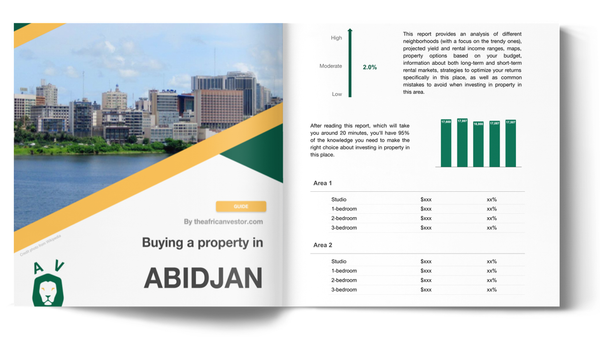
Get all the data you need about the real estate market in Abidjan
We constantly update this blog post so buyers can read the Abidjan property market as it changes in 2026.
Abidjan is a fast-growing city, but buying residential property in Abidjan still requires careful checks on price, title, access, rents and resale demand.
This article looks at apartments, villas, duplexes, standalone houses and compact family homes, but not land-only deals, hotels or commercial property.
And if you’re planning to buy a property in this place, you may want to download our pack covering the real estate market in Abidjan.
So, is now a good time?
As of June 2026, Abidjan is a rather yes market for buying residential property, but only if the home is well located, properly titled and bought below aggressive asking prices.
The strongest signal is that formal housing demand in Abidjan is still much larger than clean new supply.
Another strong signal is that Côte d’Ivoire still has solid economic growth, which supports jobs, rents and buyer confidence in Abidjan.
Other strong signals are low recent inflation, major transport upgrades, diaspora demand, executive rental demand and the scarcity of clean titled homes in good Abidjan neighborhoods.
The best strategy is to buy a titled apartment, duplex or compact house in Cocody, Riviera, Angré, Marcory, Zone 4, Biétry, Bingerville or selected Yopougon corridors, then hold for rental income and resale over several years.
This is not financial or investment advice, we do not know your personal situation, and every buyer should do their own research before buying property in Abidjan.

Is it smart to buy now in Abidjan, or should I wait as of 2026?
Do real estate prices look too high in Abidjan as of 2026?
As of 2026, residential property prices in Abidjan look moderately high rather than bubble-high, with good formal apartments and houses probably around 5% to 15% above local-income fundamentals but still close to fair value when shortage, diaspora demand and expat rental demand are included.
The clearest listings signal is that prime asking prices in Cocody, Riviera, Zone 4, Biétry and Plateau remain firm, but stale luxury villas and overpriced new-build units often need a 10% to 20% negotiation discount to move.
Another signal is that cheaper homes in Yopougon, Abobo, Koumassi and Port-Bouët often look attractive on price, but the discount usually reflects weaker access, older stock, title risk, flood risk or lower tenant quality.
You can also read our latest update regarding the housing prices in Abidjan.
Does a property price drop look likely in Abidjan as of 2026?
As of 2026, a meaningful property price decline in Abidjan looks low to medium risk, because weak affordability is real but the shortage of clean titled homes is also very real.
Over the next 12 months, a reasonable range for Abidjan residential prices is roughly 5% down to 8% up, with the downside more likely in luxury villas and the upside more likely in well-located apartments.
The macro factor that would most increase the odds of an Abidjan property price drop is tighter credit, because many local buyers already struggle with mortgage costs and down-payment requirements.
That credit shock looks possible but not the base case in 2026, because Côte d’Ivoire still has solid growth and the Abidjan market is less debt-driven than many mature property markets.
Finally, please note that we cover the price trends for next year in our pack about the property market in Abidjan.
Could property prices jump again in Abidjan as of 2026?
As of 2026, the chance of a broad Abidjan price surge in the next 12 months is medium, but the chance of a sharp jump in specific transport-linked and well-titled micro-markets is higher.
A realistic upside range for good residential property in Abidjan is about 4% to 8% over the next 12 months, while selected pockets near improved roads or strong rental demand could do closer to 8% to 12%.
The biggest demand-side trigger would be stronger diaspora and executive buyer activity, because those buyers can pay for title certainty, better locations and higher-quality finishes in Abidjan.
Please also note that we regularly publish and update real estate price forecasts for Abidjan here.
Are we in a buyer or a seller market in Abidjan as of 2026?
As of 2026, Abidjan is seller-leaning for clean titled apartments and affordable formal homes, but buyer-leaning for overpriced villas, weak-title property and badly located new builds.
The closest months-of-inventory proxy suggests that true investor-grade homes in Abidjan have a short supply, while total visible listings look larger because many ads are duplicated, stale or legally risky.
The estimated share of listings that can accept meaningful discounts is around 20% to 35%, which means sellers still have power in the best areas but buyers can negotiate hard on stale or luxury homes.

We have made this infographic to give you a quick and clear snapshot of the property market in Ivory Coast. It highlights key facts like rental prices, yields, and property costs both in city centers and outside, so you can easily compare opportunities. We’ve done some research and also included useful insights about the country’s economy, like GDP, population, and interest rates, to help you understand the bigger picture.
Are homes overpriced, or fairly priced in Abidjan as of 2026?
Are homes overpriced versus rents or versus incomes in Abidjan as of 2026?
As of 2026, homes in Abidjan look expensive versus local incomes but only mildly expensive versus rents, which is why the market can feel unaffordable without looking ready to crash.
The estimated price-to-rent ratio in Abidjan is around 11 to 17 for many good apartments, which is acceptable for a high-risk emerging market when the unit can rent well.
The estimated price-to-income multiple is much tougher, because a 40 million to 100 million XOF formal home is beyond what many local households can buy without high income, family support, diaspora money or employer-backed finance.
Finally please note that you will have all the indicators you need in our property pack covering the real estate market in Abidjan.
Are home prices above the long-term average in Abidjan as of 2026?
As of 2026, formal home prices in Abidjan are probably 15% to 30% above their pre-2020 nominal level in many good areas, but not clearly above the long-term trend after construction costs and land scarcity are included.
The estimated recent 12-month price change in Abidjan is around 3% to 7% for good formal homes, which is faster than inflation but not an obvious speculative boom.
In inflation-adjusted terms, prime Abidjan property is probably only 5% to 15% above its earlier cycle level, because some of the nominal increase has simply followed costs, incomes and scarcity.
Get fresh and reliable information about the market in Abidjan
Don't base significant investment decisions on outdated data. Get updated and accurate information.

What local changes could move prices in Abidjan as of 2026?
Are big infrastructure projects coming to Abidjan as of 2026?
As of 2026, the biggest infrastructure driver for Abidjan property is the east-west urban mobility corridor, including BRT and transport improvements between Yopougon, Adjamé, Cocody and Bingerville, which could add a 5% to 15% location premium near practical access points over several years.
The project has World Bank support, has moved through implementation reporting, and should affect prices gradually rather than overnight because property buyers wait to see real travel-time improvements before paying the full premium.
For the latest updates on the local projects, you can read our property market analysis about Abidjan here.
Are zoning or building rules changing in Abidjan as of 2026?
The most important rule change in Abidjan is not classic zoning, but land-title formalization through tools such as the ADU and the ACD process, because title risk is one of the biggest hidden risks for buyers.
As of 2026, better land formalization should support prices for clean titled homes and discount weak-documentation homes, rather than making all Abidjan property cheaper.
The areas most affected are expanding and village-origin land markets around Bingerville, Anyama, Songon, Yopougon edges and outer Riviera corridors, where customary claims and formal urban title can overlap.
Are foreign-buyer or mortgage rules changing in Abidjan as of 2026?
As of 2026, there is no clear foreign-buyer ban driving Abidjan residential prices, and the bigger issue is still mortgage access, documentation, title security, tax compliance and bankability.
The most likely foreign-buyer change is stricter enforcement and documentation, not a broad ban, which would mainly hurt informal or poorly documented purchases.
The most likely mortgage change is not a sudden liberalization, but continued caution from banks on borrower eligibility, down payments and property documentation.
You can also read our latest update about mortgage and interest rates in Ivory Coast.
Buying real estate in Abidjan can be risky
An increasing number of foreign investors are showing interest. However, 90% of them will make mistakes. Avoid the pitfalls with our comprehensive guide.

Will it be easy to find tenants in Abidjan as of 2026?
Is the renter pool growing faster than new supply in Abidjan as of 2026?
As of 2026, renter demand in Abidjan is almost certainly growing faster than formal rental supply, especially for secure, practical apartments and family homes near jobs, schools and reliable roads.
The best renter-demand signal is the continuing population and household growth of Greater Abidjan, backed by national demographic growth and Abidjan’s role as Côte d’Ivoire’s main economic city.
The supply signal is weaker because even major affordable-housing programs and private developments do not appear large enough to close the annual formal housing gap in Abidjan.
Are days-on-market for rentals falling in Abidjan as of 2026?
As of 2026, correctly priced rentals in Abidjan’s best areas often take about 2 to 6 weeks to rent, and time-to-let looks stable to falling for good apartments.
The difference between best and weaker areas is large, because Zone 4, Biétry, Marcory, Cocody, Riviera and Deux-Plateaux can rent much faster than access-poor or overpriced outer units.
One reason time-to-let falls in Abidjan is that tenants strongly prefer homes with backup water, stable electricity, parking, security and easy road access, so good units absorb demand before cheaper weak units do.
Are vacancies dropping in the best areas of Abidjan as of 2026?
As of 2026, vacancies appear to be dropping or staying very low in Zone 4, Biétry, Marcory Résidentiel, Cocody Danga, Riviera Golf, Deux-Plateaux Vallon, Angré 7e Tranche and selected Bingerville projects.
The estimated effective vacancy rate in those best Abidjan areas is roughly 3% to 8% for good apartments, compared with about 8% to 15% for the broader visible rental market and large villas.
A practical tightening sign in Abidjan is that tenants ask first about generator backup, water tanks, parking and road access before negotiating rent, which tells landlords that convenience is becoming scarce.
By the way, we’ve written a blog article detailing what are the current rent levels in Abidjan.
Make a profitable investment in Abidjan
Better information leads to better decisions. Save time and money. Download our data.
Am I buying into a tightening market in Abidjan as of 2026?
Is for-sale inventory shrinking in Abidjan as of 2026?
As of 2026, it is hard to estimate total Abidjan for-sale inventory with confidence, but quality inventory of clean titled and well-located residential property looks tight.
The closest supply proxy suggests that good investor-grade homes in Abidjan sit below a balanced level, while the total portal count looks healthier because many listings are duplicated, stale or weak on paperwork.
The most likely reason quality inventory is tight is that new construction does not automatically create financeable, rentable and legally clean homes in the neighborhoods where buyers most want to live.
Are homes selling faster in Abidjan as of 2026?
As of 2026, good titled apartments and compact homes in Abidjan can sell in about 1 to 4 months when priced realistically, while luxury villas often need 6 to 18 months.
The estimated year-over-year change is that mid-market selling time is stable or slightly shorter, while top-end selling time is slightly longer because the luxury buyer pool is narrow.
Are new listings slowing down in Abidjan as of 2026?
As of 2026, we are not confident that total new listings in Abidjan are slowing, but genuinely attractive investor-grade listings seem to be growing only slowly.
The seasonal pattern is usually more active outside major holiday periods, but the current market does not look unusually full of clean, fairly priced homes in prime Abidjan neighborhoods.
The most plausible reason quality new listings feel limited is seller caution, because owners of well-titled property in Cocody, Riviera, Marcory and Zone 4 know replacement homes are also expensive.
Is new construction failing to keep up in Abidjan as of 2026?
As of 2026, new construction in Abidjan is very likely failing to keep up with household demand, with a recurring formal housing gap that may still be around tens of thousands of units per year.
The recent trend shows active public and private building, but much of the new supply is either too expensive, too far from jobs or not enough to absorb the city’s housing pressure.
The biggest bottleneck is the mix of land security, infrastructure, construction finance and buyer affordability, because a developer cannot build affordable homes at scale if land and credit remain difficult.
Get to know the market before buying a property in Abidjan
Better information leads to better decisions. Get all the data you need before investing a large amount of money.
Will it be easy to sell later in Abidjan as of 2026?
Is resale liquidity strong enough in Abidjan as of 2026?
As of 2026, resale liquidity in Abidjan is strong enough for realistic apartments and compact houses, but much weaker for oversized luxury villas and homes with unclear title.
The estimated median days-on-market for good resale homes in Abidjan is around 60 to 150 days, compared with a healthy liquidity benchmark of roughly 90 days for a complex emerging market.
The property characteristic that most improves resale liquidity in Abidjan is clean title in a practical location, especially near jobs, schools, good roads, parking, security and reliable utilities.
Is selling time getting longer in Abidjan as of 2026?
As of 2026, selling time in Abidjan is not clearly getting longer for well-priced mid-market homes, but it is getting longer for expensive villas and over-ambitious new builds.
The estimated current selling-time range is about 30 to 120 days for attractive apartments, 60 to 180 days for family houses and 180 to 540 days for luxury villas.
Selling time can lengthen in Abidjan because affordability is weak and mortgage access is narrow, so expensive homes depend on a small group of cash, diaspora, executive or corporate buyers.
Is it realistic to exit with profit in Abidjan as of 2026?
As of 2026, the likelihood of exiting with a profit in Abidjan is medium to high for a well-bought titled apartment or compact house held several years, but only medium or low for overpriced luxury property.
The estimated minimum holding period that usually makes profit realistic in Abidjan is 4 to 6 years, because transaction costs and negotiation discounts need time to be absorbed.
The estimated round-trip cost drag is roughly 8% to 12% of the property price, which equals about 8 million to 12 million XOF on a 100 million XOF home, or about 13,000 to 20,000 USD and 12,000 to 18,000 EUR at broad 2026 exchange-rate levels.
The clearest factor that increases profit odds in Abidjan is buying at least 10% below an inflated asking price in a location with strong rental and resale demand.

We made this infographic to show you how property prices in Ivory Coast compare to other big cities across the region. It breaks down the average price per square meter in city centers, so you can see how cities stack up. It’s an easy way to spot where you might get the best value for your money. We hope you like it.
What sources have we used to write this blog article?
Whether it’s in our blog articles or the market analyses included in our property pack about Abidjan, we always rely on the strongest methodology we can and we don’t throw out numbers at random.
We also aim to be fully transparent, so below we’ve listed the authoritative sources we used, and explained how we used them and the methods behind our estimates.
| Source | Why we trust it | How we used it |
|---|---|---|
| ANStat Côte d’Ivoire | It is Côte d’Ivoire’s official statistics agency. | We used it for population, inflation, construction and macro-statistical context. We treated it as the first stop before private market signals. |
| ANStat Geoportal | It is the official geographic data portal for Côte d’Ivoire. | We used it to understand Abidjan’s spatial structure and urban density. We cross-checked neighborhood views against access and geography. |
| BCEAO main indicators | BCEAO is the central bank for the West African monetary union. | We used it for inflation, growth and interest-rate context. We used this to judge mortgage pressure and real price growth. |
| IMF Côte d’Ivoire 2026 update | The IMF gives current macroeconomic surveillance and forecasts. | We used it to assess income growth, macro stability and credit risk. We treated its 2026 growth outlook as a demand-side anchor. |
| World Bank Côte d’Ivoire data | The World Bank provides standardized long-run demographic and economic data. | We used it to cross-check population, urbanization and income trends. We did not use it as a live home-price index. |
| UN-Habitat Côte d’Ivoire country brief | UN-Habitat is the UN agency focused on cities and housing. | We used it for urbanization and housing-pressure context. We used it to explain why Abidjan differs from smaller Ivorian cities. |
| CAHF Housing Finance Yearbook | CAHF is a specialist African housing-finance research institution. | We used it to understand affordability, mortgage access and supply constraints. We cross-checked it with Habitat and IFC sources. |
| CAHF Côte d’Ivoire profile | It is a country-specific housing-finance profile. | We used it to frame mortgage access and affordability constraints. We treated it as stronger than normal market commentary. |
| Habitat for Humanity Côte d’Ivoire profile | Habitat tracks housing need and affordability in emerging markets. | We used it for the national housing deficit and Abidjan’s annual gap. We compared those figures with public and private supply. |
| IFC affordable housing Côte d’Ivoire | IFC is the World Bank Group’s private-sector arm. | We used it to assess affordable-housing programs and financing models. We used it to judge whether new supply can cool prices. |
| Ivorian government housing portal | It is an official government investment and information portal. | We used it for public housing program context. We compared program scale with Abidjan’s yearly housing need. |
| Ministry of Construction, Housing and Urban Planning | It is responsible for urban land, permits and housing policy. | We used it for land, construction and institutional context. We used it to verify that paperwork is central in Abidjan. |
| Côte d’Ivoire Service Public, ACD | It is the official public-service site for land procedures. | We used it to confirm the ACD’s role in urban land ownership. We used that to separate safer homes from risky purchases. |
| Government ADU reform notice | It is an official government communication on land reform. | We used it to assess land-rule changes in 2026. We treated the ADU as helpful but not a quick cure for land disputes. |
| World Bank Abidjan Urban Mobility Project | It is a World Bank project document on Abidjan transport. | We used it to understand transport corridors and accessibility upgrades. We linked this to Yopougon, Bingerville, Cocody and Riviera. |
| AfDB Abidjan urban transport project | AfDB is a major financier of African infrastructure. | We used it to identify transport projects that can shift local demand. We treated infrastructure as a corridor-specific catalyst. |
Don't buy the wrong property, in the wrong area of Abidjan
Buying real estate is a significant investment. Don't rely solely on your intuition. Gather the right information to make the best decision.
Related blog posts
- What are the best areas to buy a property in property in Abidjan?