
Authored by the expert who managed and guided the team behind the Ivory Coast Property Pack
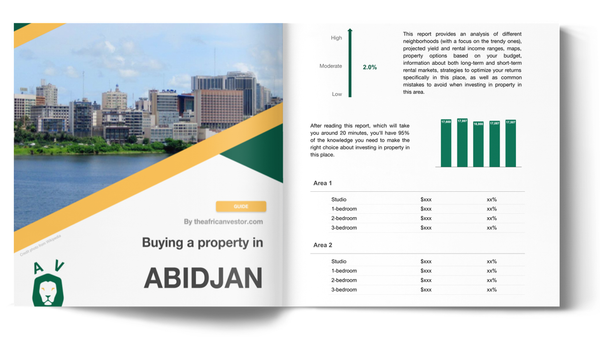
Get all the data you need about the real estate market in Abidjan
We will talk about the current housing prices in Abidjan in 2026, using the freshest figures we could verify for the Abidjan residential property market.
We constantly update this blog post because housing prices in Abidjan can change quickly from one commune to another, especially between Cocody, Plateau, Marcory, Yopougon and Bingerville.
Our goal is simple: help you understand what homes, apartments, villas and duplexes really cost in Abidjan in 2026, without making the numbers hard to read.
And if you’re planning to buy a property in this place, you may want to download our pack covering the real estate market in Abidjan.
Insights
- The median housing price in Abidjan in 2026 is around 35 million FCFA, which is more useful than the average because luxury villas strongly push the average upward.
- The average residential property price in Abidjan in 2026 is closer to 65 million FCFA, or about $116,000, because premium areas such as Cocody and Plateau are expensive.
- Most residential properties for sale in Abidjan in 2026 sit between 18 million and 180 million FCFA, so the market has a very wide price ladder.
- In Abidjan in 2026, the cheapest prices per square meter are usually found in Anyama, Songon, Abobo and Yopougon Gesco.
- The most expensive residential areas in Abidjan in 2026 remain Plateau, Zone 4, Biétry, Riviera Golf and Deux-Plateaux Vallon.
- New homes in Abidjan in 2026 usually cost 15% to 30% more than older homes because buyers pay for clean documents, parking, security and fewer repairs.
- A buyer in Abidjan should often budget 10% to 20% above the agreed purchase price once taxes, notary fees, agency support and renovation are included.
- Listed property prices in Abidjan are often 6% to 10% above final sale prices, but the discount is smaller for clean-title homes in prime areas.
- A $200,000 budget in Abidjan in 2026 is enough for a strong middle-market purchase, but not usually for a prime luxury villa in Cocody or Zone 4.
What is the average housing price in Abidjan in 2026?
The median housing price in Abidjan is more telling than the average housing price because one very expensive villa in Cocody or Riviera Golf can distort the average, while the median shows what a more typical buyer is likely to see.
We are writing this as of 2026, with the latest data collected from authoritative sources that we manually double checked.
The median housing price in Abidjan in 2026 is around 35 million FCFA, which is about $62,000 or €53,000. The average housing price in Abidjan in 2026 is around 65 million FCFA, which is about $116,000 or €99,000.
For around 80% of residential properties in Abidjan in 2026, a realistic price range is 18 million to 180 million FCFA, or about $32,000 to $321,000, or €27,000 to €274,000.
A realistic entry range in Abidjan in 2026 is 12 million to 30 million FCFA, or about $21,000 to $53,000, or €18,000 to €46,000, which can buy an older 55 to 80 sq m apartment in Yopougon Gesco, Abobo or Anyama.
A typical luxury property in Abidjan in 2026 costs around 250 million to 1.2 billion FCFA, or about $446,000 to $2.14 million, or €381,000 to €1.83 million, which can buy a renovated villa, a large penthouse or a premium home in Riviera Golf, Deux-Plateaux Vallon, Zone 4, Biétry or Plateau.
By the way, you will find much more detailed price ranges in our property pack covering the real estate market in Abidjan.
Are Abidjan property listing prices close to the actual sale price in 2026?
In Abidjan in 2026, actual residential sale prices are usually around 6% to 10% below listing prices, with 8% as a useful central estimate.
This happens because many sellers in Abidjan include room for negotiation, and buyers often ask for a discount after checking the ACD, title history, unpaid taxes, renovation needs or access-road conditions. The gap is usually smaller, around 3% to 5%, for clean-title new homes in Zone 4, Riviera Golf, Deux-Plateaux and Plateau, but it can go above 10% for older homes, unfinished homes or homes with unclear documents.
Don't buy the wrong property, in the wrong area of Abidjan
Buying real estate is a significant investment. Don't rely solely on your intuition. Gather the right information to make the best decision.

What is the price per sq m or per sq ft for properties in Abidjan in 2026?
As of 2026, the median residential price in Abidjan is around 350,000 FCFA per sq m, or about $624 and €534 per sq m, which equals about 32,500 FCFA, $58 and €50 per sq ft. The average residential price in Abidjan is around 520,000 FCFA per sq m, or about $927 and €793 per sq m, which equals about 48,300 FCFA, $86 and €74 per sq ft.
The highest price per sq m in Abidjan in 2026 is usually found in compact high-standing apartments and penthouses in Plateau, Zone 4, Biétry, Riviera Golf and Deux-Plateaux Vallon, while the lowest price per sq m is usually found in older or peripheral homes where access, infrastructure and title quality are weaker.
The highest residential price ranges in Abidjan in 2026 are usually found in Plateau, Zone 4, Biétry, Riviera Golf and Deux-Plateaux Vallon, at around 600,000 to 1.25 million FCFA per sq m. The lowest ranges are usually found in Anyama, Songon, Abobo and Yopougon Gesco, at around 55,000 to 220,000 FCFA per sq m.
How have property prices evolved in Abidjan?
Compared with one year ago, housing prices in Abidjan in 2026 are about 5% higher in nominal FCFA terms. The increase is mainly explained by population pressure, a housing shortage and strong demand near jobs, schools and secure neighborhoods.
Compared with two years ago, residential property prices in Abidjan in 2026 are roughly 12% to 15% higher in nominal FCFA terms. The increase has been stronger in Cocody, Angré, Bingerville and Riviera because buyers are still paying more for better roads, better services and safer residential areas.
Finally, if you want to know whether now is a good time to buy a property there, you can check our pack covering everything there is to know about the housing market in Abidjan.
Make a profitable investment in Abidjan
Better information leads to better decisions. Save time and money. Download our data.
How do prices vary by housing type in Abidjan in 2026?
In the Abidjan residential market in 2026, apartments represent about 38% of available homes for sale, villas about 24%, duplexes and townhouses about 15%, unfinished homes about 9%, studios about 8% and luxury villas or penthouses about 6%, because central land is expensive and many buyers prefer smaller or shared-building formats.
In Abidjan as of 2026, a studio or small apartment averages around 18 million FCFA, or $32,000 and €27,000, while a standard apartment averages around 42 million FCFA, or $75,000 and €64,000. A larger apartment is closer to 75 million FCFA, or $134,000 and €114,000, a duplex is around 95 million FCFA, or $169,000 and €145,000, a standard villa is around 135 million FCFA, or $241,000 and €206,000, and a luxury villa or penthouse is around 450 million FCFA, or $802,000 and €686,000.
How do property prices compare between existing and new homes in Abidjan in 2026?
In Abidjan in 2026, a new-build home usually costs 15% to 30% more than a comparable older home, with about 22% as a useful central estimate.
This new-build premium exists because buyers in Abidjan pay more for cleaner paperwork, modern finishes, parking, elevator access, generator support, water storage, security and fewer repairs after purchase.
Get to know the market before buying a property in Abidjan
Better information leads to better decisions. Get all the data you need before investing a large amount of money.
How do property prices vary by neighborhood in Abidjan in 2026?
Zone 4 and Biétry in Marcory mostly offer new apartments, serviced flats and villas, with typical residential prices around 90 million to 280 million FCFA, or $160,000 to $499,000, or €137,000 to €427,000 in 2026. These areas are expensive because they are close to the airport, restaurants, offices, international tenants and secure buildings.
Cocody Riviera and Deux-Plateaux mostly offer villas, duplexes and larger family apartments, with typical prices around 100 million to 500 million FCFA, or $178,000 to $891,000, or €152,000 to €762,000 in 2026. These neighborhoods are popular because families value schools, embassies, calmer streets and a stronger security image.
Plateau mostly offers high-end apartments and rare residential stock, with typical prices around 120 million to 450 million FCFA, or $214,000 to $802,000, or €183,000 to €686,000 in 2026. Plateau is expensive because it is Abidjan’s business district, and residential supply is limited.
You will find a much more detailed analysis by areas in our property pack about Abidjan. Meanwhile, here is a quick summary table we have made so you can understand how prices change across areas:
| Area in Abidjan | Market label | Typical home price | Typical price per sq m | Typical price per sq ft |
|---|---|---|---|---|
| Plateau | CBD / premium | 120m to 450m FCFA / $214k to $802k | 850k to 1.25m FCFA / $1,515 to $2,228 | 79k to 116k FCFA / $141 to $207 |
| Zone 4 / Biétry | Expat / serviced | 90m to 280m FCFA / $160k to $499k | 550k to 900k FCFA / $980 to $1,604 | 51k to 84k FCFA / $91 to $149 |
| Riviera Golf / Bonoumin | Luxury family | 150m to 650m FCFA / $267k to $1.16m | 600k to 850k FCFA / $1,070 to $1,515 | 56k to 79k FCFA / $99 to $141 |
| Deux-Plateaux Vallon | Family / embassy | 100m to 400m FCFA / $178k to $713k | 550k to 750k FCFA / $980 to $1,337 | 51k to 70k FCFA / $91 to $124 |
| Riviera 2 / 3 | Upper-middle | 65m to 240m FCFA / $116k to $428k | 480k to 680k FCFA / $856 to $1,212 | 45k to 63k FCFA / $80 to $113 |
| Angré | Rental / dynamic | 35m to 150m FCFA / $62k to $267k | 380k to 500k FCFA / $677 to $891 | 35k to 46k FCFA / $63 to $83 |
| Marcory outside Zone 4 | Central / commute | 55m to 180m FCFA / $98k to $321k | 400k to 650k FCFA / $713 to $1,159 | 37k to 60k FCFA / $66 to $108 |
| Koumassi | Value / commute | 25m to 95m FCFA / $45k to $169k | 250k to 380k FCFA / $446 to $677 | 23k to 35k FCFA / $41 to $63 |
| Bingerville | Growth / family | 35m to 140m FCFA / $62k to $250k | 250k to 380k FCFA / $446 to $677 | 23k to 35k FCFA / $41 to $63 |
| Yopougon | Affordable / mass market | 15m to 85m FCFA / $27k to $152k | 150k to 300k FCFA / $267 to $535 | 14k to 28k FCFA / $25 to $50 |
| Abobo | Entry / affordable | 10m to 55m FCFA / $18k to $98k | 90k to 220k FCFA / $160 to $392 | 8k to 20k FCFA / $15 to $36 |
| Anyama / Songon | Peripheral / land-led | 8m to 60m FCFA / $14k to $107k | 55k to 200k FCFA / $98 to $357 | 5k to 19k FCFA / $9 to $33 |
How much more do you pay for properties in Abidjan when you include renovation work, taxes, and fees?
In Abidjan in 2026, a buyer should usually budget 10% to 20% above the agreed purchase price once taxes, notary fees, agency support and renovation work are included.
For a property bought around $200,000, or about 112 million FCFA, the additional cost in Abidjan can be around 11 million to 22 million FCFA, or roughly $20,000 to $40,000. This means the total budget can end up near 123 million to 134 million FCFA, or about $220,000 to $240,000.
For a property bought around $500,000, or about 281 million FCFA, the additional cost in Abidjan can be around 28 million to 56 million FCFA, or roughly $50,000 to $100,000. This means the total budget can end up near 309 million to 337 million FCFA, or about $550,000 to $600,000.
For a property bought around $1,000,000, or about 561 million FCFA, the additional cost in Abidjan can be around 56 million to 112 million FCFA, or roughly $100,000 to $200,000. This means the total budget can end up near 617 million to 673 million FCFA, or about $1.1 million to $1.2 million.
Meanwhile, here is a detailed table of the additional expenses you may have to pay when buying a new property in Abidjan
| Extra cost | Category | Estimated cost range |
|---|---|---|
| Registration duty / mutation tax | Taxes | Usually around 4% to 7% of the purchase price. On an 80 million FCFA home, this can mean about 3.2 million to 5.6 million FCFA, or about $5,700 to $10,000. This is one of the main official costs to plan for. |
| Notary and legal formalities | Fees | Usually around 1% to 3% of the purchase price. On an 80 million FCFA home, this can mean about 800,000 to 2.4 million FCFA, or about $1,400 to $4,300. The exact amount depends on the structure of the deal. |
| Land and title checks | Due diligence | Usually around 0.3% to 1% of the purchase price. On an 80 million FCFA home, this can mean about 240,000 to 800,000 FCFA, or about $400 to $1,400. This cost is worth paying because title mistakes can be very expensive later. |
| Agency or buyer representation | Fees | Usually around 0% to 3% of the purchase price. On an 80 million FCFA home, this can mean up to 2.4 million FCFA, or about $4,300. Some buyers pay no separate fee, while others pay for search and negotiation support. |
| Bank and mortgage setup costs | Financing | Usually around 0% to 2% of the purchase price. On an 80 million FCFA home, this can mean up to 1.6 million FCFA, or about $2,900. Cash buyers may avoid part of this cost. |
| Light renovation | Renovation | Usually around 3% to 6% of the purchase price. On an 80 million FCFA home, this can mean about 2.4 million to 4.8 million FCFA, or about $4,300 to $8,600. This usually covers paint, small repairs and basic upgrades. |
| Medium renovation | Renovation | Usually around 7% to 12% of the purchase price. On an 80 million FCFA home, this can mean about 5.6 million to 9.6 million FCFA, or about $10,000 to $17,100. This can cover kitchens, bathrooms, flooring or electrical work. |
| Heavy renovation or unfinished works | Renovation | Usually around 15% to 30% or more of the purchase price. On an 80 million FCFA home, this can mean about 12 million to 24 million FCFA or more, or about $21,000 to $43,000. This is common when the property is old, unfinished or structurally weak. |
Don't lose money on your property in Abidjan
100% of people who have lost money there have spent less than 1 hour researching the market. We have reviewed everything there is to know. Grab our guide now.

What properties can you buy in Abidjan in 2026 with different budgets?
With $100,000, or about 56 million FCFA, there is a real market in Abidjan in 2026, and you can look for an existing 90 to 110 sq m apartment in Yopougon Sideci or Niangon, an existing 70 to 90 sq m apartment in Koumassi or Port-Bouët, or a small existing apartment or compact duplex in Bingerville.
With $200,000, or about 112 million FCFA, you can look for an existing 120 to 150 sq m apartment in Riviera 2 or Riviera 3, a new 120 to 160 sq m duplex in Bingerville or Angré, or an existing 180 to 220 sq m family villa in Yopougon, Koumassi or outer Cocody.
With $300,000, or about 168 million FCFA, you can look for an existing 180 to 250 sq m villa in Angré or outer Riviera, a new 150 to 180 sq m apartment in Zone 4 or Marcory, or a recent duplex in Bingerville with better finishes.
With $500,000, or about 281 million FCFA, you can look for a renovated 250 to 350 sq m villa in Deux-Plateaux or Riviera, a high-standing 180 to 220 sq m apartment in Zone 4 or Biétry, or a large villa in Bingerville or Grand-Bassam with land and pool potential.
With $1,000,000, or about 561 million FCFA, you can look for a luxury 350 to 500 sq m villa in Riviera Golf or Deux-Plateaux Vallon, a high-end villa in Zone 4 or Biétry with pool and generator, or a premium penthouse in Plateau or Zone 4.
With $2,000,000, or about 1.12 billion FCFA, the Abidjan market becomes thin and highly negotiated, but you can look for a trophy villa in Riviera Golf or Cocody, a prime lagoon-view villa in Cocody or Marcory, or a small residential compound in a prime area.
What sources have we used to write this blog article?
Whether it’s in our blog articles or the market analyses included in our property pack about Abidjan, we always rely on the strongest methodology we can … and we don’t throw out numbers at random.
We also aim to be fully transparent, so below we’ve listed the authoritative sources we used, and explained how we used them and the methods behind our estimates.
| Source | Why we consider it useful | How we used it |
|---|---|---|
| IvoireDomi — Prix immobilier Côte d’Ivoire, June 2026 | It is a local property platform with a June 2026 table of asking prices by commune and property type. | We used it as the main Abidjan-wide benchmark for asking prices per sq m. We treated the figures as listing prices, not as final transaction prices. |
| Keur-Immo — Prix du mètre carré à Abidjan par quartier, 2025 | It gives neighborhood-level price ranges and says its figures combine field observations with notary and agency data. | We used it to refine micro-neighborhood ranges for Plateau, Cocody, Riviera, Zone 4, Yopougon, Bingerville and Angré. We adjusted the 2025 figures modestly to estimate June 2026 levels. |
| Numbeo — Property Prices in Abidjan, May 2026 | It is an international cost-of-living dataset that gives a useful cross-check for apartment prices. | We used it as a cross-check for apartment prices in the city center and outside the center. We did not use it alone because it is survey-based. |
| Habitat for Humanity — Côte d’Ivoire Country Profile 2024 | It is an international housing organization with clear housing-deficit estimates for Côte d’Ivoire and Abidjan. | We used it to explain why Abidjan housing demand remains strong. We also used the housing-deficit data to understand pressure on prices. |
| World Bank — Côte d’Ivoire housing report | It is an institutional housing-sector study focused on housing shortage and affordability. | We used it to cross-check the depth of the housing shortage. We also used it to explain why formal supply remains too limited for many households. |
| Côte d’Ivoire government — 150,000 social and economic housing program | It is the official government portal and gives public-housing delivery figures. | We used it to check whether public housing supply is catching up with demand. We compared delivered homes with planned homes to understand the private-market pressure. |
| Côte d’Ivoire open data — RGPH 2021 Abidjan population | It is the national open-data portal for official census results. | We used it to anchor Abidjan’s demographic scale. We also used population concentration as a reason why housing demand is structurally high. |
| IMF — Côte d’Ivoire country page, 2026 indicators | It is the International Monetary Fund’s official country dataset. | We used it for macroeconomic context, including growth and inflation assumptions. We used these figures when comparing nominal and real housing-price changes. |
| BCEAO — Principaux indicateurs et taux directeurs | It is the official central bank dashboard for the WAEMU region. | We used it to cross-check inflation and monetary conditions. We also used it to explain why financing remains a constraint for many buyers. |
| DGI Côte d’Ivoire — Barème des coûts des actes en matière d’enregistrement | It is the Ivorian tax authority’s official registration-cost schedule. | We used it for the tax and registration-cost framework. We combined it with notary, agency and renovation assumptions to estimate total buying costs. |
| Banque de France — CFA franc fixed parity | It is an official monetary source explaining the fixed parity between the euro and the CFA franc. | We used it to convert FCFA amounts into euros. We used the fixed rate of €1 = 655.957 FCFA throughout the article. |
| Exchange-Rates.org — 2026 USD/XOF exchange history | It provides 2026 exchange-rate history for the USD/XOF pair. | We used its 2026 average of about 561 FCFA per US dollar as the dollar conversion basis. We rounded dollar amounts to keep the article easy to read. |
Get the full checklist for your due diligence in Abidjan
Don't repeat the same mistakes others have made before you. Make sure everything is in order before signing your sales contract.
