
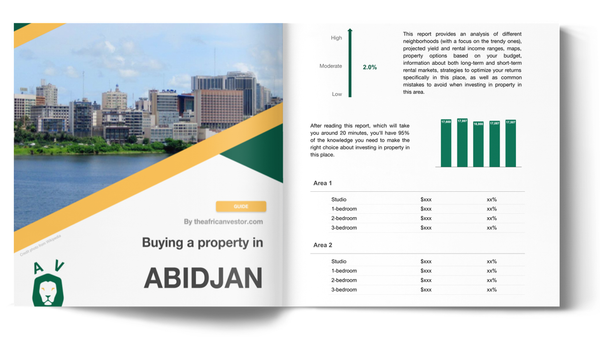
Get all the data you need about the real estate market in Abidjan
This blog post covers villa purchase prices in Abidjan as of 2026, and we update it regularly so the figures you see here are always current.
Prices vary a great deal depending on the neighborhood, the size of the villa, and the type of buyer the area attracts.
Whether you are looking at Riviera Golf at the top end or Bingerville at the entry level, this guide will help you understand where Abidjan villa prices stand today.
And if you're planning to buy a property in this place, you may want to download our real estate pack about Abidjan.
A quick summary table
| Metric | Value |
|---|---|
| Most expensive Abidjan neighborhood for villa purchases | Riviera Golf / Beverly Hills |
| Most affordable Abidjan neighborhood for villa purchases | Bingerville / Akandje |
| Average price per square meter across all Abidjan villa neighborhoods | Around 1,490,000 FCFA per m² |
| Median villa price across Abidjan | Around 390,000,000 FCFA |
| Lowest realistic starting budget for an Abidjan villa | Around 35,000,000 FCFA (Bingerville / Akandje) |
| Most expensive villa type by bedroom count in Abidjan | Three-bedroom villa |
| Most affordable villa type by bedroom count in Abidjan | One-bedroom villa |
| Average price for a one-bedroom Abidjan villa | Around 120,000,000 FCFA |
| Average price for a two-bedroom Abidjan villa | Around 185,000,000 FCFA |
| Average price for a three-bedroom Abidjan villa | Around 277,000,000 FCFA |
| Price gap between the most and least expensive Abidjan villa neighborhoods | About 6 times more expensive at the top end vs. the entry level |
| Price spread across Abidjan villa neighborhoods | From 450,000 FCFA/m² (Bingerville) to 2,800,000 FCFA/m² (Riviera Golf) |
Get fresh and reliable information about the market in Abidjan
Don't base significant investment decisions on outdated data. Get updated and accurate information.

Abidjan villa neighborhoods ranked by purchase price in 2026
This table ranks the main Abidjan neighborhoods by villa purchase price, from the most expensive to the most affordable.
For each neighborhood, the table shows the average price per square meter, the median property price, the starting budget, the average price for a one-bedroom, two-bedroom, and three-bedroom villa, the typical buyer profile, the key advantages, the key drawbacks, and the market segment.
Finally, please note you'll find much more detailed data in our real estate pack about Abidjan.
| Rank | Neighborhood | Average Price per Square Meter | Median Property Price | Starting Budget | Average Price for a One-Bedroom Villa | Average Price for a Two-Bedroom Villa | Average Price for a Three-Bedroom Villa | Typical Buyers | Key Pros | Key Cons | Market Segment |
|---|---|---|---|---|---|---|---|---|---|---|---|
| 1 | Riviera Golf / Beverly Hills | 2,800,000 FCFA/m² | 1,350,000,000 FCFA | 220,000,000 FCFA | 210,000,000 FCFA | 320,000,000 FCFA | 470,000,000 FCFA | Diplomatic elite buyers | Abidjan's strongest prestige address, large plots, gated feel, schools nearby, and very strong resale visibility | Entry prices are very high, supply is thin, and trophy homes skew comparisons upward | Luxury |
| 2 | Cocody Ambassades | 2,600,000 FCFA/m² | 1,200,000,000 FCFA | 350,000,000 FCFA | 240,000,000 FCFA | 360,000,000 FCFA | 540,000,000 FCFA | Diplomats and ultra-high-net-worth families | Very secure prestige environment close to embassies, elite schools, and top executive destinations | Very few true entry deals, and many homes need expensive upgrades to match the address | Luxury |
| 3 | Riviera 4 | 1,900,000 FCFA/m² | 620,000,000 FCFA | 220,000,000 FCFA | 170,000,000 FCFA | 260,000,000 FCFA | 390,000,000 FCFA | Affluent family buyers | Premium villas, good road access, many secure cites, and strong buyer familiarity across Abidjan | Flood-risk pockets and wide quality gaps mean thorough due diligence is very important street by street | Premium |
| 4 | Deux-Plateaux Vallons | 1,650,000 FCFA/m² | 500,000,000 FCFA | 200,000,000 FCFA | 150,000,000 FCFA | 230,000,000 FCFA | 340,000,000 FCFA | Executive local families | Mature residential address with restaurants, offices, schools, and strong daily convenience | Traffic is heavy, plots are often tight, and some housing stock feels older than the price suggests | Premium |
| 5 | Danga | 1,550,000 FCFA/m² | 480,000,000 FCFA | 230,000,000 FCFA | 155,000,000 FCFA | 240,000,000 FCFA | 350,000,000 FCFA | Quiet upper-tier families | Calm, central, and residential with a prestige feel and easier access to Plateau than outer Cocody | Thin listing volume makes price discovery harder, and renovation budgets can be significant | Premium |
| 6 | Marcory Bietry | 1,450,000 FCFA/m² | 450,000,000 FCFA | 180,000,000 FCFA | 145,000,000 FCFA | 220,000,000 FCFA | 330,000,000 FCFA | Waterfront lifestyle buyers | Popular with buyers wanting restaurants, airport access, lagoon proximity, and established expat appeal | Noise, nightlife spillover, and irregular micro-locations can weaken purely residential comfort | Premium |
| 7 | Zone 4 | 1,350,000 FCFA/m² | 400,000,000 FCFA | 170,000,000 FCFA | 135,000,000 FCFA | 205,000,000 FCFA | 310,000,000 FCFA | Urban mixed-use buyers | Strong accessibility and rental flexibility in one of Abidjan's best-known urban districts | Less quiet and less purely residential than most villa buyers look for | Mid-Market |
| 8 | Riviera 3 | 1,250,000 FCFA/m² | 360,000,000 FCFA | 155,000,000 FCFA | 125,000,000 FCFA | 190,000,000 FCFA | 285,000,000 FCFA | Upper-middle family buyers | Good balance between standing, schools, bridge access, and family-scale villa compounds | Premium homes exist, but pricing can jump sharply between secure cites and non-cite streets | Mid-Market |
| 9 | Riviera Palmeraie | 900,000 FCFA/m² | 220,000,000 FCFA | 120,000,000 FCFA | 95,000,000 FCFA | 145,000,000 FCFA | 215,000,000 FCFA | Value-seeking families | Better affordability than central Cocody, with many family compounds and improving road connections | Quality is uneven, and some areas feel more peripheral than buyers first expect | Mid-Market |
| 10 | Angre | 750,000 FCFA/m² | 180,000,000 FCFA | 75,000,000 FCFA | 75,000,000 FCFA | 115,000,000 FCFA | 170,000,000 FCFA | Aspirational local buyers | One of Abidjan's clearest paths from a tight budget to a decent family villa | Plot quality, finishes, and road environment vary widely from one tranche to another | Affordable |
| 11 | Abatta | 680,000 FCFA/m² | 165,000,000 FCFA | 95,000,000 FCFA | 70,000,000 FCFA | 110,000,000 FCFA | 160,000,000 FCFA | Long-horizon family buyers | Newer housing stock, quieter setting, and good value for larger family layouts than inner Abidjan can offer | Commute length matters here, and resale is slower than in core Cocody areas | Affordable |
| 12 | Bingerville / Akandje | 450,000 FCFA/m² | 95,000,000 FCFA | 35,000,000 FCFA | 45,000,000 FCFA | 70,000,000 FCFA | 105,000,000 FCFA | Entry-level villa buyers | Lowest realistic villa entry point around Greater Abidjan with room for long-term area improvement | Infrastructure and neighborhood finish are still inconsistent across many projects | Budget |
Make a profitable investment in Abidjan
Better information leads to better decisions. Save time and money. Download our data.
Key insights about villa purchase prices in Abidjan
Insights
- Abidjan's true luxury villa market is very narrow. Only Riviera Golf and Cocody Ambassades sit clearly above the rest, with median prices above 1 billion FCFA. Every other neighborhood falls into a separate, lower pricing band.
- The price gap between the top and bottom Abidjan villa neighborhoods is about 6 to 1. Riviera Golf averages around 2,800,000 FCFA per square meter, while Bingerville sits at around 450,000 FCFA. That is a very wide spread for a single city.
- Riviera 4 is the clearest premium middle ground in Abidjan. It offers proper prestige villas at around 1,900,000 FCFA per square meter, which is well below Riviera Golf but still well above the mid-market range starting around 1,350,000 FCFA.
- Marcory Bietry often beats Zone 4 for pure residential villa appeal. Bietry feels more waterfront-oriented and more residential, while Zone 4 is better suited to buyers who want rental flexibility or a mixed-use urban lifestyle.
- Riviera Palmeraie is where Abidjan villa prices soften materially. At around 900,000 FCFA per square meter, it is the first neighborhood where budgets shift from premium to broadly upper-middle, making it a key boundary in the market.
- Angre shows the widest internal price variation of any Abidjan neighborhood. One tranche can feel budget while another looks almost mid-market. Buyers here need to compare individual streets, not just the overall neighborhood name.
- One-bedroom villas are unusually rare in prime Abidjan districts. Because compact standalone villas are not a common product in areas like Riviera Golf or Ambassades, their one-bedroom prices are higher than most beginners expect.
- Abatta gives more house size per franc than inner Cocody. Families who need space but have a limited budget often get more built area in Abatta than they would at the same price in Riviera 3 or Riviera Palmeraie.
- Moving from Angre to Riviera 4 roughly doubles the price. That is a very steep step up, and it means buyers in the 170 to 220 million FCFA range face a sharp tradeoff between location quality and affordability.
- Bingerville and Akandje are the true entry point for villas near Abidjan. Starting budgets there are around 35 million FCFA, which is far below anything available in core Cocody or Marcory.
- Abidjan villa buyers are really choosing between prestige, commute time, and space. In most cases, you can realistically achieve only two of the three at any given budget level.
- Street-level due diligence matters almost as much as neighborhood choice in Abidjan. Flood exposure and construction quality vary sharply from one street to another, even within the same broader area.
Get to know the market before buying a property in Abidjan
Better information leads to better decisions. Get all the data you need before investing a large amount of money.
About our methodology
We applied a two-step approach to build this Abidjan villa price guide. First, we used official and institutional sources to anchor the macro and housing backdrop for Abidjan. This includes Cote d'Ivoire government data, the Ministry of Construction, and IMF projections for 2026 inflation, which sits at around 1.5%. Knight Frank also confirms that demand for quality residential stock in Abidjan remains active.
Second, we collected neighborhood-level villa evidence from live Abidjan listing portals. We only kept villa and maison listings with usable neighborhood and price information. We compared asking prices, built areas where available, and bedroom counts across Cocody, Marcory, Bingerville, and nearby suburban zones. We then smoothed clear outliers and built a best-estimate mid-2026 market positioning for each neighborhood.
For bedroom size consistency, we used these Abidjan market conventions across all neighborhoods: a one-bedroom villa is a compact standalone villa of about 70 to 90 square meters, a two-bedroom villa is about 100 to 130 square meters, and a three-bedroom villa is about 140 to 180 square meters. One-bedroom villas are uncommon in prime Abidjan districts, so those figures reflect the price of a small standalone format rather than a typical mass-market product.
We also believe it is important to show our reasoning. It is one of the ways we make our work solid, transparent, and rigorous, just as you will see in our real estate pack about Abidjan.
First, please note that this data is updated regularly, so what you see here reflects the current values as of today.
In order to get reliable data, we applied a strict source filter. We only used authoritative, verifiable sources, not random listings or unsupported figures. More on that point below.
For each Abidjan neighborhood, we aggregated the freshest villa purchase price data available. When possible, we cross-checked multiple sources to confirm the same price range.
This allowed us to estimate the average price per square meter and the median property price for each neighborhood.
We also calculated the starting budget, which represents the lowest realistic entry point to buy a villa in that Abidjan neighborhood. This is not the cheapest possible listing, but a real, achievable floor for a standard villa purchase.
For each bedroom category, we estimated an average purchase price based on local Abidjan market conventions. The typical size and layout of a one-bedroom, two-bedroom, and three-bedroom villa can vary across neighborhoods, so we adapted our estimates accordingly.
These estimates were not applied as one flat number across Abidjan. They were adjusted by neighborhood and property type to better reflect local ownership conditions and price levels.
This table should therefore be read as a structured market estimate, not as an exact guarantee of transaction prices. Honesty, quality, and rigor are at the core of our work, and they are also what you will find in our real estate pack about Abidjan.
What sources have we used to write this blog article?
Whether it's in our blog articles or the market analyses included in our real estate pack about Abidjan, we rely on verifiable sources and a transparent methodology.
We also aim to be fully transparent, so below we've listed the authoritative sources we used, and explained how we used them and the methods behind our estimates.
| Source | Why It Carries Weight | How We Used It |
|---|---|---|
| Cote d'Ivoire Open Data (Urbanisation) | It is the official national open-data portal for Cote d'Ivoire. | We used it to anchor the broad urban growth backdrop behind Abidjan housing demand. We also used it to avoid treating villa pricing as a detached niche market disconnected from the wider city. |
| Cote d'Ivoire Open Data (Population by Residence) | It is an official statistical publication based on national census outputs. | We used it to confirm Abidjan's weight inside the national urban system. We also used it to justify why Abidjan dominates formal residential search activity in Cote d'Ivoire. |
| Ministry of Construction, Housing and Urbanism | It is the official Ivorian housing and construction ministry website. | We used it to frame formal housing supply, permits, and land titling context in Abidjan. We also used it to understand the formal side of residential delivery in Cote d'Ivoire. |
| IMF Cote d'Ivoire Country Page | The IMF is a leading macroeconomic source for emerging market data. | We used it to anchor the 2026 inflation and growth backdrop for Abidjan. We also used it so that villa price comparisons are read in the right economic context. |
| Knight Frank Cote d'Ivoire | Knight Frank is a major international real estate research firm with strong African market coverage. | We used it to confirm that residential demand in Abidjan remains active. We also used it to support the idea that higher-quality housing continues to attract serious buyer interest. |
| Keur-Immo (Cocody Villas) | It is a specialized regional property portal with current Abidjan villa listings. | We used it to observe active asking-price ranges in key Cocody villa areas. We also used it to compare the upper-mid and premium Abidjan submarkets side by side. |
| Keur-Immo (Bingerville Villas) | It is a specialized regional property portal with current Abidjan area listings. | We used it to test the lower-price edge of the Abidjan villa market. We also used it to check entry budgets in areas outside core Cocody and Marcory. |
| Agentiz Cote d'Ivoire | It is a structured property marketplace with standardized listing fields across Abidjan. | We used it to cross-check prices, bedroom counts, and built areas. We also used it to reduce reliance on any single Abidjan listing portal. |
| immo.ci.cari.africa (Riviera Golf) | It is a large Abidjan listing aggregator with visible asking-price clusters by area. | We used it to map the high end of the Abidjan villa market. We also used it to identify realistic floor prices versus trophy-level outliers at Riviera Golf. |
| immo.ci.cari.africa (Angre and Abatta) | It is a large Abidjan listing aggregator with multiple neighborhood snapshots. | We used it to compare emerging and mid-market villa zones in Abidjan. We also used it to estimate where affordability improves most sharply across the city. |
Don't lose money on your property in Abidjan
100% of people who have lost money there have spent less than 1 hour researching the market. We have reviewed everything there is to know. Grab our guide now.

