
Get all the data you need about the real estate market in Abidjan
This article covers residential buildable land prices in Abidjan in 2026, broken down by neighborhood so you can quickly understand what a plot of land costs depending on where you want to buy.
We update this blog post regularly so that the data you see here stays current and useful.
Whether you are targeting a prime area like Cocody or a more affordable zone like Songon or Anyama, this guide gives you a clear picture of what to expect in the Abidjan land market in 2026.
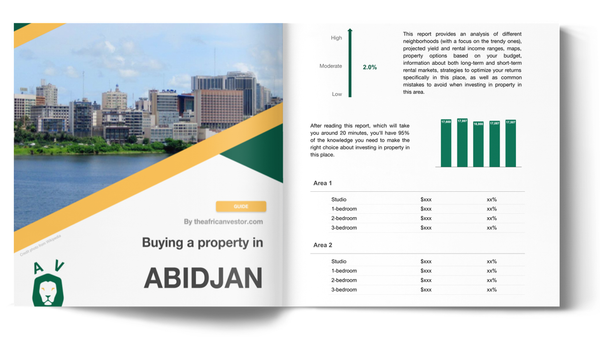
And if you're planning to buy a property in this place, you may want to download our real estate pack about Abidjan.
A quick summary table
| Metric | Value |
|---|---|
| Most expensive neighborhood for land in Abidjan | Cocody Danga / Riviera Golf |
| Most affordable neighborhood for land in Abidjan | Dabou (peri-urban) |
| Average price per square meter across all Abidjan neighborhoods | 380,000 FCFA/m2 |
| Median plot price across Abidjan | About 210,000,000 FCFA |
| Lowest realistic starting budget for a plot in Abidjan | 15,000,000 FCFA |
| Most expensive plot size category in Abidjan | Large plot (1,000 m2) |
| Most affordable plot size category in Abidjan | Small plot (300 m2) |
| Average price for a small plot (300 m2) in Abidjan | About 100,000,000 FCFA |
| Average price for a medium plot (600 m2) in Abidjan | About 200,000,000 FCFA |
| Average price for a large plot (1,000 m2) in Abidjan | About 340,000,000 FCFA |
| Price gap between the most and least expensive Abidjan neighborhoods | 1,150,000 FCFA/m2 (from 1,200,000 down to 50,000 FCFA/m2) |
| Price dispersion across Abidjan neighborhoods | Very high. The most expensive area costs 24 times more per m2 than the cheapest. |
Thinking of buying real estate in Abidjan?
Acquiring property in a different country is a complex task. Don't fall into common traps – grab our guide and make better decisions.

Abidjan neighborhoods in 2026 ranked by land purchase price
This table ranks the main neighborhoods in the Abidjan land market by purchase price, from the most expensive to the most affordable.
For each neighborhood, the table includes the average price per square meter, the median plot price, the starting budget, the average price for a small plot, a medium plot, and a large plot, the typical land use, the key advantages, the key drawbacks, and the market segment.
Finally, please note you'll find much more detailed data in our real estate pack about Abidjan.
| Rank | Neighborhood | Average Price per Square Meter | Median Plot Price | Starting Budget | Average Price for a Small Plot | Average Price for a Medium Plot | Average Price for a Large Plot | Typical Land Use | Key Pros | Key Cons | Market Segment |
|---|---|---|---|---|---|---|---|---|---|---|---|
| 1 | Cocody Danga / Riviera Golf | 1,200,000 FCFA | 720,000,000 FCFA | 500,000,000 FCFA | 360,000,000 FCFA | 720,000,000 FCFA | 1,200,000,000 FCFA | Luxury villa build | Prime roads and utilities already in place, close to embassies and high-end amenities, and secure zoning that protects land values long term | Very high entry cost, very few available plots remaining, and strict building standards that limit what you can construct | Prime Land |
| 2 | Cocody Angre (7th and 8th tranche) | 900,000 FCFA | 540,000,000 FCFA | 350,000,000 FCFA | 270,000,000 FCFA | 540,000,000 FCFA | 900,000,000 FCFA | Custom home construction | Strong infrastructure with paved roads, high buyer demand that supports resale value, and good schools nearby making it popular with families | Increasing congestion is a real issue, very few plots are still available, and prices keep rising which makes entry harder each year | Prime Land |
| 3 | Marcory Residentiel | 800,000 FCFA | 480,000,000 FCFA | 300,000,000 FCFA | 240,000,000 FCFA | 480,000,000 FCFA | 800,000,000 FCFA | Urban residential build | Central location within Abidjan, excellent road access, and utilities fully available without extra infrastructure work needed | Land is very scarce here, the dense urban environment creates noise, and building constraints are tighter than in suburban areas | Prime Land |
| 4 | Bingerville (centre) | 400,000 FCFA | 240,000,000 FCFA | 120,000,000 FCFA | 120,000,000 FCFA | 240,000,000 FCFA | 400,000,000 FCFA | Family home build | Rapid development is underway, roads are improving steadily, and there is strong future appreciation potential as the area keeps growing | Some infrastructure gaps still exist today, and the distance from Abidjan's main business districts adds to daily commute times | High-Value Land |
| 5 | Riviera Palmeraie | 350,000 FCFA | 210,000,000 FCFA | 100,000,000 FCFA | 105,000,000 FCFA | 210,000,000 FCFA | 350,000,000 FCFA | Mid-range housing | Good road network, close proximity to Cocody, and strong potential rental demand that makes this area attractive for investors | Traffic congestion can be significant, and zoning is mixed in some parts of the area which creates uncertainty for some buyers | High-Value Land |
| 6 | Yopougon Niangon | 250,000 FCFA | 150,000,000 FCFA | 70,000,000 FCFA | 75,000,000 FCFA | 150,000,000 FCFA | 250,000,000 FCFA | Affordable housing build | A large number of plots are still available, infrastructure is growing, and strong population growth means sustained demand for housing | Some zones are flood-prone, utilities can be inconsistent depending on the exact location, and commute times are longer than in central Abidjan | Mid-Range Land |
| 7 | Abobo Baoulé | 180,000 FCFA | 108,000,000 FCFA | 50,000,000 FCFA | 54,000,000 FCFA | 108,000,000 FCFA | 180,000,000 FCFA | Entry housing build | Very affordable entry prices, strong and consistent demand from buyers, and an active land subdivision market with regular new supply | Infrastructure remains limited in many parts, security can be a concern in certain pockets, and many access roads are still unpaved | Mid-Range Land |
| 8 | Anyama (central) | 150,000 FCFA | 90,000,000 FCFA | 40,000,000 FCFA | 45,000,000 FCFA | 90,000,000 FCFA | 150,000,000 FCFA | Long-term investment | Positioned in an urban expansion zone, lower density than central Abidjan, and improving transport links are making access easier over time | Far from the city center means daily life requires more travel, and infrastructure is rolling out slowly compared to closer neighborhoods | Affordable Land |
| 9 | Songon | 120,000 FCFA | 72,000,000 FCFA | 30,000,000 FCFA | 36,000,000 FCFA | 72,000,000 FCFA | 120,000,000 FCFA | Speculative development | Large land supply at low prices, future highway access planned, and sits within one of Abidjan's strongest long-term growth corridors | Utilities are limited for now, land conditions are raw in many plots, and legal verification of title is essential before any purchase here | Affordable Land |
| 10 | Grand-Bassam (residential zones) | 100,000 FCFA | 60,000,000 FCFA | 25,000,000 FCFA | 30,000,000 FCFA | 60,000,000 FCFA | 100,000,000 FCFA | Coastal home build | Coastal setting with real lifestyle appeal, tourism potential is growing, and the calmer environment suits buyers looking for a quieter life | Flood risk is real in some zones, the distance from central Abidjan is a drawback for daily commuters, and infrastructure quality varies across the area | Affordable Land |
| 11 | Azaguie | 70,000 FCFA | 42,000,000 FCFA | 20,000,000 FCFA | 21,000,000 FCFA | 42,000,000 FCFA | 70,000,000 FCFA | Long-term hold | Very low land prices, large plots are easy to find, and the area has future expansion potential as Abidjan continues growing outward | Remote location from the city, minimal infrastructure today, and price appreciation will take a long time compared to closer neighborhoods | Entry-Level Land |
| 12 | Dabou (peri-urban) | 50,000 FCFA | 30,000,000 FCFA | 15,000,000 FCFA | 15,000,000 FCFA | 30,000,000 FCFA | 50,000,000 FCFA | Entry land investment | The lowest entry point in the broader Abidjan land market, large plot sizes are easy to access, and future corridor development could drive long-term upside | Infrastructure is weak, the distance from Abidjan is significant, and legal due diligence is particularly important given the peri-urban land conditions | Entry-Level Land |
Get fresh and reliable information about the market in Abidjan
Don't base significant investment decisions on outdated data. Get updated and accurate information.
Key insights about land purchase prices in Abidjan
Insights
- The Abidjan land market in 2026 spans an enormous price range. The cheapest land in Dabou costs around 50,000 FCFA per square meter, while Cocody Danga reaches 1,200,000 FCFA per square meter. That is a 24x gap between the two ends of the market.
- Buying a small plot of 300 m2 in Cocody Danga in 2026 already costs around 360,000,000 FCFA, which is more than buying a large 1,000 m2 plot in Bingerville at 400,000,000 FCFA. Location matters far more than plot size in Abidjan.
- Bingerville land prices have roughly doubled in recent years due to urban pressure from Cocody. Buyers who missed Angre are now buying in Bingerville before that window closes too.
- Riviera Palmeraie sits at 350,000 FCFA per square meter in 2026, making it a transition zone. It is significantly cheaper than Cocody Danga but still carries strong rental demand potential, which makes it a popular compromise for mid-budget investors.
- Yopougon Niangon land costs 2 to 3 times less per square meter than Cocody, yet both neighborhoods are inside the same city. This price gap is almost entirely explained by infrastructure quality and proximity to business districts.
- In Abidjan's land market, the entry budget matters more than the price per square meter for most individual buyers. Marcory Residentiel starts at 300,000,000 FCFA even for a small plot, making it effectively closed to most non-institutional buyers despite its central location.
- Anyama and Songon prices in 2026 are driven almost entirely by future infrastructure speculation. There is little current livability to justify the purchase today, but buyers who can wait 10 or more years are betting on long-term urban expansion.
- Legal title verification is the single most important step for buyers in peri-urban areas like Songon, Azaguie, and Dabou. Plot prices are low partly because legal security is lower too, and the risk of unclear ownership is real.
- Flood risk is a hidden factor that pushes prices down in both Yopougon and Grand-Bassam, two areas that otherwise offer reasonable access and lifestyle. Buyers focused purely on price per square meter may miss this important risk.
- Abidjan's land market follows a clear concentric pattern. Prices are highest at the Cocody core and fall consistently as you move outward. Understanding where you sit on that axis immediately tells you what price range to expect.
- For buyers with a budget under 100,000,000 FCFA, the realistic options in the Abidjan land market in 2026 are limited to Abobo, Anyama, Songon, Grand-Bassam, Azaguie, and Dabou. All other neighborhoods require significantly higher entry budgets.
Get to know the market before buying a property in Abidjan
Better information leads to better decisions. Get all the data you need before investing a large amount of money.
About our methodology
We believe it is important to show our reasoning when writing about land prices in Abidjan. It is one of the ways we make our work solid, transparent, and rigorous, just as you will see in our real estate pack about Abidjan.
First, please note that this data is updated regularly, so what you see here reflects the current values as of today.
In order to get reliable data on the Abidjan land market, we applied a strict source filter. We only used authoritative, verifiable sources, not random listings or unsupported figures. More on that point below.
For each neighborhood in Abidjan, we aggregated the freshest land purchase price data available in 2026. When possible, we cross-checked multiple sources to confirm the same price range.
This allowed us to estimate the average price per square meter and the median plot price for each neighborhood.
We also calculated the starting budget, which represents the lowest realistic entry point to buy a residential buildable plot of land in that neighborhood. This is not the cheapest possible listing, but a real, achievable floor for a standard land purchase in Abidjan.
For each plot size category, we estimated an average purchase price based on local Abidjan market conventions. We defined three standard sizes: small (300 m2), medium (600 m2), and large (1,000 m2). These were adjusted by neighborhood to better reflect local conditions and price levels.
These estimates were not applied as one flat number across all of Abidjan. They were adapted by neighborhood and plot size to reflect how the local land market actually works in each area.
This table should therefore be read as a structured market estimate, not as an exact guarantee of transaction prices. Honesty, quality, and rigor are at the core of our work, and they are also what you will find in our real estate pack about Abidjan.
What sources have we used to write this blog article?
Whether it's in our blog articles or the market analyses included in our real estate pack about Abidjan, we rely on verifiable sources and a transparent methodology.
We also aim to be fully transparent, so below we've listed the authoritative sources we used to write about Abidjan land prices, and explained how we used them.
| Source | Why it is authoritative | How we used it |
|---|---|---|
| Cote d'Ivoire Ministry of Construction | It is the official government body overseeing land policy and housing regulation in Cote d'Ivoire. | We used it to understand zoning rules and land titling processes in Abidjan. We also used it to confirm which areas are officially classified as residential and buildable. |
| INS Cote d'Ivoire (National Statistics Institute) | It is the national authority for demographic and economic statistics in Cote d'Ivoire. | We used it to identify population growth zones and urban expansion areas across Abidjan. We also used it to support our understanding of housing demand patterns by neighborhood. |
| Jumia House Cote d'Ivoire | It is one of the largest real estate listing platforms in Francophone Africa, with active Abidjan land listings. | We used it to benchmark price ranges for residential land across Abidjan neighborhoods. We also used it to compare price differences between neighborhoods based on real listings. |
| Mubawab Cote d'Ivoire | It is a recognized real estate marketplace operating across Francophone Africa with regular Abidjan data. | We used it to collect listing data for land prices across multiple Abidjan neighborhoods. We also used it to estimate median plot prices at the neighborhood level. |
| Knight Frank Africa Report | It is a globally recognized real estate consultancy with dedicated research on African property markets including Abidjan. | We used it to validate prime residential zones and investor demand in Abidjan. We also used it to benchmark the positioning of high-end land areas like Cocody against broader African markets. |
| World Bank Urban Development Data | It is a leading global reference for urban growth, infrastructure investment, and city-level development trends. | We used it to identify Abidjan's urban expansion corridors and long-term growth directions. We also used it to validate which infrastructure investments are driving land price appreciation in specific areas. |
| Abidjan Urban Master Plan (SDUGA) | It is the official long-term urban planning framework for Abidjan, setting the direction for zoning and infrastructure through 2030. | We used it to identify future development zones and planned infrastructure projects that affect land values today. We also used it to assess how the master plan shapes price trends in peripheral areas like Songon and Anyama. |
| Chambre des Notaires de Cote d'Ivoire | It is the official professional body overseeing property transactions and notarial practices in Cote d'Ivoire. | We used it to confirm how land transactions are typically structured in Abidjan and what realistic entry budgets look like in practice. We also used it to validate the median deal sizes we present in this article. |
Get the full checklist for your due diligence in Abidjan
Don't repeat the same mistakes others have made before you. Make sure everything is in order before signing your sales contract.

