
As of June 2026, a realistic house budget in Abidjan starts around 35 million to 45 million FCFA for the cheapest livable homes, while a normal family house often costs 70 million to 140 million FCFA, and prime villas in Cocody, Riviera, Marcory Zone 4 or Biétry can easily reach 250 million to 900 million FCFA.
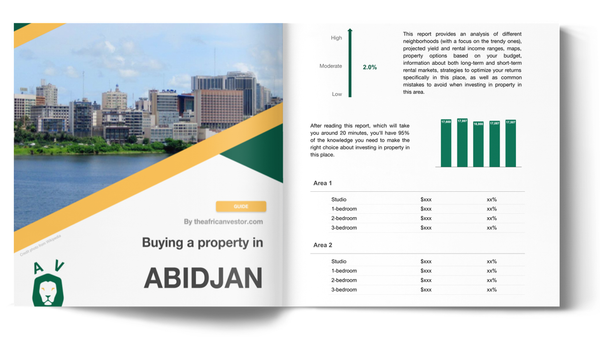
Get all the data you need about the real estate market in Abidjan
This blog post is constantly updated, because house prices in Abidjan in 2026 move quickly between Cocody, Yopougon, Bingerville and the outer suburbs.
We focus only on houses in Abidjan, not apartments, land-only plots or commercial buildings, so foreign buyers can understand the real villa market more easily.
We use official macro, tax and population sources, then we cross-check house prices with visible listings and local asking-price data.
And if you’re planning to buy a property in this place, you may want to download our pack covering the real estate market in Abidjan.
How much do houses cost in Abidjan as of 2026?
What's the median and average house price in Abidjan as of 2026?
As of 2026, the estimated median house price in Abidjan is about 95 million FCFA, or about $166,000 and €145,000, while the estimated average house price in Abidjan is closer to 145 million FCFA, or about $254,000 and €221,000.
For most buyers, the normal house price range in Abidjan in 2026 is roughly 45 million to 260 million FCFA, or about $79,000 to $455,000 and €69,000 to €396,000.
The average house price in Abidjan is higher than the median because large villas in Cocody, Riviera, Marcory Zone 4 and Biétry pull the market upward.
At the median price in Abidjan in 2026, a buyer should expect an older but livable 3-bedroom or compact 4-bedroom house in Yopougon, Port-Bouët, Koumassi, Bingerville, Abatta or outer Angré, not a prime villa in Deux-Plateaux or Riviera Golf.
What's the cheapest livable house budget in Abidjan as of 2026?
As of 2026, the cheapest realistic livable house budget in Abidjan is about 35 million to 45 million FCFA, or about $61,000 to $79,000 and €53,000 to €69,000.
At this entry price, livable usually means an older house with basic walls, roof, electricity, water access and simple finishes, but often with renovation needs and weaker road access.
These cheapest livable houses in Abidjan are usually found in Abobo, Anyama, outer Yopougon, Songon, Port-Bouët back areas and some older parts of Koumassi or Attécoubé.
Because these areas are cheaper, buyers should spend extra time checking the ACD, the cadastral plan, flooding exposure and whether the road is usable during the rainy season.
How much do 2 and 3-bedroom houses cost in Abidjan as of 2026?
As of 2026, a 2-bedroom house in Abidjan usually costs 45 million to 85 million FCFA, or about $79,000 to $149,000 and €69,000 to €130,000, while a 3-bedroom house usually costs 65 million to 150 million FCFA, or about $114,000 to $263,000 and €99,000 to €229,000.
A realistic 2-bedroom house range in Abidjan in 2026 is 35 million to 55 million FCFA in cheaper areas and 70 million to 120 million FCFA in better-connected districts.
A realistic 3-bedroom house range in Abidjan in 2026 is 50 million to 90 million FCFA in Abobo, Anyama, outer Yopougon or Port-Bouët, and 90 million to 180 million FCFA in Angré, Abatta, Riviera fringes or Bingerville.
Moving from a 2-bedroom house to a 3-bedroom house in Abidjan often adds 20 million to 60 million FCFA, because the buyer usually pays for more land, parking and a more family-friendly layout.
How much do 4-bedroom houses cost in Abidjan as of 2026?
As of 2026, a 4-bedroom house in Abidjan usually costs 110 million to 260 million FCFA, or about $193,000 to $455,000 and €168,000 to €396,000.
A 5-bedroom house in Abidjan usually costs 150 million to 380 million FCFA, or about $263,000 to $666,000 and €229,000 to €579,000.
A 6-bedroom house in Abidjan usually costs 220 million to 600 million FCFA, or about $386,000 to $1.05 million and €335,000 to €915,000.
Please note that we give much more detailed data in our pack about the property market in Abidjan.
How much do new-build houses cost in Abidjan as of 2026?
As of 2026, a new-build house in Abidjan usually costs 55 million to 130 million FCFA in outer projects, 110 million to 250 million FCFA in Angré, Abatta or Riviera fringes, and 220 million to 500 million FCFA in prime Cocody or Marcory areas.
New-build houses in Abidjan usually cost 15% to 30% more than older resale houses in the same area, especially when the house has clean title, paved access, parking, water storage and modern finishing.
How much do houses with land cost in Abidjan as of 2026?
As of 2026, a house with usable land in Abidjan usually costs 80 million to 250 million FCFA in outer family areas, or about $140,000 to $438,000 and €122,000 to €381,000, while prime land-heavy villas often cost 250 million to 800 million FCFA.
In Abidjan, a house with land usually means a house on roughly 300 m² to 1,000 m² of plot, with enough space for parking, a garden, extensions, a water tank or a small staff area.
This matters because in Cocody, Riviera, Danga, Deux-Plateaux and Marcory, the plot can be worth as much as the building, especially when the land title is clean.
Thinking of buying real estate in Abidjan?
Acquiring property in a different country is a complex task. Don't fall into common traps – grab our guide and make better decisions.

Where are houses cheapest and most expensive in Abidjan as of 2026?
Which neighborhoods have the lowest house prices in Abidjan as of 2026?
As of 2026, the lowest house prices in Abidjan are usually found in Abobo, Anyama, Songon, outer Yopougon, Port-Bouët back areas and some parts of Attécoubé.
In these cheaper Abidjan neighborhoods, a livable house usually costs 35 million to 130 million FCFA, or about $61,000 to $228,000 and €53,000 to €198,000.
These areas are cheaper because many houses sit farther from the best jobs, schools and paved access roads, and some plots still need careful title or drainage verification.
Which neighborhoods have the highest house prices in Abidjan as of 2026?
As of 2026, the three highest-price house areas in Abidjan are usually Cocody Deux-Plateaux, Riviera Golf and Marcory Zone 4, with Danga, Mermoz, Biétry and Riviera 1 close behind.
In these premium Abidjan neighborhoods, a normal villa often costs 250 million to 900 million FCFA, or about $438,000 to $1.58 million and €381,000 to €1.37 million.
These neighborhoods command high prices because they combine titled land, embassy-style housing, private schools, office access, security expectations and a limited supply of large plots.
The typical buyer in these premium Abidjan areas is a senior local executive, a diaspora family, a business owner, a diplomatic household or an investor seeking a high-standing rental villa.
How much do houses cost near the city center in Abidjan as of 2026?
As of 2026, a house near central Abidjan, meaning Plateau, Cocody Danga, Mermoz, Marcory, Treichville and Adjamé, usually costs 180 million to 600 million FCFA, or about $315,000 to $1.05 million and €274,000 to €915,000.
Near major road and transit hubs in Abidjan, including VGE, Boulevard Mitterrand, the bridges, Marcory access roads and main Yopougon routes, houses usually cost 90 million to 300 million FCFA, or about $158,000 to $526,000 and €137,000 to €457,000.
Near top private and international schools in Abidjan, including Lycée Blaise Pascal, Jean-Mermoz International School, International Community School of Abidjan and Morning Glory International School, family houses often cost 180 million to 650 million FCFA.
In expat-popular parts of Abidjan, including Deux-Plateaux, Danga, Mermoz, Riviera Golf, Riviera 1, Riviera 2, Riviera 3, Zone 4, Biétry and Bonoumin, houses usually cost 180 million to 700 million FCFA.
How much do houses cost in the suburbs in Abidjan as of 2026?
As of 2026, a suburban house in Abidjan usually costs 45 million to 180 million FCFA, or about $79,000 to $315,000 and €69,000 to €274,000.
Suburban houses in Abidjan are often 40% to 70% cheaper than city-center or prime Cocody houses, although the saving can shrink when commute time, road quality and renovation costs are included.
The most popular Abidjan suburbs for house buyers in 2026 are Bingerville, Songon, Anyama, outer Yopougon, Grand-Bassam commuter areas, Abatta and the outer tranches of Angré.
What areas in Abidjan are improving and still affordable as of 2026?
As of 2026, the best improving and still affordable house areas in Abidjan are Bingerville, Songon, Anyama, Abatta, outer Angré, outer Yopougon and Port-Bouët back areas.
In these improving Abidjan areas, a realistic house budget is usually 55 million to 180 million FCFA, or about $96,000 to $315,000 and €84,000 to €274,000.
The main sign of improvement is not just new buildings, but better road access, more structured subdivisions, more family services and growing demand from households priced out of Cocody and Marcory.
Get fresh and reliable information about the market in Abidjan
Don't base significant investment decisions on outdated data. Get updated and accurate information.
What extra costs should I budget for a house in Abidjan right now?
What are typical buyer closing costs for houses in Abidjan right now?
In Abidjan right now, a safe closing-cost budget for a house buyer is usually 9% to 13% of the purchase price.
The main closing costs in Abidjan are registration duty, land-publicity tax, fixed DGI fees, notary costs, file costs and any buyer-paid agency fee, so a 100 million FCFA house can easily need 9 million to 13 million FCFA extra.
The largest official closing-cost item for most house buyers in Abidjan is the registration duty, while the largest negotiable item is usually the agency fee if the buyer has to pay it.
We cover all these costs and the strategies to minimize them in our property pack about Abidjan.
How much are property taxes on houses in Abidjan right now?
For a normal owner-occupied house in Abidjan right now, a practical annual property-tax budget is about 300,000 to 2.5 million FCFA, or about $525 to $4,380 and €460 to €3,810, depending on the house value and assessment.
Property tax on houses in Abidjan is generally linked to the tax authority’s assessment of the property and its rental value, so two houses with the same purchase price can receive different bills.
How much is home insurance for a house in Abidjan right now?
Home insurance for a normal house in Abidjan right now usually costs 150,000 to 600,000 FCFA per year, or about $260 to $1,050 and €230 to €915.
Premiums rise when the Abidjan house is larger, has expensive contents, uses a generator, has a pool, sits in a flood-sensitive area or needs stronger security cover.
What are typical utility costs for a house in Abidjan right now?
For a normal family house in Abidjan right now, typical monthly utilities usually cost 120,000 to 300,000 FCFA, or about $210 to $525 and €180 to €460.
A simple monthly utility breakdown in Abidjan is 50,000 to 180,000 FCFA for electricity, 15,000 to 50,000 FCFA for water, from about 15,000 FCFA for fibre internet, and 30,000 to 120,000 FCFA for security, gardening, garbage and small maintenance.
What are common hidden costs when buying a house in Abidjan right now?
House buyers in Abidjan often overlook 5 million to 40 million FCFA in hidden costs, or about $8,800 to $70,000 and €7,600 to €61,000, depending on the age, title and condition of the house.
Typical inspection fees in Abidjan are 500,000 to 2 million FCFA, or about $875 to $3,500 and €760 to €3,050, when a buyer pays for legal review, cadastral checks and technical inspections.
Other common hidden costs in Abidjan include title clean-up, unpaid property tax, boundary disputes, electrical rewiring, flood remediation, repainting, roof repairs, generator installation, water storage and security upgrades.
The hidden cost that surprises first-time house buyers in Abidjan most is usually title or document clean-up, because a cheap house can become expensive if the ACD, cadastral plan or seller authority is unclear.
Get to know the market before buying a property in Abidjan
Better information leads to better decisions. Get all the data you need before investing a large amount of money.
What do locals and expats say about the market in Abidjan as of 2026?
Do people think houses are overpriced in Abidjan as of 2026?
As of 2026, many locals and expats think houses in central Abidjan and prime Cocody are overpriced, while they see Bingerville, Songon, Abatta and outer Angré as more reasonable.
A well-priced normal house in Abidjan often sells within 2 to 6 months, while expensive villas above 300 million FCFA can stay on the market for 6 to 18 months if the price is too ambitious.
The main reason people call Abidjan houses expensive is that formal titled land in good areas is scarce, while diaspora buyers, high-income households and expat renters all chase the same limited villa stock.
Compared with one or two years ago, sentiment in Abidjan is more selective in 2026, because buyers still accept high prices for clean, well-located houses but push back harder on old villas needing heavy renovation.
Are prices still rising or cooling in Abidjan as of 2026?
As of 2026, house prices in Abidjan are still rising in good family areas, but the luxury villa market is more selective and slower than the broader market.
Our estimate is that well-located Abidjan houses are up about 5% to 9% year over year, improving suburban pockets are up about 10% to 15%, and overpriced luxury villas are closer to flat or up only 3%.
For the next 6 to 12 months, locals and market professionals expect Abidjan house prices to keep rising fastest in Bingerville, Abatta, outer Angré and Songon, while very expensive older villas should need sharper pricing to sell.
Don't lose money on your property in Abidjan
100% of people who have lost money there have spent less than 1 hour researching the market. We have reviewed everything there is to know. Grab our guide now.

What sources have we used to write this blog article?
Whether it’s in our blog articles or the market analyses included in our property pack about Abidjan, we always rely on the strongest methodology we can … and we don’t throw out numbers at random.
We also aim to be fully transparent, so below we’ve listed the authoritative sources we used, and explained how we used them and the methods behind our estimates.
| Source | Why this source matters | How we used it |
|---|---|---|
| IvoireDomi Abidjan price index | It gives June 2026 asking-price benchmarks by city and property type. | We used it as the main house-price benchmark for Abidjan in 2026. We cross-checked it with visible listings and did not use it alone. |
| IvoireDomi Cocody houses and villas | It shows visible villa prices in Abidjan’s main premium commune. | We used it to price Cocody, Riviera, Angré and Deux-Plateaux houses. We used bedroom counts and listing prices to calibrate family-villa budgets. |
| Direction Générale des Impôts | It is Côte d’Ivoire’s official tax administration. | We used it for transfer formalities and official tax context. We treated DGI information as the hard source for closing-cost tax items. |
| DGI registration cost schedule | It lists official costs for property registration acts. | We used it to frame registration duties and fixed administrative charges. We kept agency and notary costs separate from official taxes. |
| IMF Côte d’Ivoire country page | The IMF is a standard source for macroeconomic projections. | We used it for 2026 growth and inflation context. We did not use IMF data to set house prices directly. |
| BCEAO indicators and interest rates | BCEAO is the central bank for the WAEMU currency area. | We used it for inflation, currency and interest-rate context. We used the currency figures to make simple USD and EUR conversions. |
| ANSTAT Côte d’Ivoire | It is the national statistics agency. | We used it for official population and inflation-publication context. We avoided relying only on broker commentary for demographic pressure. |
| RGPH 2021 census dataset | It is the official population census dataset. | We used it to ground Abidjan’s population base. We combined it with later sources to interpret 2026 housing pressure. |
| UN-Habitat Côte d’Ivoire country brief | UN-Habitat is a recognized urban-housing source. | We used it for density and urban-pressure context in Abidjan. We did not use it as a price source. |
| Le Monde Abidjan housing article | It reports concrete housing pressure and local market constraints. | We used it to understand affordability pressure and suburban spillover. We treated it as qualitative context, not a price index. |
| Orange Côte d’Ivoire | It is a major telecom operator’s official website. | We used it as the public fibre-internet cost anchor. We combined it with villa utility norms for household budget estimates. |
| Properstar Abidjan homes | It gives visible international listing examples. | We used it as a secondary check on asking-price ranges. We gave more weight to local Abidjan sources for neighborhood pricing. |
Buying real estate in Abidjan can be risky
An increasing number of foreign investors are showing interest. However, 90% of them will make mistakes. Avoid the pitfalls with our comprehensive guide.
