
Authored by the expert who managed and guided the team behind the Ivory Coast Property Pack
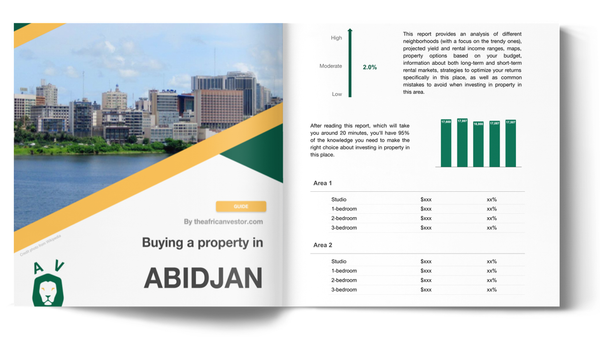
Get all the data you need about the real estate market in Abidjan
This article is constantly updated so foreign buyers can understand the current property rules in Abidjan without reading legal texts for hours.
As of June 2026, foreigners can buy most residential property types in Abidjan, but the safety of the purchase depends much more on title quality than nationality.
That is why this guide focuses on what a normal individual can buy, what documents matter, what visas change, and what fees usually appear in Abidjan in 2026.
And if you’re planning to buy a property in this place, you may want to download our pack covering the real estate market in Abidjan.
What can I legally buy and truly own as a foreigner in Abidjan?
What property types can foreigners legally buy in Abidjan right now?
Foreigners can legally buy mainstream residential property in Abidjan, including apartments, villas, duplexes, townhouses, detached houses, and titled residential plots meant for housing.
The main condition in Abidjan is not a special foreigner quota, but a clean formal title, a notarized sale, and registration through the land and mortgage registry.
In practical terms, a foreign buyer looking at Cocody, Marcory, Zone 4, Deux Plateaux, Angré, Bingerville, or Plateau should care less about the marketing label and more about the title document behind the home.
For apartments, the safest reading is that you are buying a specific apartment lot in a registered building, while for houses and villas the key check is whether the building sits on the titled parcel being sold.
Finally, please note that our pack about the property market in Abidjan is specifically tailored to foreigners.
Can I own land in my own name in Abidjan right now?
Yes, a foreigner can own urban residential land in their own name in Abidjan when the land is inside the formal urban land system and the transfer is properly registered.
That does not mean every piece of land marketed around Abidjan is safe, because informal village land, family land, and unfinished ACD files can still create serious problems for a foreign buyer.
The clean target is land where the notary can verify the registered owner, the parcel number, the urban status, the boundaries, and the absence of mortgages or disputes before the buyer pays the main price.
As of 2026, what other key foreign-ownership rules or limits should I know in Abidjan?
As of 2026, the key Abidjan rules that usually affect foreigners are identity checks, tax registration, title verification, notarization, payment traceability, and land registry completion.
There is no general foreign ownership quota like 49% for ordinary apartments or condo-style residential buildings in Abidjan, although a building’s own co-ownership rules still need checking.
The main registration requirement is that the sale must be handled through the formal transfer process, with the notary submitting the file to the Conservation de la Propriété Foncière et des Hypothèques.
The notable recent legal point for 2026 is that Côte d’Ivoire’s urban land framework was modernized by the 2020 code and later amendments, so buyers should rely on current urban land rules rather than old agent habits.
What’s the biggest ownership mistake foreigners make in Abidjan right now?
The biggest mistake foreigners make in Abidjan is paying a deposit or full price before an independent notary confirms exactly what title the seller holds.
The real consequence can be painful, because the buyer may end up with only a private promise, a blocked transfer, a disputed parcel, or a property already pledged to a bank.
Other classic Abidjan pitfalls include relying on WhatsApp copies, ignoring unpaid service charges, buying land with unclear ACD history, and treating an agent’s confidence as legal proof.
Get fresh and reliable information about the market in Abidjan
Don't base significant investment decisions on outdated data. Get updated and accurate information.

Which visa or residency status changes what I can do in Abidjan?
Do I need a specific visa to buy property in Abidjan right now?
As of June 2026, you do not need a special property-buyer visa to buy residential property in Abidjan, and a foreigner can start a purchase while visiting on a tourist or business visa.
The most common non-property issue that can block a non-resident buyer in Abidjan is banking and compliance, because the notary or bank may ask for clear proof of identity, funds, address, and marital status.
You should expect to need a Côte d’Ivoire tax identifier, commonly called an NCC, either before the final deed or during the notary’s transfer workflow.
A typical foreign buyer file in Abidjan includes a passport, visa or entry evidence, address proof, marital status documents, proof of funds, bank details, tax registration details, and translated or legalized documents when needed.
Does buying property help me get residency and citizenship in Abidjan in 2026?
As of 2026, buying property in Abidjan does not automatically give a foreigner Côte d’Ivoire residency, permanent residency, or citizenship.
Côte d’Ivoire does not operate a simple real estate golden visa where a residential purchase in Abidjan directly creates a residence right.
Other residence routes usually depend on staying legally under a recognized basis, such as work, business activity, family links, investment activity, or long-term residence, while citizenship is a separate legal process.
Can I legally rent out property on my visa in Abidjan right now?
Your visa status does not usually stop you from owning and renting out a residential property in Abidjan, but it can affect whether you can personally manage the rental activity on the ground.
You do not need to live in Côte d’Ivoire to rent out a property in Abidjan, but a non-resident owner should normally use a local manager, written lease, tax file, and traceable rent payments.
The details matter because long-term rental income is treated differently from hands-on short-stay hospitality, especially if the owner is frequently in Abidjan negotiating tenants, hiring staff, or running serviced accommodation.
Get to know the market before buying a property in Abidjan
Better information leads to better decisions. Get all the data you need before investing a large amount of money.
How does the buying process actually work step-by-step in Abidjan?
What are the exact steps to buy property in Abidjan right now?
The standard Abidjan process is to choose the property, request the title documents, appoint a notary, verify the seller and title, sign the deed, pay duties and fees, file the transfer, and collect the final registry proof.
You do not always need to be physically present for every step in Abidjan, because a properly drafted and legalized power of attorney can often let a representative sign or complete formalities.
The step that usually makes the deal legally serious is the authenticated sale deed before the notary, especially once the price, duties, and registration file are moving together.
For a clean residential file in Abidjan, a practical timeline is often one to three months from accepted offer to final registration, while land, mortgage, or dispute checks can take longer.
We have a document entirely dedicated to the whole buying process our pack about properties in Abidjan.
Is it mandatory to get a lawyer or a notary to buy a property in Abidjan right now?
A notary is practically essential for a safe property purchase in Abidjan, while a lawyer is strongly recommended for land, off-plan property, developer contracts, inheritance files, or high-value villas.
The notary prepares and registers the formal deed, while the lawyer protects the buyer’s position in negotiation, risk review, contract wording, and dispute handling.
The engagement scope should clearly require direct registry checks, seller identity verification, mortgage and lien checks, tax status review, and written confirmation of the exact document the buyer will receive.
Make a profitable investment in Abidjan
Better information leads to better decisions. Save time and money. Download our data.
What checks should I run so I don’t buy a problem property in Abidjan?
How do I verify title and ownership history in Abidjan right now?
The official title check in Abidjan should go through the Conservation de la Propriété Foncière et des Hypothèques, usually handled by the notary rather than by the buyer alone.
The key proof to request after completion is the Certificat de Mutation de la Propriété Foncière or another official updated registry document showing the buyer as owner.
A realistic look-back in Abidjan is to review the current registered owner and the chain of transfers behind the file, with deeper checks when land came from family, customary, subdivision, or developer history.
A red flag that should pause the purchase is any mismatch between the seller’s name, parcel number, surface area, building description, and the property the buyer actually visited.
How do I confirm there are no liens in Abidjan right now?
The standard way to confirm there are no liens in Abidjan is for the notary to request an état foncier or equivalent registry search before final payment.
The common encumbrance to ask about is a mortgage registered for a bank loan, especially on higher-value apartments and villas in Cocody, Riviera, Zone 4, and Marcory.
The best written proof is a recent land-registry certificate or search result showing current ownership and registered mortgages, seizures, restrictions, or other charges.
How do I check zoning and permitted use in Abidjan right now?
Zoning and permitted use in Abidjan should be checked against urban planning records and the formal urban land framework, with help from the notary, lawyer, or competent planning office.
The useful evidence is usually the urban planning classification, subdivision approval, building permit history, or plan reference confirming that the parcel can legally be used for housing.
The pitfall foreigners miss in Abidjan is buying land that looks residential on the ground but sits in a risky area affected by drainage, road widening, informal occupation, lagoon-edge constraints, or unclear subdivision approval.
Don't buy the wrong property, in the wrong area of Abidjan
Buying real estate is a significant investment. Don't rely solely on your intuition. Gather the right information to make the best decision.
Can I get a mortgage as a foreigner in Abidjan, and on what terms?
Do banks lend to foreigners for homes in Abidjan in 2026?
As of 2026, banks in Abidjan can lend to foreigners for residential property, but approval is selective and strongest for borrowers with stable income, clear documents, and a clean titled property.
A realistic foreign-buyer loan-to-value range in Abidjan is about 50% to 70%, with non-residents often pushed toward the lower end or asked for a larger cash contribution.
The requirement that matters most is income quality, because banks want salary, business income, or diaspora income they can verify and enforce against if the loan becomes difficult.
Which banks are most foreigner-friendly in Abidjan in 2026?
As of 2026, the three practical first calls for many foreign mortgage buyers in Abidjan are Société Générale Côte d’Ivoire, NSIA Banque, and Bank of Africa Côte d’Ivoire.
These banks are more practical for foreigners because they have visible retail mortgage capacity, stronger compliance teams, and more experience with documented salaried, business, or diaspora clients.
They may lend to non-residents, but a non-resident buyer should expect heavier paperwork, lower leverage, more cash upfront, and a stronger need for traceable income and funds.
We actually have a specific document about how to get a mortgage as a foreigner in our pack covering real estate in Abidjan.
What mortgage rates are foreigners offered in Abidjan in 2026?
As of 2026, many foreign buyers in Abidjan should model residential mortgage rates around 8% to 11% per year, with the strongest local-style files sometimes closer to 7% or 8%.
Fixed-rate loans tend to feel safer but can price slightly higher or come with stricter conditions, while variable or revisable pricing may start lower but leaves the borrower exposed to future rate changes.
Get fresh and reliable information about the market in Abidjan
Don't base significant investment decisions on outdated data. Get updated and accurate information.
What will taxes, fees, and ongoing costs look like in Abidjan?
What are the total closing costs as a percent in Abidjan in 2026?
In 2026, a foreign buyer should usually budget about 8% to 10% of the purchase price for total closing costs on a standard residential purchase in Abidjan.
A realistic low-to-high range for most clean transactions in Abidjan is about 7% to 11%, while financed purchases, land files, and messy title histories can move closer to 12%.
The usual fee categories are registration duties, land-publicity fees, notary costs, administrative file costs, tax clearance items, bank fees, mortgage-registration costs, translations, and legal advice.
The largest single item is usually the property-sale registration duty, because DGI schedules commonly place property sale registration around 4% or 3% depending on the seller’s status.
What annual property tax should I budget in Abidjan in 2026?
As of 2026, a simple owner-occupied home in Abidjan might often require a practical annual property-tax reserve of about 150,000 to 900,000 XOF, which is roughly 250 to 1,500 USD or 230 to 1,400 EUR.
Annual property tax in Abidjan is mainly assessed through rental value and property category, with different treatment for owner-occupied homes, rented built property, companies, and undeveloped urban land.
How is rental income taxed for foreigners in Abidjan in 2026?
As of 2026, a foreign individual renting out residential property in Abidjan should often reserve about 12% of annual gross rent for property and rental-related taxes before management, repairs, and vacancy.
The owner or local manager usually needs to declare the property, keep written lease documents, register or document rental arrangements where required, and pay DGI tax obligations on Côte d’Ivoire-source rent.
What insurance is common and how much in Abidjan in 2026?
As of 2026, a standard home insurance policy in Abidjan often costs about 25,000 to 400,000 XOF per year for many apartments and small villas, roughly 40 to 660 USD or 35 to 610 EUR.
The most common cover is multirisque habitation, which usually groups fire, water damage, theft, civil liability, and building or contents protection depending on the contract.
The biggest factor behind the premium in Abidjan is the insured value and risk profile of the home, with higher premiums for large villas, valuable contents, theft exposure, and flood-sensitive locations.
Get to know the market before buying a property in Abidjan
Better information leads to better decisions. Get all the data you need before investing a large amount of money.
What sources have we used to write this blog article?
Whether it’s in our blog articles or the market analyses included in our property pack about Abidjan, we always rely on the strongest methodology we can … and we don’t throw out numbers at random.
We also aim to be fully transparent, so below we’ve listed the authoritative sources we used, and explained how we used them and the methods behind our estimates.
| Source | Why we trust it | How we used it |
|---|---|---|
| Côte d’Ivoire Urban Planning and Urban Land Code | It is the core legal framework for urban land in Côte d’Ivoire. | We used it to define formal urban land in Abidjan. We also used it to avoid mixing urban residential purchases with rural or customary land issues. |
| DGI official urban land code PDF | It is published by the tax authority involved in property transfer formalities. | We used it to cross-check the urban land code from an official Ivorian source. We also used it to identify the administrative framework behind formal title. |
| DGI mutation immobilière procedure | It explains the official real-estate transfer process in practical terms. | We used it to explain what happens after a buyer and seller agree. We also used it to describe the notary’s role in the transfer file. |
| DGI other real estate procedures | It names practical registry certificates used in property files. | We used it for documents such as état foncier and Certificat de Mutation de la Propriété Foncière. We also used it for lien and ownership proof checks. |
| DGI list of land-registry acts | It lists documents issued by land and mortgage registry services. | We used it to identify the formal certificates buyers should request. We also used it to explain why registry proof matters more than private papers. |
| DGI registration fee schedule | It gives official registration charges for property sales and leases. | We used it to estimate the largest closing-cost item. We also used it to explain why closing costs in Abidjan often reach high single digits. |
| DGI land-publicity fee schedule | It shows official charges for registry and mortgage-publicity acts. | We used it to estimate the extra registry cost layer. We also used it to explain why financed purchases can cost more. |
| DGI property-tax brochure | It explains property-tax obligations and declaration rules for owners. | We used it to estimate annual property-tax exposure. We also used it to separate rented, owner-occupied, built, and non-built property cases. |
| Service Public Côte d’Ivoire property-tax page | It is the government public-service portal for citizen-facing procedures. | We used it to cross-check property-tax rates and taxable base language. We also used it to make the tax explanation easier for non-specialists. |
| DGI official tax code portal | It is the official online tax code for Côte d’Ivoire. | We used it for tax categories and current tax-code structure. We also used it to support the rental-income and property-tax sections. |
| SNEDAI official e-visa portal | It is the official channel for Côte d’Ivoire e-visa information. | We used it to separate entry permission from property ownership rights. We also used it to explain why a tourist visa is not a residence right. |
| ONECI resident-card portal | ONECI is the authority for resident cards for non-ECOWAS foreigners. | We used it to explain that residence status is handled separately from property purchase. We also used it to check whether a property purchase creates automatic residency. |
| BCEAO conditions de banque | BCEAO is the central bank for the WAEMU banking system. | We used it as the macro anchor for lending conditions in Côte d’Ivoire. We also compared it with bank-level mortgage and tariff information. |
| World Bank Doing Business Côte d’Ivoire profile | It gives standardized property-registration benchmarks, even though the series is discontinued. | We used it only as a historical process benchmark. We did not use it as a 2026 legal source. |
Make a profitable investment in Abidjan
Better information leads to better decisions. Save time and money. Download our data.
