
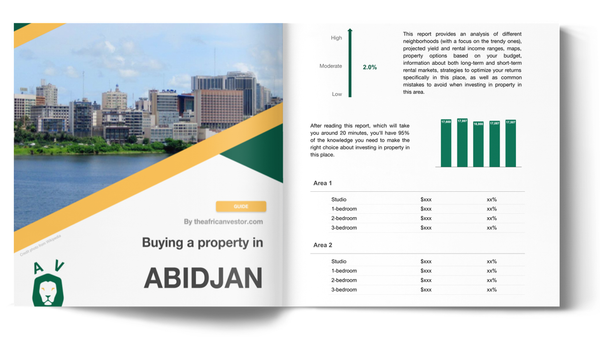
Get all the data you need about the real estate market in Abidjan
SUMMARY
We analyzed residential property rental yields in Abidjan as of 2026 for residential property buyers, using the raw dataset provided as the factual base and interpreting it through a practical foreign-buyer lens.
The dataset compares estimated purchase prices, monthly rents, gross rental yields, and net rental yields across Abidjan neighborhoods for 1-bedroom, 2-bedroom, and 3-bedroom residential properties.
We conduct this research every month and update this page regularly, so the figures should be read as a current Abidjan residential property yield snapshot for May 2026.
The strongest balanced income market in the dataset is Marcory Zone 4 / Biétry, where estimated net yields reach 6.1% for 1-bedroom properties, 6.2% for 2-bedroom properties, and 6.1% for 3-bedroom properties.
Treichville, Koumassi, Plateau, Deux Plateaux / Vallon, and Yopougon also show attractive yield signals, but the risk profile changes sharply by building quality, tenant depth, access, and resale liquidity.
The main practical finding is that 2-bedroom apartments often give the best balance between rental income, purchase price, tenant depth, maintenance burden, and resale potential in the Abidjan residential property market.
Large 3-bedroom properties and villas can earn high monthly rents in areas such as Riviera Golf / Riviera 3, Marcory Zone 4 / Biétry, Cocody Centre, and Deux Plateaux / Vallon, but heavier repairs, security, generator costs, vacancy risk, and management friction can reduce the real net return.
The weakest beginner-investor profile is usually found in locations where the headline yield looks acceptable but liquidity, documentation, building quality, or tenant budgets are weaker, especially Abobo, Anyama, and poor-access pockets of Yopougon or Port-Bouët.
For a foreign individual buyer, the safest Abidjan rental-yield strategy is not to chase the cheapest property. The better approach is to compare net yield, access, tenant depth, title quality, operating costs, building condition, and resale liquidity together.
Get fresh and reliable information about the market in Abidjan
Don't base significant investment decisions on outdated data. Get updated and accurate information.

Residential property rental yields in Abidjan in 2026
This table compares residential property rental yields in Abidjan by neighborhood and bedroom count.
For each area, the table shows estimated purchase price, estimated monthly rent, gross rental yield, and net rental yield for 1-bedroom, 2-bedroom, and 3-bedroom residential property.
Finally, please note you'll find much more detailed data in our real estate pack about Abidjan.
| Neighborhood | 1-bedroom property average purchase price | 1-bedroom property average monthly rent | 1-bedroom property gross rental yield | 1-bedroom property net rental yield | 2-bedroom property average purchase price | 2-bedroom property average monthly rent | 2-bedroom property gross rental yield | 2-bedroom property net rental yield | 3-bedroom property average purchase price | 3-bedroom property average monthly rent | 3-bedroom property gross rental yield | 3-bedroom property net rental yield |
|---|---|---|---|---|---|---|---|---|---|---|---|---|
| Abobo | 18,000,000 FCFA | 100,000 FCFA | 6.7% | 4.8% | 30,000,000 FCFA | 180,000 FCFA | 7.2% | 5.2% | 45,000,000 FCFA | 250,000 FCFA | 6.7% | 4.8% |
| Angré | 42,000,000 FCFA | 250,000 FCFA | 7.1% | 5.4% | 68,000,000 FCFA | 380,000 FCFA | 6.7% | 5.0% | 95,000,000 FCFA | 520,000 FCFA | 6.6% | 4.9% |
| Anyama | 20,000,000 FCFA | 110,000 FCFA | 6.6% | 4.7% | 32,000,000 FCFA | 180,000 FCFA | 6.8% | 4.8% | 50,000,000 FCFA | 260,000 FCFA | 6.2% | 4.4% |
| Bingerville | 35,000,000 FCFA | 200,000 FCFA | 6.9% | 4.8% | 58,000,000 FCFA | 330,000 FCFA | 6.8% | 4.8% | 95,000,000 FCFA | 500,000 FCFA | 6.3% | 4.4% |
| Cocody Centre | 58,000,000 FCFA | 330,000 FCFA | 6.8% | 5.0% | 95,000,000 FCFA | 520,000 FCFA | 6.6% | 4.8% | 150,000,000 FCFA | 850,000 FCFA | 6.8% | 5.0% |
| Deux Plateaux / Vallon | 55,000,000 FCFA | 350,000 FCFA | 7.6% | 5.6% | 90,000,000 FCFA | 600,000 FCFA | 8.0% | 5.8% | 140,000,000 FCFA | 950,000 FCFA | 8.1% | 5.9% |
| Koumassi | 28,000,000 FCFA | 180,000 FCFA | 7.7% | 5.7% | 45,000,000 FCFA | 300,000 FCFA | 8.0% | 5.9% | 70,000,000 FCFA | 430,000 FCFA | 7.4% | 5.5% |
| Marcory Zone 4 / Biétry | 62,000,000 FCFA | 450,000 FCFA | 8.7% | 6.1% | 105,000,000 FCFA | 780,000 FCFA | 8.9% | 6.2% | 165,000,000 FCFA | 1,200,000 FCFA | 8.7% | 6.1% |
| Plateau | 65,000,000 FCFA | 420,000 FCFA | 7.8% | 5.8% | 110,000,000 FCFA | 720,000 FCFA | 7.9% | 5.9% | 160,000,000 FCFA | 1,050,000 FCFA | 7.9% | 5.9% |
| Port-Bouët | 30,000,000 FCFA | 180,000 FCFA | 7.2% | 5.2% | 48,000,000 FCFA | 300,000 FCFA | 7.5% | 5.4% | 78,000,000 FCFA | 480,000 FCFA | 7.4% | 5.3% |
| Riviera Golf / Riviera 3 | 70,000,000 FCFA | 500,000 FCFA | 8.6% | 5.7% | 120,000,000 FCFA | 850,000 FCFA | 8.5% | 5.6% | 210,000,000 FCFA | 1,600,000 FCFA | 9.1% | 6.0% |
| Riviera Palmeraie / M’Badon | 44,000,000 FCFA | 280,000 FCFA | 7.6% | 5.4% | 72,000,000 FCFA | 450,000 FCFA | 7.5% | 5.3% | 120,000,000 FCFA | 750,000 FCFA | 7.5% | 5.3% |
| Treichville | 32,000,000 FCFA | 220,000 FCFA | 8.3% | 6.1% | 52,000,000 FCFA | 350,000 FCFA | 8.1% | 6.0% | 80,000,000 FCFA | 520,000 FCFA | 7.8% | 5.8% |
| Yopougon | 24,000,000 FCFA | 150,000 FCFA | 7.5% | 5.5% | 38,000,000 FCFA | 250,000 FCFA | 7.9% | 5.8% | 58,000,000 FCFA | 350,000 FCFA | 7.2% | 5.3% |
Make a profitable investment in Abidjan
Better information leads to better decisions. Save time and money. Download our data.
Which neighborhoods offer the best net yield among areas people actually want to live in Abidjan?
The best net-yield neighborhoods among areas people actually want to live in Abidjan are Marcory Zone 4 / Biétry, Deux Plateaux / Vallon, Treichville, Plateau, and Riviera Golf / Riviera 3.
These areas combine above-average estimated net yields with real tenant depth, lifestyle appeal, central access, and better resale liquidity than purely cheap areas.
Marcory Zone 4 / Biétry is the strongest balanced performer in the dataset. Its estimated net yields are 6.1% for 1-bedroom, 6.2% for 2-bedroom, and 6.1% for 3-bedroom residential property, supported by monthly rents of 450,000 FCFA, 780,000 FCFA, and 1.2 million FCFA.
Deux Plateaux / Vallon is the safer premium-yield option. Its estimated net yield reaches 5.8% for 2-bedroom property and 5.9% for 3-bedroom property, while still benefiting from Cocody’s schools, embassies, security perception, and family demand.
Treichville and Plateau also produce strong net yields near 5.8% to 6.1%, but the investor must be stricter on building condition, parking, security, and utilities. For a beginner, the best risk-adjusted choice is usually a modern 2-bedroom apartment in Marcory Zone 4 / Biétry or Deux Plateaux / Vallon.
Where can I find residential properties with above-average yields and below-average entry prices in Abidjan?
The clearest Abidjan neighborhoods with above-average yields and below-average entry prices are Koumassi, Treichville, Yopougon, and Port-Bouët.
These areas are cheaper than Cocody, Marcory, Riviera Golf, and Plateau, but rents are still strong enough to support estimated net yields around 5.3% to 6.1%.
Koumassi is the best value case in the table. A 2-bedroom property is estimated at 45 million FCFA, with rent around 300,000 FCFA per month, giving 8.0% gross yield and 5.9% net yield.
Treichville is also compelling because its central access supports rent without requiring Marcory-level purchase prices. A 1-bedroom at 32 million FCFA and 220,000 FCFA monthly rent produces an estimated 8.3% gross yield and 6.1% net yield.
Yopougon is cheaper still, with a 2-bedroom property estimated at 38 million FCFA and 250,000 FCFA monthly rent. The practical trade-off is that Yopougon has huge population depth, but foreign-buyer resale liquidity can be thinner than in Cocody, Marcory, or central neighborhoods.
Where does the rent level justify the purchase price most clearly in Abidjan?
The rent level most clearly justifies the purchase price in Marcory Zone 4 / Biétry, Treichville, Koumassi, and Deux Plateaux / Vallon.
These areas show a rational rent-to-price relationship because tenants pay meaningful rents for access, lifestyle, convenience, and practical commute value.
Marcory Zone 4 / Biétry is the clearest example. A 2-bedroom property is estimated at 105 million FCFA with 780,000 FCFA monthly rent, giving 8.9% gross yield and 6.2% net yield.
Treichville is the lower-price version of the same logic. A 2-bedroom property is estimated at 52 million FCFA with 350,000 FCFA monthly rent, producing about 8.1% gross yield and 6.0% net yield.
Deux Plateaux / Vallon is expensive, but the rent is still credible. A 3-bedroom property at 140 million FCFA with monthly rent around 950,000 FCFA gives 8.1% gross yield and 5.9% net yield.
We have actually built the our real estate pack about Abidjan to make sure you won’t buy in the wrong area. Check it out.
Get to know the market before buying a property in Abidjan
Better information leads to better decisions. Get all the data you need before investing a large amount of money.
Where is the best place to buy if I want stable rental income rather than maximum yield in Abidjan?
The best neighborhoods for stable rental income rather than maximum yield in Abidjan are Deux Plateaux / Vallon, Cocody Centre, Riviera Palmeraie / M’Badon, and Marcory Zone 4 / Biétry.
These areas are not always the cheapest, but they have deeper tenant pools and better resale confidence than purely yield-led locations.
Deux Plateaux / Vallon is the strongest stability choice. Estimated net yields of 5.6% to 5.9% are high enough, while tenant demand is supported by schools, embassies, clinics, offices, family renters, and Cocody’s safety perception.
Cocody Centre is less spectacular but safer. Its estimated net yields are around 4.8% to 5.0%, with rents from 330,000 FCFA for 1-bedroom property to 850,000 FCFA for 3-bedroom property.
Marcory Zone 4 / Biétry gives higher income, with net yields around 6.1% to 6.2%, but part of the rent base is linked to expats, corporate tenants, and short-stay or relocation demand. The honest trade-off is simple: Cocody is steadier, while Marcory is more profitable.
What type of residential property should a beginner investor buy to maximize rental profitability in Abidjan?
A beginner investor in Abidjan should usually buy a modern 2-bedroom apartment in a deep rental area.
This property type gives the best balance between entry price, rent, tenant depth, maintenance burden, and resale liquidity in the Abidjan residential property market.
The numbers support this. Two-bedroom properties produce estimated net yields of 6.2% in Marcory Zone 4 / Biétry, 6.0% in Treichville, 5.9% in Koumassi, 5.8% in Deux Plateaux / Vallon, and 5.8% in Yopougon.
A 1-bedroom property can work well in Marcory, Plateau, Treichville, Angré, and Riviera Palmeraie. It has a lower purchase price, but smaller units can also have more frequent tenant turnover and more leasing friction.
A 3-bedroom property works best where family or corporate demand is real, such as Deux Plateaux, Cocody, Riviera Golf, Marcory, and selected Bingerville family zones. For a beginner, the cleanest answer is to buy a 2-bedroom apartment, not a villa, unless the buyer already understands Abidjan maintenance and tenant management.
We give you more details in the our real estate pack about Abidjan.
Which neighborhoods offer strong rental income with the lowest vacancy risk in Abidjan?
The neighborhoods that combine strong rental income with lower vacancy risk in Abidjan are Deux Plateaux / Vallon, Cocody Centre, Marcory Zone 4 / Biétry, Riviera Palmeraie / M’Badon, and Angré.
These areas have stronger tenant depth because they offer a practical mix of access, lifestyle, security perception, schools, offices, and daily services.
Deux Plateaux / Vallon has the best mix. Its 2-bedroom rent estimate is 600,000 FCFA per month, with 5.8% net yield, and the tenant base includes families, executives, embassy-adjacent workers, school-oriented renters, and higher-income locals.
Marcory Zone 4 / Biétry has the highest rent level among the balanced areas. A 2-bedroom property rents around 780,000 FCFA per month, with estimated net yield around 6.2%.
Riviera Palmeraie / M’Badon is the practical middle. A 2-bedroom at 72 million FCFA renting for 450,000 FCFA gives 5.3% net yield, with a lower entry price than Riviera Golf and Cocody Centre.
Buying real estate in Abidjan can be risky
An increasing number of foreign investors are showing interest. However, 90% of them will make mistakes. Avoid the pitfalls with our comprehensive guide.

Which areas look overpriced relative to their rental income in Abidjan?
The areas that look most overpriced relative to rental income in Abidjan are Cocody Centre, parts of Riviera Golf / Riviera 3, and older residential stock in Plateau.
These are good places to live, but they are not always the best pure rental-yield investments.
Cocody Centre has high prices and moderate yields. A 2-bedroom property costs about 95 million FCFA and rents for 520,000 FCFA, giving 6.6% gross yield and 4.8% net yield.
Riviera Golf / Riviera 3 can still produce high rents, but purchase prices rise quickly. The table shows a 3-bedroom property at 210 million FCFA with 1.6 million FCFA monthly rent, but net yield falls to 6.0% after heavier ownership costs.
Plateau is expensive because it is the business core, but residential supply is thin and many renters prefer more livable evening-and-weekend neighborhoods. The trade-off is not bad neighborhood versus good neighborhood, but income return versus prestige, liquidity, and capital preservation.
Which neighborhoods should I avoid even if the rental yield looks attractive in Abidjan?
Beginner investors should be cautious with Abobo, Anyama, and low-quality pockets of Yopougon, even when the rental yield looks attractive.
The issue is not only yield. The real issue is vacancy risk, resale liquidity, building quality, tenant depth, and foreign-buyer exit risk.
Abobo shows an estimated 5.2% net yield for 2-bedroom properties, which is not bad. But rent is low at around 180,000 FCFA per month, and the investor depends on a more price-sensitive tenant pool.
Anyama may benefit from the future metro corridor, but the rental case still depends heavily on future infrastructure delivery and local affordability. Its estimated 3-bedroom net yield is only 4.4%, which is not enough to compensate for uncertainty unless the purchase price is very attractive.
Yopougon is more nuanced. It has huge population depth and a 2-bedroom net yield estimate of 5.8%, but a foreign beginner should avoid poor-access, low-quality, or weakly managed buildings because resale and maintenance risk can overwhelm the yield.
Which neighborhoods look risky even though the rental yield is high in Abidjan?
The high-yield but riskier Abidjan neighborhoods are Treichville, Koumassi, Yopougon, Abobo, and Port-Bouët.
They can produce good yields, but the risk-adjusted return depends heavily on building quality, exact street, road access, tenant screening, and maintenance control.
Treichville has an estimated 6.0% to 6.1% net yield, which is excellent. The risk is uneven residential stock, because a renovated apartment with parking, security, and reliable utilities is very different from an older unit without those basics.
Koumassi has a strong 5.9% estimated net yield for 2-bedroom property. Its advantage is spillover from Marcory and airport-side demand, but the wrong street or older building can attract more price-sensitive tenants and higher maintenance costs.
Yopougon’s 5.8% net yield on 2-bedroom property is attractive, but the investor must understand the submarket. A slightly lower yield in Angré, Riviera Palmeraie, or Cocody can be better if tenant replacement is easier and the building is more liquid.
Don't lose money on your property in Abidjan
100% of people who have lost money there have spent less than 1 hour researching the market. We have reviewed everything there is to know. Grab our guide now.
What neighborhoods should I avoid when buying a rental property in Abidjan?
A beginner rental investor in Abidjan should generally avoid Abobo, Anyama, poor-access Yopougon pockets, and weak-quality Port-Bouët stock unless the property is bought at a clear discount and managed locally.
These areas are not impossible investment markets, but they are less forgiving for a foreign individual buyer who may be managing from abroad.
Abobo should be avoided by beginners, not necessarily by all investors. The estimated yields are respectable, but rents are low, tenant budgets are tighter, and foreign-buyer resale liquidity is weak.
Anyama should be approached only with a transport-led strategy. The future metro could improve access, but buying before the rental market matures adds timing risk, especially when the estimated 3-bedroom net yield is only 4.4%.
Port-Bouët is a selection market. The metro route and airport-linked demand may help, but coastal exposure, building quality, security, and road access matter, so weak buildings can easily lose their yield through repairs and vacancy.
Which neighborhoods are seeing rental demand weaken, and why, in Abidjan?
As of May 2026, rental demand appears more fragile in older Plateau stock, some high-priced Riviera villa pockets, poorly connected Yopougon pockets, and lower-quality outer areas such as Anyama before metro benefits fully materialize.
This does not mean demand has collapsed. It means the rental case is becoming more selective when properties are expensive, outdated, poorly located, or dependent on future infrastructure.
Older Plateau stock is the clearest example. Plateau remains Abidjan’s business core, but some residential buildings are old, parking is limited, and many renters prefer Cocody or Marcory after work.
Some Riviera Golf / Riviera 3 villas also face thinner demand because the total monthly rent is high. The table estimates 1.6 million FCFA per month for a 3-bedroom property, which can work for executives or wealthy families but creates a narrower tenant pool.
Outer areas such as Anyama may improve later because of the metro, but investors should not price future accessibility as if it were already fully delivered. In Abidjan, the weakness is usually a mismatch between price, building quality, and tenant depth.
Which neighborhoods are seeing new developments that could create stronger rental demand in Abidjan?
The neighborhoods where new development could strengthen rental demand are Anyama, Abobo, Treichville, Marcory, Port-Bouët, Bingerville, Angré, and Yopougon.
The key question is whether development brings tenants, or only more supply. New transport, roads, schools, clinics, offices, or retail can deepen demand, while too many similar apartments can cap rent growth.
The clearest infrastructure-led corridor is the Abidjan Metro Line 1, which is planned to connect Anyama, Abobo, Adjamé, Plateau, Treichville, Marcory, and Port-Bouët. That matters because transport can change which areas are practical for daily commuting.
Bingerville is a different development story. It can support family rental demand where road access, private schools, and new retail make it a realistic alternative to Cocody, but too many similar houses can pressure rents.
Angré is already a more immediate rental market because universities, clinics, and expanding residential tranches support demand from students, professors, professionals, and middle-income households.
Thinking of buying real estate in Abidjan?
Acquiring property in a different country is a complex task. Don't fall into common traps – grab our guide and make better decisions.
Which neighborhoods are becoming more attractive to renters because of recent infrastructure or transport changes in Abidjan?
The neighborhoods becoming more attractive because of infrastructure and transport changes are Treichville, Marcory, Port-Bouët, Abobo, Anyama, Yopougon, and Bingerville.
Transport matters in Abidjan because congestion can sharply reduce the practical value of a cheaper home.
Treichville and Marcory are direct beneficiaries of the planned metro corridor. If station access improves daily mobility, well-located apartments near transport nodes should become easier to rent.
Port-Bouët may also gain from metro and airport-linked access. The table shows estimated net yields of 5.2% to 5.4%, which are reasonable if vacancy risk falls over time.
Yopougon has already become more attractive in selected submarkets where road and bridge access improves daily commuting. The practical rule is to buy the exact access story, not only the neighborhood name.
Which neighborhoods have become less attractive for property investors over the last 12 months in Abidjan?
The neighborhoods that have become less attractive for yield-focused investors are older Plateau stock, overheated Riviera Golf / Riviera 3 villas, and weak-quality outer-area properties bought on future-infrastructure optimism.
The problem is not that these neighborhoods are bad places to live. The problem is that the balance between purchase price, rent, net yield, tenant depth, operating cost, and resale liquidity has become less forgiving.
Plateau is still prestigious, but it is not automatically attractive for rental yield. If the building is old and the price remains high, rent may not rise enough to justify the capital required.
Riviera Golf / Riviera 3 remains desirable, but the investment case weakens when buyers overpay for large villas. A 3-bedroom property in the table generates 9.1% gross yield, but estimated net yield falls to 6.0% after larger ownership costs.
Some outer-area properties have also become less attractive because investors priced in future growth too early. Anyama’s metro story is real, but the current 3-bedroom net yield estimate is only 4.4%, which is not enough unless the purchase price is low and the location is clearly positioned for future commuter demand.
Which property types are becoming harder to rent in Abidjan, and in which neighborhoods?
The property types becoming harder to rent in Abidjan are large expensive villas in premium Riviera and Cocody pockets, older apartments in Plateau and Treichville, and low-spec apartments in outer or weak-access areas.
Large villas are harder because the monthly rent is high and the tenant pool is narrow. In Riviera Golf / Riviera 3, the table estimates 1.6 million FCFA monthly rent for a 3-bedroom property.
That rent can work for high-income tenants, but vacancy risk rises if the property lacks modern finishes, security, generator reliability, or easy road access.
Older apartments in Plateau and Treichville can also be harder to rent. The central location is useful, but renters paying 350,000 FCFA to 720,000 FCFA per month expect parking, water reliability, security, and reasonable building condition.
Low-spec apartments in Abobo, Anyama, and poor-access Yopougon pockets are difficult for a different reason. Rents are lower, tenants are more budget-sensitive, and small repairs can consume a larger share of income.
Get the full checklist for your due diligence in Abidjan
Don't repeat the same mistakes others have made before you. Make sure everything is in order before signing your sales contract.
Which bedroom count offers the best balance between entry price, rental yield, and tenant demand in Abidjan?
The best bedroom count for a beginner investor in Abidjan is usually the 2-bedroom property.
It offers the best balance between entry price, rental yield, tenant depth, and resale liquidity across different Abidjan residential property submarkets.
The yield evidence is strong. The 2-bedroom category reaches estimated net yields of 6.2% in Marcory Zone 4 / Biétry, 6.0% in Treichville, 5.9% in Koumassi, 5.8% in Deux Plateaux / Vallon, 5.8% in Yopougon, and 5.6% in Riviera Golf / Riviera 3.
A 1-bedroom property has the lowest entry price and works well in Marcory, Plateau, Treichville, Angré, and Riviera Palmeraie, especially for singles, young professionals, students, and mobile expats.
A 3-bedroom property gives higher absolute rent but a narrower tenant pool. For a foreign beginner, the practical answer is to buy a 2-bedroom apartment in Marcory, Deux Plateaux, Angré, Palmeraie, Treichville, or Koumassi, depending on budget and risk tolerance.
INSIGHTS
These insights are drawn from the Abidjan residential property rental yield dataset, with a focus on what a foreign individual buyer should understand before buying a residential property to rent out.
You’ll find even more insights in our our real estate pack about Abidjan.
- Marcory Zone 4 / Biétry is the strongest balanced yield market in the dataset. Its 2-bedroom segment reaches 6.2% estimated net yield, which is the highest net yield shown for a mainstream premium area.
- Treichville looks cheaper than Marcory but still produces serious income. Its 1-bedroom and 2-bedroom segments reach estimated net yields of 6.1% and 6.0%, but building quality matters more than the neighborhood label.
- Deux Plateaux / Vallon is rare because it combines premium livability with strong net yield. The 2-bedroom and 3-bedroom segments reach 5.8% and 5.9%, which is attractive for a Cocody-area market.
- Riviera Golf / Riviera 3 has high rent, but bigger properties carry a heavier cost burden. A 3-bedroom can rent for 1.6 million FCFA per month, but the net yield is lower than the gross yield suggests because maintenance and vacancy risk rise.
- Yopougon’s numbers are attractive, but the exit risk is different from Cocody or Marcory. The 2-bedroom segment reaches 5.8% net yield, yet foreign-buyer resale liquidity can be thinner in weaker pockets.
- Koumassi is a practical value market because rents are supported by Marcory spillover and airport-side access. A 2-bedroom at 45 million FCFA with 300,000 FCFA monthly rent reaches 5.9% net yield.
- Abobo’s headline yield is not enough by itself. A 2-bedroom net yield of 5.2% can be wiped out if tenant budgets, repairs, vacancy, or resale friction are not controlled.
- Bingerville works best for family tenants, not for quick income flipping. The 3-bedroom segment reaches 4.4% net yield, so the buyer needs patience, good road access, and a clear family-renter profile.
- Plateau rents are high, but residential stock is thinner and more uneven. A 2-bedroom can rent for 720,000 FCFA per month, yet older buildings may struggle if parking, water, elevators, or security are weak.
- Port-Bouët may benefit from transport and airport demand, but property selection is critical. The yields look reasonable, but coastal exposure, building quality, access, and security can decide the real return.
- Cocody Centre is safer than spectacular. Net yields around 4.8% to 5.0% are not the highest in Abidjan, but tenant quality, resale depth, and reputation can matter more for a cautious buyer.
- Angré is a useful middle-market option for 1-bedroom and 2-bedroom apartments. Its 1-bedroom net yield of 5.4% and 2-bedroom net yield of 5.0% suggest practical rental demand without prime-area pricing.
- Riviera Palmeraie / M’Badon balances price and rent better than prime Riviera Golf for many buyers. Its 1-bedroom and 2-bedroom segments both stay above 5.0% net yield while avoiding the highest Riviera purchase prices.
- In Abidjan, 2-bedroom apartments often give the best rent-to-price balance. They are broad enough for couples, small families, and professionals, but not as operationally heavy as large family properties.
- Large Abidjan villas can show high rent but lose yield through repairs, security, generator costs, garden upkeep, and longer vacancy. For a beginner foreign buyer, that operational burden can matter more than the rent headline.
Don't sign a document you don't understand in Abidjan
Buying a property over there? We have reviewed all the documents you need to know. Stay out of trouble - grab our comprehensive guide.
OUR METHODOLOGY TO BUILD THIS TRACKER
To estimate purchase price, monthly rent, and rental yield in different Abidjan neighborhoods, we built this dataset ourselves from the ground up. We did not reuse a third-party yield dataset.
We manually researched current residential sale and rental listings across major real estate platforms relevant to Abidjan, including Keur-Immo, CoinAfrique, and Properstar. These public portals help us cross-check market context, but they do not override the yield figures shown in this tracker.
For each neighborhood, area, and property type covered in the tracker, we collected comparable sale listings and comparable rental listings ourselves. We then cleaned, filtered, normalized, and interpreted the data before calculating rental yield estimates.
On the sale side, we reviewed current residential listings and kept only reasonably comparable properties based on location, property type, size, condition, and listing quality. Duplicate listings, unrealistic asking prices, luxury outliers, distressed assets, serviced-style offers, incomplete listings, and clearly non-comparable properties were removed before calculating the estimates.
Sale prices were normalized in FCFA and, where possible, checked against price-per-square-meter evidence. We used the median price as the main reference, or the average only when the sample was clean enough.
We then built the rental side of the dataset separately. For the same neighborhood and property type, we manually collected rental listings, removed outliers and non-comparable listings, and estimated a realistic monthly rent using the median rent where possible.
Gross rental yield was calculated as annual rent divided by estimated purchase price. Purchase prices and rents were researched separately, then matched by neighborhood and property type to estimate the gross yield shown in the table.
To estimate net yield, we did not apply one flat discount to every segment. The deduction was adjusted by neighborhood and property type, reflecting differences in vacancy risk, maintenance, management costs, agent fees, tax friction, repairs, utilities, service charges, security, generator costs, garden or pool costs, and other operating costs when relevant.
This matters because a small central apartment, a larger family property, a townhouse, and a villa do not have the same operating cost profile. A large villa may earn more rent, but it can also require more repairs, security, garden care, generator maintenance, and longer leasing time.
For residential property markets, we also paid attention to property-level factors when available. These include building condition, age, access, layout, privacy, maintenance burden, tenant depth, rental restrictions, title and documentation risk, and resale liquidity.
Each estimate was assigned a confidence level based on the quality and size of the comparable listing sample. 30 to 40 comparable listings means higher confidence, 20 to 30 comparable listings means usable but less robust, and fewer than 20 comparable listings means directional only unless the comparable area was widened.
These estimates are updated regularly and should be read as structured market estimates, not as guarantees of future rental income. Honesty, quality, and rigor are at the core of our work, and they are also what you will find in our real estate pack about Abidjan.
