
Authored by the expert who managed and guided the team behind the South Africa Property Pack

Everything you need to know before buying real estate is included in our South Africa Property Pack
Durban offers foreign investors a straightforward path to rental property ownership, with no residency requirement and gross yields averaging around 7.5% in early 2026.
The city's rental market splits clearly between stable long-term returns in student areas like Glenwood and higher but riskier short-term income in coastal hotspots like Umhlanga.
We constantly update this blog post to reflect the latest regulations, market data, and practical insights for foreign landlords in Durban.
And if you're planning to buy a property in this place, you may want to download our pack covering the real estate market in Durban.
Insights
- Durban's short-term rental market shows around 1,517 active Airbnb listings with only 48% average occupancy, meaning location and property quality matter more than ever for profitability in 2026.
- Net rental yields in Durban drop from roughly 7.5% gross to about 5% net, largely because sectional title levies in apartment buildings can run R1,800 to R3,800 monthly.
- The gap between Umhlanga's premium rents and inner suburb yields means a R14,500 monthly rent in Umhlanga often delivers lower returns than a R10,500 rent in Glenwood.
- Foreign landlords in Durban must register with SARS for a tax number even without residency, and rental income is taxable regardless of where you live.
- Durban's December peak season can push short-term nightly rates well above the R1,084 average, but winter months from May to August see significant occupancy drops.
- Sectional title body corporate rules can override municipal permission for Airbnb rentals, making building-level due diligence essential before buying in Durban.
- Budget around 1.3 months of vacancy per year in Durban, though well-priced units in Umhlanga or near UKZN can achieve less than one month vacant annually.
- Backup power readiness has become a rent-boosting feature in Durban due to load shedding history, with inverter-equipped units commanding measurable premiums.
Can I legally rent out a property in Durban as a foreigner right now?
Can a foreigner own-and-rent a residential property in Durban in 2026?
As of early 2026, foreigners can legally purchase, own, and rent out residential property in Durban without facing blanket ownership prohibitions.
The most common ownership structure for foreign landlords in Durban is direct personal ownership, though some investors choose to hold property through a South African registered company or trust depending on their tax planning needs.
The main friction points for foreign owners are not about ownership itself but rather about banking, exchange control compliance when moving money in and out, and the requirement to file South African taxes on rental income.
Do I need residency to rent out in Durban right now?
No, residency is not required to rent out a property in Durban, and many foreign landlords manage their rentals entirely through local letting agents without ever living in South Africa.
However, you will typically need a South African tax reference number from SARS to legally collect and declare rental income, which you can obtain by registering as a non-resident taxpayer using the IT77 form.
A local South African bank account is common for collecting rent, but the key requirement is having an account structure that your agent can work with and that complies with exchange control and FICA regulations.
Durban has a well-developed ecosystem of property managers and letting agents, especially in popular rental nodes like Umhlanga, Durban North, and Morningside, making remote management entirely feasible for foreign owners.
Thinking of buying real estate in Durban?
Acquiring property in a different country is a complex task. Don't fall into common traps – grab our guide and make better decisions.

What rental strategy makes the most money in Durban in 2026?
Is long-term renting more profitable than short-term in Durban in 2026?
As of early 2026, long-term renting in Durban generally offers more stable and predictable returns, while short-term renting can generate higher gross income in prime tourism locations but comes with significantly higher costs and occupancy risk.
A well-managed long-term rental in Durban might bring in around R120,000 to R170,000 per year (roughly $6,700 to $9,400 or €6,000 to €8,500), while a well-managed short-term rental in a beachfront node could gross R180,000 to R220,000 annually (roughly $10,000 to $12,200 or €9,000 to €11,000), but after higher operating costs the net difference often shrinks considerably.
Short-term renting tends to outperform financially in Durban when your property is located in tourism-heavy areas like Umhlanga, uMhlanga Rocks, or near the Durban ICC, and when your building's body corporate rules actually permit it.
What's the average gross rental yield in Durban in 2026?
As of early 2026, the average gross rental yield for residential property in Durban sits around 7.5%, which is solid by South African standards and attractive compared to many global markets.
Most Durban rental properties fall within a gross yield range of 6% to 9%, with well-bought properties in high-demand areas occasionally reaching 10%.
Smaller units like studios and one-bedroom apartments in student or young professional areas such as Glenwood, Umbilo, and Berea typically achieve the highest gross yields because purchase prices remain moderate while rental demand stays strong.
By the way, we have much more granular data about rental yields in our property pack about Durban.
What's the realistic net rental yield after costs in Durban in 2026?
As of early 2026, the average net rental yield in Durban after all costs typically lands around 5%, representing a meaningful drop from gross yields due to Durban's specific cost structure.
Most landlords in Durban experience net yields in the range of 3.8% to 6.2%, with the exact figure depending heavily on their property type, management approach, and building levies.
The three cost categories that hit Durban landlords hardest are sectional title levies (which can run R1,800 to R3,800 monthly in apartment buildings), letting and management fees for remote owners (typically 8% to 10% of rent plus VAT), and the reality of periodic vacancy even in good areas.
What monthly rent can I get in Durban in 2026?
As of early 2026, typical monthly rents in Durban for rentable units in good areas run around R8,000 ($445 or €400) for a studio, R10,500 ($580 or €525) for a one-bedroom, and R14,500 ($805 or €725) for a two-bedroom apartment.
A decent studio in Durban typically rents in the range of R7,000 to R9,000 per month (roughly $390 to $500 or €350 to €450), with location and security being the main price drivers.
A standard one-bedroom apartment in areas like Durban North or Morningside generally commands R9,000 to R12,000 monthly (roughly $500 to $670 or €450 to €600).
A typical two-bedroom apartment in Durban's popular rental nodes fetches R12,000 to R17,000 per month (roughly $670 to $945 or €600 to €850), with sea views and premium security pushing rents toward the higher end.
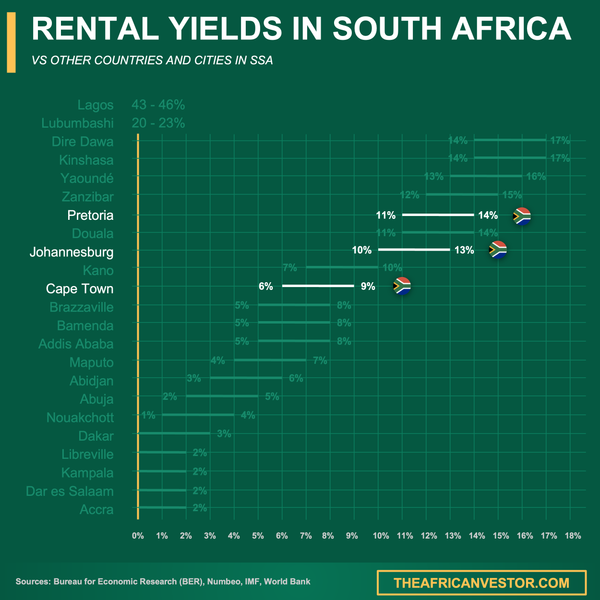
We did some research and made this infographic to help you quickly compare rental yields of the major cities in South Africa versus those in neighboring countries. It provides a clear view of how this country positions itself as a real estate investment destination, which might interest you if you’re planning to invest there.
What are the real numbers I should budget for renting out in Durban in 2026?
What's the total "all-in" monthly cost to hold a rental in Durban in 2026?
As of early 2026, the total monthly cost to hold and maintain a typical rental property in Durban (excluding any mortgage) runs between R4,500 and R8,500 ($250 to $470 or €225 to €425) plus your management fee percentage if you use an agent.
Most Durban rental properties fall within this range, though premium complexes with extensive amenities can push levies higher, and freestanding homes may have lower levies but higher individual maintenance costs.
In Durban specifically, sectional title levies tend to be the largest single monthly cost for apartment investors, often ranging from R1,800 to R3,800 depending on the complex's age, amenities, and reserve fund contributions.
What's the typical vacancy rate in Durban in 2026?
As of early 2026, the typical vacancy rate for rental properties in Durban hovers around 11%, meaning landlords should expect their units to sit empty for roughly one to two months per year on average.
A realistic budget for Durban landlords is about 1.3 months of vacancy annually, though well-priced properties in strong demand nodes like Umhlanga or near UKZN campuses can achieve under one month vacant per year.
The main factor that causes vacancy rates to vary across Durban neighborhoods is the match between rental price and local tenant demand, with overpriced units in any area suffering longer vacancies regardless of location quality.
Durban typically sees higher tenant turnover around November to January when leases renew and students move, though the December holiday period can slow new tenant searches as many people postpone decisions.
We have a whole part covering the best rental strategies in our pack about buying a property in Durban.
Get fresh and reliable information about the market in Durban
Don't base significant investment decisions on outdated data. Get updated and accurate information.
Where do rentals perform best in Durban in 2026?
Which neighborhoods have the highest long-term demand in Durban in 2026?
As of early 2026, the three Durban neighborhoods with the strongest overall long-term rental demand are Umhlanga, Durban North, and Morningside, all of which benefit from security, amenities, and proximity to employment nodes.
Families looking for long-term rentals in Durban gravitate toward Durban North, Westville, and La Lucia, where good schools, larger units, and secure estates drive consistent demand.
Student rental demand in Durban concentrates around Glenwood, Umbilo, and Berea due to their proximity to UKZN campuses and relatively affordable rent levels.
Expats and international professionals seeking long-term rentals in Durban typically prefer Umhlanga, La Lucia, and Morningside, where security standards, modern amenities, and proximity to Gateway and business districts meet corporate relocation expectations.
Which neighborhoods have the best yield in Durban in 2026?
As of early 2026, the three Durban neighborhoods offering the best rental yields are Glenwood, Umbilo, and Berea, all of which combine moderate purchase prices with steady tenant demand from students and young professionals.
These higher-yielding Durban neighborhoods typically deliver gross yields in the 8% to 10% range when properties are bought at reasonable prices and managed efficiently.
The main reason these areas outperform on yield is that property prices remain grounded by practical tenant demographics rather than inflated by lifestyle premiums, while rental demand stays consistently strong due to UKZN, hospitals, and inner-city employment.
We cover a lot of neighborhoods and provide a lot of updated data in our pack about real estate in Durban.
Where do tenants pay the highest rents in Durban in 2026?
As of early 2026, the three Durban neighborhoods where tenants pay the highest rents are Umhlanga (including Umhlanga Rocks and Umhlanga Ridge), La Lucia, and Durban North, all commanding significant premiums over the city average.
A standard apartment in these premium Durban neighborhoods typically rents for R12,000 to R20,000 per month ($670 to $1,110 or €600 to €1,000), with sea-view units and newer developments pushing even higher.
These neighborhoods command Durban's highest rents primarily because they offer a combination of beach proximity, modern security infrastructure, Gateway mall accessibility, and a concentration of upmarket dining and lifestyle amenities that create genuine scarcity value.
The typical tenant profile in Durban's highest-rent neighborhoods includes corporate professionals, business owners, medical specialists working at nearby hospitals, and expatriates on relocation packages who prioritize security and convenience over budget optimization.

We created this infographic to give you a simple idea of how much it costs to buy property in different parts of South Africa. As you can see, it breaks down price ranges and property types for popular cities in the country. We hope this makes it easier to explore your options and understand the market.
What do tenants actually want in Durban in 2026?
What features increase rent the most in Durban in 2026?
As of early 2026, the three property features that increase monthly rent the most in Durban are backup power capability (inverter or generator access), secure covered parking, and fiber internet connectivity, all of which address practical daily-life concerns in the city.
Backup power readiness can add roughly 10% to 15% to achievable rent in Durban because tenants remember load shedding disruptions and actively seek properties that offer resilience against power outages.
One commonly overrated feature in Durban is luxury kitchen finishes, where landlords often overspend on high-end countertops and appliances that tenants appreciate visually but won't pay significantly more for compared to clean, functional alternatives.
An affordable upgrade that provides strong return on investment for Durban landlords is installing a basic inverter system with battery backup, which costs relatively little compared to the rent premium and faster letting it enables.
Do furnished rentals rent faster in Durban in 2026?
As of early 2026, furnished apartments in Durban typically rent around two to three weeks faster than comparable unfurnished units, particularly in corporate and expat-heavy areas like Umhlanga and La Lucia where relocating tenants need move-in-ready options.
Furnished rentals in Durban generally command a rent premium of 15% to 25% over unfurnished equivalents, though this comes with higher upfront investment, more wear-and-tear, and greater management complexity for landlords.
Get to know the market before buying a property in Durban
Better information leads to better decisions. Get all the data you need before investing a large amount of money.
How regulated is long-term renting in Durban right now?
Can I freely set rent prices in Durban right now?
In early 2026, landlords in Durban have full freedom to set initial rent prices by agreement with tenants, as there is no citywide rent control table or government-mandated starting rent in South Africa.
Rent increases during a tenancy are not capped by a specific percentage in Durban, but they must follow what's agreed in the lease, and tenants can challenge increases they consider unfair through the Rental Housing Tribunal process established under the Rental Housing Act.
What's the standard lease length in Durban right now?
The standard lease length for residential rentals in Durban is 12 months, typically rolling to month-to-month after the initial fixed term ends, though six-month leases are also common in student areas.
South African law does not specify a universal maximum security deposit, but the market norm in Durban is one to two months' rent, and landlords must handle deposits according to fair practice requirements under the Rental Housing Act framework.
At the end of a tenancy in Durban, landlords must return the deposit within a reasonable period (commonly interpreted as seven to fourteen days), minus any legitimate deductions for damages beyond normal wear and tear, with proper documentation provided to the tenant.

We made this infographic to show you how property prices in South Africa compare to other big cities across the region. It breaks down the average price per square meter in city centers, so you can see how cities stack up. It’s an easy way to spot where you might get the best value for your money. We hope you like it.
How does short-term renting really work in Durban in 2026?
Is Airbnb legal in Durban right now?
Airbnb-style short-term rentals are legal in Durban in principle, but your specific property must comply with both municipal accommodation regulations and any building or body corporate rules that apply to your complex.
Durban's eThekwini Municipality has an Accommodation Establishments By-law (2022) that governs accommodation-style use, and depending on how your property is classified, you may need to ensure compliance with zoning, safety, and operational requirements rather than obtaining a simple "STR license."
There is no simple citywide "90-night cap" in Durban, but your ability to rent short-term depends on your property's zoning classification and whether your sectional title scheme rules permit it.
The most common consequence for operating a non-compliant short-term rental in Durban is enforcement action from your body corporate (including fines and potential legal action through CSOS) rather than direct municipal prosecution, which makes building-level due diligence essential before buying.
What's the average short-term occupancy in Durban in 2026?
As of early 2026, the average annual occupancy rate for short-term rentals in Durban is approximately 48%, which translates to around 175 booked nights per year for a typical listing.
Most Durban short-term rentals experience occupancy rates ranging from 35% to 65%, with performance depending heavily on location, property quality, pricing strategy, and guest reviews.
December is by far the strongest month for Durban short-term rentals, benefiting from summer holidays, beach tourism, and events, with occupancy rates often exceeding 70% in well-positioned properties.
The slowest months for Durban short-term rentals typically fall between May and August during the cooler winter season, when beach-focused tourism drops and occupancy can fall below 30% for average listings.
Finally, please note that you can find much more granular data about this topic in our property pack about Durban.
What's the average nightly rate in Durban in 2026?
As of early 2026, the average nightly rate for short-term rentals in Durban is approximately R1,084 ($60 or €54), though this varies significantly by property type, location, and season.
Most Durban short-term rental listings fall within a nightly rate range of R600 to R1,800 ($33 to $100 or €30 to €90), with budget-friendly inland units at the low end and premium beachfront apartments at the high end.
The typical difference between peak season (December) and off-season (winter months) nightly rates in Durban is roughly R300 to R500 ($17 to $28 or €15 to €25), with savvy hosts adjusting prices dynamically to capture holiday demand.
Is short-term rental supply saturated in Durban in 2026?
As of early 2026, Durban's short-term rental market is not fully saturated citywide, but specific high-traffic nodes are experiencing meaningful competition that pressures pricing and occupancy for average listings.
The current trend shows approximately 1,517 active Airbnb listings in Durban, representing steady supply that has grown as more investors entered the market over recent years.
The most oversaturated neighborhoods for short-term rentals in Durban are certain beachfront blocks in Umhlanga, parts of Umhlanga Rocks, and some Durban North clusters where listing density creates direct price competition.
Neighborhoods in Durban that still have room for new short-term rental supply include areas with differentiated offerings (unique views, exceptional security, backup power) and emerging nodes near the Durban ICC or King Shaka Airport corridor where supply has not yet caught up with event-driven demand.
Don't lose money on your property in Durban
100% of people who have lost money there have spent less than 1 hour researching the market. We have reviewed everything there is to know. Grab our guide now.

What sources have we used to write this blog article?
Whether it's in our blog articles or the market analyses included in our property pack about Durban, we always rely on the strongest methodology we can … and we don't throw out numbers at random.
We also aim to be fully transparent, so below we've listed the authoritative sources we used, and explained how we used them and the methods behind our estimates.
| Source | Why it's authoritative | How we used it |
|---|---|---|
| SARS - Tax and Non-Residents | It's the official South African tax authority for all taxpayer obligations. | We used it to confirm that rental income from Durban is taxable for non-resident foreign owners. We used it to shape the tax registration guidance for foreign landlords. |
| Rental Housing Act 50 of 1999 | It's the core national law governing landlord-tenant relationships in South Africa. | We used it to explain deposit rules, dispute processes, and rent-setting freedom. We used it to ensure our long-term rental guidance is legally accurate for 2026. |
| eThekwini Accommodation Establishments By-law 2022 | It's the official local municipal law governing short-term accommodation in Durban. | We used it to explain what Durban regulates when a property is used for short stays. We used it to frame the Airbnb legality discussion around actual municipal requirements. |
| PayProp Rental Index Q1 2025 | PayProp is a major rental payment platform with robust transaction data. | We used it to anchor typical rent levels for KwaZulu-Natal as a Durban proxy. We used it as one leg of our yield calculations on the rent side. |
| TPN Residential Vacancy Survey Q2 2024 | TPN is a long-running credit bureau and rental data provider in South Africa. | We used it to set realistic vacancy expectations by price band and province. We used it to ensure our "months vacant" budgeting advice is grounded in real data. |
| Airbtics - Durban Airbnb Data | It's a dedicated short-term rental data vendor with Durban-specific metrics. | We used it to estimate Durban short-term occupancy, ADR, and listing supply. We used it to quantify saturation risk and seasonality patterns. |
| Property24 - Umhlanga Property Values | Property24 uses Deeds Office data for its property valuation tools. | We used it to anchor Umhlanga as Durban's premium price benchmark. We used it as one leg of our yield range calculations on the price side. |
| Sectional Titles Schemes Management Act Regulations | These are the official rules framework for sectional title buildings in South Africa. | We used it to explain why building rules can restrict short-term lets even when Airbnb is legal. We used it to warn investors about body corporate decision-making power. |
| CSOS Consolidated Practice Directives 2025 | CSOS is the national ombud for community scheme disputes in South Africa. | We used it to clarify that disputes in complexes have real enforcement pathways. We used it to shape the "check your body corporate rules" advice. |
| SARB Currency and Exchanges Manual | It's SARB's primary rulebook for exchange control used by banks. | We used it to explain how money can be received via banks as a non-resident. We used it to inform the local bank account discussion for foreign landlords. |
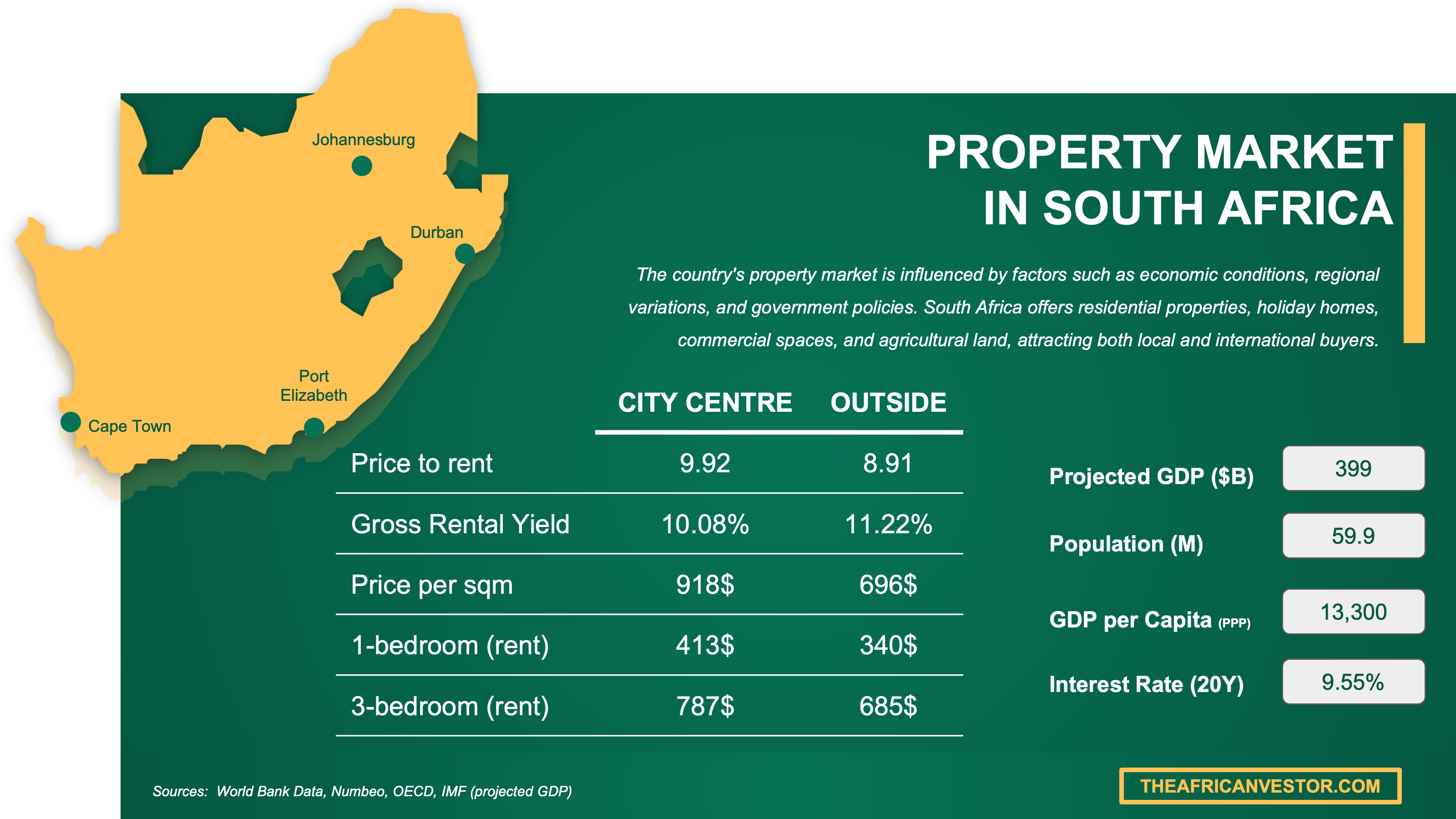
We have made this infographic to give you a quick and clear snapshot of the property market in South Africa. It highlights key facts like rental prices, yields, and property costs both in city centers and outside, so you can easily compare opportunities. We’ve done some research and also included useful insights about the country’s economy, like GDP, population, and interest rates, to help you understand the bigger picture.
