
Authored by the expert who managed and guided the team behind the South Africa Property Pack

Everything you need to know before buying real estate is included in our South Africa Property Pack
Buying property in Durban as a foreigner in 2026 is legally straightforward, but the real risks come from payment fraud, verification shortcuts, and coastal building maintenance traps that catch unprepared buyers.
This guide covers the specific scams targeting foreign buyers in Durban right now, the grey-area practices you should watch for, and the verification steps that actually protect your money.
We constantly update this blog post to reflect the latest market conditions and regulatory changes.
And if you're planning to buy a property in this place, you may want to download our pack covering the real estate market in Durban.
How risky is buying property in Durban as a foreigner in 2026?
Can foreigners legally own properties in Durban in 2026?
As of early 2026, foreigners can legally purchase and own residential property in Durban in their own name without requiring residency permits or special government approval.
The main restrictions foreigners face in Durban relate to financing rather than ownership, since South African banks typically cap mortgage lending to non-residents at 50% of the property value, meaning you will need substantial cash reserves for the remaining balance.
Most foreign buyers in Durban purchase property directly in their personal name, though some use South African trusts or companies for estate planning purposes, and this direct ownership route is the simplest and most common legal structure.
What really matters for foreigners buying in Durban is not the legal structure but rather compliance with exchange control rules administered by the South African Reserve Bank, which requires that all funds coming into the country go through an authorized dealer bank with proper documentation of source and purpose.
What buyer rights do foreigners actually have in Durban in 2026?
As of early 2026, foreign buyers in Durban have the same contractual and property rights as South African citizens, including the right to enforce sale agreements through the courts and register ownership at the Deeds Office.
If a seller breaches a contract in Durban, foreign buyers can pursue specific performance (forcing the sale to complete) or claim damages through South African courts, though enforcement can take 12 to 24 months depending on complexity and court backlogs.
The most common buyer right that foreigners mistakenly assume they have in Durban is the ability to easily recover deposits paid into fraudulent accounts, when in reality, once money is transferred to a scammer's bank account, recovery is extremely difficult regardless of your legal rights.
How strong is contract enforcement in Durban right now?
Contract enforcement in Durban property transactions is functional but slower than in places like the UK or Germany, with South Africa ranking 60th out of 143 countries in the 2025 World Justice Project Rule of Law Index, meaning disputes can be resolved but require patience and proper documentation.
The main weakness foreigners should understand about contract enforcement in Durban is the time factor: even with a clear-cut case, court proceedings can stretch over a year, which is why prevention through proper verification matters far more than planning to litigate later.
By the way, we detail all the documents you need and what they mean in our property pack covering Durban.
Buying real estate in Durban can be risky
An increasing number of foreign investors are showing interest. However, 90% of them will make mistakes. Avoid the pitfalls with our comprehensive guide.

Which scams target foreign buyers in Durban right now?
Are scams against foreigners common in Durban right now?
Real estate scams targeting foreigners in Durban are common enough in early 2026 that you should expect to encounter at least one suspicious approach or red-flag situation during your property search, particularly in popular areas like Umhlanga and La Lucia where foreign buyer activity is highest.
The type of property transaction most frequently targeted by scammers in Durban is the deposit payment stage, where fraudsters intercept email communications and redirect funds to their own accounts before buyers realize anything is wrong.
The profile of foreign buyer most commonly targeted in Durban is someone purchasing remotely who relies heavily on email communication, cannot easily visit the property in person, and is unfamiliar with local banking verification procedures.
The single biggest warning sign that a deal may be a scam in Durban is any request to change bank account details mid-transaction, especially when communicated by email rather than confirmed by phone using independently verified contact numbers.
What are the top three scams foreigners face in Durban right now?
The top three scams targeting foreigners buying property in Durban in 2026 are payment redirection fraud (where hackers intercept emails and send fake banking details), fake seller scams (where fraudsters pose as property owners using forged documents), and sectional title financial traps (where buyers purchase units in buildings with hidden maintenance debts or special levy obligations).
The most common scam in Durban unfolds when a fraudster compromises email communication between buyer and conveyancer, monitors the transaction progress, then sends a convincing email just before payment is due with "updated" banking details that direct funds to a criminal's account instead of the legitimate trust account.
The single most effective protection against payment fraud in Durban is to verify all banking details by phone using a number you have independently sourced (not from the suspicious email), while for fake seller scams you should insist your conveyancer confirms identity against Deeds Office records, and for sectional title traps you must demand audited scheme financials and levy histories before signing anything.
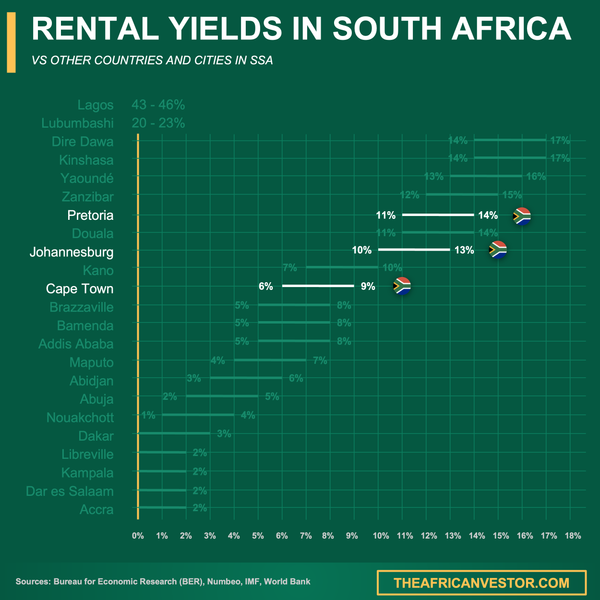
We did some research and made this infographic to help you quickly compare rental yields of the major cities in South Africa versus those in neighboring countries. It provides a clear view of how this country positions itself as a real estate investment destination, which might interest you if you’re planning to invest there.
How do I verify the seller and ownership in Durban without getting fooled?
How do I confirm the seller is the real owner in Durban?
The standard verification process in Durban requires your conveyancing attorney to obtain current ownership information from the Deeds Office and confirm that the person signing the sale agreement matches the registered owner, including verification of identity documents and authority to sell.
The official document foreigners should insist their conveyancer checks in Durban is the title deed held at the Deeds Office, which shows the registered owner, any existing bonds, and registered servitudes affecting the property.
The most common trick fake sellers use in Durban is claiming the owner is "abroad" or "unavailable" while using forged identity documents and powers of attorney, which happens occasionally and underscores why you should never accept rushed transactions without proper verification.
Where do I check liens or mortgages on a property in Durban?
Your conveyancing attorney in Durban accesses liens and mortgage information through the Deeds Office, which maintains official records of all registered bonds and encumbrances against properties in the eThekwini area.
When checking for liens in Durban, you should specifically request confirmation of any existing mortgage bonds, the current outstanding amounts, and whether there are any registered servitudes, interdicts, or caveats that could affect your ownership rights.
The type of encumbrance most commonly missed by foreign buyers in Durban is levy arrears on sectional title properties, because these debts transfer with the unit and can amount to tens of thousands of rands if the previous owner defaulted, making levy clearance certificates essential before transfer.
It's one of the aspects we cover in our pack about the real estate market in Durban.
How do I spot forged documents in Durban right now?
The most common forged documents in Durban property scams are identity documents and powers of attorney, which sometimes happen when fraudsters target properties where owners are abroad or deceased estates are being administered.
Red flags that suggest a document may be forged in Durban include inconsistent fonts or formatting, spelling errors in official text, missing security features on identity documents, and any reluctance from the seller to allow independent verification of their identity with original documents.
The official verification method in Durban is to have your conveyancing attorney validate identity documents through the Department of Home Affairs system and confirm practitioner credentials through the Legal Practice Council register, rather than relying on visual inspection alone.
Get the full checklist for your due diligence in Durban
Don't repeat the same mistakes others have made before you. Make sure everything is in order before signing your sales contract.
What "grey-area" practices should I watch for in Durban?
What hidden costs surprise foreigners when buying a property in Durban?
The three hidden costs that most surprise foreigners buying property in Durban are transfer duty and conveyancing fees (typically 8% to 10% of purchase price, or R160,000 to R200,000 on a R2 million property, roughly USD 8,500 to 10,700 or EUR 7,800 to 9,800), municipal rates clearance delays, and sectional title special levies for deferred building maintenance.
The hidden cost most often deliberately concealed by sellers or agents in Durban is pending special levies in sectional title buildings, which sometimes happens when a body corporate has approved major repairs that will be billed to unit owners after transfer, making it essential to request recent trustee meeting minutes and planned maintenance budgets.
Are "cash under the table" requests common in Durban right now?
Cash under the table requests in Durban property transactions are uncommon but do occur occasionally, particularly when sellers want to reduce the declared purchase price to lower transfer duty obligations or hide proceeds from other parties.
The typical reason sellers give for requesting undeclared cash payments in Durban is to "speed up the process" or "reduce your costs," but these justifications mask the real intent of tax evasion or asset concealment from creditors or divorce proceedings.
Foreigners who agree to undeclared cash payments in Durban face serious legal risks including prosecution for tax fraud, problems proving legitimate source of funds when they later sell, and potential complications with exchange control compliance that could block repatriation of sale proceeds.
Are side agreements used to bypass rules in Durban right now?
Side agreements to bypass official rules in Durban property transactions happen occasionally, particularly informal arrangements about repairs, fixtures, or levy arrears that parties prefer to keep out of the registered sale agreement.
The most common type of side agreement in Durban involves promises about building repairs or maintenance ("the body corporate will fix the waterproofing soon") or informal arrangements to include furniture and appliances outside the main contract to reduce declared value.
Foreigners caught using side agreements in Durban face risks including unenforceable promises (since informal agreements are nearly impossible to litigate), potential SARS penalties if the arrangement is deemed tax evasion, and complications with insurance claims if undisclosed fixtures are later damaged.

We made this infographic to show you how property prices in South Africa compare to other big cities across the region. It breaks down the average price per square meter in city centers, so you can see how cities stack up. It’s an easy way to spot where you might get the best value for your money. We hope you like it.
Can I trust real estate agents in Durban in 2026?
Are real estate agents regulated in Durban in 2026?
As of early 2026, real estate agents in Durban are regulated by the Property Practitioners Regulatory Authority (PPRA), which requires practitioners to be registered, comply with a code of conduct, and maintain fidelity fund coverage that protects client deposits.
A legitimate real estate agent in Durban should hold a valid Fidelity Fund Certificate issued by the PPRA, which confirms they are registered, have met educational requirements, and are covered by the industry protection fund.
Foreigners can verify whether an agent is properly licensed in Durban by searching the PPRA online register, calling the PPRA directly, or asking the agent to provide their Fidelity Fund Certificate number for independent verification.
Please note that we have a list of contacts for you in our property pack about Durban.
What agent fee percentage is normal in Durban in 2026?
As of early 2026, the normal agent commission in Durban ranges from 5% to 7.5% of the sale price plus VAT (15.5%), with 7% plus VAT being the most commonly quoted rate in popular areas like Umhlanga, La Lucia, and Durban North.
The typical range that covers most transactions in Durban runs from about 5% plus VAT for higher-value properties or negotiated mandates up to 7.5% plus VAT for standard sole mandates, with room for negotiation depending on property price and market conditions.
In Durban, the seller typically pays the agent commission, which is deducted from the sale proceeds at transfer, though buyers should confirm this arrangement is clearly stated in the sale agreement to avoid surprises.
Get the full checklist for your due diligence in Durban
Don't repeat the same mistakes others have made before you. Make sure everything is in order before signing your sales contract.
What due diligence actually prevents disasters in Durban?
What structural inspection is standard in Durban right now?
The standard structural inspection for property purchases in Durban involves hiring a qualified home inspector to assess the building's physical condition, though coastal and hillside properties require additional focus on moisture, waterproofing, and retaining walls due to Durban's humid subtropical climate.
A qualified inspector in Durban should check the roof and waterproofing, foundation and retaining walls, electrical and plumbing systems, damp and moisture intrusion, and for coastal apartments specifically, balcony condition and concrete spalling from salt exposure.
Structural inspections in Durban should be performed by a registered home inspector or, for complex issues, a professional engineer registered with the Engineering Council of South Africa, and for new builds you should confirm NHBRC enrollment and warranty coverage.
The most common structural issues revealed in Durban properties are water-related problems including damp, roof leaks, failed waterproofing, and inadequate drainage, all amplified by the coastal humidity and the aftermath of the severe 2022 KZN floods that affected many eThekwini properties.
How do I confirm exact boundaries in Durban?
The standard process for confirming property boundaries in Durban involves your conveyancer obtaining the registered diagram from the Deeds Office and comparing it against a physical site survey if there is any doubt about where boundaries fall on the ground.
The official document showing legal boundaries in Durban is the registered diagram or general plan held at the Surveyor-General's office, which your conveyancer should obtain and review as part of the transfer process.
The most common boundary dispute affecting foreign buyers in Durban involves encroachments (structures built over boundary lines) and servitude surprises (access or utility rights you did not know existed), particularly in older suburbs like Glenwood, Musgrave, and Morningside where historical subdivisions created complex boundary situations.
To physically verify boundaries in Durban, you should hire a professional land surveyor registered with the South African Geomatics Council, especially if the property has been subdivided, has unclear fencing, or is on a sloped site where boundaries may not be obvious.
What defects are commonly hidden in Durban right now?
The top three defects commonly hidden by sellers in Durban are water intrusion problems (damp, leaks, failed waterproofing), unapproved building alterations (garages converted to rooms, illegal additions), and deferred maintenance in sectional title buildings (aging lifts, deteriorating facades), with water issues being common and the other two happening occasionally in the current market.
The best tools for uncovering hidden defects in Durban include moisture meters and thermal imaging cameras for water issues, comparison of actual floor plans against approved municipal records for illegal alterations, and detailed review of body corporate minutes and reserve fund statements for maintenance problems.
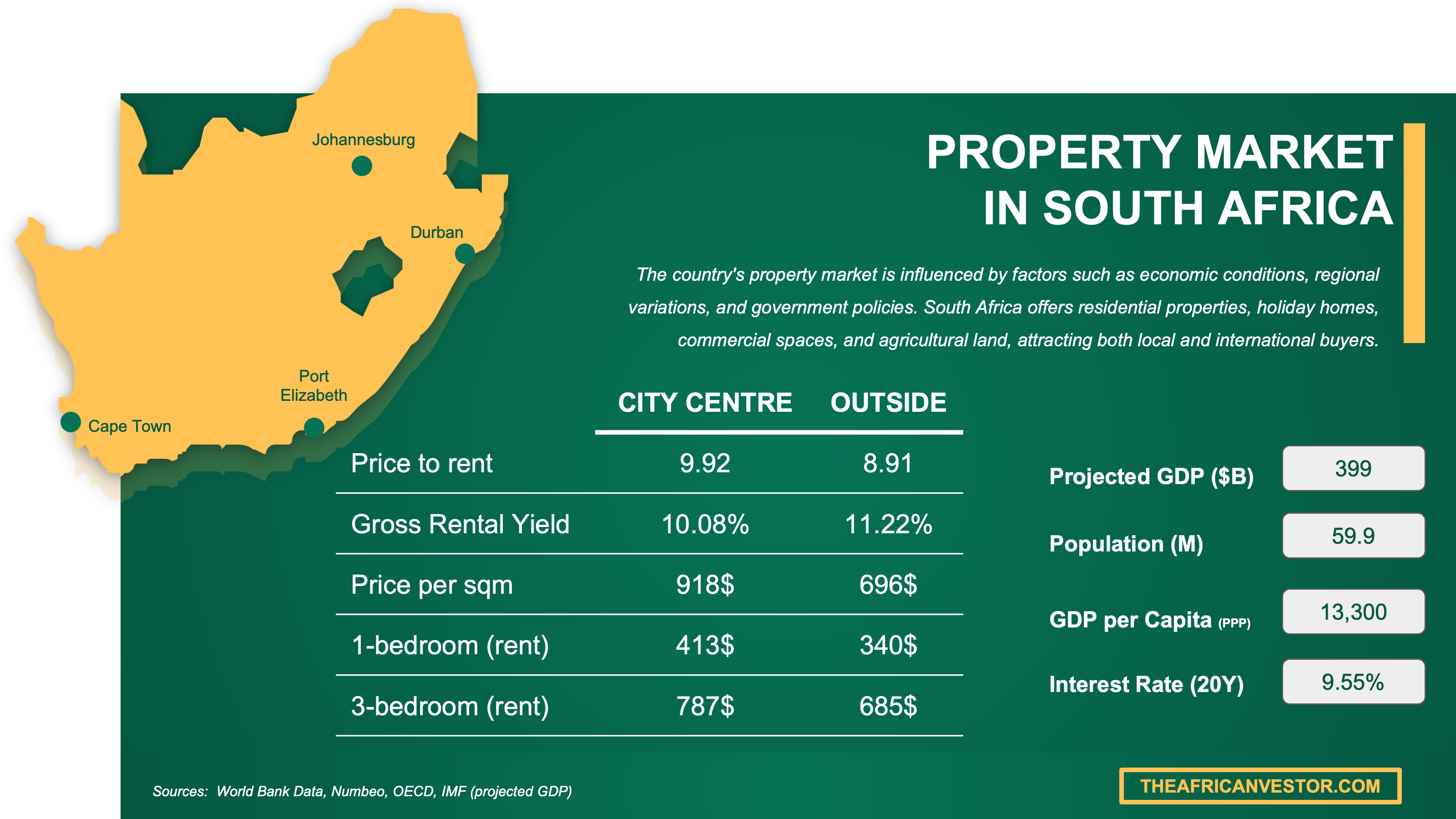
We have made this infographic to give you a quick and clear snapshot of the property market in South Africa. It highlights key facts like rental prices, yields, and property costs both in city centers and outside, so you can easily compare opportunities. We’ve done some research and also included useful insights about the country’s economy, like GDP, population, and interest rates, to help you understand the bigger picture.
What insider lessons do foreigners share after buying in Durban?
What do foreigners say they did wrong in Durban right now?
The most common mistake foreigners say they made when buying property in Durban was prioritizing the deal over verification, rushing to secure an attractive property without independently confirming seller identity, agent credentials, and payment details.
The top three regrets foreigners mention after buying in Durban are using the seller's recommended conveyancer instead of choosing their own, underestimating Durban-specific risks like flood exposure and building maintenance, and relying on email communication without phone verification for payment instructions.
The single piece of advice experienced foreign buyers in Durban give most often is to slow down and verify everything independently, because the few hours spent confirming details through separate channels can save you from losing your entire deposit to fraud.
The mistake foreigners say cost them the most money or stress in Durban was failing to demand scheme financials for sectional title properties, leading to surprise special levies of R50,000 to R100,000 (USD 2,700 to 5,400) for building repairs that were already planned but not disclosed.
What do locals do differently when buying in Durban right now?
The key difference in how locals approach buying property in Durban compared to foreigners is that locals obsessively verify the paper trail and professional credentials, treating "trust but verify" as non-negotiable rather than optional due diligence.
The verification step locals routinely take that foreigners often skip in Durban is physically driving to the conveyancer's office to confirm it exists, calling the Legal Practice Council to verify the attorney is in good standing, and personally delivering deposit payments rather than relying solely on email instructions.
The local knowledge that helps Durban residents get better deals is their understanding of which buildings have reserve fund problems, which hillside areas have drainage issues, and which body corporates are well-managed, information they gather through word of mouth, local forums, and direct inquiries that remote foreign buyers rarely access.
Don't buy the wrong property, in the wrong area of Durban
Buying real estate is a significant investment. Don't rely solely on your intuition. Gather the right information to make the best decision.

What sources have we used to write this blog article?
Whether it's in our blog articles or the market analyses included in our property pack about Durban, we always rely on the strongest methodology we can ... and we don't throw out numbers at random.
We also aim to be fully transparent, so below we've listed the authoritative sources we used, and explained how we used them and the methods behind our estimates.
| Source | Why it's authoritative | How we used it |
|---|---|---|
| Property Practitioners Regulatory Authority (PPRA) | The official regulator overseeing all estate agents in South Africa. | We used PPRA guidance to explain agent verification and consumer protections. We also referenced their registration requirements for credential checks. |
| Financial Intelligence Centre Act (FIC) | The primary law governing identity checks and anti-money laundering in property transactions. | We used FIC requirements to explain why FICA compliance matters. We also referenced it to highlight red flags when sellers skip identity verification. |
| South African Reserve Bank (SARB) | The official authority for exchange control and cross-border money flows. | We used SARB guidelines to explain how foreigners must route funds. We also referenced their rules to warn against informal payment shortcuts. |
| World Justice Project Rule of Law Index | A respected international index measuring judicial effectiveness and contract enforcement. | We used the 2025 ranking to contextualize contract enforcement reliability. We also compared South Africa against other countries for perspective. |
| Banking Association of South Africa | An industry body with direct knowledge of payment fraud patterns affecting property transactions. | We used their guidance to explain how deposit fraud works. We also referenced their warnings to build practical protection steps. |
| Legal Practice Council | The official register for verifying attorneys and conveyancers are legitimate and practicing. | We used the LPC register to recommend verification procedures. We also referenced it as a key defense against attorney impersonation scams. |
| Sectional Titles Schemes Management Act | The governing law for body corporates and sectional title ownership in South Africa. | We used STSMA to explain levy obligations and scheme governance. We also referenced it to highlight why scheme financials matter before buying. |
| Community Schemes Ombud Service (CSOS) | The statutory body resolving disputes in sectional title and community schemes. | We used CSOS to explain dispute resolution options for scheme problems. We also referenced them to show buyers have recourse when things go wrong. |
| South African Revenue Service (SARS) | The official tax authority setting transfer duty rates and thresholds. | We used SARS tables to calculate transfer duty examples. We also referenced their 2025 threshold updates to ensure cost estimates are current. |
| South African Government (KZN Floods Data) | Official government figures on the 2022 flood disaster affecting Durban. | We used this data to justify why flood and drainage due diligence is essential in Durban. We also referenced it to support site-risk inspection recommendations. |

We created this infographic to give you a simple idea of how much it costs to buy property in different parts of South Africa. As you can see, it breaks down price ranges and property types for popular cities in the country. We hope this makes it easier to explore your options and understand the market.
