
Authored by the expert who managed and guided the team behind the South Africa Property Pack

Yes, the analysis of Johannesburg's property market is included in our pack
Johannesburg is South Africa's economic engine, and it attracts foreign investors who want to earn rental income from residential property.
This guide covers everything you need to know about renting out a property in Johannesburg as a foreigner in 2026, from legal requirements to realistic yield expectations.
We constantly update this blog post to reflect the latest data, regulations, and market conditions.
And if you're planning to buy a property in this place, you may want to download our pack covering the real estate market in Johannesburg.
Insights
- Johannesburg's average gross rental yield sits around 8.5% in early 2026, which is higher than most major African cities because property prices remain relatively affordable compared to rents in business nodes like Sandton.
- Short-term rental occupancy in Johannesburg averages only 48%, meaning most Airbnb hosts experience empty nights more than half the year, which makes long-term renting more predictable for foreign investors.
- Backup power (inverters or generators) can add 10% to 15% to your monthly rent in Johannesburg because load shedding makes tenants willing to pay extra for uninterrupted electricity.
- The Gauteng Rental Housing Tribunal handles most landlord-tenant disputes in Johannesburg, and cases typically take 3 to 6 months to resolve, which means you need to budget for potential non-payment periods.
- Johannesburg has over 11,500 active short-term rental listings according to AirDNA, creating real competition that pushes average nightly rates down to around R970 (about $59 USD or €55 EUR).
- Sectional title apartments in Johannesburg sold for an average of R1.28 million in 2025, making them accessible entry points for foreign investors compared to freehold houses.
- Body corporate rules in Johannesburg apartment buildings often restrict or ban short-term rentals, so checking these rules before buying is more important than checking city regulations.
- Student rental demand in Johannesburg concentrates around Braamfontein, Auckland Park, and Melville near Wits and UJ universities, and these areas see higher turnover but also higher yields.
- Foreign landlords in Johannesburg must register with SARS to declare South African-source rental income, but they do not need residency or a work permit to own and rent out property.
Can I legally rent out a property in Johannesburg as a foreigner right now?
Can a foreigner own-and-rent a residential property in Johannesburg in 2026?
As of early 2026, there are no nationality restrictions preventing foreigners from owning and renting out residential property in Johannesburg, and the process works the same as it does for South African citizens.
Most foreign investors in Johannesburg hold property directly in their personal name, though some use South African-registered companies or trusts depending on their tax planning needs and estate planning goals.
The main limitation foreigners face is not legal but practical: you need to comply with SARS tax reporting requirements for South African-source rental income, which means registering appropriately and filing returns even if you live abroad.
Do I need residency to rent out in Johannesburg right now?
No, you do not need South African residency to rent out a property in Johannesburg, and many foreign investors successfully manage their rental properties remotely using local agents.
However, if you earn rental income from Johannesburg property, SARS generally expects you to register for tax purposes so you can declare that income and pay any tax due on your South African-source earnings.
A local South African bank account is not legally required, but it makes rent collection much easier because most tenants and letting agents strongly prefer paying into a local account rather than dealing with international transfers.
Managing a Johannesburg rental remotely is entirely feasible if you hire a reputable property management company, though you should budget for management fees of 8% to 12% of monthly rent plus VAT.
Thinking of buying real estate in Johannesburg?
Acquiring property in a different country is a complex task. Don't fall into common traps – grab our guide and make better decisions.

What rental strategy makes the most money in Johannesburg in 2026?
Is long-term renting more profitable than short-term in Johannesburg in 2026?
As of early 2026, long-term renting is generally the safer and more consistent money-maker for foreign investors in Johannesburg because short-term rental occupancy averages only 48%, which means your property sits empty more than half the time.
A well-managed long-term rental in Johannesburg typically generates R110,000 to R150,000 per year (roughly $6,700 to $9,100 USD or €6,200 to €8,500 EUR), while a short-term rental at average occupancy and rates might earn R130,000 to R180,000 but comes with much higher operating costs and effort.
Short-term renting can outperform long-term in specific Johannesburg locations like Sandton, Rosebank, and Melrose Arch where corporate travelers pay premium rates, but only if your building allows it and you manage it professionally with dynamic pricing and reliable cleaning.
What's the average gross rental yield in Johannesburg in 2026?
As of early 2026, the average gross rental yield for residential properties in Johannesburg sits around 8.5%, which is notably higher than many comparable cities because property prices remain moderate while rents in business nodes stay strong.
Most Johannesburg residential properties fall within a gross yield range of 7% to 10%, with the lower end applying to premium houses in expensive suburbs and the higher end found in apartment buildings near transport and employment hubs.
Studios and one-bedroom apartments in sectional title buildings typically achieve the highest gross yields in Johannesburg because they have lower purchase prices relative to the rent they command from young professionals and students.
By the way, we have much more granular data about rental yields in our property pack about Johannesburg.
What's the realistic net rental yield after costs in Johannesburg in 2026?
As of early 2026, the average net rental yield after operating costs in Johannesburg lands between 4.5% and 6.5%, with most investors realistically achieving around 5.5% before financing and personal income tax.
Most Johannesburg landlords experience net yields in the range of 4% to 6%, though those who self-manage and maintain low vacancy can push toward 7%, while those with high turnover or deferred maintenance might fall below 4%.
The three biggest cost categories that eat into your gross yield in Johannesburg are sectional title levies (which include security and building maintenance), municipal rates and taxes (based on property valuation), and the security and backup power costs that Johannesburg tenants expect.
What monthly rent can I get in Johannesburg in 2026?
As of early 2026, typical monthly rents in Johannesburg are roughly R7,500 (about $460 USD or €425 EUR) for a studio, R10,500 ($640 USD or €595 EUR) for a one-bedroom, and R15,000 ($915 USD or €850 EUR) for a two-bedroom apartment.
A decent studio in Johannesburg rents for R6,500 to R9,000 per month ($400 to $550 USD or €370 to €510 EUR), with the lower end in areas like Randburg and the higher end in Sandton or Rosebank.
A typical one-bedroom apartment in Johannesburg commands R8,500 to R12,500 per month ($520 to $760 USD or €480 to €710 EUR), depending heavily on whether it has secure parking and backup power.
A standard two-bedroom apartment in Johannesburg fetches R11,500 to R18,000 per month ($700 to $1,100 USD or €650 to €1,020 EUR), with premium nodes like Sandton and Melrose Arch reaching the top of that range.
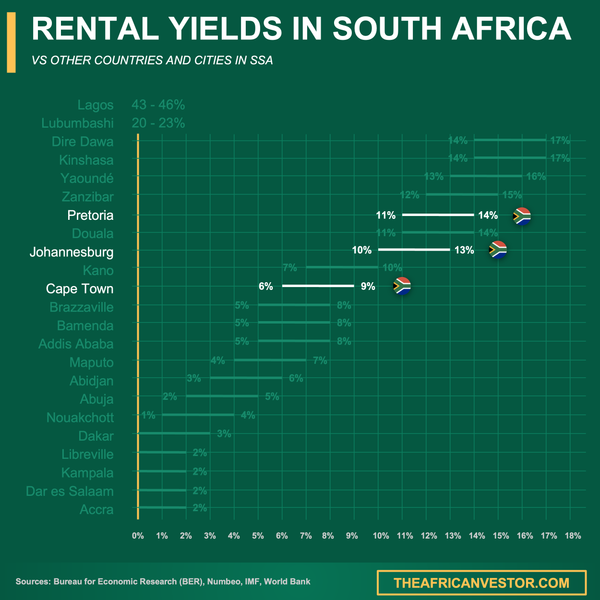
We did some research and made this infographic to help you quickly compare rental yields of the major cities in South Africa versus those in neighboring countries. It provides a clear view of how this country positions itself as a real estate investment destination, which might interest you if you’re planning to invest there.
What are the real numbers I should budget for renting out in Johannesburg in 2026?
What's the total "all-in" monthly cost to hold a rental in Johannesburg in 2026?
As of early 2026, the total monthly holding cost for a typical rental property in Johannesburg runs between R3,500 and R8,000 ($215 to $490 USD or €200 to €455 EUR) for an apartment, and R4,000 to R10,000 ($245 to $610 USD or €225 to €565 EUR) for a freehold house.
Most Johannesburg apartment investors should budget R4,500 to R6,500 per month ($275 to $400 USD or €255 to €370 EUR) for levies, rates, insurance, and maintenance reserves, while house owners face higher costs due to larger maintenance footprints.
The single largest cost category for most Johannesburg rental properties is sectional title levies, which typically include building insurance, security personnel, common area maintenance, and increasingly, shared backup power systems.
What's the typical vacancy rate in Johannesburg in 2026?
As of early 2026, landlords in Johannesburg should plan for a vacancy rate of 8% to 15%, which translates to roughly one to two months of lost rent per year.
Conservative budgeting for a Johannesburg rental means assuming 1.5 months of vacancy annually because tenant turnover happens naturally when leases end, and finding a qualified replacement takes two to four weeks even in high-demand areas.
The main factor that pushes vacancy rates higher or lower across Johannesburg neighborhoods is proximity to employment nodes, with properties near Sandton, Rosebank, and Midrand re-letting faster than those in peripheral areas with weaker transport links.
Tenant turnover in Johannesburg tends to peak in November and December when lease cycles align with the year-end holiday period, and again in January when people relocate for new jobs or university terms.
We have a whole part covering the best rental strategies in our pack about buying a property in Johannesburg.
Get fresh and reliable information about the market in Johannesburg
Don't base significant investment decisions on outdated data. Get updated and accurate information.
Where do rentals perform best in Johannesburg in 2026?
Which neighborhoods have the highest long-term demand in Johannesburg in 2026?
As of early 2026, the three neighborhoods with the highest overall long-term rental demand in Johannesburg are Sandton (including Morningside and Benmore), Rosebank, and Fourways, all of which benefit from strong employment concentrations and lifestyle amenities.
Families looking for long-term rentals in Johannesburg gravitate toward Bryanston, Parkview, Parkhurst, and Northcliff because these areas offer good schools, larger properties, and established security infrastructure.
Student rental demand in Johannesburg concentrates heavily in Braamfontein, Auckland Park, Melville, and Westdene, all within easy reach of the University of the Witwatersrand and the University of Johannesburg campuses.
Expats and international professionals seeking long-term rentals in Johannesburg typically target Sandton, Rosebank, Melrose Arch, and the Waterfall estate area in Midrand because these locations offer corporate proximity, security, and familiar urban amenities.
Which neighborhoods have the best yield in Johannesburg in 2026?
As of early 2026, the three neighborhoods offering the best rental yields in Johannesburg are Braamfontein, Randburg, and parts of Midrand, where purchase prices remain accessible but tenant demand stays consistent.
These top-yielding Johannesburg neighborhoods typically deliver gross yields in the 9% to 11% range, compared to the citywide average of around 8.5%, though net yields depend heavily on management quality.
The main characteristic that allows these neighborhoods to achieve higher yields is their lower entry price per square meter combined with steady demand from students, young professionals, and mid-income families who prioritize affordability over prestige addresses.
We cover a lot of neighborhoods and provide a lot of updated data in our pack about real estate in Johannesburg.
Where do tenants pay the highest rents in Johannesburg in 2026?
As of early 2026, the three neighborhoods where tenants pay the highest rents in Johannesburg are Sandton, Melrose Arch, and Waterfall estate in Midrand, where premium two-bedroom apartments regularly exceed R20,000 per month ($1,220 USD or €1,130 EUR).
A standard apartment in these premium Johannesburg neighborhoods typically rents for R15,000 to R25,000 per month ($915 to $1,525 USD or €850 to €1,415 EUR), with penthouses and larger units commanding significantly more.
These neighborhoods command the highest rents in Johannesburg because they combine walkable access to corporate headquarters with comprehensive lifestyle amenities, 24-hour security, reliable backup power, and fiber internet as standard features.
The typical tenant profile in these high-rent Johannesburg neighborhoods includes senior corporate executives, foreign diplomats, multinational company employees on housing allowances, and entrepreneurs who value time savings and security over cost optimization.

We created this infographic to give you a simple idea of how much it costs to buy property in different parts of South Africa. As you can see, it breaks down price ranges and property types for popular cities in the country. We hope this makes it easier to explore your options and understand the market.
What do tenants actually want in Johannesburg in 2026?
What features increase rent the most in Johannesburg in 2026?
As of early 2026, the three property features that increase monthly rent the most in Johannesburg are backup power systems (inverter or generator), secure covered parking with at least one bay, and 24-hour access-controlled security with guards or biometric entry.
Backup power alone can add 10% to 15% to your monthly rent in Johannesburg because load shedding remains a daily reality, and tenants actively seek properties where they can work from home and keep refrigerators running during outages.
One commonly overrated feature that Johannesburg landlords invest in but tenants do not pay much extra for is luxury kitchen finishes, since most renters care more about functional appliances and storage than granite countertops or designer fixtures.
One affordable upgrade that delivers strong return on investment for Johannesburg landlords is installing fiber internet connectivity, which costs relatively little but makes a property immediately more attractive to remote workers and younger professionals.
Do furnished rentals rent faster in Johannesburg in 2026?
As of early 2026, furnished apartments in Johannesburg typically rent two to three weeks faster than unfurnished equivalents, particularly in corporate-heavy areas like Sandton and Rosebank where tenants relocating for work want move-in ready options.
Furnished rentals in Johannesburg typically command a 15% to 25% rent premium over unfurnished equivalents, though this comes with higher wear-and-tear costs, more frequent inventory replacement, and greater management complexity for remote owners.
Get to know the market before buying a property in Johannesburg
Better information leads to better decisions. Get all the data you need before investing a large amount of money.
How regulated is long-term renting in Johannesburg right now?
Can I freely set rent prices in Johannesburg right now?
In early 2026, landlords in Johannesburg have complete freedom to set initial rent prices at market rates, with no rent control caps or government-mandated pricing limits on new leases.
Rent increases during an existing tenancy are also unregulated in Johannesburg, though the practical constraint is tenant affordability, and the PayProp Rental Index shows that Gauteng rents only grew about 2.9% year-on-year in early 2025 because landlords who push too hard simply lose tenants to competitors.
What's the standard lease length in Johannesburg right now?
The standard lease length for residential rentals in Johannesburg is 12 months, though 24-month leases are also common, and the Consumer Protection Act caps most fixed-term consumer agreements at 24 months unless specific conditions justify longer terms.
Landlords in Johannesburg typically ask for a security deposit of one to two months' rent (R10,000 to R30,000 or $610 to $1,830 USD or €565 to €1,700 EUR for a typical apartment), with the exact amount set by agreement rather than strict legal maximums.
At the end of a tenancy in Johannesburg, landlords must return the deposit within seven days after conducting an inspection and deducting only documented damages or unpaid amounts, and disputes over deposit returns can be escalated to the Gauteng Rental Housing Tribunal.

We made this infographic to show you how property prices in South Africa compare to other big cities across the region. It breaks down the average price per square meter in city centers, so you can see how cities stack up. It’s an easy way to spot where you might get the best value for your money. We hope you like it.
How does short-term renting really work in Johannesburg in 2026?
Is Airbnb legal in Johannesburg right now?
In early 2026, Airbnb-style short-term rentals are not banned in Johannesburg, but legality depends on whether your property's zoning permits visitor accommodation and whether your body corporate rules allow short stays.
Johannesburg does not have a simple citywide short-term rental license system, so instead of applying for a permit, you need to check whether your property use aligns with the City of Johannesburg Land Use Scheme and potentially apply for consent use if it does not.
There are no annual night caps in Johannesburg like those found in cities such as London or Amsterdam, so the main restrictions come from zoning categories and building-level rules rather than total nights permitted per year.
The most common consequence for operating a non-compliant short-term rental in Johannesburg is receiving complaints from neighbors or the body corporate, which can lead to fines, legal action from the homeowners' association, or orders to cease operations from the municipality.
What's the average short-term occupancy in Johannesburg in 2026?
As of early 2026, the average annual occupancy rate for short-term rentals in Johannesburg is approximately 48%, meaning most properties sit empty more than half the year.
Most Johannesburg short-term rentals experience occupancy rates in the range of 35% to 60%, with professional operators in prime locations like Sandton achieving the higher end and casual hosts in less central areas falling toward the lower end.
The highest occupancy months for Johannesburg short-term rentals are typically September through November and March through May, when business travel peaks and major conferences and events draw visitors to the city.
The lowest occupancy months for Johannesburg short-term rentals are December and January, when corporate travel slows dramatically for the summer holiday period, and June through August when winter reduces leisure tourism.
Finally, please note that you can find much more granular data about this topic in our property pack about Johannesburg.
What's the average nightly rate in Johannesburg in 2026?
As of early 2026, the average nightly rate for short-term rentals in Johannesburg is approximately R970 ($59 USD or €55 EUR), though this varies significantly by property type, location, and amenities.
Most Johannesburg short-term rental listings fall within a nightly rate range of R600 to R1,800 ($37 to $110 USD or €34 to €102 EUR), with budget-friendly studios at the lower end and premium multi-bedroom apartments in Sandton at the higher end.
The typical nightly rate difference between peak and off-season in Johannesburg is R200 to R400 ($12 to $24 USD or €11 to €23 EUR), with savvy hosts using dynamic pricing to capture higher rates during major events and conferences.
Is short-term rental supply saturated in Johannesburg in 2026?
As of early 2026, the Johannesburg short-term rental market shows moderate saturation with over 11,500 active listings competing for a finite pool of guests, which pushes average occupancy down to 48%.
The number of active short-term rental listings in Johannesburg has grown steadily in recent years, though growth has slowed as hosts realize the operational complexity and modest returns relative to long-term renting.
The most oversaturated neighborhoods for short-term rentals in Johannesburg include Sandton CBD, Rosebank, and Maboneng, where listing density is highest and competition for the same corporate and tourist guests is most intense.
Neighborhoods in Johannesburg that still have room for new short-term rental supply include emerging areas around the Gautrain corridor in Midrand, some Fourways pockets, and locations near conference venues outside the core tourist zones.
Don't lose money on your property in Johannesburg
100% of people who have lost money there have spent less than 1 hour researching the market. We have reviewed everything there is to know. Grab our guide now.

What sources have we used to write this blog article?
Whether it's in our blog articles or the market analyses included in our property pack about Johannesburg, we always rely on the strongest methodology we can … and we don't throw out numbers at random.
We also aim to be fully transparent, so below we've listed the authoritative sources we used, and explained how we used them and the methods behind our estimates.
| Source | Why It's Authoritative | How We Used It |
|---|---|---|
| SARS - Tax on Rental Income | It's South Africa's tax authority explaining exactly how rental income gets taxed. | We used it to explain how rental income is declared and what deductible costs look like. We also used it to shape the net yield calculations. |
| SARS - Tax and Non-Residents | It's SARS' guidance on how South Africa taxes people who are not tax-resident. | We used it to explain whether foreigners need residency to rent out property. We also used it to outline the practical reporting requirements. |
| PayProp Rental Index Q1 2025 | It's one of South Africa's most respected rental market datasets based on real transactions. | We used it to benchmark Gauteng's average rent level and rental growth. We also used it to keep yield estimates grounded in actual data. |
| Property24 Johannesburg Trends | It's a major property portal that references Deeds Office registrations for sold prices. | We used it to anchor realistic purchase price starting points for sectional title units. We also used it to make gross yield math defensible. |
| AirDNA Johannesburg Overview | It's the industry standard dataset for Airbnb and short-term rental performance metrics. | We used it to estimate occupancy, average daily rates, and supply saturation. We also used it to compare long-term versus short-term strategies. |
| Rental Housing Act | It's the primary national law governing residential renting in South Africa. | We used it to explain landlord and tenant basics like deposits and inspections. We also used it to ground the regulatory section. |
| Consumer Protection Act Regulation 5 | It's the legislation source showing fixed-term agreement rules in structured text. | We used it to explain why most leases default to 12 or 24 months. We also used it to clarify early-cancellation risk for cash flow planning. |
| City of Johannesburg Land Use Scheme 2018 | It's the City's zoning rulebook that determines what a property may be used for. | We used it to explain why short-term rentals depend on zoning permissions. We also used it to show that building rules often gate Airbnb activity. |
| Gauteng Rental Housing Tribunal | It's the provincial government body that handles landlord-tenant disputes in Gauteng. | We used it to explain the practical enforcement route for deposit disputes. We also used it to keep the article Johannesburg-specific. |
| Wise ZAR/USD History | It's a mainstream foreign exchange provider with transparent recent rate data. | We used it to sanity-check currency conversions when translating short-term rental metrics. We did not use it for any property claims. |
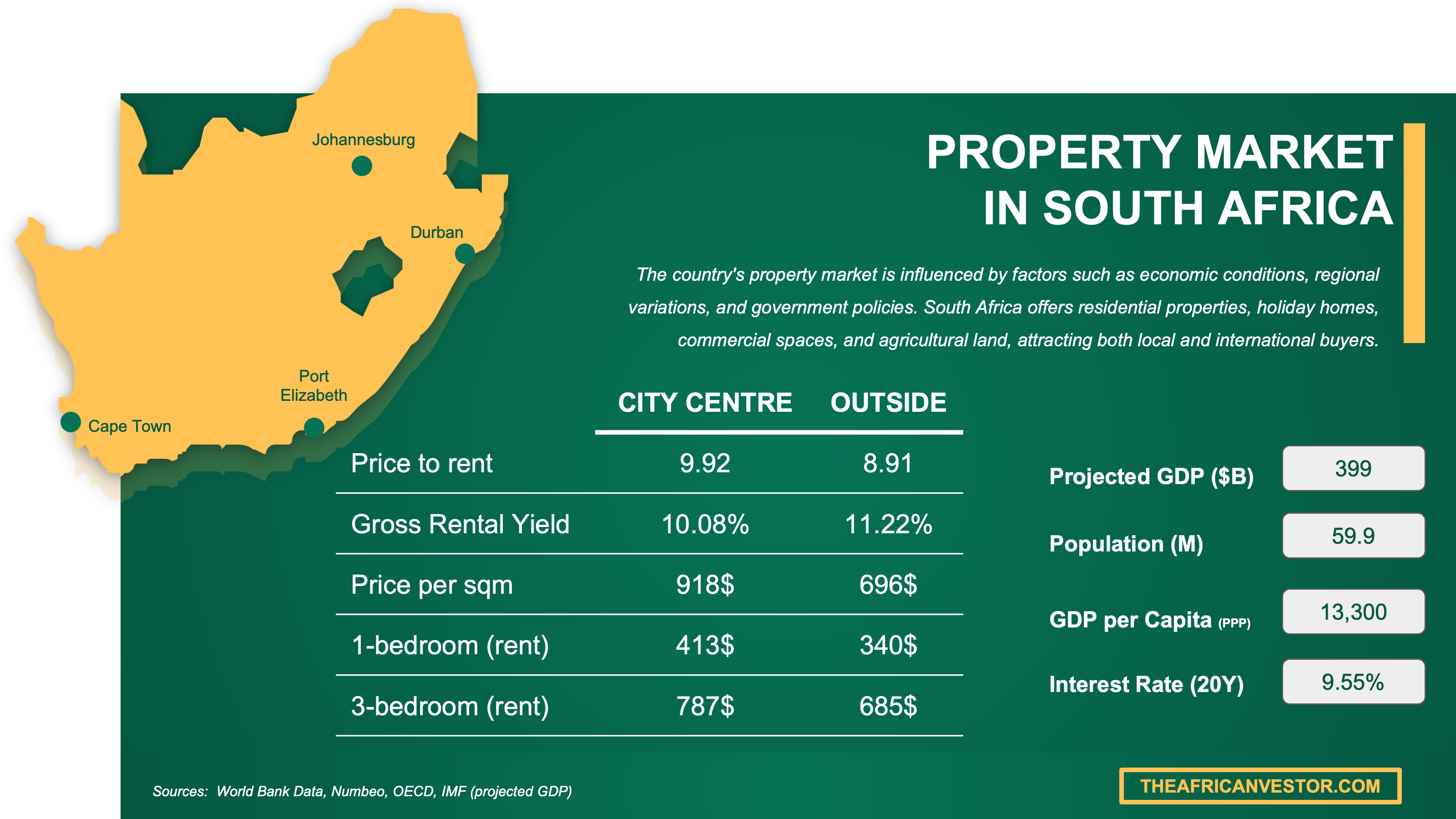
We have made this infographic to give you a quick and clear snapshot of the property market in South Africa. It highlights key facts like rental prices, yields, and property costs both in city centers and outside, so you can easily compare opportunities. We’ve done some research and also included useful insights about the country’s economy, like GDP, population, and interest rates, to help you understand the bigger picture.
