
Authored by the expert who managed and guided the team behind the South Africa Property Pack

Yes, the analysis of Johannesburg's property market is included in our pack
Johannesburg is South Africa's economic powerhouse and the largest city on the African continent, attracting thousands of expats each year for career opportunities, lifestyle, and adventure.
This comprehensive Johannesburg expat guide for 2026 covers everything you need to know about living costs, safety, healthcare, schools, visas, jobs, and buying property in Johannesburg.
We constantly update this blog post to ensure you have the most accurate and current information available.
And if you're planning to buy a property in this place, you may want to download our pack covering the real estate market in Johannesburg.
Is Johannesburg a good place to live in 2026?
Is quality of life getting better or worse in Johannesburg in 2026?
As of early 2026, quality of life in Johannesburg is on a mixed but cautiously improving trajectory, with lifestyle nodes like Sandton and Rosebank offering increasingly polished urban experiences while infrastructure challenges persist in other parts of the city.
The factor that has improved most notably in Johannesburg over the past two to three years is the reduction in load shedding (power outages), which plagued the city in 2023 and 2024 but has stabilized significantly by early 2026, making daily life and business operations more predictable.
However, the persistent challenge remains security, as Johannesburg residents still invest heavily in private security, gated living, and careful route planning, which adds friction and cost to everyday life even in affluent neighborhoods.
Are hospitals good in Johannesburg in 2026?
As of early 2026, private hospitals in Johannesburg are generally of good quality and comparable to Western European or North American standards, while public hospitals are more variable and typically underfunded.
The hospitals most commonly recommended by expats in Johannesburg include Wits Donald Gordon Medical Centre in Parktown, Netcare Milpark Hospital known for its trauma unit, and Mediclinic Sandton in the northern suburbs.
A standard GP consultation in Johannesburg in 2026 typically costs between R500 and R900 (approximately $27 to $50 or €25 to €45), while specialist consultations can range from R900 to R1,600 or more.
Private health insurance is strongly recommended for expats in Johannesburg because the private healthcare system, which most expats use, operates through medical schemes that provide predictable access and billing, with monthly premiums typically ranging from R2,000 to R9,000 per person depending on coverage level.
Are there any good international schools in Johannesburg in 2026?
As of early 2026, Johannesburg has approximately 10 to 15 international schools offering various curricula including American, British, French, German, and International Baccalaureate programs, with generally high academic standards and excellent facilities.
The most reputable international schools among expat families in Johannesburg include the American International School of Johannesburg (AISJ) in Bryanston, Deutsche Internationale Schule Johannesburg (DSJ), and Lycée Jules Verne for French-curriculum education.
Annual tuition fees at international schools in Johannesburg in 2026 typically range from R90,000 to R700,000 (approximately $5,000 to $38,000 or €4,600 to €35,000), with the American International School at the higher end charging around R380,000 to R680,000 depending on grade level.
Waitlists for popular international schools in Johannesburg, particularly at entry grades like Pre-K, Grade 1, and Grade 8, can be long, so expat families are advised to apply 6 to 12 months in advance, and while some public schools are excellent, most expats choose private or international options for curriculum consistency and predictable resources.
Is Johannesburg a dangerous place in 2026?
As of early 2026, Johannesburg is not uniformly dangerous but has a high crime rate compared to most Western cities, with safety varying dramatically by neighborhood, building security, and daily habits.
The most common safety concerns for expats in Johannesburg are property crime and opportunistic theft such as phone snatching and smash-and-grab attacks on vehicles, while more serious crimes like armed robbery and carjacking tend to occur in specific hotspots that expats can largely avoid with local knowledge.
The safest neighborhoods in Johannesburg for expats include Sandton, Rosebank, Melrose Arch, Parkhurst, Illovo, Bryanston, and security estates like Dainfern and Waterfall, which offer controlled access and 24-hour security.
Many women do live alone safely in Johannesburg by choosing secure apartment buildings with controlled access, avoiding walking alone at night in quiet areas, using e-hailing services like Uber for door-to-door transport, and living in neighborhoods with strong everyday footfall or estate security.
Thinking of buying real estate in Johannesburg?
Acquiring property in a different country is a complex task. Don't fall into common traps – grab our guide and make better decisions.

How much does everyday life cost in Johannesburg in 2026?
What monthly budget do I need to live well in Johannesburg in 2026?
As of early 2026, a single person can live comfortably in a prime Johannesburg neighborhood like Rosebank or Sandton on approximately R45,000 to R65,000 per month (about $2,500 to $3,500 or €2,300 to €3,200), including rent, car, healthcare, and lifestyle expenses.
A modest but decent lifestyle in Johannesburg is achievable on around R25,000 to R35,000 per month ($1,400 to $1,900 or €1,250 to €1,750), which covers basic rent in a secure building outside prime areas, transport, groceries, and essential costs without many luxuries.
A more comfortable or upscale lifestyle in Johannesburg, including a 2-bedroom apartment in Sandton, a car, private healthcare, dining out regularly, and weekend activities, requires approximately R75,000 to R110,000 per month ($4,000 to $6,000 or €3,700 to €5,500) for a couple, or R130,000 to R220,000+ ($7,000 to $12,000 or €6,500 to €11,000) for a family with children in international school.
In Johannesburg, housing combined with transport and security costs typically takes the largest share of a monthly budget, often 40% to 50%, because expats tend to live in secure buildings or estates, own or lease a car due to limited walkability, and factor in backup power solutions and private security subscriptions.
What is the average income tax rate in Johannesburg in 2026?
As of early 2026, a typical middle-income earner in Johannesburg earning around R500,000 per year (approximately $27,000 or €25,000) pays an effective income tax rate of about 20%, while someone earning R800,000 per year pays around 26% effective tax after the primary rebate.
South Africa uses a progressive income tax system with marginal rates ranging from 18% for the lowest bracket up to 45% for income above R1,817,000 per year, meaning higher earners pay progressively more on each additional rand earned, with the effective rate being lower than the marginal rate due to brackets and rebates.
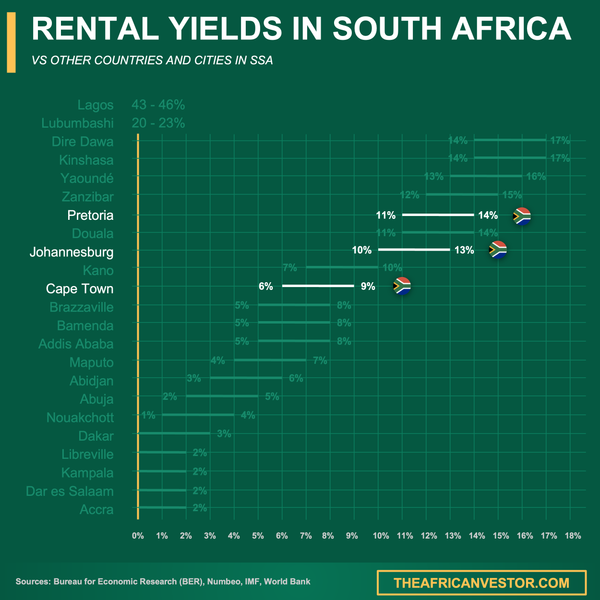
We did some research and made this infographic to help you quickly compare rental yields of the major cities in South Africa versus those in neighboring countries. It provides a clear view of how this country positions itself as a real estate investment destination, which might interest you if you’re planning to invest there.
What kind of foreigners actually live in Johannesburg in 2026?
Where do most expats come from in Johannesburg in 2026?
As of early 2026, the largest share of international migrants in Johannesburg and Gauteng province come from other African countries, particularly Zimbabwe, Mozambique, Lesotho, and Nigeria, while the corporate expat community includes significant numbers from the UK, Germany, India, China, and the United States.
South Africa hosts an estimated 2.4 to 3 million international migrants, with Gauteng province (where Johannesburg is located) being the primary destination, accounting for a large portion of the country's foreign-born population due to its economic opportunities.
Regional African migrants are drawn to Johannesburg primarily by economic opportunity and proximity, while Western and Asian expats typically relocate for corporate positions in finance, mining headquarters, consulting, and technology sectors concentrated in Sandton and surrounding business districts.
The expat population in Johannesburg is predominantly working professionals in corporate, mining, and financial services roles, with smaller communities of entrepreneurs, diplomats, NGO workers, and some retirees, rather than the digital nomad crowd more common in Cape Town.
Where do most expats live in Johannesburg in 2026?
As of early 2026, expats in Johannesburg concentrate primarily in the northern suburbs including Sandton (Morningside, Bryanston, Rivonia), the Rosebank-Melrose-Illovo corridor, and family-oriented security estates like Dainfern, Fourways, and Waterfall in Midrand.
These neighborhoods attract expats because they combine proximity to corporate headquarters and business districts with secure living options, walkable lifestyle pockets with restaurants and shops, good international school access, and established expat communities that make settling in easier.
Emerging neighborhoods attracting more expats in Johannesburg include Waterfall Estate in Midrand with its modern developments and corporate parks, the regenerating Maboneng district for creatives seeking urban lifestyle, and parts of Johannesburg CBD for adventurous expats drawn to inner-city renewal projects.
Are expats moving in or leaving Johannesburg in 2026?
As of early 2026, the expat migration trend in Johannesburg is mixed, with economic opportunities continuing to attract new arrivals, particularly in finance and corporate sectors, while some long-term residents have departed citing security concerns and infrastructure frustrations from previous years.
The main factor driving expats to move to Johannesburg right now is career opportunity, as the city remains South Africa's economic hub with the highest concentration of multinational headquarters, financial services firms, and professional services jobs on the continent.
The main factors causing some expats to leave Johannesburg include the cumulative effect of security-related lifestyle adjustments, concerns about long-term infrastructure reliability (although load shedding has improved), and some families choosing Cape Town or international relocation for perceived better quality of life.
Compared to other African destinations, Johannesburg still attracts more corporate expats than cities like Lagos or Nairobi due to its developed infrastructure, established business ecosystem, and relatively high living standards, though Cape Town increasingly competes for remote workers and lifestyle-focused expats.
Get fresh and reliable information about the market in Johannesburg
Don't base significant investment decisions on outdated data. Get updated and accurate information.
What paperwork do I need to move to Johannesburg in 2026?
What visa options are popular in Johannesburg in 2026?
As of early 2026, the three most popular visa types for expats moving to Johannesburg are the Critical Skills Work Visa for professionals in scarce occupations, the General Work Visa for those with a confirmed job offer, and the Intra-company Transfer Work Visa for employees relocating within a multinational company.
The Critical Skills Work Visa, which is the most sought-after option, requires your occupation to appear on South Africa's Critical Skills List, a SAQA evaluation of your foreign qualifications, registration with a relevant professional body, at least five years of work experience, and typically a job offer from a South African employer.
South Africa does not currently offer a dedicated digital nomad visa in 2026, though there have been discussions about introducing one; remote workers typically enter on tourist visas (up to 90 days) or explore business visa options, but working remotely for foreign clients while on a tourist visa occupies a legal gray area.
Critical Skills Work Visas are typically valid for up to 5 years with a job offer (or 1 year without), General Work Visas are usually issued for the duration of the employment contract up to 5 years, and all work visas can be renewed within South Africa provided you continue to meet the requirements.
How long does it take to get residency in Johannesburg in 2026?
As of early 2026, obtaining a temporary residence visa (work visa) in South Africa typically takes 4 to 12 weeks from application to approval, while permanent residence applications often take 12 to 24 months or longer due to administrative backlogs.
Factors that can delay your residency application include incomplete documentation, SAQA qualification evaluation delays, professional body registration processing times, and general Department of Home Affairs workload, while having a Trusted Employer sponsor or using experienced immigration attorneys can help speed things up.
To become eligible for permanent residence in South Africa, you typically need to hold a work visa and have been employed continuously in the country for at least 5 years, or qualify through other routes like critical skills (where permanent residence can be applied for immediately upon securing permanent employment) or spousal relationships.

We created this infographic to give you a simple idea of how much it costs to buy property in different parts of South Africa. As you can see, it breaks down price ranges and property types for popular cities in the country. We hope this makes it easier to explore your options and understand the market.
How hard is it to find a job in Johannesburg in 2026?
Which industries are hiring the most in Johannesburg in 2026?
As of early 2026, the top three industries hiring the most in Johannesburg are financial services and fintech (concentrated in the Sandton business district), mining and mining services headquarters functions, and professional services including audit, tax, legal, and management consulting.
It is realistic for expats to get hired in Johannesburg without speaking local languages like Zulu, Sotho, or Afrikaans, as English is the dominant business language in corporate environments, though knowing local languages can be a significant advantage for customer-facing roles and deeper professional integration.
The most accessible roles for foreign job seekers in Johannesburg include specialized positions in IT and software development, financial analysis and actuarial work, engineering (particularly mining and civil), healthcare specialists, and senior management roles where international experience is valued and local talent is scarce.
What salary ranges are common for expats in Johannesburg in 2026?
As of early 2026, typical salary ranges for expats working in professional roles in Johannesburg span from R600,000 to R2,500,000 per year (approximately $33,000 to $135,000 or €30,000 to €125,000), depending heavily on industry, seniority, and the scarcity of the skills involved.
Entry-level to mid-level expat positions in Johannesburg typically pay R400,000 to R800,000 per year ($22,000 to $43,000 or €20,000 to €40,000), which covers roles like junior consultants, analysts, engineers with a few years of experience, and mid-level corporate professionals.
Senior specialists and management expat roles in Johannesburg typically command R1,200,000 to R2,500,000+ per year ($65,000 to $135,000+ or €60,000 to €125,000+), with executive positions and highly scarce technical skills potentially exceeding these ranges, particularly in mining, finance, and technology leadership.
Employers in Johannesburg do sponsor work visas, but typically for scarce skills and senior roles where local talent is genuinely unavailable, and sponsorship is more common among large multinational corporations and companies with established immigration processes than among smaller local firms.
Get to know the market before buying a property in Johannesburg
Better information leads to better decisions. Get all the data you need before investing a large amount of money.
What's daily life really like for expats in Johannesburg right now?
What do expats love most about living in Johannesburg right now?
Expats in Johannesburg most commonly love the career density and networking opportunities, the excellent food and restaurant scene in areas like Rosebank and Parkhurst, and the easy access to world-class wildlife experiences and weekend escapes like Pilanesberg, Magaliesberg, and the Kruger National Park.
The lifestyle benefit most frequently praised is the outdoor lifestyle combined with affordable domestic help, allowing expats to enjoy spacious homes with gardens, pools, and the ability to outsource household tasks in ways that would be unaffordable in their home countries.
Expats appreciate that their money goes further in Johannesburg compared to London, New York, or Sydney, with dining out, domestic wine, and household staff being particularly good value, while housing offers significantly more space than equivalent spending in major Western cities.
Socially and culturally, expats enjoy Johannesburg's genuinely multicultural environment, the warmth and hospitality of South Africans, the vibrant arts and music scene, and the sense of possibility in a city where entrepreneurship and innovation are thriving despite broader economic challenges.
What do expats dislike most about life in Johannesburg right now?
Expats' top complaints about Johannesburg include the constant security awareness required (planning routes, avoiding certain areas at night, living in gated complexes), the heavy dependence on cars due to limited walkability and unreliable public transport, and the ongoing need to budget for infrastructure redundancies like backup power and water storage.
The daily inconvenience that frustrates expats most in Johannesburg is traffic congestion, as the sprawling city design means commutes between the northern suburbs and different business nodes can be lengthy and stressful, particularly during peak hours when a 15km drive can take over an hour.
Bureaucratic headaches that frustrate expats include the slow and unpredictable visa and permit processes at the Department of Home Affairs, difficulties in getting foreign qualifications recognized by SAQA, and the complexity of registering with professional bodies required for certain work visas.
Most expats find these frustrations manageable rather than deal-breakers, particularly if their employer provides support for visa processes, they choose their neighborhood carefully to minimize commute friction, and they accept that budgeting for security and infrastructure redundancy is simply part of Johannesburg life.
What are the biggest culture shocks in Johannesburg right now?
The biggest culture shocks for expats moving to Johannesburg include how completely normalized private security, electric fences, gated communities, and controlled-access living are, how quickly locals switch between world-class experiences and high-friction realities, and the stark visible inequality between affluent suburbs and nearby townships.
The social norm that surprises newcomers most is how openly South Africans discuss crime, security measures, and "close calls" as a normal part of conversation, with detailed advice about which intersections to avoid at night or how to handle different carjacking scenarios being shared casually among colleagues and neighbors.
The aspect of daily routines that takes longest to adjust to in Johannesburg is the car-centric lifestyle where almost everything requires driving, as expats from walkable cities find themselves driving to the gym, to meet friends for coffee, and even to visit a neighbor, with the associated planning around traffic and parking becoming second nature only after several months.

We made this infographic to show you how property prices in South Africa compare to other big cities across the region. It breaks down the average price per square meter in city centers, so you can see how cities stack up. It’s an easy way to spot where you might get the best value for your money. We hope you like it.
Can I buy a home as a foreigner in Johannesburg in 2026?
Can foreigners legally own property in Johannesburg in 2026?
As of early 2026, foreigners can legally own property in South Africa including Johannesburg with full freehold ownership rights identical to South African citizens, and there are no nationality-based restrictions on purchasing residential, commercial, or agricultural property.
The main conditions that apply to foreigners buying property in Johannesburg relate to financing and fund transfers rather than ownership itself: non-residents must transfer funds into South Africa through authorized channels complying with exchange control regulations, and the South African Reserve Bank monitors large transactions for compliance purposes.
Foreigners can own all property types in Johannesburg including freestanding houses, apartments (sectional title), townhouses, land, commercial buildings, and even agricultural property, with the title deed registered directly in the foreign buyer's name providing complete ownership of both land and structures.
What is the average price per m² in Johannesburg in 2026?
As of early 2026, the average price per square meter for residential property in Johannesburg ranges from approximately R11,000 to R16,000 (roughly $600 to $870 or €550 to €800) for typical middle-market apartments and townhouses, with prime areas like Sandton and Rosebank commanding premiums above R20,000 per m².
Property prices in Johannesburg have been relatively stable over the past two to three years with modest growth, recovering from a sluggish period and showing firmer sentiment by early 2026, with bank economists noting that price growth has outpaced inflation slightly but remains far from a boom.
Do banks give mortgages to foreigners in Johannesburg in 2026?
As of early 2026, mortgages for foreigners in Johannesburg are available but limited, with most major South African banks offering home loans to non-residents at a maximum loan-to-value ratio of 50%, meaning you need to provide at least a 50% cash deposit from foreign funds.
The major banks in Johannesburg known to offer mortgages to foreigners include First National Bank (FNB) with their Foreign Choice product, Standard Bank, and Absa, all of which have established processes for international buyers.
Typical mortgage conditions for foreigners in Johannesburg include a 50% deposit requirement for non-residents, interest rates at prime plus 0.5% to 2% (making effective rates around 11% to 13% in early 2026), loan terms up to 20 to 30 years, and a requirement to obtain South African Reserve Bank approval before the loan can proceed.
To qualify for a mortgage as a foreigner in Johannesburg, you typically need a valid passport, proof of income from your home country, bank statements, a credit history verification, SARB exchange control approval, and often you'll need to open a South African bank account for repayments.
Buying real estate in Johannesburg can be risky
An increasing number of foreign investors are showing interest. However, 90% of them will make mistakes. Avoid the pitfalls with our comprehensive guide.

What sources have we used to write this blog article?
Whether it's in our blog articles or the market analyses included in our property pack about Johannesburg, we always rely on the strongest methodology we can … and we don't throw out numbers at random.
We also aim to be fully transparent, so below we've listed the authoritative sources we used, and explained how we used them and the methods behind our estimates.
| Source | Why it's authoritative | How we used it |
|---|---|---|
| South African Revenue Service (SARS) | SARS is the official tax authority and the legal reference for income tax. | We used the 2026 tax year brackets and rebates to calculate effective tax rates at common expat salaries. We translated gross salaries into realistic take-home pay for Johannesburg expats. |
| Statistics South Africa (Stats SA) | Stats SA is South Africa's official statistics agency with credible migration data. | We used their migration reports to ground our claims about expat origins and population patterns. We avoided anecdotal claims by relying on official census and survey data. |
| South African Police Service (SAPS) | SAPS is the national police service and official publisher of crime statistics. | We used SAPS data to frame Johannesburg safety realistically and distinguish between crime types. We built practical neighborhood and lifestyle advice based on precinct-level patterns. |
| PayProp Rental Index | PayProp maintains a transparent rental dataset based on actual managed portfolios. | We used their national rent baseline and adjusted upward for Johannesburg's prime nodes. We built realistic housing budgets for expats rather than relying on listing prices alone. |
| Property24 | Property24 is South Africa's largest property portal with consistent market data. | We used their Johannesburg trends to triangulate average prices and market direction. We combined price levels with typical unit sizes to estimate realistic price per m² ranges. |
| Council for Medical Schemes (CMS) | CMS regulates medical schemes and provides credible healthcare funding data. | We used their reports to explain why private cover is standard for expats in Johannesburg. We anchored healthcare affordability discussions and insurance recommendations. |
| GEMS Tariff Files | GEMS publishes formal tariff schedules used for medical reimbursement. | We extracted GP consultation tariff values to estimate typical appointment costs. We built confident Johannesburg price ranges by adding typical private provider markups. |
| Deutsche Internationale Schule Johannesburg | DSJ publishes official fee schedules that are direct and auditable. | We used their 2026 fee schedule to provide hard-number examples of international school costs. We triangulated the broader international school fee range in Johannesburg. |
| FNB Property Barometer | FNB's economics team is widely cited for South African housing market analysis. | We used their commentary to contextualize whether Johannesburg prices are rising faster than inflation. We triangulated market momentum versus listing-based sources. |
| Expat Arrivals | Expat Arrivals provides practical, interview-based insights from actual expats. | We gathered lifestyle sentiment and practical tips from expat experiences. We validated our cost of living and quality of life assessments against real-world feedback. |
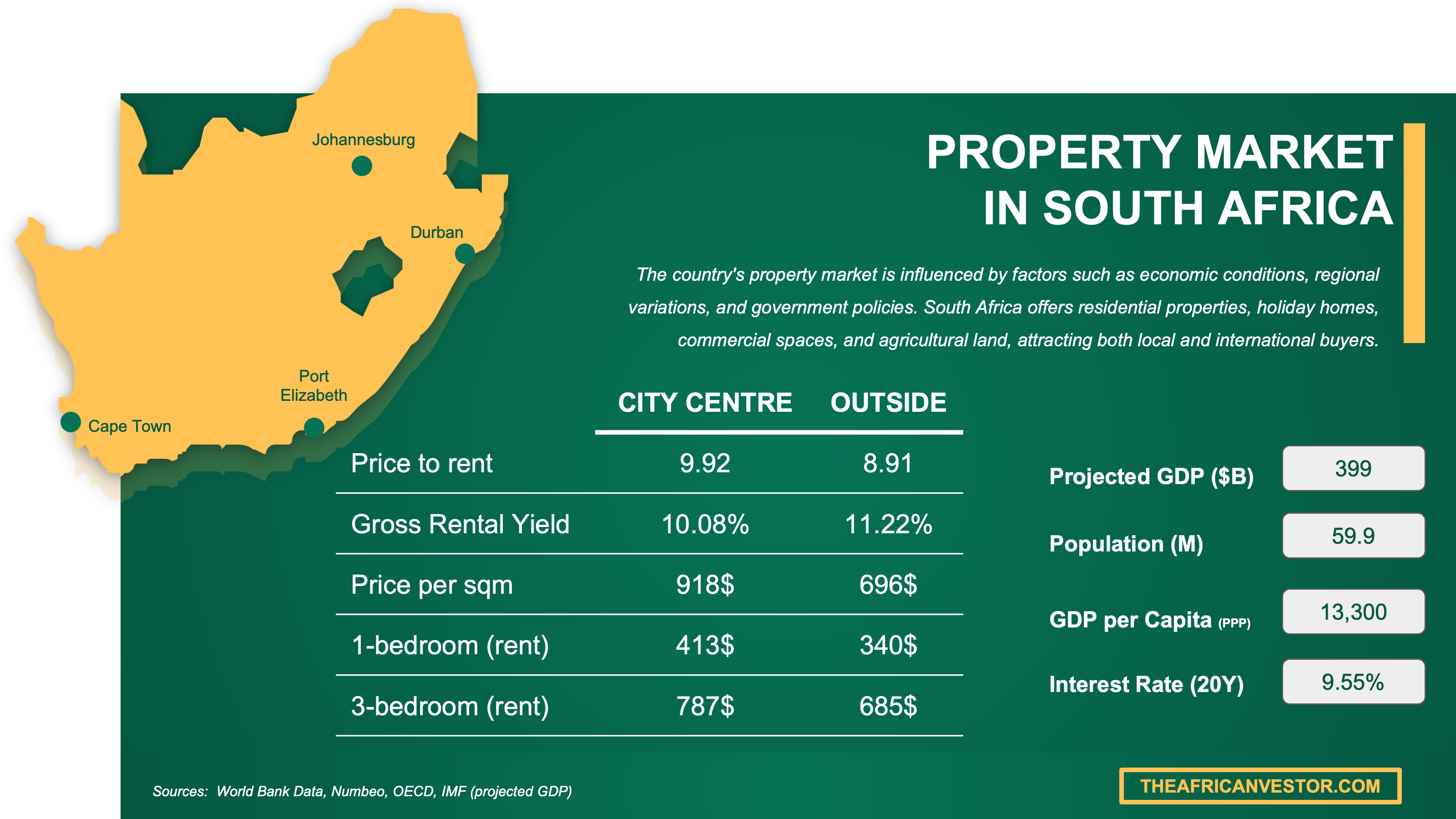
We have made this infographic to give you a quick and clear snapshot of the property market in South Africa. It highlights key facts like rental prices, yields, and property costs both in city centers and outside, so you can easily compare opportunities. We’ve done some research and also included useful insights about the country’s economy, like GDP, population, and interest rates, to help you understand the bigger picture.
