

Get all the data you need about the real estate market in Johannesburg
SUMMARY
We analyzed apartment rental yields in Johannesburg, as of 2026, for residential apartment buyers using the raw dataset provided, then turned the neighborhood-level price, rent, gross yield, and net yield evidence into a practical guide for foreign individual buyers.
This page is designed as a regularly updated Johannesburg apartment yield tracker. The numbers should be read as a May 2026 snapshot, not as a promise of future rental income.
The clearest finding is that Johannesburg offers unusually high apartment rental yields compared with many global city markets, with several modeled gross yields above 10% and several modeled net yields above 8.5%.
Bedfordview is the strongest yield area in the dataset. Its modeled net yields range from 9.2% for studios to 9.6% for 2-bedroom apartments, which makes it the best all-round income market in the table.
Sunninghill, Randburg, Sandton Central, Rosebank, and Killarney also look strong because they combine solid rents, realistic entry prices, and enough tenant depth to make the income case believable.
The weakest pure yield profile appears in Johannesburg CBD 2-bedroom apartments, where the modeled net yield falls to 6.2%. That is still not low in absolute terms, but it is weak once vacancy, resale, security, and building-management risk are considered.
Studios are often the most capital-efficient apartment type in Johannesburg. They work especially well in Braamfontein, Sunninghill, Randburg, Killarney, and Parktown because demand comes from students, young workers, first-job renters, and single professionals.
For a beginner foreign buyer, the safest income strategy is not simply to chase the highest gross yield. The better approach is to compare net yield, tenant quality, building management, vacancy risk, resale liquidity, and neighborhood safety together.
The practical takeaway is that Bedfordview, Sandton Central, Sunninghill, Randburg, and Rosebank offer different versions of the same trade-off: income return, tenant quality, entry price, and liquidity.
Get fresh and reliable information about the market in Johannesburg
Don't base significant investment decisions on outdated data. Get updated and accurate information.

Neighborhoods and apartment rental yields in Johannesburg in 2026
This table compares apartment rental yields in Johannesburg by neighborhood and apartment size, using modeled May 2026 estimates from the supplied dataset.
For each area, the table shows estimated purchase price, estimated monthly rent, gross rental yield, and net rental yield for studio, 1-bedroom, and 2-bedroom apartments.
Finally, please note you'll find much more detailed data in our real estate pack about Johannesburg.
| Neighborhood | Studio average purchase price | Studio average monthly rent | Studio gross rental yield | Studio net rental yield | 1-bedroom average purchase price | 1-bedroom average monthly rent | 1-bedroom gross rental yield | 1-bedroom net rental yield | 2-bedroom average purchase price | 2-bedroom average monthly rent | 2-bedroom gross rental yield | 2-bedroom net rental yield |
|---|---|---|---|---|---|---|---|---|---|---|---|---|
| Bedfordview | R750,000 | R7,000 | 11.2% | 9.2% | R950,000 | R9,000 | 11.4% | 9.4% | R1,350,000 | R13,000 | 11.6% | 9.6% |
| Braamfontein | R520,000 | R5,200 | 12.0% | 9.5% | R700,000 | R6,700 | 11.5% | 9.0% | R1,050,000 | R9,000 | 10.3% | 7.8% |
| Fourways | R780,000 | R6,900 | 10.6% | 8.4% | R1,050,000 | R8,500 | 9.7% | 7.5% | R1,450,000 | R12,500 | 10.3% | 8.1% |
| Illovo | R950,000 | R8,500 | 10.7% | 8.7% | R1,350,000 | R11,500 | 10.2% | 8.2% | R2,100,000 | R17,000 | 9.7% | 7.7% |
| Johannesburg CBD | R400,000 | R3,900 | 11.7% | 8.7% | R550,000 | R5,000 | 10.9% | 7.9% | R850,000 | R6,500 | 9.2% | 6.2% |
| Killarney | R550,000 | R5,200 | 11.3% | 9.0% | R760,000 | R6,900 | 10.9% | 8.6% | R1,150,000 | R9,500 | 9.9% | 7.6% |
| Maboneng | R600,000 | R5,800 | 11.6% | 8.8% | R790,000 | R7,500 | 11.4% | 8.6% | R1,200,000 | R10,500 | 10.5% | 7.7% |
| Melrose Arch | R1,450,000 | R12,000 | 9.9% | 7.8% | R2,000,000 | R17,000 | 10.2% | 8.1% | R3,000,000 | R25,000 | 10.0% | 7.9% |
| Melville / Auckland Park | R600,000 | R5,700 | 11.4% | 8.9% | R820,000 | R7,200 | 10.5% | 8.0% | R1,200,000 | R10,000 | 10.0% | 7.5% |
| Parktown | R650,000 | R6,000 | 11.1% | 8.8% | R900,000 | R8,000 | 10.7% | 8.4% | R1,350,000 | R12,000 | 10.7% | 8.4% |
| Randburg | R500,000 | R4,800 | 11.5% | 9.1% | R700,000 | R6,400 | 11.0% | 8.6% | R1,000,000 | R9,200 | 11.0% | 8.6% |
| Rosebank | R1,100,000 | R9,500 | 10.4% | 8.5% | R1,600,000 | R14,000 | 10.5% | 8.6% | R2,500,000 | R20,500 | 9.8% | 7.9% |
| Sandton Central | R900,000 | R8,200 | 10.9% | 8.9% | R1,450,000 | R13,000 | 10.8% | 8.8% | R2,250,000 | R20,000 | 10.7% | 8.7% |
| Sunninghill | R650,000 | R6,200 | 11.4% | 9.3% | R900,000 | R8,000 | 10.7% | 8.6% | R1,250,000 | R11,200 | 10.8% | 8.7% |
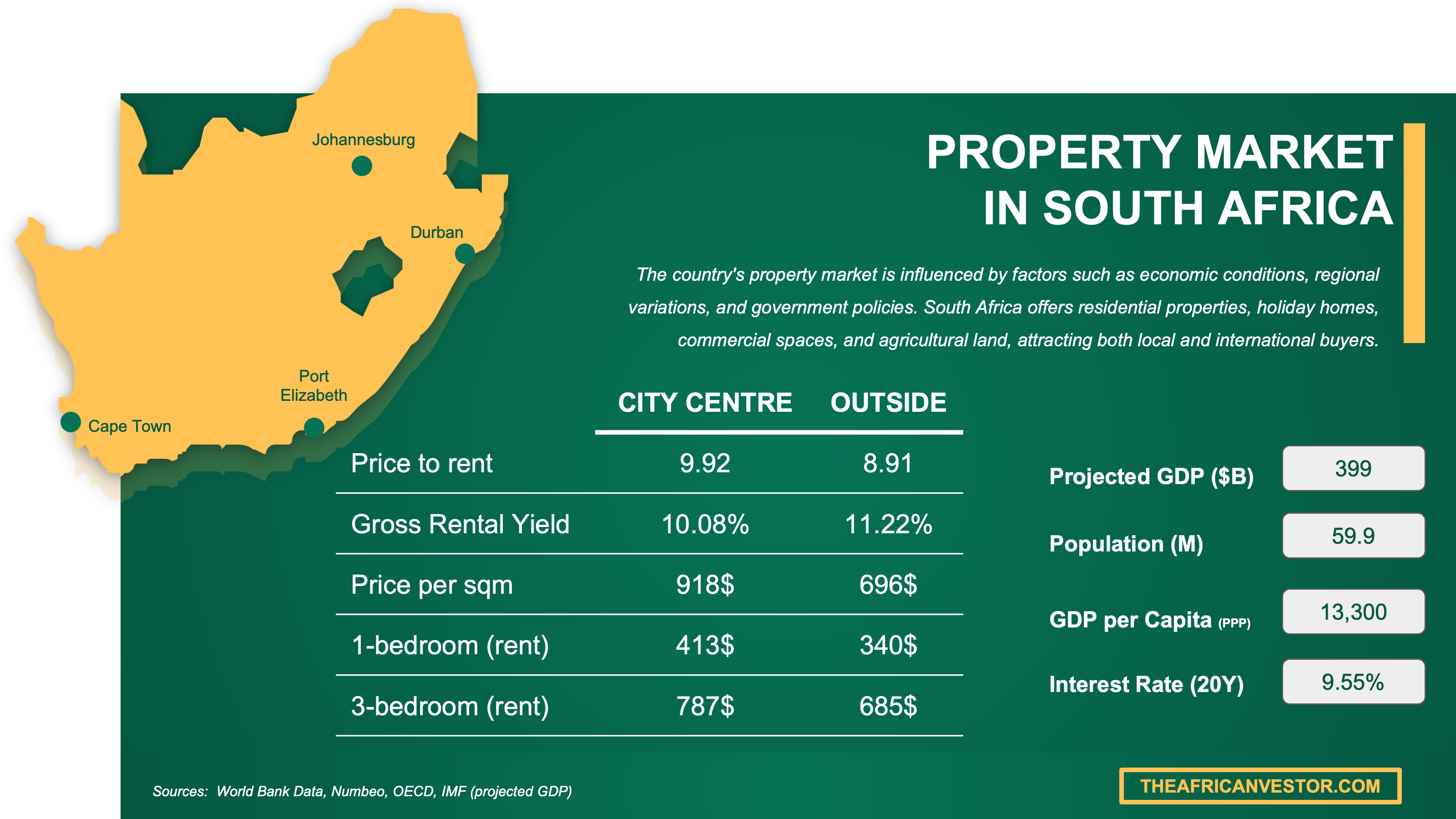
We have made this infographic to give you a quick and clear snapshot of the property market in South Africa. It highlights key facts like rental prices, yields, and property costs both in city centers and outside, so you can easily compare opportunities. We’ve done some research and also included useful insights about the country’s economy, like GDP, population, and interest rates, to help you understand the bigger picture.
Which neighborhoods offer the best net yield among areas people actually want to live in Johannesburg?
The best net-yield neighborhoods among areas people actually want to live in Johannesburg are Bedfordview, Sunninghill, Randburg, Sandton Central, Rosebank, and Killarney.
These areas combine modeled net yields around 8.5% to 9.6% with enough tenant depth to make the yield believable for a residential apartment buyer.
Bedfordview is the standout in the table. Estimated net yields range from 9.2% for studios to 9.6% for 2-bedroom apartments, so the income case is strong across all three apartment sizes.
Sunninghill is also attractive, especially for studios and 2-bedroom apartments. Its modeled net yields are 9.3% for studios, 8.6% for 1-bedroom apartments, and 8.7% for 2-bedroom apartments.
Sandton Central and Rosebank are more expensive, but they are safer than many high-yield areas because tenant demand is supported by offices, transport access, business travel, retail, restaurants, and walkability.
The trade-off is simple. Bedfordview, Randburg, and Sunninghill give better entry prices, while Rosebank and Sandton Central give better liquidity and tenant quality.
Where can I find apartments with above-average yields and below-average entry prices in Johannesburg?
The clearest Johannesburg value pockets are Randburg, Sunninghill, Killarney, Braamfontein studios, and selected Johannesburg CBD studios.
They offer entry prices below prime northern suburbs while still producing modeled net yields above roughly 8.5% in the strongest apartment formats.
Randburg is the most balanced low-entry option. A modeled 1-bedroom apartment costs about R700,000, rents for about R6,400 per month, and gives an estimated 8.6% net yield.
Sunninghill is slightly more expensive but cleaner operationally. A studio at about R650,000 and R6,200 monthly rent gives a modeled 9.3% net yield, helped by demand from northern-suburbs workers who cannot or do not want to pay Sandton prices.
Braamfontein studios look strong at about 9.5% net yield, but the tenant base is more student and young-worker driven. That means more turnover and more sensitivity to building quality, security, furniture, and management.
Johannesburg CBD studios look cheap at about R400,000, but the low price is partly a risk signal. The modeled net yield is still 8.7%, yet vacancy, building management, resale liquidity, and safety perception make it less beginner-friendly than Randburg or Sunninghill.
Where does the rent level justify the purchase price most clearly in Johannesburg?
The rent level most clearly justifies the purchase price in Bedfordview, Sandton Central, Sunninghill, Randburg, and Rosebank 1-bedroom apartments.
These Johannesburg markets show a good rent-to-price relationship without depending only on very low purchase prices.
Bedfordview 2-bedroom apartments are the strongest example. At about R1.35 million purchase price and R13,000 monthly rent, the modeled gross yield is 11.6% and the modeled net yield is 9.6%.
Sandton Central is also rational despite higher prices. A 1-bedroom apartment at about R1.45 million and R13,000 monthly rent gives about 10.8% gross yield and 8.8% net yield.
Rosebank is expensive, but the rent premium has real support. A 1-bedroom apartment at about R1.6 million and R14,000 monthly rent still reaches about 8.6% modeled net yield.
The weak cases are places where both price and rent are low, but risk is high. Johannesburg CBD can look rational on paper, but weaker resale liquidity and building-management variation mean the rent-to-price ratio is not enough by itself.
We have actually built the our real estate pack about Johannesburg to make sure you won’t buy in the wrong area. Check it out.
Make a profitable investment in Johannesburg
Better information leads to better decisions. Save time and money. Download our data.
Where is the best place to buy if I want stable rental income rather than maximum yield in Johannesburg?
For stable rental income rather than maximum yield in Johannesburg, the best areas are Sandton Central, Rosebank, Illovo, Bedfordview, and Sunninghill.
They are not always the highest-yielding neighborhoods in the dataset, but they offer deeper tenant pools and better resale logic.
Sandton Central is the cleanest stability market. Its modeled net yields are 8.7% to 8.9%, and its tenant base includes corporate renters, business travellers, consultants, young professionals, and expats.
Rosebank is similar but more walkable. Its modeled net yield is lower for 2-bedroom apartments at 7.9%, but 1-bedroom apartments still reach 8.6%, supported by transport, offices, retail, restaurants, and lifestyle demand.
Illovo is more conservative. Net yields are around 7.7% to 8.7%, but it benefits from proximity to Sandton, Rosebank, Melrose, and established apartment buildings.
The trade-off is that stable areas cost more. You accept a lower headline yield because vacancy, tenant-quality risk, and resale uncertainty are usually lower than in higher-yield inner-city areas.
Which apartment type gives the best return for the lowest total investment in Johannesburg?
For most beginner investors in Johannesburg, studio apartments give the highest return for the lowest total investment, but 1-bedroom apartments are the best all-round product.
Studios are strongest on capital efficiency. In the table, studios often cost R400,000 to R750,000 outside prime nodes and still produce modeled net yields around 8.7% to 9.5%.
The studio demand base in Johannesburg is mostly students, young professionals, interns, first-job renters, and single workers. This works best in Braamfontein, Sunninghill, Randburg, Killarney, and Parktown.
1-bedroom apartments are usually easier to resell and easier to rent to a wider tenant pool. In Sandton Central, Rosebank, Randburg, and Sunninghill, 1-bedroom net yields cluster around 8.6% to 8.8%.
2-bedroom apartments produce higher absolute rent, but they require much more capital. They work best where sharers, couples, small families, or corporate tenants are deep enough, such as Bedfordview, Sandton Central, Sunninghill, and Parktown.
We give you more details in the our real estate pack about Johannesburg.
Which neighborhoods offer strong rental income with the lowest vacancy risk in Johannesburg?
The best Johannesburg neighborhoods for strong rent with lower vacancy risk are Sandton Central, Rosebank, Bedfordview, Sunninghill, Illovo, and Parktown.
They combine good monthly rents with durable renter demand, which matters more than chasing the absolute highest yield.
Sandton Central has some of the highest modeled monthly rents in the dataset: around R8,200 for studios, R13,000 for 1-bedroom apartments, and R20,000 for 2-bedroom apartments.
Rosebank has similar demand depth, especially for studios and 1-bedroom apartments. Studios rent for about R9,500 per month, while 1-bedroom apartments rent for about R14,000 per month.
Bedfordview is strong because it gives high rents without Sandton-level prices. Its modeled 2-bedroom monthly rent of R13,000 supports the highest net yield in the table.
Some high-rent areas can still be riskier. Melrose Arch has excellent rents, but the buyer entry price is high, so a vacant month is expensive and the tenant pool is narrower.
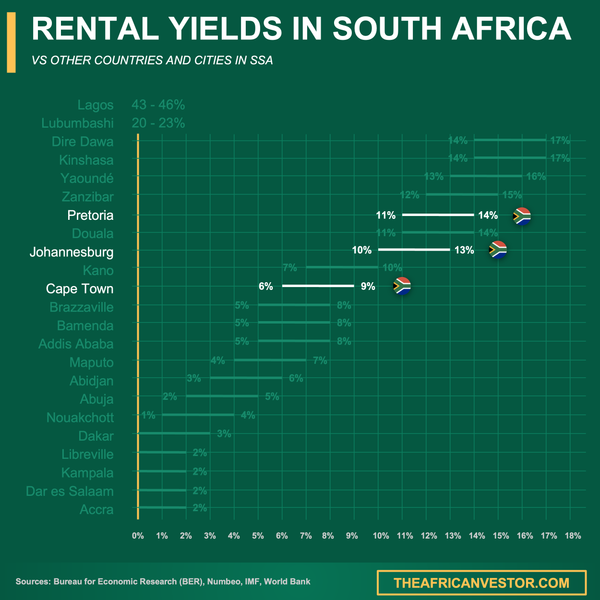
We did some research and made this infographic to help you quickly compare rental yields of the major cities in South Africa versus those in neighboring countries. It provides a clear view of how this country positions itself as a real estate investment destination, which might interest you if you’re planning to invest there.
Which areas look overpriced relative to their rental income in Johannesburg?
The areas that look most expensive relative to rental income are Melrose Arch, Rosebank 2-bedroom apartments, Illovo 2-bedroom apartments, and Fourways 1-bedroom apartments.
These are not bad places to live, but their income case is weaker than the headline rent may suggest.
Melrose Arch has very high rents, but purchase prices are also high. A modeled 2-bedroom apartment costs about R3 million, rents for about R25,000, and gives a net yield of about 7.9%.
Rosebank 2-bedroom apartments show the same issue. The estimated purchase price is about R2.5 million, while monthly rent is about R20,500, producing a modeled net yield of 7.9%.
Illovo 2-bedroom apartments are attractive for lifestyle and location, but at about R2.1 million and R17,000 rent, the modeled net yield is only 7.7%.
The trade-off is prestige versus income. These neighborhoods may preserve value better and attract stronger tenants, but a rental-income investor should not overpay just because the area is desirable.
Which neighborhoods should I avoid even if the rental yield looks attractive in Johannesburg?
A beginner should be careful with Johannesburg CBD, Maboneng, and some Braamfontein buildings, even when the headline yield looks attractive.
The issue is not always the neighborhood. The real issue is building-level risk, vacancy risk, security, body corporate health, and resale liquidity.
Johannesburg CBD studios show a modeled 11.7% gross yield, but the net yield falls to 8.7% after a heavier risk allowance. For 2-bedroom apartments, the net yield drops to only 6.2%.
Maboneng looks better on the surface, with modeled net yields of 8.8% for studios and 8.6% for 1-bedroom apartments. The risk is that demand can be more lifestyle and short-stay sensitive than in Sandton or Rosebank.
Braamfontein studios can work, but larger units are less compelling. The modeled 2-bedroom net yield is 7.8%, and student-heavy tenant demand can mean more turnover.
The avoid rule is not never buy there. It is do not buy there as a beginner unless the building is proven, secure, liquid, well-managed, and priced with a clear risk discount.
Which neighborhoods look risky even though the rental yield is high in Johannesburg?
The high-yield but riskier Johannesburg neighborhoods are Johannesburg CBD, Maboneng, Braamfontein, and parts of Melville / Auckland Park.
Their yields are attractive because purchase prices are lower, not always because demand is stronger or more stable.
Johannesburg CBD has the clearest risk-adjusted gap. Studios show 8.7% modeled net yield, but 2-bedroom apartments fall to 6.2%, which is weak once risk costs are included.
Maboneng has a lifestyle brand, but it can be more sensitive to short-term rental demand, tourism sentiment, nightlife demand, and perceptions of inner-city safety.
Braamfontein is stronger for studios than for 2-bedroom apartments because demand is shaped by students, young workers, and small households. The larger the unit, the more the tenant pool narrows.
Safer alternatives are Randburg, Sunninghill, and Bedfordview. Their yields are still high, but the rental demand is less dependent on a single renter group.
Get to know the market before buying a property in Johannesburg
Better information leads to better decisions. Get all the data you need before investing a large amount of money.
What neighborhoods should I avoid when buying a rental apartment in Johannesburg?
For a beginner rental investor in Johannesburg, the main avoid-or-approach-carefully list is Johannesburg CBD, Maboneng, weak Braamfontein buildings, and over-priced Fourways or Melrose Arch units.
Johannesburg CBD should be avoided by beginners unless the building has strong management, security, low arrears, and clean financials. The modeled 2-bedroom net yield of 6.2% is not enough compensation for the extra risk.
Maboneng should be approached selectively. Studios and 1-bedroom apartments can work, but resale liquidity and tenant depth are more fragile than in northern nodes.
Braamfontein is suitable mainly for compact units. Studios show 9.5% net yield, but the investor must understand student turnover, building condition, furnished demand, and security expectations.
Fourways and Melrose Arch should not be avoided completely, but investors should avoid overpaying. In those areas, the mistake is buying a lifestyle apartment at a price that the rent cannot support.
The simple beginner rule is this: avoid Johannesburg apartments where the only attractive number is the gross yield. The building, tenant pool, and resale path need to be attractive too.
Which neighborhoods are seeing rental demand weaken, and why, in Johannesburg?
The areas most exposed to weakening rental demand are Johannesburg CBD, some Maboneng buildings, some Braamfontein buildings, and weaker Fourways stock.
This is mainly about affordability pressure, building quality, location convenience, security, and competition from similar apartments.
Johannesburg CBD and Maboneng can show longer letting times and higher discounting if buildings are poorly managed or security is weak. That is why the table uses heavier risk allowances for these areas.
In Braamfontein, demand is still real, but it is concentrated in affordable studios and small 1-bedroom apartments. Larger or badly furnished units can struggle because the tenant pool is narrower.
In Fourways, the issue is different. Demand exists, but renters compare many similar modern apartments, so landlords without backup power, good security, sharp pricing, or strong facilities can lose tenants to better stock.
The practical recommendation is to treat weak rental demand as a building-level warning, not just a neighborhood label. A good building in a risky area can outperform a weak building in a popular area.
Which neighborhoods are seeing new developments that could create stronger rental demand in Johannesburg?
The strongest development-linked rental-demand areas are Rosebank, Sandton Central, Randburg, Midrand-adjacent northern nodes, and selected Parktown / Auckland Park pockets.
The key is demand-creating development, not just more apartments. A new office, transport node, hospital, school, or retail hub can deepen the tenant pool, while a new apartment block can simply increase competition.
Rosebank benefits from mixed-use density, offices, retail, restaurants, and Gautrain logic. That supports apartment demand from renters who value walkability and access to Sandton, Pretoria, the airport, and nearby employment nodes.
Sandton Central remains the main corporate rental node. New office, hotel, and lifestyle activity supports premium apartment rents, even when price growth makes yields less exciting.
Randburg is more value-led. Public-realm and infrastructure upgrades can help rental demand if they improve safety, walkability, and local confidence.
The caution is supply. Beginner investors should prefer areas where new development creates renters, not only new rental competition.

We created this infographic to give you a simple idea of how much it costs to buy property in different parts of South Africa. As you can see, it breaks down price ranges and property types for popular cities in the country. We hope this makes it easier to explore your options and understand the market.
Which neighborhoods are becoming more attractive to renters because of recent infrastructure or transport changes in Johannesburg?
The Johannesburg neighborhoods most helped by infrastructure and transport logic are Rosebank, Sandton Central, Parktown, Randburg, and Sunninghill.
Transport matters because Johannesburg is spread out and car-dependent. Renters often pay more for shorter commutes, secure access, better road connections, and proximity to offices or lifestyle nodes.
Rosebank is the clearest transport-led apartment market in the dataset. Its 1-bedroom apartment estimate of R1.6 million purchase price, R14,000 monthly rent, and 8.6% net yield shows that the rent premium still works.
Sandton Central also benefits from Gautrain logic and business concentration. Its modeled net yields of 8.7% to 8.9% are unusually strong for such a prime office node.
Parktown benefits from proximity to hospitals, universities, and the central-to-northern corridor. Its 1-bedroom and 2-bedroom modeled net yields are both about 8.4%, which is stable rather than spectacular.
Randburg’s case depends on local upgrades translating into better safety, public space, and confidence. If that happens, its low prices and 8.6% to 9.1% modeled net yields become more attractive.
Which neighborhoods have become less attractive for apartment investors over the last 12 months in Johannesburg?
Over the last 12 months, Melrose Arch, Rosebank 2-bedroom apartments, Fourways 1-bedroom apartments, and weaker inner-city stock have become less attractive for rental-income investors.
The reason is different in each case. In prime lifestyle areas, the issue is price versus rent. In inner-city areas, the issue is risk versus reward.
Melrose Arch and Rosebank remain desirable, but prices are high. When purchase prices move ahead of rents, net yields compress, as shown by modeled net yields below 8.0% for 2-bedroom apartments in both areas.
Fourways is not a bad rental market, but 1-bedroom apartments look weak in the table. A modeled 7.5% net yield is below stronger Johannesburg alternatives.
Johannesburg CBD and Maboneng face the opposite problem. Prices are low enough to create yield, but risk costs reduce the real return, especially for larger units.
The recommendation is not to abandon these areas. It is to buy only at a clear discount, focus on the most liquid unit type, and avoid buildings where rent cannot cover the risk.
Which apartment types are becoming harder to rent in Johannesburg, and in which neighborhoods?
The apartment types becoming harder to rent in Johannesburg are overpriced 2-bedroom apartments in premium nodes, larger inner-city apartments, and generic 1-bedroom apartments in oversupplied lifestyle estates.
In Rosebank and Melrose Arch, 2-bedroom apartments can be harder to justify for rental yield because entry prices are high. Rosebank 2-bedroom apartments show a modeled 7.9% net yield, while Melrose Arch 2-bedroom apartments also show 7.9%.
In Johannesburg CBD, 2-bedroom apartments are much weaker than studios. The modeled net yield falls from 8.7% for studios to 6.2% for 2-bedroom apartments because rents do not rise enough to justify the larger purchase price and risk.
In Fourways, 1-bedroom apartments look less attractive than studios or 2-bedroom apartments. The modeled 1-bedroom net yield is 7.5%, mainly because the entry price is not low enough relative to achievable rent.
The safest Johannesburg apartment type remains the well-located 1-bedroom apartment in Sandton Central, Rosebank, Sunninghill, Bedfordview, or Randburg.
Studios can outperform, but only where the tenant base is deep and turnover is manageable. The practical rule is to buy tenant depth, not just apartment size.
Don't buy the wrong property, in the wrong area of Johannesburg
Buying real estate is a significant investment. Don't rely solely on your intuition. Gather the right information to make the best decision.
INSIGHTS
These insights are drawn from the Johannesburg apartment rental yield dataset, with a focus on what a foreign individual buyer should understand before buying a residential apartment to rent out.
You’ll find even more insights in our our real estate pack about Johannesburg.
- Bedfordview 2-bedroom apartments show Johannesburg’s strongest modeled net yield at about 9.6%. The important point is that this yield is not only created by a cheap entry price. It is supported by a rent level of about R13,000 per month on a purchase price of about R1.35 million.
- Braamfontein studios are highly efficient because student and young-worker demand fits smaller budgets. The 9.5% modeled net yield looks strong, but the real test is turnover control, furniture quality, and building security.
- Rosebank apartments are expensive, but 1-bedroom units still hold an 8.6% modeled net yield. That makes Rosebank more useful than many buyers assume, especially for investors who want tenant quality and resale logic as well as income.
- Sandton Central looks unusually balanced. High rents, strong liquidity, and modeled net yields near 8.7% to 8.9% make it one of the safest income markets in the dataset.
- Johannesburg CBD studios look high-yield, but the risk-adjusted story is much weaker. The studio net yield is still 8.7%, yet 2-bedroom apartments fall to 6.2%, which shows how quickly risk costs can erase the headline return.
- Randburg gives Johannesburg buyers low entry prices without collapsing modeled rents. A 1-bedroom apartment at about R700,000 and R6,400 rent is a good example of a practical middle-market income asset.
- Sunninghill studios offer one of Johannesburg’s best low-cost, low-complexity income profiles. The modeled 9.3% net yield is attractive because the area can catch renters priced out of Sandton and other northern nodes.
- Melrose Arch rents are high, but purchase prices cap net yields below top alternatives. This is a classic reminder that high rent does not automatically mean strong rental yield.
- Killarney is strongest in studios and 1-bedroom apartments, not 2-bedroom apartments. For a beginner buyer, the smaller formats are usually the cleaner way to enter the area.
- Fourways 1-bedroom apartments underperform because entry prices rise faster than rents. A 7.5% modeled net yield is not bad, but it is weak compared with Randburg, Sunninghill, Bedfordview, and Sandton Central.
- Parktown 2-bedroom apartments hold up better than many student-adjacent 2-bedroom options. The 8.4% modeled net yield suggests that hospitals, universities, and corridor access can support larger rental units when the location is practical.
- Maboneng’s yield is attractive, but vacancy and resale risk reduce the real return. The dataset treats Maboneng as a selective opportunity, not as a beginner default.
- Illovo is a stability play, not Johannesburg’s highest-yield apartment market. Its net yields of 7.7% to 8.7% are useful for buyers who value location quality more than maximum income.
- For beginner investors, 1-bedroom Johannesburg apartments give the best balance of rent and liquidity. Studios can produce stronger yields, but 1-bedroom apartments usually appeal to a wider tenant pool and resale market.
- The best Johannesburg yield is not always the safest Johannesburg rental income. A buyer should treat net yield, building health, tenant depth, safety, and resale liquidity as one combined decision.
Don't lose money on your property in Johannesburg
100% of people who have lost money there have spent less than 1 hour researching the market. We have reviewed everything there is to know. Grab our guide now.

OUR METHODOLOGY TO BUILD THIS TRACKER
To estimate purchase price, monthly rent, gross rental yield, and net rental yield in different Johannesburg neighborhoods, we built the analysis manually from the ground up by neighborhood and apartment type.
We did not reuse a third-party yield dataset. We manually researched current residential sale and rental listings across major South African real estate platforms relevant to Johannesburg, including Property24, Private Property, and MyProperty.
For each neighborhood and apartment type, we first collected comparable sale listings. We then cleaned the sale sample by removing duplicates, incomplete listings, unrealistic asking prices, luxury outliers, distressed assets, serviced-style offers, and other properties that would distort the estimate.
We kept only reasonably comparable residential apartments based on location, property type, size, condition, and listing quality. We used the median purchase price as the main reference where possible, or the average only when the sample was clean enough.
We built the rental side separately. For the same Johannesburg neighborhood and apartment type, we manually collected comparable rental listings, removed outliers and non-comparable listings, then estimated a realistic monthly rent using the median rent where possible.
Purchase prices and rents were researched separately, then matched by neighborhood and apartment type to estimate gross rental yield. Gross rental yield is calculated as annual rent divided by estimated purchase price.
To estimate net rental yield, we adjusted for costs and risks that matter in each segment, including levies, vacancy risk, maintenance, letting fees, management costs, insurance, repairs, municipal costs, tax friction, building-level costs, and other operating costs where relevant.
We did not apply one flat deduction to every apartment. The deduction was adjusted by neighborhood and property type because a small central studio, a secure northern-suburbs 1-bedroom apartment, and a larger inner-city 2-bedroom apartment do not have the same operating cost or risk profile.
Each estimate was assigned a confidence level based on the quality and size of the comparable listing sample. Around 30 to 40 comparable listings means higher confidence, 20 to 30 comparable listings means usable but less robust, and fewer than 20 comparable listings means directional only unless the comparable area is widened.
These estimates are updated regularly and should be read as structured market estimates, not as guarantees of future rental income. Honesty, quality, and rigor are central to the work, and they are also what you will find in our real estate pack about Johannesburg.

Related blog posts