
Authored by the expert who managed and guided the team behind the South Africa Property Pack

Yes, the analysis of Johannesburg's property market is included in our pack
Buying property in Johannesburg as a foreigner in 2026 comes with real risks that go far beyond language barriers or unfamiliar paperwork.
The city has a functioning legal system and regulated professionals, but scammers are sophisticated and they specifically target foreign buyers who do not know the local process.
We constantly update this blog post to reflect the latest risks, scams, and practical advice for foreigners looking at Johannesburg real estate.
And if you're planning to buy a property in this place, you may want to download our pack covering the real estate market in Johannesburg.

How risky is buying property in Johannesburg as a foreigner in 2026?
Can foreigners legally own properties in Johannesburg in 2026?
As of early 2026, foreigners can legally buy and own residential property in Johannesburg under the same rules as South African citizens, with no special restrictions on direct ownership.
The main practical differences for foreigners buying property in Johannesburg are not legal barriers but rather financing terms, since South African banks typically offer less favorable mortgage conditions to non-residents, and you will face more paperwork for anti-money laundering compliance.
Because direct ownership is allowed, foreigners in Johannesburg do not need to use complex legal structures like trusts or nominee arrangements, though some buyers choose these for estate planning or privacy reasons.
Your ownership is recorded in South Africa's national Deeds Registry, which is the official system that proves you own the property.
What buyer rights do foreigners actually have in Johannesburg in 2026?
As of early 2026, foreigners buying property in Johannesburg have the same legal buyer rights as locals, including the right to have ownership properly registered in the Deeds Registry and to use regulated conveyancing attorneys for the transfer.
If a seller breaches a contract in Johannesburg, foreign buyers can legally enforce the agreement through South African courts, seek damages, or cancel the deal, but the practical challenge is that court processes can be slow and expensive, especially if you are overseas.
The most common right that foreigners mistakenly assume they have in Johannesburg is the ability to quickly recover funds or reverse a transaction if something goes wrong, when in reality, once money leaves your account to a scammer or disputed party, getting it back can take years or may never happen.
How strong is contract enforcement in Johannesburg right now?
Contract enforcement for real estate transactions in Johannesburg exists and works, but it is slower and more unpredictable than in countries like the UK, Germany, or Australia, where courts resolve property disputes faster and with more consistent outcomes.
The main weakness foreigners should know about contract enforcement in Johannesburg is the time factor: if you end up in a legal dispute, it can take years to resolve, and being overseas makes it harder to manage, which is why preventing problems through verification is far more important than relying on courts to fix them later.
By the way, we detail all the documents you need and what they mean in our property pack covering Johannesburg.
Buying real estate in Johannesburg can be risky
An increasing number of foreign investors are showing interest. However, 90% of them will make mistakes. Avoid the pitfalls with our comprehensive guide.

Which scams target foreign buyers in Johannesburg right now?
Are scams against foreigners common in Johannesburg right now?
Real estate scams targeting foreigners in Johannesburg are common enough that the Legal Practice Council, which regulates attorneys, has issued public warnings specifically about fraud patterns affecting property payments and trust accounts.
The type of property transaction most frequently targeted by scammers in Johannesburg is any deal involving a foreign buyer making large transfers, especially when communication happens primarily through email or WhatsApp rather than in-person meetings.
Foreign buyers most commonly targeted by scammers in Johannesburg are those who are purchasing remotely, who do not have a trusted local contact, and who are unfamiliar with the normal steps in a South African property transfer.
The single biggest warning sign that a deal may be a scam in Johannesburg is any request to change banking details via email or messaging, or any pressure to move quickly without proper verification through regulated professionals.
What are the top three scams foreigners face in Johannesburg right now?
The top three scams that foreigners most commonly face when buying property in Johannesburg are payment diversion fraud (where criminals send fake banking details), fake seller or impersonation scams (where someone pretends to own a property they do not), and hidden debt surprises (where municipal arrears or scheme levies are concealed until after you have committed).
The most common scam, payment diversion, typically unfolds when a fraudster intercepts or impersonates email communication between you and your conveyancer or agent, then sends a message with "updated" banking details, and if you transfer money to these new details, the funds disappear almost immediately.
The single most effective way to protect yourself from payment diversion is to never accept banking detail changes by email and always verify by calling a phone number you found independently; for fake sellers, insist your conveyancer runs a Deeds Registry search before you pay anything; and for hidden debts, demand municipal clearance certificates and full body corporate financial statements before signing.
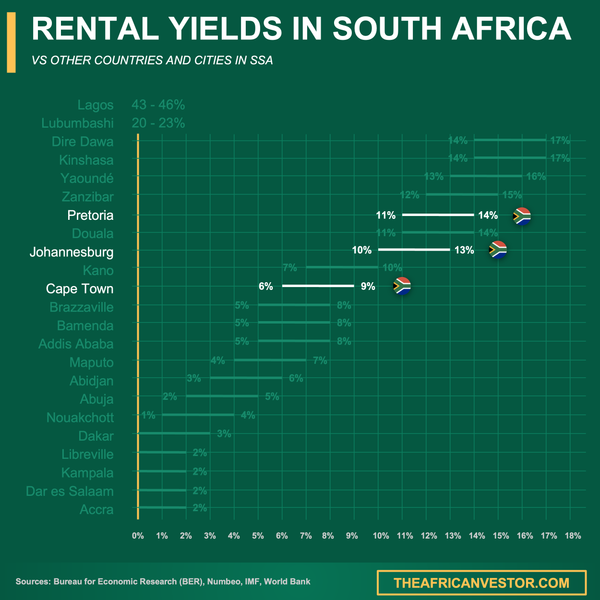
We did some research and made this infographic to help you quickly compare rental yields of the major cities in South Africa versus those in neighboring countries. It provides a clear view of how this country positions itself as a real estate investment destination, which might interest you if you’re planning to invest there.
How do I verify the seller and ownership in Johannesburg without getting fooled?
How do I confirm the seller is the real owner in Johannesburg?
The standard verification process to confirm the seller is the real owner in Johannesburg is to have your conveyancing attorney conduct a formal search at the Deeds Registry, which shows the registered owner and any bonds or restrictions on the property.
The official document foreigners should check to verify ownership in Johannesburg is the title deed, but you must confirm it through a fresh Deeds Registry search done by your attorney, not by trusting a PDF or screenshot sent by the seller or agent.
The most common trick fake sellers use to appear legitimate in Johannesburg is providing convincing-looking copies of title deeds, identity documents, and even arranging property viewings, which happens often enough that you should never rely on documents alone without independent registry verification.
Where do I check liens or mortgages on a property in Johannesburg?
The official registry where you check liens or mortgages on a property in Johannesburg is the Deeds Registry, where all mortgage bonds registered against a property are recorded and can be searched.
When checking for liens in Johannesburg, you should request a full deeds search that shows the property description, registered owner, all registered bonds, and any interdicts or caveats that might affect the transfer.
The type of lien or encumbrance most commonly missed by foreign buyers in Johannesburg is outstanding municipal debt, because it does not always appear in a deeds search and requires a separate clearance certificate from the City of Johannesburg to confirm the seller's municipal accounts are up to date.
It's one of the aspects we cover in our our pack about the real estate market in Johannesburg.
How do I spot forged documents in Johannesburg right now?
The most common type of forged document used in property scams in Johannesburg is a fake title deed or ownership certificate, and this happens commonly enough that you should treat any document received via email or messaging as unverified until confirmed through official channels.
Specific red flags that indicate a document may be forged in Johannesburg include poor print quality, inconsistent fonts, missing official stamps or signatures, and most importantly, any reluctance from the seller to allow independent verification through the Deeds Registry or a conveyancing attorney.
The official verification method you should use to authenticate documents in Johannesburg is to have your conveyancer run an independent Deeds Registry search and verify the seller's identity through the processes required by the Financial Intelligence Centre's anti-money laundering rules, which mandate proper identity and proof-of-funds checks.
Get the full checklist for your due diligence in Johannesburg
Don't repeat the same mistakes others have made before you. Make sure everything is in order before signing your sales contract.
What "grey-area" practices should I watch for in Johannesburg?
What hidden costs surprise foreigners when buying a property in Johannesburg?
The three most common hidden costs that foreigners overlook when buying property in Johannesburg are transfer duty (which can reach 13% on properties above R2.5 million, roughly $140,000 or 130,000 euros), conveyancing and registration fees (typically R30,000 to R80,000, around $1,700 to $4,500 or 1,500 to 4,000 euros), and municipal clearance delays that can require paying off the seller's outstanding utility bills to unblock the transfer.
The hidden cost most often deliberately concealed by sellers or agents in Johannesburg is outstanding municipal arrears or unpaid body corporate levies, and this sometimes happens when sellers downplay or hide these debts, hoping the buyer will only discover them after signing.
If you want to go into more details, we also have a blog article detailing all the property taxes and fees in Johannesburg.
Are "cash under the table" requests common in Johannesburg right now?
"Cash under the table" requests in Johannesburg property transactions are not rare, and foreigners are particularly targeted because sellers assume you might want a faster or simpler process and may not understand the normal procedures.
The typical reason sellers give for requesting undeclared cash payments in Johannesburg is to reduce the official purchase price on paper, which lowers the transfer duty both parties pay to SARS, or to avoid having funds traced for personal reasons.
The legal risks foreigners face if they agree to an undeclared cash payment in Johannesburg include being complicit in tax fraud, losing legal protection if the deal goes wrong because the real terms are not in the contract, and potential violations of anti-money laundering laws enforced by the Financial Intelligence Centre.
Are side agreements used to bypass rules in Johannesburg right now?
Side agreements to bypass official rules in Johannesburg property transactions are not uncommon, and they are sometimes presented to foreign buyers as "standard practice" when they are actually risky workarounds.
The most common type of side agreement used to circumvent regulations in Johannesburg is price-splitting, where you officially declare a lower purchase price and pay the difference separately as "cash for furniture" or through another informal channel, which reduces the transfer duty owed to SARS.
The legal consequences foreigners face if a side agreement is discovered by authorities in Johannesburg include tax penalties and interest from SARS, potential criminal charges for fraud, and the risk that your entire transaction could be challenged or voided because the official contract does not reflect the true deal.

We made this infographic to show you how property prices in South Africa compare to other big cities across the region. It breaks down the average price per square meter in city centers, so you can see how cities stack up. It’s an easy way to spot where you might get the best value for your money. We hope you like it.
Can I trust real estate agents in Johannesburg in 2026?
Are real estate agents regulated in Johannesburg in 2026?
As of early 2026, real estate agents in Johannesburg are regulated under the Property Practitioners Act, which requires them to be registered with the Property Practitioners Regulatory Authority (PPRA) and hold a valid Fidelity Fund Certificate.
The official license a legitimate real estate agent should have in Johannesburg is a Fidelity Fund Certificate (FFC) issued by the PPRA, which confirms they are registered, compliant, and that client funds are protected.
Foreigners can verify whether an agent is properly licensed in Johannesburg by checking with the PPRA directly or asking the agent to provide their current FFC, which must be renewed annually and shows their registration status.
Please note that we have a list of contacts for you in our property pack about Johannesburg.
What agent fee percentage is normal in Johannesburg in 2026?
As of early 2026, the normal agent fee percentage in Johannesburg is typically between 5% and 7.5% of the sale price, plus VAT at 15%.
The typical range of agent fee percentages that covers most Johannesburg property transactions is 5% to 7.5%, though fees can sometimes be negotiated lower on higher-value properties or higher for specialized services.
In Johannesburg, the seller typically pays the agent fee, not the buyer, though this is agreed in the mandate between the seller and the agent and can occasionally vary.
Get the full checklist for your due diligence in Johannesburg
Don't repeat the same mistakes others have made before you. Make sure everything is in order before signing your sales contract.
What due diligence actually prevents disasters in Johannesburg?
What structural inspection is standard in Johannesburg right now?
The standard structural inspection process for property purchases in Johannesburg is not mandatory, so cautious buyers hire an independent building inspector before signing, especially for older homes in suburbs like Parkhurst, Greenside, Melville, Bryanston, or Fourways.
A qualified inspector in Johannesburg should check the roof, foundation, walls for cracks, plumbing, electrical systems, dampness, and any signs of structural movement or water damage.
The type of professional qualified to perform structural inspections in Johannesburg is a registered building inspector, structural engineer, or a qualified home inspector with experience in South African construction standards.
The most common structural issues that inspections reveal in Johannesburg properties are roof leaks, rising damp, cracked walls from foundation movement, outdated or unsafe electrical installations, and unauthorized building additions that were never approved by the municipality.
How do I confirm exact boundaries in Johannesburg?
The standard process for confirming exact property boundaries in Johannesburg is to ensure your conveyancing attorney verifies the property description against the Deeds Registry records and, for freehold properties where boundaries matter, to commission a professional survey.
The official document that shows the legal boundaries of a property in Johannesburg is the Surveyor General's diagram, which is referenced in the title deed and held in the Deeds Registry.
The most common boundary dispute that affects foreign buyers in Johannesburg is discovering after purchase that walls, fences, pools, or extensions encroach onto neighboring land or municipal property, which can require expensive remediation or legal action.
The professional you should hire to physically verify boundaries on the ground in Johannesburg is a registered land surveyor, who can compare the official diagram to the actual property and identify any encroachments or discrepancies.
What defects are commonly hidden in Johannesburg right now?
The top three defects that sellers frequently conceal from buyers in Johannesburg are unapproved building alterations (common), electrical non-compliance or outdated certificates (common), and in sectional title properties in areas like Sandton, Rosebank, or Melrose Arch, undisclosed special levies or body corporate financial problems (sometimes happens).
The inspection technique that helps uncover hidden defects in Johannesburg is hiring a professional building inspector to check the physical property, demanding all electrical compliance certificates, and for apartments, requesting the full body corporate financial pack including minutes of recent meetings where problems are often discussed.
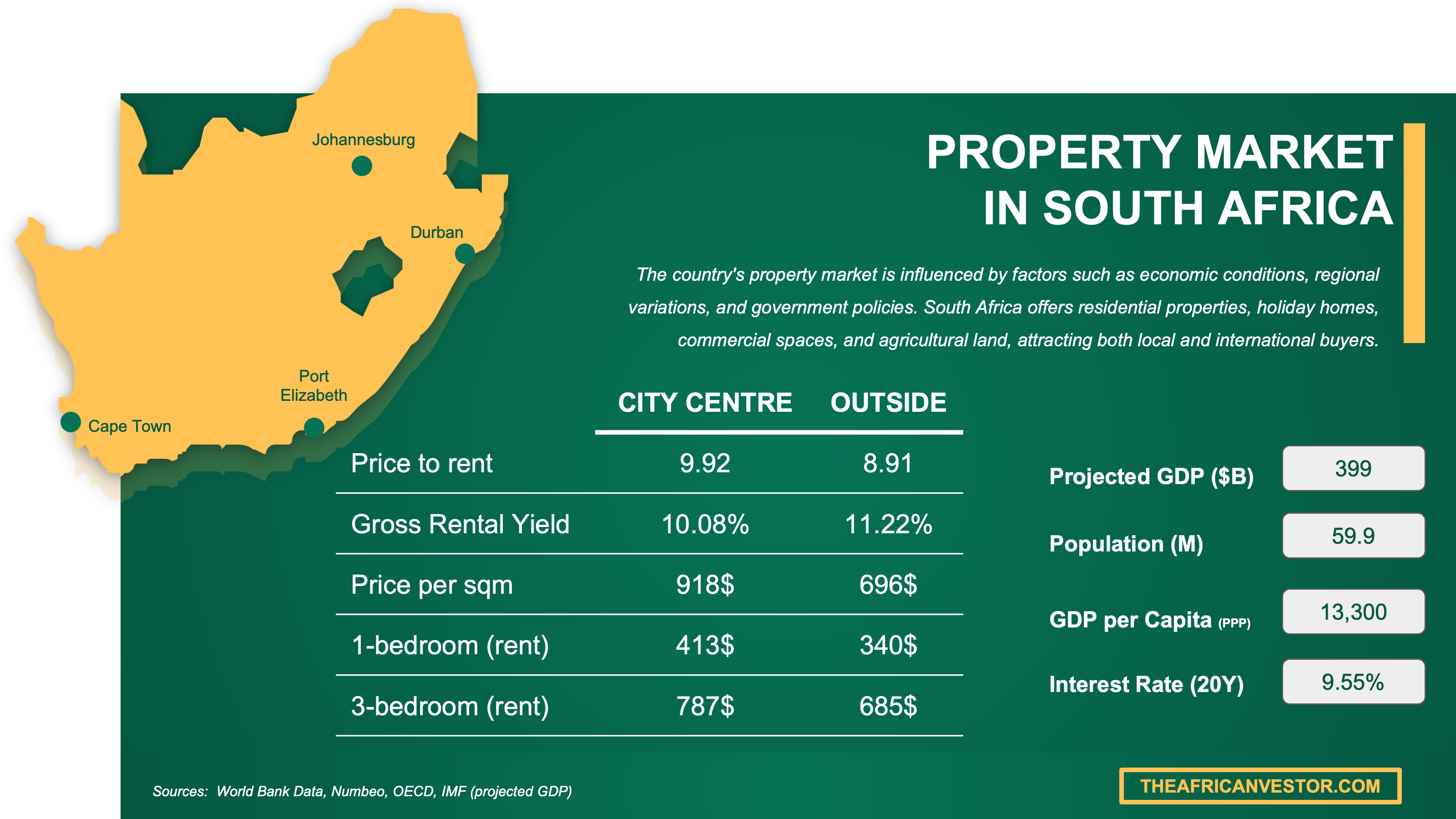
We have made this infographic to give you a quick and clear snapshot of the property market in South Africa. It highlights key facts like rental prices, yields, and property costs both in city centers and outside, so you can easily compare opportunities. We’ve done some research and also included useful insights about the country’s economy, like GDP, population, and interest rates, to help you understand the bigger picture.
What insider lessons do foreigners share after buying in Johannesburg?
What do foreigners say they did wrong in Johannesburg right now?
The most common mistake foreigners say they made when buying property in Johannesburg is trusting documents, screenshots, and PDFs sent via email or WhatsApp instead of verifying everything through official sources like the Deeds Registry or their conveyancer.
The top three regrets foreigners most frequently mention after buying in Johannesburg are not hiring their own conveyancer early enough, accepting payment instructions without verifying them by phone, and underestimating the importance of body corporate finances in apartment buildings in areas like Sandton or Rosebank.
The single piece of advice experienced foreign buyers most often give to newcomers in Johannesburg is to never change banking details based on an email and always verify any payment instruction by calling a number you found independently, not one provided in the same message.
The mistake foreigners say cost them the most money or caused the most stress in Johannesburg is falling for payment diversion fraud, where they transferred funds to a scammer's account after receiving fake "updated" banking details, and the money was gone before anyone realized what happened.
What do locals do differently when buying in Johannesburg right now?
The key difference in how locals approach buying property in Johannesburg compared to foreigners is that locals typically choose and engage a conveyancing attorney early in the process and treat the conveyancer, not the agent, as the control center for the transaction.
The verification step locals routinely take that foreigners often skip in Johannesburg is personally calling the conveyancer's office using a phone number found independently to confirm any payment instructions, because locals have heard enough scam stories to know that email banking details cannot be trusted.
The local knowledge advantage that helps locals get better deals in Johannesburg is understanding which body corporates in areas like Sandton, Illovo, or Melrose Arch are well-managed versus financially troubled, and knowing to demand the full scheme financial pack and recent meeting minutes before making any offer on a sectional title property.
Don't buy the wrong property, in the wrong area of Johannesburg
Buying real estate is a significant investment. Don't rely solely on your intuition. Gather the right information to make the best decision.

What sources have we used to write this blog article?
Whether it's in our blog articles or the market analyses included in our property pack about Johannesburg, we always rely on the strongest methodology we can … and we don't throw out numbers at random.
We also aim to be fully transparent, so below we've listed the authoritative sources we used, and explained how we used them and the methods behind our estimates.
| Source | Why It's Authoritative | How We Used It |
|---|---|---|
| Deeds Registry (Deeds.gov.za) | Official national property registry for South Africa. | We used it to explain how ownership and bonds are recorded. We based all verification guidance on this system. |
| Property Practitioners Act 22 of 2019 | The actual law regulating estate agents in South Africa. | We used it to explain agent licensing requirements. We referenced it to set the baseline for what agents can legally do. |
| PPRA (Property Practitioners Regulatory Authority) | The regulator that issues Fidelity Fund Certificates. | We used it to explain how to verify if an agent is licensed. We referenced their public notices for current regulatory reality. |
| SARS Transfer Duty | Official tax authority for transfer duty rates. | We used it to quantify a major hidden cost for foreigners. We referenced it to explain why price manipulation is risky. |
| City of Johannesburg Clearance Certificates | The municipality controlling transfer clearance in Johannesburg. | We used it to explain municipal arrears risks. We made it a key due diligence checkpoint for Johannesburg buyers. |
| Legal Practice Council | Statutory regulator of attorneys including conveyancers. | We used it to explain what a real conveyancer is. We referenced their fraud warnings to highlight payment scam risks. |
| LPC Fraud Warning Statement | Official warning about fraud targeting property transactions. | We used it to explain payment diversion scams. We designed verification rules based on their warnings. |
| CSOS (Community Schemes Ombud Service) | Statutory ombud for sectional title and HOA disputes. | We used it to explain risks in apartment and estate living. We recommended demanding body corporate documents because of CSOS dispute patterns. |
| Financial Intelligence Centre | National anti-money laundering authority for South Africa. | We used it to explain identity and funds verification requirements. We referenced it to frame safe payment practices. |
| World Justice Project Rule of Law Index 2025 | Independent global benchmark for rule of law conditions. | We used it to ground contract enforcement expectations. We referenced it to explain why prevention matters more than litigation. |
| World Bank Worldwide Governance Indicators | Major international governance dataset used globally. | We used it to provide context on rule of law and corruption control. We justified extra verification discipline for foreigners. |
| Transparency International CPI 2024 | Most cited global corruption perception index. | We used it to set realistic expectations on corruption risk. We explained why processes should not depend on informal shortcuts. |

We created this infographic to give you a simple idea of how much it costs to buy property in different parts of South Africa. As you can see, it breaks down price ranges and property types for popular cities in the country. We hope this makes it easier to explore your options and understand the market.
Related blog posts