
Authored by the expert who managed and guided the team behind the South Africa Property Pack

Yes, the analysis of Johannesburg's property market is included in our pack
This guide breaks down what you can actually buy in Johannesburg at different budget levels, from $100k to $500k and beyond.
We cover current housing prices in Johannesburg, closing costs, neighborhoods, and what foreigners need to know, and we constantly update this blog post to reflect the latest market conditions.
And if you're planning to buy a property in this place, you may want to download our pack covering the real estate market in Johannesburg.
What can I realistically buy with $100k in Johannesburg right now?
Are there any decent properties for $100k in Johannesburg, or is it all scams?
With $100,000 (roughly R1.64 million at January 2026 exchange rates), you can realistically purchase a decent 1 to 2 bedroom apartment or townhouse in many parts of Johannesburg, well above the city's median transaction price of around R1.15 million.
Neighborhoods like Soweto (including Protea Glen, Orlando, and Pimville), Roodepoort, Florida, Randburg, and parts of Midrand offer the best value and most legitimate options for a $100k budget, where you can often find freestanding houses or larger townhouses rather than just small flats.
Yes, it is possible to buy in popular areas like Rosebank for $100k, but you will be limited to smaller units such as studios or 1-bedroom apartments since entry-level prices in Rosebank start around R800,000 to R1.5 million for compact units.
The main risk at this price point is not that decent properties do not exist, but rather scams involving fake sellers or agents asking for deposits into personal accounts, which is why you should always verify agents through the PPRA's official search tool and use a licensed conveyancer for all money transfers.
What property types can I afford for $100k in Johannesburg (studio, land, old house)?
For $100k (R1.64 million) in Johannesburg in 2026, the range of property types available includes apartments (from studios to 2-bedrooms), smaller townhouses in security complexes, and older freestanding houses in value-focused areas like Soweto or Roodepoort.
At this price point, buyers should expect properties that may need some cosmetic updates like paint, flooring, or kitchen and bathroom refreshes, especially in older buildings where the price reflects "good for the area" rather than move-in perfect condition.
For long-term value, well-priced sectional-title apartments or townhouses in secure complexes tend to perform best at the $100k level because they attract a larger pool of future buyers and renters, and the security and managed maintenance help protect resale value in Johannesburg's market.
What's a realistic budget to get a comfortable property in Johannesburg as of 2026?
As of early 2026, the realistic minimum budget to get a comfortable property in Johannesburg is around R3.2 million ($200,000 or approximately €185,000), which gives you access to well-maintained 2 to 3 bedroom apartments or townhouses in secure complexes.
Most buyers looking for a comfortable standard in Johannesburg need to budget between R2.5 million and R5 million ($150,000 to $300,000 or €140,000 to €275,000) depending on how central they want to be and whether they prioritize space over location.
In Johannesburg, "comfortable" generally means a property with reliable security features (access control, guards, or secure complex), 80 to 140 square meters of space, modern finishes, good parking, and increasingly, backup power and water solutions.
The required budget can vary significantly by neighborhood in Johannesburg, with the same R3 million buying you a spacious family home in Soweto or Roodepoort but only a modest 2-bedroom apartment in premium areas like Sandton or Rosebank.
Get fresh and reliable information about the market in Johannesburg
Don't base significant investment decisions on outdated data. Get updated and accurate information.

What can I get with a $200k budget in Johannesburg as of 2026?
What "normal" homes become available at $200k in Johannesburg as of 2026?
As of early 2026, with $200,000 (roughly R3.28 million), you move from "entry-level" to "normal comfortable" in Johannesburg, which typically means a 2-bedroom apartment in a well-managed complex, a 2 to 3 bedroom townhouse with security and parking, or even a smaller freestanding home in mid-priced suburbs.
For this budget, the typical size in Johannesburg ranges from 80 to 140 square meters depending on the suburb and building age, with newer developments in trendy areas offering smaller units while outer suburbs give you more space for the same money.
By the way, we have much more granular data about housing prices in our property pack about Johannesburg.
What places are the smartest $200k buys in Johannesburg as of 2026?
As of early 2026, the smartest neighborhoods to buy at the $200k (R3.28 million) level in Johannesburg include Midrand (especially near Waterfall), Randburg (areas like Ferndale and North Riding), Roodepoort (Weltevreden Park and Radiokop), and parts of Fourways where you can still find good value.
These areas are smarter buys compared to other $200k options because they combine strong rental demand, good security infrastructure, proximity to business districts, and consistent resale liquidity, meaning your property will not sit empty or unsold for long.
The main growth drivers in these smart-buy areas are infrastructure improvements (like Gautrain access and highway upgrades), the ongoing migration of young professionals and families seeking affordability near Sandton, and new commercial developments creating local jobs and amenities.
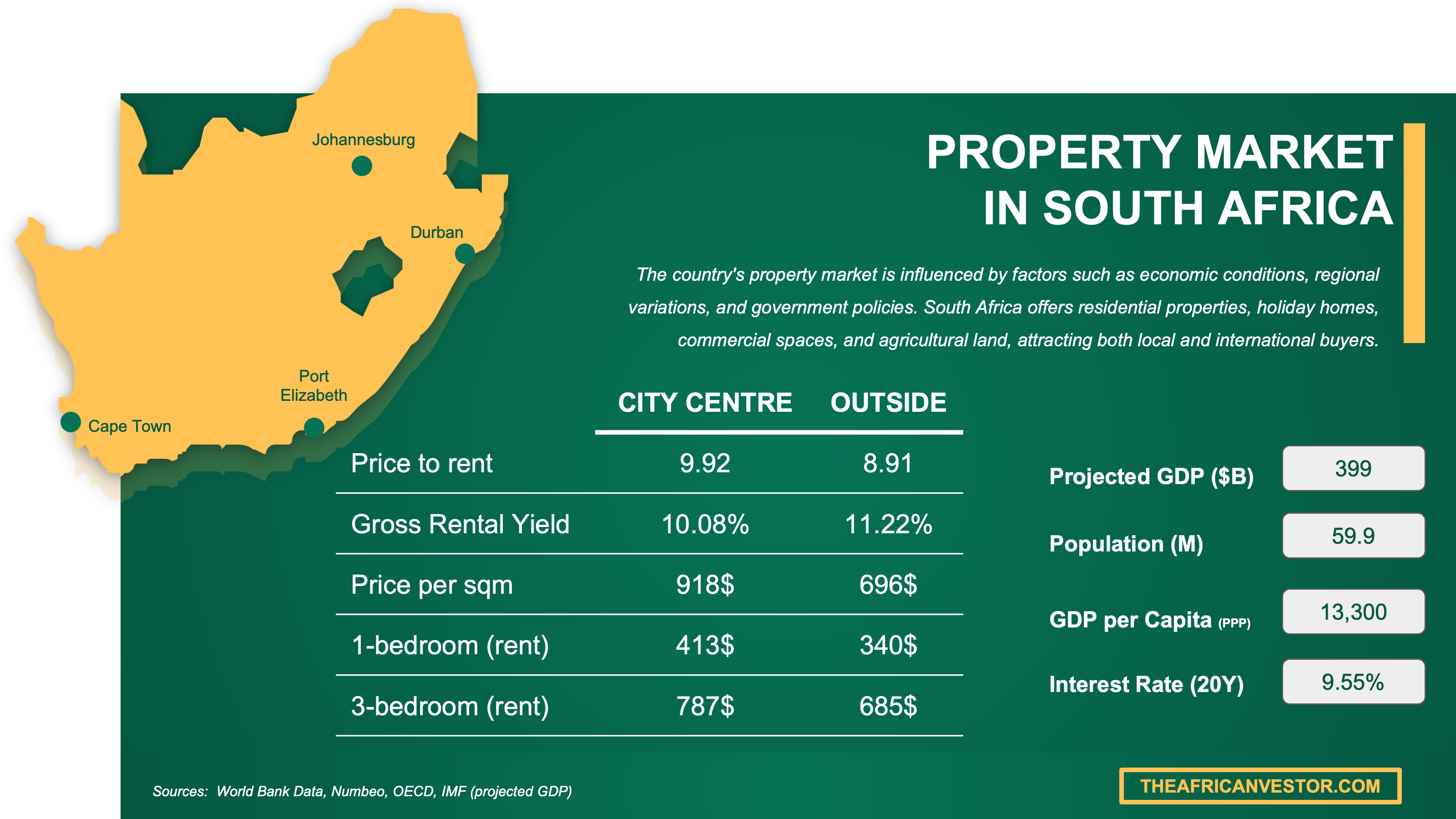
We have made this infographic to give you a quick and clear snapshot of the property market in South Africa. It highlights key facts like rental prices, yields, and property costs both in city centers and outside, so you can easily compare opportunities. We’ve done some research and also included useful insights about the country’s economy, like GDP, population, and interest rates, to help you understand the bigger picture.
What can I buy with $300k in Johannesburg in 2026?
What quality upgrade do I get at $300k in Johannesburg in 2026?
As of early 2026, moving from $200k to $300k (R4.9 million) in Johannesburg typically gets you newer or better-run complexes with backup power and water, better security systems, improved parking arrangements, and noticeably higher-quality finishes throughout the property.
Yes, $300k can often buy a property in a newer building in Johannesburg, especially in townhouse or cluster developments across northern suburbs like Fourways, Midrand, and parts of Sandton, though you should always check the complex's financial reserves and levy history.
At this budget level, typical features that become available include granite or quartz countertops, built-in appliances, double garages, private gardens or courtyards, modern security systems, and fiber internet connectivity as standard.
Can $300k buy a 2-bedroom in Johannesburg in 2026 in good areas?
As of early 2026, finding a 2-bedroom property for $300k (R4.9 million) in good areas of Johannesburg is very realistic, and at this budget you can often choose between a well-finished 2-bedroom or a modest 3-bedroom in most desirable suburbs.
Specific good areas in Johannesburg offering solid 2-bedroom options at this budget include Rosebank (larger apartments than at $200k), parts of Sandton, Bryanston, Fourways, and the better pockets of Randburg and Bedfordview.
A $300k 2-bedroom in Johannesburg typically offers 90 to 130 square meters in central locations like Rosebank, or 120 to 160 square meters in slightly less premium areas where your money stretches further.
Which places become "accessible" at $300k in Johannesburg as of 2026?
At the $300k (R4.9 million) price point in Johannesburg, the broader Sandton area, Rosebank, Bryanston, and premium pockets of Fourways become genuinely accessible rather than just barely reachable with compromise options.
These newly accessible areas are desirable compared to lower-budget options because they offer proximity to Africa's richest square mile (Sandton CBD), walkable lifestyle amenities, Gautrain connectivity, top private schools, and the kind of address recognition that supports property values over time.
In these newly accessible areas for $300k, buyers can typically expect a well-finished 2 to 3 bedroom apartment in a secure complex, a modern townhouse with good parking, or occasionally a smaller cluster home in well-established security estates.
Get to know the market before buying a property in Johannesburg
Better information leads to better decisions. Get all the data you need before investing a large amount of money.
What does a $500k budget unlock in Johannesburg in 2026?
What's the typical size and location for $500k in Johannesburg in 2026?
As of early 2026, a $500k budget (roughly R8.2 million) in Johannesburg typically gets you 180 to 300 square meters in strong northern suburbs like Sandton, Bryanston, Hyde Park, or premium Fourways estates, or even larger properties in slightly less central areas.
Yes, $500k can absolutely buy a family home with outdoor space in Johannesburg, often as a freestanding house with a garden, a spacious cluster home with private yard, or a large townhouse in an estate setting with communal gardens and amenities.
At this budget, the typical configuration in Johannesburg is 3 to 4 bedrooms and 2 to 3 bathrooms, frequently with a guest suite or staff quarters, double or triple garages, and dedicated entertainment areas both inside and outside.
Which "premium" neighborhoods open up at $500k in Johannesburg in 2026?
At the $500k (R8.2 million) price point in Johannesburg, truly premium neighborhoods that open up include the broader Sandton area, Hyde Park, Houghton, Dunkeld, Sandhurst (entry-level), Melrose, and the best parts of Bryanston.
These neighborhoods are considered premium in Johannesburg because they feature 24-hour security patrols, tree-lined streets, proximity to top private schools like St. Stithians and Crawford, easy access to Sandton City and major business headquarters, and consistent historical value appreciation.
For $500k in these premium Johannesburg neighborhoods, buyers can realistically expect a well-maintained 3 to 4 bedroom family home, a spacious modern townhouse in a secure estate, or a generous apartment with high-end finishes and excellent views.
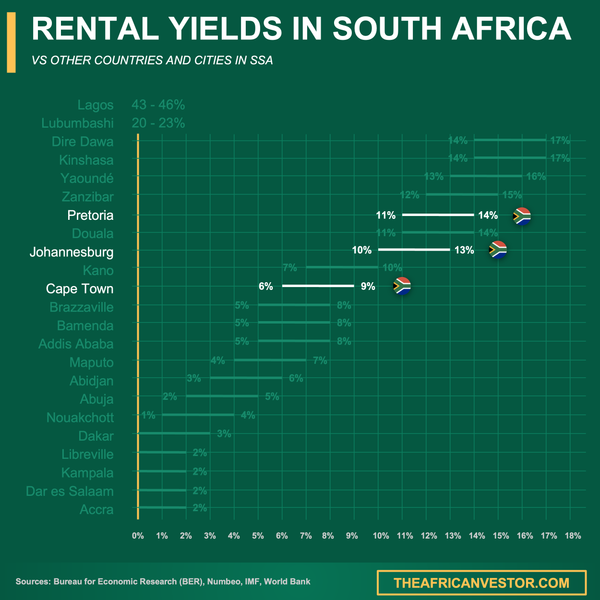
We did some research and made this infographic to help you quickly compare rental yields of the major cities in South Africa versus those in neighboring countries. It provides a clear view of how this country positions itself as a real estate investment destination, which might interest you if you’re planning to invest there.
What counts as "luxury" in Johannesburg in 2026?
At what amount does "luxury" start in Johannesburg right now?
In Johannesburg in 2026, the luxury segment genuinely starts around R10 million ($610,000 or approximately €560,000), which is where you consistently see a shift toward premium land sizes, high-end security estates, exceptional finishes, and prestige addresses.
Entry-level luxury in Johannesburg typically means large stands of 1,000 square meters or more, architectural design rather than developer standard, imported fixtures and finishes, resort-style pools and entertainment areas, smart home technology, and staff accommodation.
Compared to other markets, Johannesburg's luxury threshold is significantly lower than cities like London, New York, or even Cape Town's Atlantic Seaboard, making it accessible to international buyers who want substantial properties without the global premium price tag.
Mid-tier luxury in Johannesburg ranges from R15 million to R30 million ($915,000 to $1.83 million or €840,000 to €1.68 million), while top-tier luxury properties in areas like Sandhurst and Westcliff can exceed R50 million ($3 million or €2.75 million).
Which areas are truly high-end in Johannesburg right now?
The truly high-end areas in Johannesburg in 2026 are Sandhurst, Westcliff, Hyde Park, Houghton, Saxonwold, Dunkeld, and the ultra-premium pockets of Sandton where properties routinely trade above R20 million.
These areas are considered truly high-end in Johannesburg because they combine diplomatic security zones, mature tree canopies, historic estates with architectural significance, proximity to premier golf courses and country clubs, and a concentration of C-suite executives and wealthy families.
The typical buyer profile for these high-end Johannesburg areas includes senior corporate executives (local and expatriate), successful entrepreneurs, foreign diplomats, high-net-worth individuals seeking rand-denominated assets, and wealthy South Africans returning from abroad.
Don't buy the wrong property, in the wrong area of Johannesburg
Buying real estate is a significant investment. Don't rely solely on your intuition. Gather the right information to make the best decision.
How much does it really cost to buy, beyond the price, in Johannesburg in 2026?
What are the total closing costs in Johannesburg in 2026 as a percentage?
As of early 2026, total closing costs in Johannesburg typically range from 3% to 6% of the purchase price for cash buyers (or 5% to 9% if you include bond registration for mortgage buyers), depending on the property value and specific transaction details.
The realistic low-to-high percentage range that covers most standard Johannesburg property transactions is 4% to 8%, with lower-priced properties seeing higher percentages (since some fees are fixed) and higher-priced properties benefiting from economies of scale.
The specific fee categories making up this total in Johannesburg include transfer duty (the largest chunk for properties above R1.1 million), conveyancing or transfer attorney fees, deeds office registration fees, and various administrative and compliance costs.
To avoid hidden costs and bad surprises, you can check our our pack covering the property buying process in Johannesburg.
How much are notary, registration, and legal fees in Johannesburg in 2026?
As of early 2026, the combined cost for conveyancing (transfer attorney), registration, and legal fees in Johannesburg typically ranges from R30,000 to R85,000 ($1,800 to $5,200 or €1,650 to €4,800) depending on the property price, with higher-value properties paying more.
These fees typically represent 1% to 2.5% of the property price in Johannesburg, with the percentage decreasing as property values increase because many fee components are structured on sliding scales rather than flat percentages.
In Johannesburg, the conveyancing or transfer attorney fee is usually the most expensive of these three categories, followed by deeds office registration fees, with miscellaneous legal costs (FICA compliance, postage, searches) being the smallest but still adding up.
What annual property taxes should I expect in Johannesburg in 2026?
As of early 2026, annual property taxes (called rates) for a typical R3 million property in Johannesburg are approximately R28,000 to R32,000 per year ($1,700 to $1,950 or €1,550 to €1,800), based on the City of Johannesburg's published residential rates-in-the-rand.
Property taxes in Johannesburg typically represent about 0.9% to 1% of the property value per year, using the City's 2025/26 residential rate of approximately 0.009545 cents in the rand applied to your municipal valuation.
Property taxes in Johannesburg vary based on your property's municipal valuation (which may differ from market value), with higher-value properties in areas like Sandton paying significantly more (R60,000 to R100,000+ annually for R10 million+ homes) while modest properties in townships pay considerably less.
There are rebates available for pensioners over 60 and certain qualifying categories, though most foreign buyers and working-age homeowners will pay the standard rate without significant reductions.
Is mortgage a viable option for foreigners in Johannesburg right now?
Yes, mortgages are available to foreigners buying property in Johannesburg, but banks typically require a much larger deposit than local buyers, often 50% of the purchase price for non-residents, with the loan covering only the remaining half.
Foreign buyers in Johannesburg can typically expect loan-to-value ratios of 50% (meaning 50% deposit required), with interest rates around prime plus 1% to 2% (currently translating to roughly 11% to 12.5% annually based on January 2026 prime rates of 10.25%).
To qualify for a mortgage in Johannesburg, foreign buyers need passport and proof of identity, proof of income and employment or business ownership, bank statements showing the source of funds, a valid South African bank account for transfers, and documentation showing funds are being legally introduced through the banking system for future repatriation.

We made this infographic to show you how property prices in South Africa compare to other big cities across the region. It breaks down the average price per square meter in city centers, so you can see how cities stack up. It’s an easy way to spot where you might get the best value for your money. We hope you like it.
What should I predict for resale and growth in Johannesburg in 2026?
What property types resell fastest in Johannesburg in 2026?
As of early 2026, the property types that resell fastest in Johannesburg are well-priced sectional-title apartments and townhouses in secure complexes, particularly 2-bedroom units in the R1.5 million to R3 million range where buyer demand is strongest.
The typical time on market to sell a property in Johannesburg is currently around 10 to 14 weeks for well-priced stock, with the FNB Property Barometer citing approximately 12 weeks as the average from listing to signed sale agreement.
In Johannesburg specifically, properties with reliable security, backup power solutions, and proximity to Gautrain stations sell faster because buyers increasingly prioritize these features over raw space, especially post-load-shedding and given ongoing crime concerns.
Properties that tend to be slowest to resell in Johannesburg include oversized luxury homes requiring significant maintenance budgets, inner-city units in buildings with poor management, and freestanding houses in areas without adequate security infrastructure.
If you're interested, we cover all the best exit strategies in our real estate pack about Johannesburg.
Make a profitable investment in Johannesburg
Better information leads to better decisions. Save time and money. Download our data.
What sources have we used to write this blog article?
Whether it's in our blog articles or the market analyses included in our property pack about Johannesburg, we always rely on the strongest methodology we can ... and we don't throw out numbers at random.
We also aim to be fully transparent, so below we've listed the authoritative sources we used, and explained how we used them and the methods behind our estimates.
| Source | Why it's authoritative | How we used it |
|---|---|---|
| South African Reserve Bank (SARB) | South Africa's central bank publishes official exchange rates. | We used SARB data to anchor USD to ZAR conversions for January 2026 pricing. We then translated each USD budget into realistic rand amounts for Johannesburg property shopping. |
| South African Revenue Service (SARS) | SARS is the tax authority publishing legal transfer duty rates. | We used the 2026 transfer duty brackets to compute rand-based transfer duty for each budget level. We then expressed these as percentages so buyers can budget properly. |
| Law Society of South Africa (LSSA) | The national professional body publishes conveyancing fee guidelines. | We used the schedule to estimate typical conveyancer fees at each price point. We then rolled these into all-in closing cost estimates for Johannesburg buyers. |
| Property24 | South Africa's largest property portal with consistent area data. | We used Property24's area pages for Johannesburg, Sandton, Rosebank, Midrand, and Soweto to triangulate pricing by neighborhood. We then mapped what each budget realistically buys. |
| FNB Home Loans | A major South African bank stating documented mortgage requirements. | We used FNB's Foreign Choice page to confirm non-resident deposit requirements of 50%. We then explained why foreigners should plan for cash-heavy deals. |
| Property Practitioners Regulatory Authority (PPRA) | The official regulator's lookup tool for registered agents. | We used it to build a practical anti-scam checklist for verifying agents. We then tied this to safe transaction practices in Johannesburg. |
| STBB Attorneys | A specialist SA property law firm with structured buyer guides. | We used it to confirm no restrictions on foreign ownership and practical process notes. We then framed what foreigners need to do differently regarding FICA and banking. |
| SAIV/FNB Property Barometer | A published barometer citing FNB Economics metrics like time on market. | We used it to ground how long selling typically takes (around 12 weeks). We then explained resale liquidity by property type and price band. |
| Global Property Guide | An international property research platform with South Africa data. | We used their rental yield and price history data to validate Johannesburg market conditions. We then incorporated their insights into our investment guidance. |
| Lightstone Property | South Africa's leading property data provider with Deeds Office records. | We used Lightstone transaction data to verify actual sale prices versus listing prices. We then calibrated our budget recommendations against real market outcomes. |

We created this infographic to give you a simple idea of how much it costs to buy property in different parts of South Africa. As you can see, it breaks down price ranges and property types for popular cities in the country. We hope this makes it easier to explore your options and understand the market.
