
Authored by the expert who managed and guided the team behind the South Africa Property Pack

Everything you need to know before buying real estate is included in our South Africa Property Pack
Yes, foreigners can legally buy and rent out residential property in Pretoria in 2026, and this guide covers everything you need to know about rental yields, tenant demand, and real costs.
We constantly update this blog post with fresh data on Pretoria rental markets, vacancy rates, and neighborhood performance.
Whether you want to do long-term renting in Hatfield or short-term Airbnb in Menlyn, you will find practical numbers and specific advice below.
And if you're planning to buy a property in this place, you may want to download our pack covering the real estate market in Pretoria.
Insights
- Pretoria gross rental yields in 2026 typically range from 7% to 11%, with student areas like Hatfield often hitting the higher end while premium suburbs like Waterkloof compress toward 7%.
- The average vacancy rate in Gauteng sits around 5.8%, which means Pretoria landlords should budget for roughly three weeks of emptiness per year.
- Short-term rental occupancy in Pretoria averages only 49%, so Airbnb income is less predictable than in Cape Town and requires strong operations to beat long-term renting.
- A typical 1-bedroom apartment in Pretoria rents for R8,200 to R9,800 per month (about $450 to $540 USD), with Hatfield and Menlo Park showing the strongest demand.
- Backup power and secure parking are the two features that increase Pretoria rents the most, often adding 10% to 15% to monthly asking prices.
- There are roughly 1,640 active Airbnb listings in Pretoria, making short-term rental competition meaningful but not overwhelming compared to Cape Town.
- Net rental yields in Pretoria drop to 4.5% to 7.5% after factoring in levies, City of Tshwane municipal rates, management fees, and vacancy provisions.
- Foreigners do not need South African residency to rent out property, but they should register for a tax number and typically use a local bank account for compliance.

Can I legally rent out a property in Pretoria as a foreigner right now?
Can a foreigner own-and-rent a residential property in Pretoria in 2026?
As of early 2026, foreigners can legally buy, own, and rent out residential property in Pretoria without needing special permits or residency status.
Most foreign investors in Pretoria hold property in their personal name, though some use South African trusts or companies when managing multiple properties or planning for estate purposes.
The main difference for foreign landlords is the extra paperwork layer, which includes exchange control compliance through your bank and registering with SARS for tax on your South African rental income.
If you're not a local, you might want to read our guide to foreign property ownership in Pretoria.
Do I need residency to rent out in Pretoria right now?
You do not need South African residency to rent out a property in Pretoria, and many foreign landlords successfully manage their investments from overseas.
However, you should expect to register for a South African tax number because SARS taxes all rental income earned from property located in South Africa, regardless of your residency.
While not legally required, most foreign landlords open a South African non-resident bank account because it simplifies paying municipal bills, receiving rent, and handling exchange control compliance through authorised dealers.
Managing a Pretoria rental remotely is definitely feasible if you appoint a local property manager or letting agent to handle viewings, maintenance, and tenant issues on your behalf.
Thinking of buying real estate in Pretoria?
Acquiring property in a different country is a complex task. Don't fall into common traps – grab our guide and make better decisions.

What rental strategy makes the most money in Pretoria in 2026?
Is long-term renting more profitable than short-term in Pretoria in 2026?
As of early 2026, long-term renting in Pretoria is typically the more predictable and lower-effort strategy, while short-term can outperform in specific high-demand pockets but requires professional-level operations.
A well-managed long-term rental in Pretoria might generate R96,000 to R130,000 per year (roughly $5,300 to $7,200 USD or 4,900 to 6,600 EUR) for a 1-bedroom, while a short-term rental in the same property could potentially reach R140,000 to R170,000 annually, but only at 50% to 60% occupancy with excellent reviews.
Short-term renting tends to outperform long-term in Pretoria locations near hospitals, business travel nodes like Menlyn, and areas with corporate housing demand, where guests pay premium nightly rates for flexibility.
What's the average gross rental yield in Pretoria in 2026?
As of early 2026, the average gross rental yield for residential property in Pretoria sits around 8.5% to 9.5%, which is notably higher than many other South African metros.
The realistic range spans from about 7% in premium suburbs like Waterkloof and Brooklyn to as high as 11% in student-heavy areas like Hatfield and Sunnyside.
Smaller units like studios and 1-bedroom apartments typically achieve the highest gross yields in Pretoria because they have lower purchase prices relative to achievable rents, especially near the University of Pretoria.
By the way, we have much more granular data about rental yields in our property pack about Pretoria.
What's the realistic net rental yield after costs in Pretoria in 2026?
As of early 2026, the realistic net rental yield in Pretoria after all operating costs typically lands between 4.5% and 7.5%, depending on your property type and management efficiency.
Most Pretoria landlords experience net yields in the 5% to 6.5% range once they account for all recurring expenses and set aside a vacancy buffer.
The three biggest cost categories that eat into your Pretoria gross yield are sectional title levies (which can run R1,800 to R3,500 monthly), City of Tshwane municipal rates and services (R900 to R2,200 monthly), and letting agent or property management fees (typically 8% to 10% of rent).
You might want to check our latest analysis about gross and net rental yields in Pretoria.
What monthly rent can I get in Pretoria in 2026?
As of early 2026, typical monthly rents in Pretoria are roughly R6,500 (about $360 USD or 330 EUR) for a studio, R8,700 (about $480 USD or 440 EUR) for a 1-bedroom, and R12,000 (about $660 USD or 610 EUR) for a 2-bedroom apartment.
A decent entry-level studio in Pretoria rents for around R6,200 to R7,800 per month ($340 to $430 USD or 315 to 395 EUR), with lower prices in areas like Sunnyside and higher prices in secure complexes near Menlyn.
A typical 1-bedroom apartment in a good Pretoria location like Hatfield or Lynnwood commands R8,200 to R9,800 per month ($450 to $540 USD or 415 to 500 EUR).
For a 2-bedroom apartment in Pretoria, expect to achieve R11,000 to R13,500 per month ($610 to $750 USD or 560 to 685 EUR), with the top of the range in secure estates and premium Old East suburbs.
If you want to know more about this topic, you can read our guide about rents and rental incomes in Pretoria.
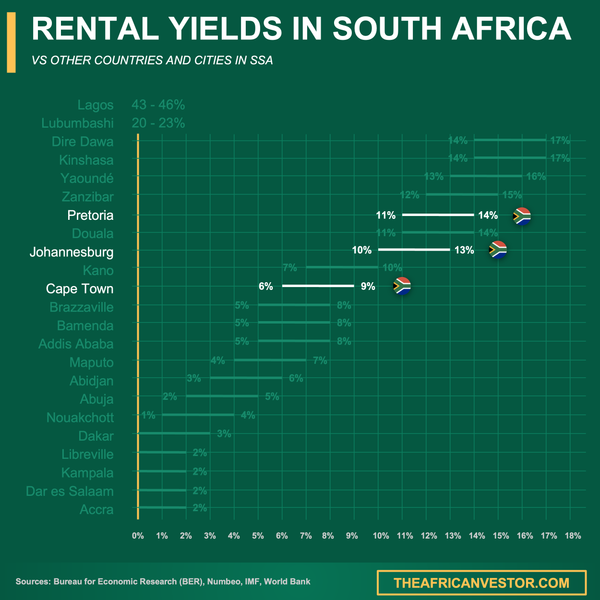
We did some research and made this infographic to help you quickly compare rental yields of the major cities in South Africa versus those in neighboring countries. It provides a clear view of how this country positions itself as a real estate investment destination, which might interest you if you’re planning to invest there.
What are the real numbers I should budget for renting out in Pretoria in 2026?
What's the total "all-in" monthly cost to hold a rental in Pretoria in 2026?
As of early 2026, the total all-in monthly cost to hold a typical Pretoria rental property (excluding mortgage payments) runs between R3,200 and R6,800, which is roughly $175 to $375 USD or 160 to 345 EUR.
The realistic range for most standard apartments and townhouses in Pretoria falls between R3,500 and R5,500 per month ($195 to $305 USD or 180 to 280 EUR), with higher costs for larger units in security estates.
Sectional title levies tend to be the single largest monthly cost in Pretoria, often ranging from R1,800 to R3,500 depending on the building's amenities, security level, and reserve fund requirements.
You want to go into more details? Check our list of property taxes and fees you have to pay when buying a property in Pretoria.
What's the typical vacancy rate in Pretoria in 2026?
As of early 2026, the typical vacancy rate for rental properties in Pretoria ranges from 5% to 7%, depending heavily on location and pricing.
This means Pretoria landlords should realistically budget for about 0.6 to 0.9 months of vacancy per year (roughly 18 to 27 days), which translates to setting aside half to one month's rent annually as a buffer.
The main factor driving vacancy differences across Pretoria neighborhoods is proximity to demand engines, with areas near universities, hospitals, and major business nodes like Menlyn experiencing tighter markets than overpriced luxury stock in quieter suburbs.
Tenant turnover in Pretoria tends to peak in November through January, when students move after exams and families relocate during the school holiday period before the new academic year.
We have a whole part covering the best rental strategies in our pack about buying a property in Pretoria.
Get fresh and reliable information about the market in Pretoria
Don't base significant investment decisions on outdated data. Get updated and accurate information with our guide.
Where do rentals perform best in Pretoria in 2026?
Which neighborhoods have the highest long-term demand in Pretoria in 2026?
As of early 2026, the top three Pretoria neighborhoods with the highest overall long-term rental demand are Menlyn and Menlo Park (retail and office nodes), Hatfield (university area), and Lynnwood (established professional suburb).
Families looking for long-term rentals in Pretoria concentrate in Faerie Glen, Garsfontein, Moreleta Park, and the Silver Lakes estate area because of the larger homes, good schools, and gated security options.
Student rental demand in Pretoria is strongest in Hatfield, Sunnyside, and Arcadia, which are all within walking or easy commuting distance of the University of Pretoria campus.
Expats and international professionals in Pretoria typically prefer Waterkloof, Brooklyn, Lynnwood, and Menlo Park because of embassy proximity, established infrastructure, and the "Old East" suburb reputation for security and quality.
By the way, we've written a blog article detailing what are the current best areas to invest in property in Pretoria.
Which neighborhoods have the best yield in Pretoria in 2026?
As of early 2026, the top three Pretoria neighborhoods for rental yield are Hatfield, Sunnyside, and Pretoria Central (in well-managed buildings), all offering gross yields potentially above 9%.
These high-yielding Pretoria neighborhoods typically deliver gross rental yields in the 9% to 11% range, compared to 7% to 8% in more premium areas.
The key characteristic allowing these areas to achieve higher yields is their combination of consistently strong tenant demand (students, young professionals) with purchase prices that have not inflated as much as in "Old East" suburbs, keeping the rent-to-price ratio favorable.
We cover a lot of neighborhoods and provide a lot of updated data in our pack about real estate in Pretoria.
Where do tenants pay the highest rents in Pretoria in 2026?
As of early 2026, the top three Pretoria neighborhoods where tenants pay the highest rents are Waterkloof and Waterkloof Ridge, Brooklyn, and premium secure estates like Silver Lakes.
In these premium Pretoria neighborhoods, a standard 2-bedroom apartment typically rents for R14,000 to R20,000 per month ($775 to $1,100 USD or 710 to 1,015 EUR), while larger family homes in estates can exceed R30,000 monthly.
These neighborhoods command the highest rents because they offer a combination of embassy-area prestige, mature tree-lined streets, excellent private school access, and 24-hour guarded security that is difficult to replicate elsewhere in Pretoria.
The typical tenant profile in these highest-rent Pretoria areas includes diplomatic staff, senior corporate executives on relocation packages, and high-income South African professionals who prioritize security, lifestyle, and proximity to top schools.

We created this infographic to give you a simple idea of how much it costs to buy property in different parts of South Africa. As you can see, it breaks down price ranges and property types for popular cities in the country. We hope this makes it easier to explore your options and understand the market.
What do tenants actually want in Pretoria in 2026?
What features increase rent the most in Pretoria in 2026?
As of early 2026, the top three property features that increase monthly rent the most in Pretoria are reliable backup power (inverter or generator), secure covered parking, and fibre internet connectivity, all of which address daily frustrations unique to South African city living.
Backup power is the single most valuable feature in Pretoria rentals right now, typically adding 10% to 15% to monthly asking rents because tenants want protection from load-shedding disruptions.
One commonly overrated feature that Pretoria landlords invest in but tenants do not pay much extra for is luxury kitchen finishes, since most renters care more about functionality and reliability than imported countertops.
An affordable upgrade that provides strong return on investment for Pretoria landlords is installing a basic inverter system, which can cost R15,000 to R30,000 upfront but justifies higher rent and reduces vacancy time significantly.
Do furnished rentals rent faster in Pretoria in 2026?
As of early 2026, furnished apartments in Pretoria typically rent about 1 to 2 weeks faster than unfurnished equivalents, especially in areas like Hatfield and Menlyn that attract students, visiting academics, and corporate tenants on short contracts.
Furnished rentals in Pretoria generally command a rent premium of 15% to 25% over unfurnished units, though this comes with higher wear-and-tear costs and the need for inventory management between tenants.
Get to know the market before you buy a property in Pretoria
Better information leads to better decisions. Get all the data you need before investing a large amount of money. Download our guide.
How regulated is long-term renting in Pretoria right now?
Can I freely set rent prices in Pretoria right now?
Landlords in Pretoria can freely set initial rent prices at market levels, as South Africa does not have universal rent control for private residential leases.
Rent increases during a tenancy are not capped by a specific percentage, but they must be "reasonable" under the Rental Housing Act, and tenants can challenge clearly excessive increases through the Rental Housing Tribunal as an "unfair practice."
What's the standard lease length in Pretoria right now?
The most common lease length for residential rentals in Pretoria is 12 months, though month-to-month periodic leases are also legally valid and sometimes used for flexibility.
The Rental Housing Act does not impose a hard cap like "maximum one month's deposit," but deposits must be handled properly, placed in an interest-bearing account, and returned with interest less legitimate deductions at lease end.
At the end of a tenancy in Pretoria, landlords must return the deposit within a reasonable time (typically 7 to 14 days), after deducting any amounts for actual damage beyond normal wear and tear, with an itemized breakdown provided to the tenant.

We made this infographic to show you how property prices in South Africa compare to other big cities across the region. It breaks down the average price per square meter in city centers, so you can see how cities stack up. It’s an easy way to spot where you might get the best value for your money. We hope you like it.
How does short-term renting really work in Pretoria in 2026?
Is Airbnb legal in Pretoria right now?
Airbnb-style short-term rentals are not illegal by default in Pretoria, but their legality depends on your property's zoning, your sectional title scheme or body corporate rules, and compliance with basic accommodation standards.
There is no single South Africa-wide Airbnb license, so whether you need a permit depends on your municipal zoning and your building's conduct rules, which means you must check the specific property's status before buying.
Pretoria does not have a citywide annual night cap like some European cities, but your body corporate may impose its own restrictions on short-term letting frequency or guest behavior.
The most common consequence for operating a non-compliant short-term rental in Pretoria is action from your body corporate, which can include fines, legal action to enforce conduct rules, or pressure to cease operations entirely.
By the way, we also have a blog article detailing whether owning an Airbnb rental is profitable in Pretoria.
What's the average short-term occupancy in Pretoria in 2026?
As of early 2026, the average annual occupancy rate for short-term rentals in Pretoria sits around 45% to 55%, which is notably lower than coastal tourism hotspots like Cape Town.
The realistic range for most Pretoria short-term rentals spans from about 35% occupancy for poorly positioned or overpriced listings to 65% or higher for well-managed properties in prime business travel locations.
Occupancy in Pretoria peaks during government and corporate event seasons, typically March through May and August through October, when business travelers and conference attendees fill available listings.
The lowest occupancy months in Pretoria are typically December and January, when government offices close, universities are on holiday, and business travel drops significantly.
Finally, please note that you can find much more granular data about this topic in our property pack about Pretoria.
What's the average nightly rate in Pretoria in 2026?
As of early 2026, the average nightly rate for short-term rentals in Pretoria is approximately R950 (about $52 USD or 48 EUR), though this varies significantly by property type and location.
The realistic nightly rate range for most Pretoria short-term listings runs from about R650 to R1,400 ($36 to $77 USD or 33 to 71 EUR), with basic studios at the low end and premium 2-bedroom apartments or unique properties at the high end.
Peak season rates in Pretoria (during major conferences and events) can run 20% to 35% higher than off-season, meaning a property averaging R950 per night might achieve R1,150 to R1,280 during busy periods but drop to R750 to R850 in December.
Is short-term rental supply saturated in Pretoria in 2026?
As of early 2026, the short-term rental market in Pretoria is meaningfully competitive but not severely oversaturated, with roughly 1,640 active Airbnb listings citywide.
The number of active short-term rental listings in Pretoria has been relatively stable, with moderate growth driven by landlords seeking higher returns, but occupancy rates suggest demand is absorbing new supply without dramatic rate erosion.
The most oversaturated areas for short-term rentals in Pretoria are Hatfield (heavy competition from student-adjacent properties) and Pretoria Central (many listings targeting budget travelers), where standing out requires excellent reviews and competitive pricing.
Areas that still have room for new short-term rental supply in Pretoria include the Menlyn business node (strong corporate demand), areas near major hospitals like Steve Biko Academic Hospital, and premium suburbs like Waterkloof where quality listings are scarce.
Don't lose money on your property in Pretoria
100% of people who have lost money there have spent less than 1 hour researching the market. We have reviewed everything there is to know. Grab our guide now.

What sources have we used to write this blog article?
Whether it's in our blog articles or the market analyses included in our property pack about Pretoria, we always rely on the strongest methodology we can, and we don't throw out numbers at random.
We also aim to be fully transparent, so below we've listed the authoritative sources we used, and explained how we used them and the methods behind our estimates.
| Source | Why It's Authoritative | How We Used It |
|---|---|---|
| South African Government - Rental Housing Act 50 of 1999 | It's the actual national law setting baseline rules for residential leases. | We used it to explain what landlords can and cannot do in long-term leases. We also grounded the rent-increase and deposit sections in this law. |
| SARS - Tax on Rental Income | SARS is South Africa's tax authority. | We used it to explain that rental income is taxable and what costs are deductible. We also used it to frame net yield calculations properly. |
| SARB - Financial Surveillance FAQ | SARB is the exchange control authority for South Africa. | We used it to explain how foreign landlords move money in and out legally. We also used it to support practical steps for non-resident bank accounts. |
| TPN Vacancy Survey Q3 2024 | TPN is a major rental payment and tenant data provider. | We used it to anchor Gauteng and Pretoria vacancy expectations. We translated vacancy percentages into practical monthly budget reserves. |
| PayProp Rental Index Q1 2025 | PayProp processes large volumes of actual rental transactions. | We used it to anchor Gauteng's average rent levels for context. We triangulated market rent against suburb-level listing data. |
| Property24 - Pretoria Rentals | Property24 is one of South Africa's biggest property marketplaces. | We used it to check what tenants are actually being asked to pay. We triangulated unit-level rent bands for studios, 1-beds, and 2-beds. |
| City of Tshwane - Promulgated Tariffs | It's the official municipal page for rates and service tariffs. | We used it to justify why municipal charges are real recurring costs. We supported our budgeting ranges for Pretoria municipal expenses. |
| Airbtics - Pretoria STR Metrics | Airbtics provides city-specific short-term rental estimates. | We used it to get Pretoria occupancy, ADR, and active listing counts. We compared these metrics to long-term rental returns. |
| AirDNA | AirDNA is a widely used short-term rental analytics provider. | We used it as the category anchor for STR metrics methodology. We avoided relying on anecdotes about Airbnb performance. |
| South African Government - Tourism Act 3 of 2014 | It's the national statute for tourism accommodation framework. | We used it as the national anchor when discussing STR regulations. We kept the short-term rental section grounded in law. |
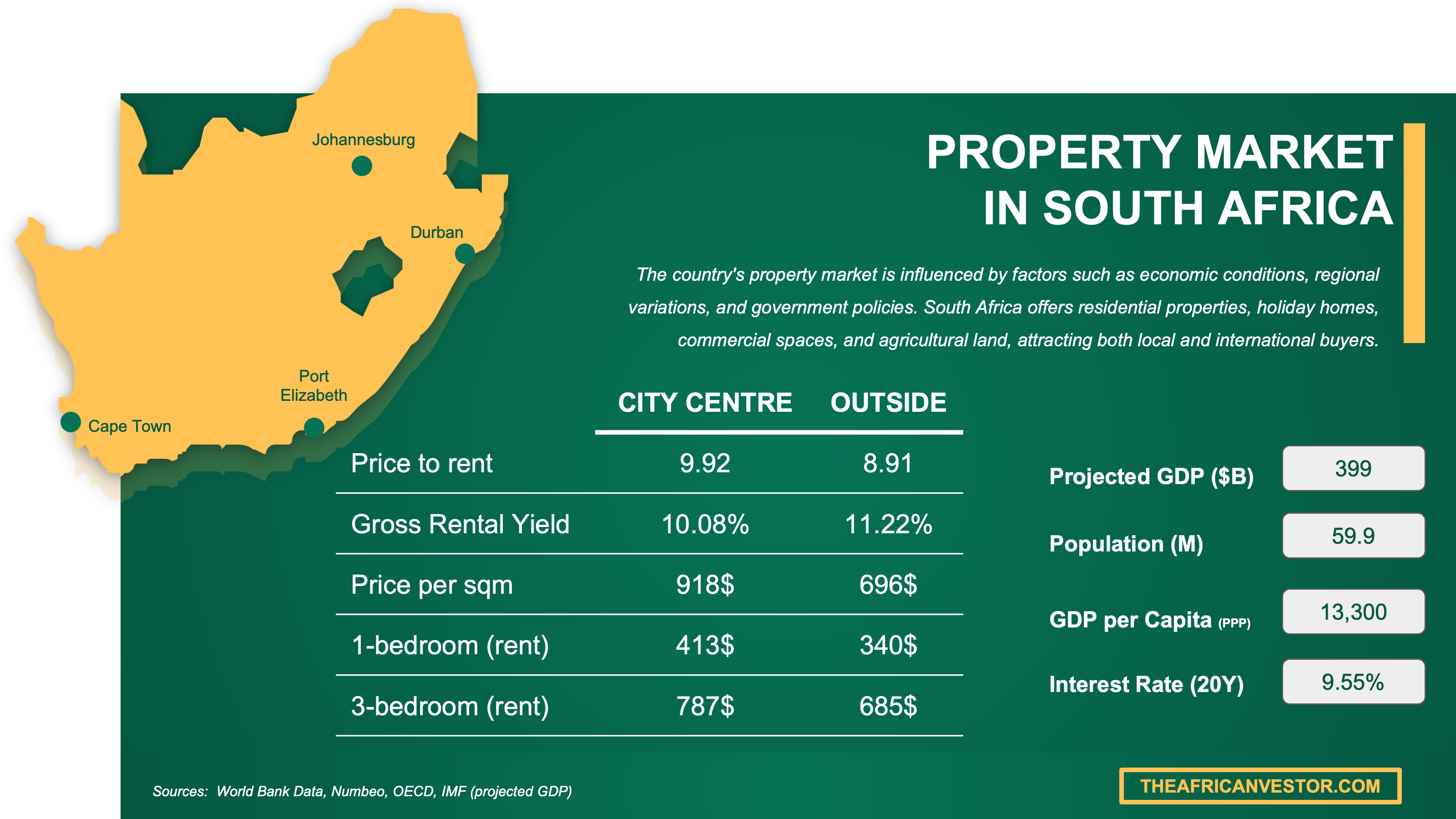
We have made this infographic to give you a quick and clear snapshot of the property market in South Africa. It highlights key facts like rental prices, yields, and property costs both in city centers and outside, so you can easily compare opportunities. We’ve done some research and also included useful insights about the country’s economy, like GDP, population, and interest rates, to help you understand the bigger picture.
Related blog posts
