
Authored by the expert who managed and guided the team behind the South Africa Property Pack

Everything you need to know before buying real estate is included in our South Africa Property Pack
Pretoria, known as the Jacaranda City for its 70,000 purple-blooming trees, is South Africa's administrative capital and a surprisingly practical choice for expats seeking a more relaxed pace than nearby Johannesburg.
With over 130 foreign embassies, a strong university presence, and leafy suburbs popular with diplomats and professionals, Pretoria in 2026 offers a unique blend of affordability, government proximity, and a suburban lifestyle that many expats find appealing.
We constantly update this blog post to bring you the most current information available about living in Pretoria as a foreigner.
And if you're planning to buy a property in this place, you may want to download our pack covering the real estate market in Pretoria.
Is Pretoria a good place to live in 2026?
Is quality of life getting better or worse in Pretoria in 2026?
As of early 2026, quality of life in Pretoria is showing cautious improvement after several difficult years, particularly because the severe electricity load-shedding that plagued the city has become less frequent and more predictable.
The single biggest improvement expats notice in Pretoria over the past two to three years is the relative stabilization of power supply, which means fewer disruptions to daily routines, remote work, and security systems compared to the worst periods of 2023.
However, the persistent challenge that remains in Pretoria is the steep rise in municipal costs, with electricity tariffs, water rates, and property taxes increasing faster than inflation, putting pressure on household budgets regardless of income level.
These factors combine to create a mixed picture where daily life feels more stable, but the cost of maintaining that stability keeps climbing.
Are hospitals good in Pretoria in 2026?
As of early 2026, private hospitals in Pretoria deliver healthcare quality comparable to Western European standards, with modern equipment, specialist availability, and shorter waiting times, though public facilities remain more variable in quality and access.
The private hospitals that expats in Pretoria most commonly recommend are Netcare Unitas Hospital in Centurion, Mediclinic Muelmed in Arcadia, and the Faerie Glen Hospital in the eastern suburbs, all of which offer comprehensive emergency, maternity, and specialist services.
A standard private GP consultation in Pretoria in 2026 typically costs between R500 and R900 (roughly $28 to $50, or €26 to €48), while specialist visits often range from R1,200 to R2,500 ($65 to $140, or €64 to €133).
Private health insurance, typically through a South African medical scheme, is strongly recommended for expats because it provides predictable access, shorter wait times, and coverage at the private hospitals where most foreigners prefer to receive care.
Are there any good international schools in Pretoria in 2026?
As of early 2026, Pretoria has a solid selection of around 15 to 20 independent and international-style schools, offering quality that ranges from good to excellent depending on the institution and curriculum chosen.
The international schools most popular among expat families in Pretoria include the American International School of Johannesburg (Pretoria Campus), the Crawford International Pretoria, and the Deutsche Internationale Schule Pretoria (German School), each offering internationally recognized curricula and English-medium instruction.
Annual tuition fees at independent and international schools in Pretoria in 2026 typically range from R80,000 to R220,000 ($4,500 to $12,000, or €4,200 to €11,700), with true international-brand schools sometimes exceeding R300,000 ($16,500, or €16,000) per year.
Waitlists at the most sought-after independent schools in Pretoria can be long, often requiring applications 12 to 24 months in advance, while public schools, though affordable, present language and administrative challenges that make them a less common choice for expat families without local guidance.
Is Pretoria a dangerous place in 2026?
As of early 2026, Pretoria has significant safety disparities between neighborhoods, meaning expats who choose their area carefully and follow common precautions can live comfortably, while certain parts of the city have genuinely elevated crime risks.
The most common safety concerns expats should be aware of in Pretoria include opportunistic property crime such as house break-ins and car theft, street robbery in poorly lit areas, and the occasional carjacking, particularly near traffic intersections in less secure neighborhoods.
The neighborhoods generally considered safest for expats in Pretoria include Waterkloof, Waterkloof Ridge, Menlo Park, Brooklyn, Lynnwood, Faerie Glen, Garsfontein, Moreleta Park, Groenkloof, and Centurion suburbs like Irene, all of which feature gated communities, active security patrols, and controlled access.
Women can and do live alone safely in Pretoria, especially in well-secured buildings or estates, though common precautions include avoiding walking alone at night, using rideshare apps rather than hailing taxis, and choosing apartments in access-controlled complexes.
Thinking of buying real estate in Pretoria?
Acquiring property in a different country is a complex task. Don't fall into common traps – grab our guide and make better decisions.

How much does everyday life cost in Pretoria in 2026?
What monthly budget do I need to live well in Pretoria in 2026?
As of early 2026, a single expat in Pretoria needs roughly R35,000 to R50,000 per month ($1,900 to $2,800, or €1,850 to €2,650) to live comfortably in a nice neighborhood with a car, private healthcare, and regular dining out.
For a modest but decent lifestyle in Pretoria, a single person can manage on R20,000 to R30,000 per month ($1,100 to $1,650, or €1,050 to €1,600), which covers basic rent in a secure complex, groceries, transport, and essential services without much room for extras.
A more comfortable or upscale lifestyle in Pretoria, including a larger home in a premium suburb, regular travel, private schooling, and household help, requires R90,000 to R160,000 per month ($5,000 to $8,900, or €4,800 to €8,500) for a family with children.
The expense category that often surprises newcomers in Pretoria is not housing but rather the combined cost of transport (most expats need a car), security services, and utilities, especially electricity, which together can account for 25% to 35% of a monthly budget.
What is the average income tax rate in Pretoria in 2026?
As of early 2026, a typical middle-income earner in Pretoria, earning around R600,000 per year (roughly $33,000 or €32,000), faces an effective income tax rate of approximately 18% to 25% after rebates and deductions.
South Africa uses a progressive tax system where marginal rates in 2026 range from 18% on the first R237,100 of taxable income up to 45% on income exceeding R1,817,000, meaning higher earners see their effective rate climb toward 30% to 40%.
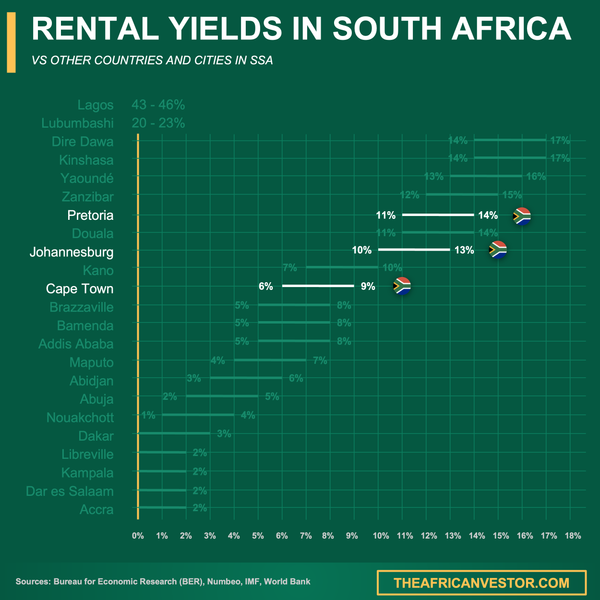
We did some research and made this infographic to help you quickly compare rental yields of the major cities in South Africa versus those in neighboring countries. It provides a clear view of how this country positions itself as a real estate investment destination, which might interest you if you’re planning to invest there.
What kind of foreigners actually live in Pretoria in 2026?
Where do most expats come from in Pretoria in 2026?
As of early 2026, the largest groups of expats in Pretoria come from neighboring SADC countries such as Zimbabwe, Mozambique, and Lesotho, along with significant communities from Europe, particularly the UK, Germany, and the Netherlands, as well as professionals from India and China.
South Africa as a whole hosts nearly 2 million foreign-born residents, representing just over 3% of the population, with Gauteng province, which includes Pretoria and Johannesburg, home to more than half of all expats in the country.
The main reason expats from these origin countries are drawn to Pretoria specifically is the city's role as the administrative capital, which attracts diplomats, embassy staff, NGO workers, and government contractors who need proximity to national institutions.
The expat population in Pretoria is predominantly a mix of working professionals and diplomatic personnel, with fewer retirees and digital nomads compared to Cape Town, making it a more career-focused destination.
Where do most expats live in Pretoria in 2026?
As of early 2026, expats in Pretoria tend to concentrate in the eastern and southeastern suburbs, particularly Waterkloof, Brooklyn, Menlo Park, Lynnwood, Faerie Glen, Garsfontein, Moreleta Park, and the Centurion suburbs of Irene and Eldoraigne.
What makes these neighborhoods attractive to expats is not just safety but also their proximity to private hospitals, international schools, major shopping centers like Menlyn, and easy access to highways connecting Pretoria to Johannesburg and OR Tambo International Airport.
Emerging neighborhoods that are starting to attract more expats in Pretoria include areas around the Tshwane Automotive Special Economic Zone and newer security estates in Centurion, where modern housing developments offer competitive pricing compared to established premium suburbs.
Are expats moving in or leaving Pretoria in 2026?
As of early 2026, the expat migration trend in Pretoria is roughly stable, with steady inflows of diplomatic and professional workers balanced against some departures of younger expats seeking denser urban lifestyles in Johannesburg or Cape Town.
The main factor driving expats to move to Pretoria right now is affordability combined with quality of life, as the city offers more space, lower costs, and a calmer environment than Johannesburg while remaining within commuting distance of that larger job market.
The main factor causing some expats to leave Pretoria recently is the perception that it lacks the cosmopolitan energy and nightlife of Cape Town or Johannesburg, making it less appealing for younger professionals without families.
Compared to similar destinations in South Africa, Pretoria's expat population has remained more stable than Johannesburg's (which sees higher turnover) but has grown slower than Cape Town's (which continues to attract lifestyle migrants and remote workers).
Get fresh and reliable information about the market in Pretoria
Don't base significant investment decisions on outdated data. Get updated and accurate information.
What paperwork do I need to move to Pretoria in 2026?
What visa options are popular in Pretoria in 2026?
As of early 2026, the three most popular visa types for expats moving to Pretoria are the General Work Visa (for those with job offers), the Critical Skills Work Visa (for professionals in high-demand fields), and the Intra-Company Transfer Visa (for employees of multinational companies).
The main eligibility requirements for the General Work Visa, the most commonly used expat visa in South Africa, include having a confirmed job offer from a South African employer, proof of qualifications, and documentation showing the employer could not find a suitable local candidate for the role.
South Africa launched a Digital Nomad Visa (officially called the Remote Work Visa) in March 2025, which allows remote workers earning foreign income of at least R650,000 per year (about $36,000 or €34,500) to live in the country for up to three years with renewals.
Most work visas in South Africa are issued for periods of one to five years depending on the employment contract, and renewal typically requires submitting updated employment documentation and proof of continued eligibility several months before expiration.
How long does it take to get residency in Pretoria in 2026?
As of early 2026, temporary residence visas in South Africa typically take one to three months to process when documentation is complete and straightforward, though complex cases or backlogs can extend this to four to six months.
Common factors that can delay residency applications in Pretoria include incomplete documentation, missing police clearance certificates, issues with qualification verification, and periodic processing backlogs at the Department of Home Affairs, while using a registered immigration practitioner can often speed things up.
To become eligible for permanent residency in South Africa, expats must typically live in the country for at least five continuous years on a valid temporary residence permit, though Critical Skills visa holders may qualify for a faster track under certain conditions.

We created this infographic to give you a simple idea of how much it costs to buy property in different parts of South Africa. As you can see, it breaks down price ranges and property types for popular cities in the country. We hope this makes it easier to explore your options and understand the market.
How hard is it to find a job in Pretoria in 2026?
Which industries are hiring the most in Pretoria in 2026?
As of early 2026, the top three industries hiring in Pretoria are government and public sector administration, automotive manufacturing (thanks to the BMW, Ford, and Nissan plants in the region), and information technology including cybersecurity and data services.
It is realistic for expats to get hired in Pretoria without speaking Afrikaans or other local languages, as English is widely used in business, government, and professional settings, though some customer-facing or public-sector roles may prefer bilingual candidates.
The types of roles most accessible to foreign job seekers in Pretoria include engineering positions in the automotive sector, IT specialists and software developers, healthcare professionals (especially specialists), international school teachers, and management consultants serving government or corporate clients.
What salary ranges are common for expats in Pretoria in 2026?
As of early 2026, skilled expats working in Pretoria typically earn between R700,000 and R1,600,000 per year ($39,000 to $89,000, or €37,000 to €85,000), with the range depending heavily on industry, experience, and seniority.
Entry-level or mid-level expat positions in Pretoria typically pay R400,000 to R800,000 per year ($22,000 to $44,000, or €21,000 to €42,500), which allows for a comfortable but not luxurious lifestyle in the city.
Senior or specialized expat roles in Pretoria, particularly in engineering, IT management, healthcare, or executive positions, can command R1,200,000 to R2,500,000 or more per year ($67,000 to $139,000, or €64,000 to €133,000).
Employers in Pretoria do sponsor work visas, but they generally prefer candidates who minimize administrative friction, meaning those with critical skills, clean documentation, and a strong track record have the best chances of securing sponsorship.
Get to know the market before buying a property in Pretoria
Better information leads to better decisions. Get all the data you need before investing a large amount of money.
What's daily life really like for expats in Pretoria right now?
What do expats love most about living in Pretoria right now?
The top things expats love most about living in Pretoria are the exceptional value for money (large homes and gardens at reasonable prices), the relaxed suburban pace compared to Johannesburg, and the stunning natural beauty when the jacaranda trees bloom purple each October.
The lifestyle benefit most frequently praised by expats in Pretoria is the ability to enjoy a spacious, garden-style home with a pool and outdoor entertaining area at a fraction of what similar properties would cost in major international cities.
The practical advantage expats appreciate most in Pretoria is the city's manageable size and lower traffic congestion compared to Johannesburg, combined with good access to the Gautrain rapid rail connection and proximity to OR Tambo International Airport.
The social and cultural aspect that makes Pretoria particularly enjoyable is the strong sense of community within expat-heavy neighborhoods, where diplomatic networks, international school parent groups, and sports clubs create natural opportunities to build friendships.
What do expats dislike most about life in Pretoria right now?
The top complaints expats have about living in Pretoria are the constant need to think about security logistics (alarms, guards, access control), near-total car dependency for daily errands, and the slower service pace that locals sometimes call "African time."
The daily inconvenience that frustrates expats most in Pretoria is the unpredictability of municipal services, particularly occasional water outages and the need to maintain backup power solutions even when load-shedding is less severe than before.
The bureaucratic issue that causes the most headaches for expats in Pretoria is the slow and sometimes inconsistent processing at Home Affairs for visa renewals and permit changes, which can require multiple visits and careful document preparation.
Most expats find these frustrations manageable rather than deal-breaking, especially once they establish routines, hire reliable domestic help, and learn which service providers to trust.
What are the biggest culture shocks in Pretoria right now?
The biggest culture shocks expats experience when moving to Pretoria are the pervasive security infrastructure (armed guards, electric fences, boom gates), how dramatically neighborhood quality can change within a few kilometers, and the extent to which daily planning revolves around infrastructure reliability.
The social norm that surprises newcomers most in Pretoria is how openly and casually people discuss security measures, with conversations about alarm systems, response times, and "safe routes" being as normal as discussing weather in other countries.
The aspect of daily routines that takes expats longest to adjust to in Pretoria is the shopping and errand rhythm, where most activities happen at large mall complexes rather than walkable neighborhood streets, and where peak-hour traffic means timing errands carefully to avoid congestion.

We made this infographic to show you how property prices in South Africa compare to other big cities across the region. It breaks down the average price per square meter in city centers, so you can see how cities stack up. It’s an easy way to spot where you might get the best value for your money. We hope you like it.
Can I buy a home as a foreigner in Pretoria in 2026?
Can foreigners legally own property in Pretoria in 2026?
As of early 2026, foreigners are fully permitted to buy and own property in Pretoria with the same ownership rights as South African citizens, including freehold title to land and buildings.
The specific restrictions that apply to foreigners buying property in Pretoria are minimal: there are no nationality-based limits, but exchange control regulations require that purchase funds be transferred through authorized South African banks with proper documentation of the source.
Foreigners in Pretoria can purchase any property type, including apartments, freestanding houses, land, and commercial buildings, with no restrictions on the type or value of real estate they can own.
What is the average price per m² in Pretoria in 2026?
As of early 2026, the average price per square meter for residential property in Pretoria ranges from roughly R12,000 to R18,000 ($670 to $1,000, or €640 to €950) for apartments, and R9,000 to R15,000 ($500 to $830, or €480 to €800) for freestanding houses, with premium suburbs like Waterkloof commanding significantly higher prices.
Property prices in Pretoria have shown moderate stability over the past two to three years, with modest nominal increases that have roughly kept pace with inflation, meaning real-terms prices have been flat to slightly soft in most suburbs.
Do banks give mortgages to foreigners in Pretoria in 2026?
As of early 2026, mortgages for foreigners in Pretoria are available but come with stricter conditions than for locals, with most banks limiting loan-to-value ratios to 50% for non-residents, meaning you need a deposit of at least half the purchase price.
The major South African banks that offer mortgages to foreigners include First National Bank (FNB) with its "Foreign Choice" product, Standard Bank, Nedbank, and ABSA, all of which have specific departments for international clients.
Typical mortgage conditions for foreigners in Pretoria include a minimum 50% deposit for non-residents (up to 75% for those with work permits), interest rates around prime plus 0.5% to 2% (currently meaning 11.75% to 13.25%), and maximum loan terms of 20 to 30 years.
To qualify for a mortgage as a foreigner in Pretoria, you typically need a valid passport, proof of foreign income (three to six months of bank statements), exchange control approval from the South African Reserve Bank, and documentation showing the deposit funds originate from abroad.
Buying real estate in Pretoria can be risky
An increasing number of foreign investors are showing interest. However, 90% of them will make mistakes. Avoid the pitfalls with our comprehensive guide.

What sources have we used to write this blog article?
Whether it's in our blog articles or the market analyses included in our property pack about Pretoria, we always rely on the strongest methodology we can ... and we don't throw out numbers at random.
We also aim to be fully transparent, so below we've listed the authoritative sources we used, and explained how we used them and the methods behind our estimates.
| Source | Why it's authoritative | How we used it |
|---|---|---|
| Statistics South Africa (Stats SA) | South Africa's official statistics agency, the closest thing to ground truth for population and household data. | We used Stats SA publications to anchor Pretoria context on households, incomes, and public safety perceptions. We then sanity-checked private-sector numbers against these official baselines. |
| SAPS Crime Statistics | The official police dataset for recorded crime in South Africa. | We used SAPS releases to frame crime risks and trends relevant to Pretoria. We combined this with victimization surveys to avoid relying only on reported-crime counts. |
| South African Revenue Service (SARS) | The tax authority, so brackets and rebates are official and current. | We used SARS to estimate average effective tax rates for typical expat salary bands. We converted gross salary ranges into net pay estimates for the monthly budgets. |
| South African Reserve Bank (SARB) | The central bank, providing official inflation and interest rate context. | We used SARB to frame 2026 purchasing-power expectations. We stress-tested budgets and mortgage affordability assumptions against current rate environments. |
| City of Tshwane Tariffs | The municipality's official tariffs for utilities and local services. | We used these tariffs to estimate realistic utilities in Pretoria household budgets. We scaled by typical consumption patterns for apartments versus houses. |
| Department of Home Affairs (DHA) | The government department that sets and administers visa and residency rules. | We used DHA as the authoritative reference for visa categories and requirements. We avoided relying on forums for legal rules. |
| Council for Medical Schemes (CMS) | The regulator of private medical schemes in South Africa. | We used CMS reports to ground healthcare coverage recommendations. We sanity-checked typical premium levels for expat medical scheme options. |
| Property24 | A major national property portal with extensive market coverage. | We used Property24 to anchor property values and neighborhood names in Pretoria. We treated it as market cross-check rather than official statistics. |
| FNB Property Barometer | A major bank's research with defined methodology and consistent time series. | We used FNB for house-price trend direction and interest-rate sensitivity. We sanity-checked whether 2026 prices feel hot or soft. |
| Numbeo Cost of Living | A widely-used crowdsourced database for cost of living comparisons. | We used Numbeo to cross-reference our budget estimates with global benchmarks. We verified specific price points against local market research. |
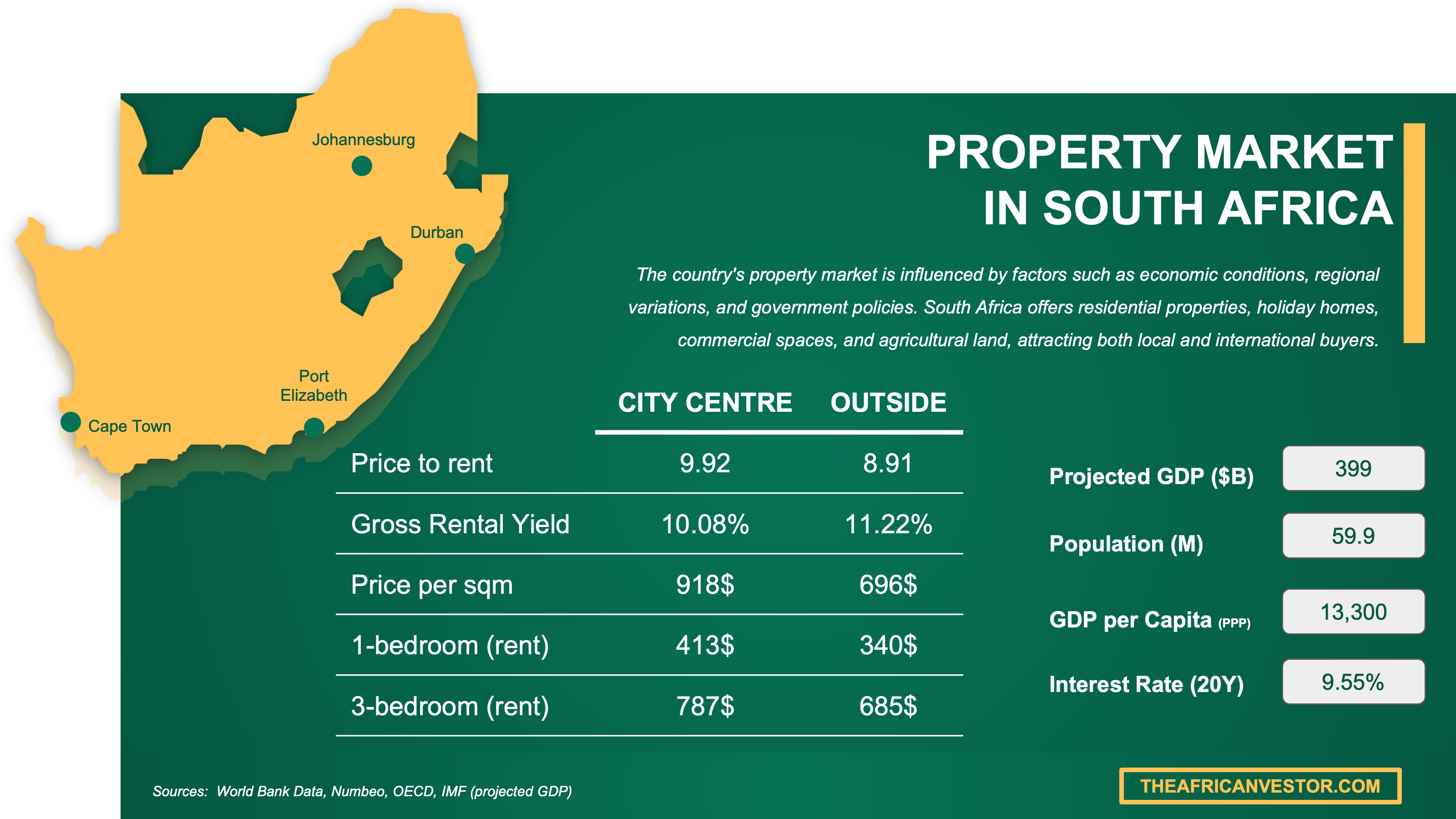
We have made this infographic to give you a quick and clear snapshot of the property market in South Africa. It highlights key facts like rental prices, yields, and property costs both in city centers and outside, so you can easily compare opportunities. We’ve done some research and also included useful insights about the country’s economy, like GDP, population, and interest rates, to help you understand the bigger picture.
