Authored by the expert who managed and guided the team behind the South Africa Property Pack

Everything you need to know before buying real estate is included in our South Africa Property Pack
Yes, foreigners can get a mortgage in South Africa, but the terms depend heavily on whether you live in the country or not.
This guide covers everything you need to know about eligibility, deposit requirements, interest rates, and which South African banks actually say yes to foreign buyers.
We constantly update this blog post to reflect the latest rules and market conditions.
And if you're planning to buy a property in this place, you may want to download our pack covering the real estate market in South Africa.
Can foreigners get a mortgage in South Africa right now?
Can a foreigner get a residential mortgage in South Africa right now?
Yes, foreigners can get residential mortgages in South Africa in early 2026, but the deal you get depends on whether you are a non-resident or someone living and working in the country.
Foreign nationals who already live and work in South Africa with valid permits typically have the easiest access to mortgages because banks can verify their local income and assess risk more easily.
The most common restriction for foreign applicants in South Africa is exchange control, which in practice means non-residents are usually limited to borrowing around 50% of the property value and must fund the rest from offshore.
By the way, we have a whole document dedicated to mortgages for foreigners in our property pack about South Africa.
Can I get a mortgage in South Africa without residency?
Yes, non-residents can obtain a mortgage in South Africa, but they typically face stricter terms than those who live in the country.
The main residency statuses that qualify for mortgages in South Africa include permanent residents, temporary residents with work visas, foreign nationals working locally, and bona fide non-residents who live abroad.
Banks in South Africa most commonly require non-residents without permanent residency to provide a deposit of around 50% of the property price, with the funds transferred from offshore through proper banking channels.
Do banks require a local work contract in South Africa right now?
Banks in South Africa do not always require a local work contract, especially if you are applying as a non-resident and can meet the 50% deposit requirement.
If you do not have a local work contract, South African banks typically accept alternatives like foreign employment contracts, tax returns, audited business financials, and bank statements showing consistent income.
When a local work contract is present, most banks in South Africa prefer to see at least 3 to 6 months of employment history, though some may accept less if your overall financial profile is strong.
Can self-employed foreigners qualify for a mortgage in South Africa?
Yes, self-employed foreigners can qualify for a mortgage in South Africa, but the process usually takes longer and requires more documentation to prove stable income.
Most South African banks typically require self-employed applicants to show at least 12 to 24 months of business history, supported by bank statements, audited financials, or tax returns.
Is foreign income accepted for mortgages in South Africa right now?
Yes, banks in South Africa often accept foreign income for mortgage applications, particularly when you are applying through the non-resident track.
When earning income abroad, South African banks typically require additional documentation including foreign tax returns, employment contracts, payslips, and bank statements showing consistent deposits over several months.
Can I buy a primary home (and an investment property?) with a mortgage in South Africa as a foreigner?
Yes, foreigners can obtain a mortgage for a primary home in South Africa, and this is generally easier if you live and work in the country with a valid permit and local income.
Foreigners can also get mortgages for investment or holiday properties in South Africa, though these purchases typically fall under the non-resident rules with around 50% deposit required.
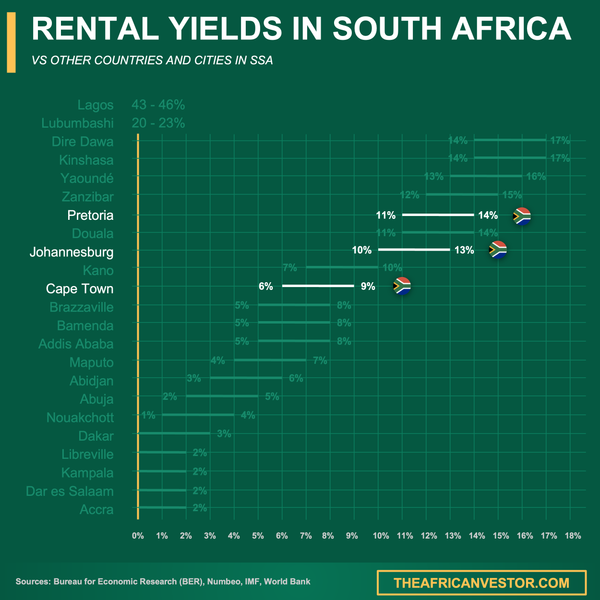
We did some research and made this infographic to help you quickly compare rental yields of the major cities in South Africa versus those in neighboring countries. It provides a clear view of how this country positions itself as a real estate investment destination, which might interest you if you’re planning to invest there.
What are the eligibility rules banks actually use in South Africa?
What minimum monthly income do I need in South Africa as of 2026?
As of early 2026, there is no single official minimum income for mortgages in South Africa because banks assess affordability individually, but a practical baseline for a R1 million loan is around R30,000 to R35,000 per month (roughly $1,650 to $1,900 USD or 1,500 to 1,750 EUR).
Most approved borrowers in South Africa tend to fall into an income range of R40,000 to R80,000 per month (about $2,200 to $4,400 USD or 2,000 to 4,000 EUR), depending on the property price and loan amount.
The minimum income requirement in South Africa scales directly with your loan amount because banks want your monthly repayment to fit comfortably within roughly 30% to 35% of your gross income.
Yes, banks in South Africa do allow combining household incomes from multiple applicants, such as spouses or partners, to meet the minimum income threshold for mortgage approval.
What debt-to-income limit do banks use in South Africa right now?
Banks in South Africa typically work within a debt-to-income comfort zone of around 30% to 40%, though the binding rule is the full affordability assessment rather than a fixed ratio.
When calculating your debt-to-income ratio, South African banks include all existing obligations such as credit card payments, car loans, personal loans, store accounts, and any other mortgages you may have.
Do I need a local credit score in South Africa right now?
Having a South African credit score helps a lot because local banks use local bureau data to assess risk, but it is not always strictly required for non-residents who can demonstrate strong finances otherwise.
Banks in South Africa may accept foreign credit reports as supporting evidence, but they still rely primarily on local account conduct, verified income stability, and a larger deposit to offset the lack of local credit history.
Do banks require a local guarantor in South Africa right now?
No, South African banks do not usually require a local guarantor for standard residential mortgages, including those for foreigners.
Banks in South Africa are most likely to request additional security when the applicant has a thin credit history, complex income sources, or is requesting a higher loan-to-value ratio than typical for their profile.
If a guarantor is required, they typically need to be a South African resident with a stable income and good credit standing, though this situation is uncommon for foreign buyers who meet the deposit requirements.
Make a profitable investment in South Africa
Better information leads to better decisions. Save time and money. Download our data.

How much cash do I need upfront in South Africa as of 2026?
What's the minimum down payment in South Africa right now?
For bona fide non-residents buying property in South Africa, the minimum down payment is typically around 50% of the property price due to exchange control regulations.
The realistic range of down payments in South Africa varies from 25% for foreign nationals living and working locally with strong profiles, up to 50% or more for non-residents based abroad.
A foreign buyer in South Africa might secure a lower down payment if they hold a work permit, have local employment with verifiable income, and can demonstrate a strong relationship with a South African bank.
What loan terms can I realistically get in South Africa as of 2026?
What mortgage interest rates are typical in South Africa as of 2026?
As of early 2026, typical mortgage interest rates in South Africa for foreigners range from around 9% to 11%, depending on your profile and the bank's assessment.
The factors that most influence your interest rate in South Africa include your deposit size, income stability, credit profile, and whether you apply through a mortgage originator that can shop multiple banks for you.
Foreigners in South Africa do not necessarily receive higher interest rates than locals if their profile is strong, though those with weaker documentation or higher risk profiles may see rates at prime or above (around 10.25% or higher).
The interest rate is one of the factors we look at when assessing whether now is a good time to buy a property in South Africa.
Are fixed-rate mortgages available in South Africa right now?
Yes, fixed-rate mortgages are available to foreigners in South Africa, though they are less common than variable-rate loans and usually come at a premium.
Fixed-rate periods offered by South African banks are typically shorter than in other countries, often ranging from 2 to 5 years before reverting to a variable rate linked to prime.

We created this infographic to give you a simple idea of how much it costs to buy property in different parts of South Africa. As you can see, it breaks down price ranges and property types for popular cities in the country. We hope this makes it easier to explore your options and understand the market.
How do I maximize approval chances in South Africa right now?
What financial profile gets "yes" fastest in South Africa right now?
The ideal financial profile for fast mortgage approval in South Africa is a buyer with a large deposit (50% or more for non-residents), stable and well-documented income, and low existing debt.
South African banks consider an ideal income level to be around R50,000 or more per month (roughly $2,750 USD or 2,500 EUR) combined with a debt-to-income ratio below 30% for the fastest approvals.
Banks in South Africa most favor employed applicants with permanent contracts and at least 6 to 12 months of employment history at their current job, as this signals income stability.
A down payment of 50% or higher typically signals a very strong applicant profile in South Africa, especially for non-residents, as it eliminates most exchange control concerns.
We give more detailed tips in our pack covering the property buying process in South Africa.
What mistakes make foreigners get rejected in South Africa right now?
The most common mistake that leads to mortgage rejection for foreigners in South Africa is having an unclear or incomplete paper trail for the deposit funds, which makes banks nervous about exchange control compliance.
The financial red flag that most often disqualifies foreign applicants in South Africa is assuming the 50% non-resident deposit requirement is negotiable when it is actually a structural constraint driven by exchange control regulations, not a bank preference.
Get to know the market before buying a property in South Africa
Better information leads to better decisions. Get all the data you need before investing a large amount of money.
Which banks say yes to foreigners in South Africa right now?
Which banks are most foreigner-friendly in South Africa as of 2026?
As of early 2026, the banks considered most foreigner-friendly for mortgages in South Africa are FNB, Absa, Standard Bank, and Nedbank, all of which have dedicated programs for foreign buyers.
What makes these banks more accessible is that they have specific product pages, application channels, and staff trained to handle foreign income verification, exchange control requirements, and non-resident documentation.
Which banks accept non-resident borrowers in South Africa right now?
Banks that accept non-resident borrowers for mortgages in South Africa include FNB (through its Foreign Choice and non-resident home loan products), Absa (via International Mortgages), and Standard Bank (which confirms credit facilities for non-residents in its FAQ).
These banks typically require non-resident applicants in South Africa to provide a 50% deposit funded from offshore, proof of foreign income, and documentation showing the source and transfer of funds into the country.
Do international banks lend more easily in South Africa right now?
International banks do not necessarily lend more easily to foreigners in South Africa than local banks, but they may be a better fit for higher-income or more complex clients.
Investec is one international-style bank with a presence in South Africa that offers home loans, though its private banking model is typically best suited for wealthier clients with more sophisticated financial profiles.
The main advantage of using a bank like Investec in South Africa is personalized service and potentially more flexibility for complex income structures, but this comes with higher minimum requirements than mainstream banks.

We made this infographic to show you how property prices in South Africa compare to other big cities across the region. It breaks down the average price per square meter in city centers, so you can see how cities stack up. It’s an easy way to spot where you might get the best value for your money. We hope you like it.
What sources have we used to write this blog article?
Whether it's in our blog articles or the market analyses included in our property pack about South Africa, we always rely on the strongest methodology we can, and we don't throw out numbers at random.
We also aim to be fully transparent, so below we've listed the authoritative sources we used, and explained how we used them and the methods behind our estimates.
| Source | Why it's authoritative | How we used it |
|---|---|---|
| South African Reserve Bank (SARB) | It's the central bank's official release for policy-linked rates. | We used it to anchor the repo and prime rate context for early 2026. We then translated prime-linked pricing into what borrowers typically see. |
| Government of South Africa NCA Regulations | It's the official Gazette publication for affordability assessment rules. | We used it to describe how banks assess affordability under the National Credit Act. We then turned that into practical guidance on income and debt requirements. |
| FNB Foreign Choice | It's a major bank's own product page for foreign borrowers. | We used it as direct evidence that a large South African bank actively lends to foreigners. We also used it to shape realistic expectations for non-resident buyers. |
| Absa International Mortgages | It's a major bank's dedicated channel for non-South African citizens. | We used it to identify a clearly foreigner-facing channel inside a top-four bank. We then used that to guide which banks are most set up to approve foreign buyers. |
| Nedbank Non-Resident Guide | It's a big bank explaining how it categorizes foreign borrowers. | We used it to separate foreign nationals living in South Africa from bona fide non-residents. We then used Nedbank's LTV guidance as a realistic benchmark. |
| ooba Home Loans | It's a large South African mortgage originator working across multiple banks. | We used it to validate the exchange-control-driven 50% borrowing reality for non-residents. We then turned it into practical approval tactics. |
| ooba oobarometer | It's a transparent market report tracking actual approved mortgage pricing. | We used it to estimate realistic mortgage pricing as prime minus a discount. We then mapped that to an estimated all-in rate for early 2026 borrowers. |
| Property24 | It's a major national property portal summarizing SARB decisions. | We used it to pin a concrete prime rate level entering early 2026. We then used that prime level as the base for typical mortgage rate estimates. |
| STBB Attorneys | It's a specialist property law firm's practical guide for non-residents. | We used it to ground the timeline and transfer workflow that happens after approval. We then used it to explain what money must be brought in and when. |
| Standard Bank Non-Resident FAQ | It's the bank's own published FAQ for non-resident clients. | We used it to confirm Standard Bank offers credit facilities to non-residents. We then translated that into how to approach them in the bank shortlisting section. |
Get the full checklist for your due diligence in South Africa
Don't repeat the same mistakes others have made before you. Make sure everything is in order before signing your sales contract.