
Authored by the expert who managed and guided the team behind the South Africa Property Pack

Everything you need to know before buying real estate is included in our South Africa Property Pack
South Africa offers retirees a unique mix of affordable living, stunning landscapes, and modern infrastructure that few countries can match.
In this guide, we break down exactly how much money you need to retire in South Africa in 2026, from survival budgets to luxury lifestyles, with current housing prices and real monthly expenses.
We update this blog post regularly to reflect the latest cost-of-living data, exchange rates, and property market trends in South Africa.
And if you're planning to buy a property in this place, you may want to download our pack covering the real estate market in South Africa.
How much money do I need to retire in South Africa right now?
What's the absolute minimum monthly budget to survive in South Africa?
The absolute minimum monthly budget for a foreign retiree to survive in South Africa in 2026 is around R22,000 per month, which works out to approximately $1,325 or €1,220.
This bare-bones budget in South Africa covers a modest one-bedroom rental in a cheaper inland suburb, basic groceries, essential utilities, minimal transport, and a basic private medical scheme to avoid being uninsured.
At this survival level in South Africa, you will need to skip regular dining out, forgo domestic travel, live far from premium coastal areas like Cape Town's Atlantic Seaboard, and accept that any unexpected expense (like a car repair or medical procedure) could throw your budget off balance.
What lifestyle do I get with $2,000/month in South Africa in 2026?
As of early 2026, a budget of $2,000 per month (around R33,000) in South Africa gives you a comfortably modest lifestyle where you can cover all essentials plus enjoy some regular leisure activities without constant penny-pinching.
For housing in South Africa at this budget, you can realistically afford a decent one-bedroom or small two-bedroom apartment in good inland suburbs like Durbanville or Table View in Cape Town, Randburg or Bedfordview in Johannesburg, or Kloof and Hillcrest near Durban, with rents typically ranging from R10,000 to R14,000 ($600 to $845, or €550 to €775) per month.
At the $2,000 level in South Africa, you can enjoy regular meals at mid-range restaurants, join a local gym, visit wine farms in Stellenbosch or the Winelands on weekends, and occasionally take short domestic trips to places like the Garden Route or Kruger National Park area.
The main limitation at $2,000 per month in South Africa is that premium coastal neighborhoods like Sea Point or Camps Bay in Cape Town remain out of reach for comfortable living, and you will need to be disciplined about car costs and avoid lifestyle creep to stay within budget.
What lifestyle do I get with $3,000/month in South Africa in 2026?
As of early 2026, a budget of $3,000 per month (around R50,000) in South Africa positions you in the comfortably upper-middle tier, where you can live well in desirable neighborhoods without worrying about covering unexpected costs.
For housing in South Africa at this level, you can afford a nice two-bedroom apartment in sought-after areas like Gardens, Green Point, or Rondebosch in Cape Town, Sandton (older units), Melrose, or Parkhurst in Johannesburg, or central Knysna and parts of Plettenberg Bay along the Garden Route, with rents typically between R15,000 and R22,000 ($905 to $1,325, or €830 to €1,220) per month.
At $3,000 per month in South Africa, you can dine out frequently at quality restaurants, maintain gym and club memberships, take regular weekend trips to coastal towns or game reserves, and comfortably budget for domestic flights to explore different provinces.
The key upgrade from a $2,000 budget in South Africa is the ability to invest in backup power solutions like an inverter or UPS system (essential given load-shedding realities), choose safer and more walkable neighborhoods, and afford a stronger medical scheme tier that covers more without stress.
What lifestyle do I get with $5,000/month in South Africa in 2026?
As of early 2026, a budget of $5,000 per month (around R83,000) in South Africa delivers a very comfortable lifestyle, while $10,000 per month (around R166,000) puts you firmly in the luxury category where location and convenience come before budget constraints.
At $5,000 per month in South Africa, you can rent premium apartments in neighborhoods like Sea Point, Oranjezicht, or Constantia in Cape Town, or Bryanston and Hyde Park in Johannesburg, typically paying R25,000 to R40,000 ($1,505 to $2,410, or €1,385 to €2,220) per month, while at $10,000 per month, you unlock beachfront rentals in Camps Bay or Clifton and top security estates with full-time domestic help.
In the $5,000 to $10,000 range in South Africa, you gain access to top-tier private healthcare with gap cover, membership at exclusive golf and country clubs, frequent international travel, a well-maintained vehicle, regular fine dining, and the ability to hire full-time housekeeping and gardening staff.
How much for a "comfortable" retirement in South Africa in 2026?
As of early 2026, a comfortable retirement in South Africa requires a monthly budget of R40,000 to R60,000, which translates to approximately $2,410 to $3,615 or €2,220 to €3,325 per month.
Given that electricity tariffs and administered prices in South Africa can jump faster than general inflation (thanks to ongoing NERSA-approved increases), the safest approach is to add a 15% buffer to your target budget, meaning if you plan for R50,000 per month, you should actually budget around R57,500 ($3,465 or €3,190) to stay stress-free.
A comfortable retirement budget in South Africa covers what a basic budget cannot: a solid medical scheme with meaningful out-of-pocket buffer, backup power equipment and running costs, regular domestic help, quality dining and entertainment, a reliable vehicle with full insurance, and the flexibility to handle unexpected repairs or medical needs without panic.
How much for a "luxury" retirement in South Africa in 2026?
As of early 2026, a luxury retirement in South Africa requires a monthly budget of R90,000 to R150,000, which works out to approximately $5,420 to $9,040 or €4,985 to €8,315 per month.
At the luxury level in South Africa, you can afford premium coastal rentals with sea views (R40,000 to R80,000 per month, or $2,410 to $4,820), top-tier medical schemes plus elective procedures without hesitation, full-time domestic staff, a late-model vehicle, and regular international travel.
The most popular neighborhoods for luxury retirees in South Africa include Camps Bay, Clifton, and Bantry Bay along Cape Town's Atlantic Seaboard, the Constantia wine valley, Sandhurst and Hyde Park in Johannesburg, Umhlanga and La Lucia in Durban, and exclusive Garden Route enclaves like Plettenberg Bay's beachfront.
Beyond comfort and convenience, the main advantage of a luxury budget in South Africa is the ability to prioritize location and security first, whether that means living in a top-rated security estate, choosing a home specifically for its proximity to excellent private hospitals, or simply picking the view you want without compromise.
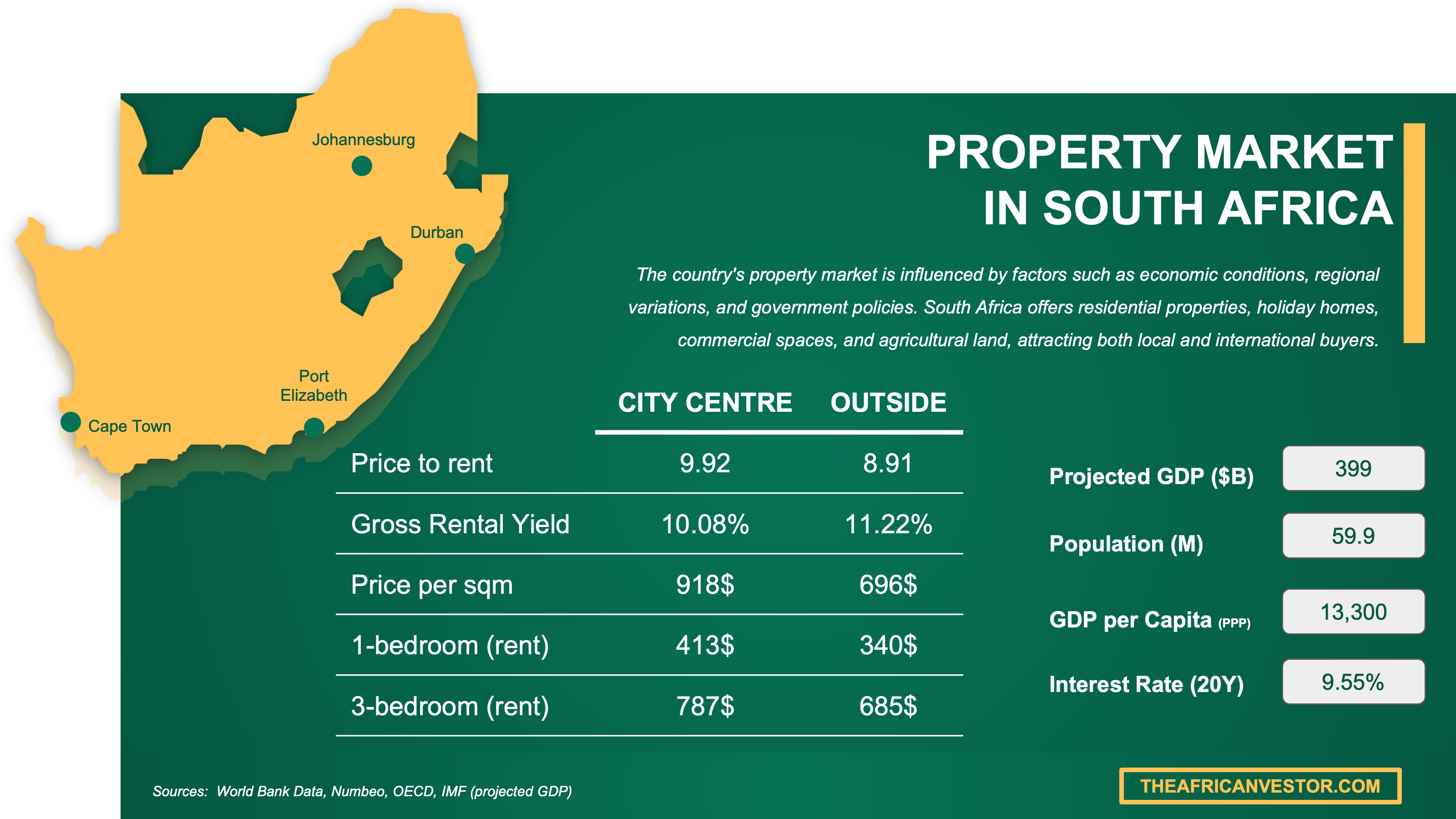
We have made this infographic to give you a quick and clear snapshot of the property market in South Africa. It highlights key facts like rental prices, yields, and property costs both in city centers and outside, so you can easily compare opportunities. We’ve done some research and also included useful insights about the country’s economy, like GDP, population, and interest rates, to help you understand the bigger picture.
What are the real monthly expenses for retirees in South Africa in 2026?
What is a realistic monthly budget breakdown by category in South Africa?
A realistic monthly budget breakdown for a retiree in South Africa in 2026 at the modest-comfort level (around R35,000 or $2,110/€1,940 per month) typically allocates roughly R12,000 for rent, R6,500 for healthcare, R5,500 for groceries, R4,500 for transport, R2,500 for dining and entertainment, R1,800 for utilities, R1,200 for insurance, and R1,000 for internet and mobile.
Housing costs in South Africa typically consume 30% to 40% of a retiree's total monthly budget, meaning you can expect to spend R10,000 to R20,000 ($600 to $1,205, or €550 to €1,110) depending on whether you choose an affordable inland suburb or a more desirable urban neighborhood.
Food and groceries in South Africa generally account for 15% to 20% of your monthly budget, translating to roughly R4,500 to R7,500 ($270 to $450, or €250 to €415) per month for a single person who cooks at home regularly.
The budget category that varies most in South Africa depending on personal lifestyle is transport, because owning a car (R4,000 to R9,000 per month including fuel, insurance, and maintenance) costs significantly more than relying on ride-hailing apps, yet most South African cities are car-dependent due to limited public transit.
What fees surprise foreigners most after moving to South Africa?
The top three hidden fees that surprise foreigners in South Africa are security costs (armed response subscriptions, estate levies, and electric fencing maintenance), backup power expenses (inverters, batteries, and generator fuel during load-shedding), and out-of-pocket healthcare costs that fall outside medical scheme coverage.
When first arriving in South Africa, foreigners should budget for one-time setup costs including a rental deposit (typically two months' rent, so R20,000 to R40,000 or $1,205 to $2,410), vehicle registration and licensing if buying a car (R2,000 to R5,000 or $120 to $300), initial utility deposits (R1,500 to R3,000 or $90 to $180), and potentially a furniture package if renting unfurnished (common in South Africa).
What's the average rent for a 1-bedroom or a 2-bedroom in South Africa in 2026?
As of early 2026, the average monthly rent for a one-bedroom apartment in South Africa ranges from R9,000 to R14,000 ($540 to $845, or €500 to €775), while a two-bedroom typically costs R12,000 to R20,000 ($725 to $1,205, or €665 to €1,110) depending on location.
For a one-bedroom in South Africa, you can find budget options in smaller towns or less central suburbs for around R6,000 to R8,000 ($360 to $480, or €330 to €440), while upscale neighborhoods like Sea Point in Cape Town or Sandton in Johannesburg can push rents to R18,000 or higher ($1,085+, or €1,000+).
For a two-bedroom in South Africa, affordable areas like Durbanville, Randburg, or Hillcrest offer rentals starting around R10,000 to R14,000 ($600 to $845, or €550 to €775), whereas premium locations on Cape Town's Atlantic Seaboard or in Johannesburg's northern suburbs can exceed R30,000 ($1,810, or €1,665) per month.
Retirees seeking affordable rent with good value in South Africa should consider neighborhoods like Table View and Durbanville in Cape Town, Bedfordview and Randburg in Johannesburg, Kloof and Hillcrest near Durban, and smaller Garden Route towns like George or Mossel Bay that offer lower costs with pleasant coastal or semi-rural living.
What do utilities cost monthly in South Africa in 2026?
As of early 2026, the total monthly utilities cost for a typical retiree apartment in South Africa ranges from R1,500 to R3,500 ($90 to $210, or €85 to €195), with significant variation depending on municipality, property size, and electricity usage.
For individual utilities in South Africa, electricity typically runs R800 to R2,000 ($48 to $120, or €44 to €110) per month depending on usage and whether you run air conditioning or heating, water costs R200 to R600 ($12 to $36, or €11 to €33), and gas (if used for cooking or heating) adds another R200 to R400 ($12 to $24, or €11 to €22).
Internet and mobile phone service in South Africa typically costs R800 to R1,200 ($48 to $72, or €44 to €66) per month combined for a fiber connection and a mobile plan with data, though costs can vary significantly between urban areas with fiber coverage and rural or coastal areas where connectivity options are more limited.
What's the monthly food and transportation budget for one person in South Africa in 2026?
As of early 2026, a combined monthly food and transportation budget for one person in South Africa ranges from R9,000 to R18,000 ($540 to $1,085, or €500 to €1,000), depending on whether you cook at home or dine out frequently and whether you own a car or rely on ride-hailing.
For groceries in South Africa, a single retiree cooking at home can manage on R4,500 to R6,000 ($270 to $360, or €250 to €330) per month shopping at stores like Checkers, Pick n Pay, or Woolworths, while a more generous budget with premium products and organic options runs R7,000 to R9,000 ($420 to $540, or €390 to €500).
Dining out regularly in South Africa adds significantly to the food budget, with mid-range restaurant meals costing R150 to R300 ($9 to $18) per person and a lifestyle that includes frequent restaurant visits easily adding R3,000 to R5,000 ($180 to $300, or €165 to €275) per month on top of groceries.
For transportation in South Africa, owning a modest car costs R4,000 to R9,000 ($240 to $540, or €220 to €500) per month when you factor in fuel, insurance, and averaged maintenance, while retirees without a car need to budget heavily for ride-hailing services like Uber or Bolt since public transit is limited and unreliable in most South African cities.
Get fresh and reliable information about the market in South Africa
Don't base significant investment decisions on outdated data. Get updated and accurate information.

Can I retire in South Africa if I want to buy property in 2026?
What's the average home price in South Africa in 2026?
As of early 2026, the average home price in South Africa for a typical middle-market purchase is around R1.7 million to R1.9 million, which translates to approximately $102,000 to $114,000 or €94,000 to €105,000.
Home prices in South Africa vary dramatically by location: affordable inland towns and suburbs offer properties starting around R800,000 to R1.2 million ($48,000 to $72,000, or €44,000 to €66,000), while prime Cape Town coastal neighborhoods like Camps Bay or Clifton can easily exceed R10 million ($600,000+, or €550,000+) for a modest apartment.
For retirees in South Africa, sectional title apartments (similar to condos) often offer the best value because they include security features, shared maintenance costs, and are located in well-established complexes in desirable suburbs, making them easier to manage than freehold houses.
Please note that you will find all the information you need in our pack about properties in South Africa.
What down payment do foreigners usually need in South Africa in 2026?
As of early 2026, foreigners purchasing property in South Africa typically need a down payment of around 50%, meaning for an average home priced at R1.8 million ($108,000 or €100,000), you would need approximately R900,000 ($54,000 or €50,000) upfront.
Yes, foreigners in South Africa face significantly higher down payment requirements than locals, who can often secure 100% bonds (mortgages) with good credit; foreign nationals are generally limited to a maximum loan-to-value of around 50% due to bank policies, as outlined by major lenders like FNB.
We have a document entirely dedicated to the mortgage process in our pack about properties in South Africa.
[VARIABLE MORTGAGE]What's the all-in monthly cost to own in South Africa in 2026?
As of early 2026, the all-in monthly cost to own a typical property in South Africa (assuming a R1.8 million home with a 50% foreigner deposit and a R900,000 bond) ranges from R14,000 to R22,000 ($845 to $1,325, or €775 to €1,220) per month.
This all-in ownership figure in South Africa includes your monthly bond repayment (around R9,000 or $540), municipal rates and taxes (R800 to R2,500 or $48 to $150), home insurance (R600 to R1,500 or $36 to $90), sectional title levies if applicable (R1,500 to R4,000 or $90 to $240), and a maintenance reserve (R1,000 to R2,500 or $60 to $150).
Typical monthly property taxes (municipal rates) in South Africa run R800 to R2,500 ($48 to $150, or €44 to €140) depending on property value and municipality, while HOA or body corporate levies in sectional title complexes range from R1,500 to R4,000 ($90 to $240, or €85 to €220) per month.
The hidden ownership cost that catches new buyers off guard in South Africa is the combination of special levies (unexpected building repairs charged by the body corporate), rising electricity costs that affect common property, and the ongoing expense of security upgrades in a country where residential security is a significant line item.
Is buying cheaper than renting in South Africa in 2026?
As of early 2026, buying can be cheaper than renting in South Africa in monthly cash-flow terms if you have a large deposit: a decent two-bedroom rents for R12,000 to R20,000 ($725 to $1,205) per month nationally, while owning a similar property with a 50% deposit costs R14,000 to R22,000 ($845 to $1,325) all-in, but you build equity.
The typical break-even point where buying becomes cheaper than renting in South Africa is around 5 to 7 years, accounting for upfront transaction costs (transfer duty, legal fees, moving expenses) which can add 5% to 8% to your purchase price.
The key factors that make buying more attractive than renting for retirees in South Africa include the ability to install permanent backup power systems, lock in your housing costs against rental inflation, benefit from the weak rand if you earn foreign currency, and the fact that sectional title complexes offer built-in security and maintenance that retirees often value highly.
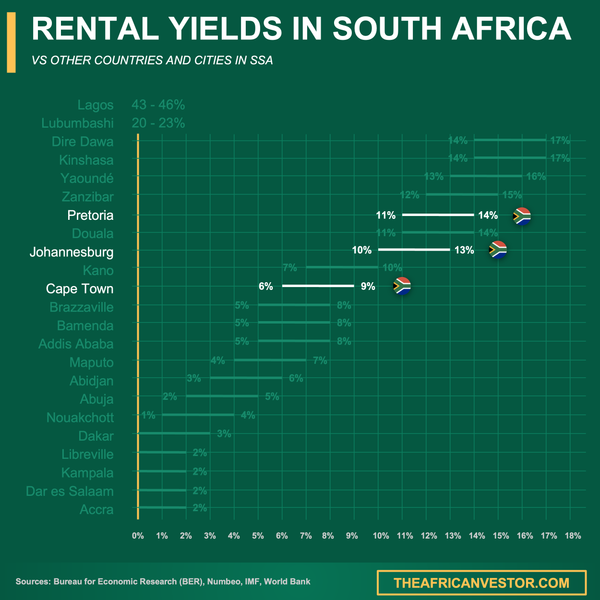
We did some research and made this infographic to help you quickly compare rental yields of the major cities in South Africa versus those in neighboring countries. It provides a clear view of how this country positions itself as a real estate investment destination, which might interest you if you’re planning to invest there.
What visas, taxes, and healthcare costs should I plan for in South Africa in 2026?
What retirement visa options exist in South Africa in 2026?
As of early 2026, South Africa offers a retired person visa (a type of temporary residence permit) that typically costs R1,520 ($92 or €85) in government application fees, plus additional costs for required documentation like police clearances and medical certificates.
To qualify for a retirement visa in South Africa, you generally need to demonstrate a minimum monthly income of around R37,000 ($2,230 or €2,050) from pensions, retirement annuities, or investments, or show equivalent capital reserves, along with proof of medical cover and a clean criminal record.
The typical annual visa renewal in South Africa involves similar documentation requirements and fees (around R1,520 per renewal), though longer-term permits can reduce renewal frequency once you have established residency history.
The most common visa mistake foreign retirees make in South Africa is underestimating the documentation burden: applications require certified copies, apostilles, police clearances from every country you have lived in, and medical reports, so starting the process 6 to 12 months before your intended move is strongly recommended.
Do I pay tax on foreign income in South Africa in 2026?
As of early 2026, if you become a South African tax resident, you are generally subject to tax on your worldwide income, meaning foreign pensions, investment returns, and other income could be taxable in South Africa at progressive rates up to 45%.
Foreign pensions and retirement income in South Africa are typically taxable if you are a tax resident, though there are exemptions for the first R500,000 ($30,000 or €27,500) of foreign employment income earned while abroad; investment income and Social Security payments from countries like the US are generally included in taxable income.
South Africa has tax treaties with many major countries including the United States, United Kingdom, Germany, Australia, and Canada, which can help prevent double taxation and may allow you to claim credits for taxes paid in your home country.
The single most important tax rule foreign retirees should understand before moving to South Africa is the "physical presence test" for tax residency: if you spend more than 91 days per year in South Africa over multiple years, you may become a tax resident and owe tax on worldwide income, so structuring your time carefully and consulting a cross-border tax specialist is essential.
What health insurance do retirees need in South Africa in 2026?
As of early 2026, foreign retirees in South Africa typically need private medical scheme coverage (similar to health insurance), which costs R4,000 to R10,000 ($240 to $600, or €220 to €550) per month depending on age, coverage tier, and whether you add hospital plan or comprehensive options.
Foreigners in South Africa can technically access public healthcare facilities, but the system is significantly overstretched with long waiting times and variable quality, so the practical reality is that most foreign retirees rely entirely on private healthcare and should budget accordingly.
A realistic total annual healthcare budget for a retiree in South Africa, including medical scheme premiums, out-of-pocket co-payments, medications, dental, and optical care, ranges from R80,000 to R150,000 ($4,820 to $9,040, or €4,430 to €8,315) per year, or roughly R6,500 to R12,500 ($390 to $755) per month.
Buying real estate in South Africa can be risky
An increasing number of foreign investors are showing interest. However, 90% of them will make mistakes. Avoid the pitfalls with our comprehensive guide.

What sources have we used to write this blog article?
Whether it's in our blog articles or the market analyses included in our property pack about South Africa, we always rely on the strongest methodology we can ... and we don't throw out numbers at random.
We also aim to be fully transparent, so below we've listed the authoritative sources we used, and explained how we used them and the methods behind our estimates.
| Source | Why it's authoritative | How we used it |
|---|---|---|
| Statistics South Africa - Poverty Trends Report | It's the national statistics agency's official poverty measurement work. | We used it to anchor survival and minimum living-cost thresholds using the official poverty-line framework. We also pulled rebased per-person poverty-line values to sanity-check our bottom-end monthly budgets. |
| Statistics South Africa - Consumer Price Index | Stats SA is the official source for inflation data in South Africa. | We used the latest CPI context to keep all figures in early 2026 terms. We also used it to justify small buffers for likely price drift into January 2026. |
| SARS - Exchange Rates Tool | It's published by the tax authority and used for official conversions. | We used it to convert ZAR budgets into USD consistently for January 2026 planning. We also used it to avoid unreliable exchange rates from random websites. |
| SARS - Transfer Duty Rates | It's the official, legally applicable buyer tax schedule for property transfers. | We used it to estimate one-time buying costs at realistic home-price points. We also used it to show exactly where the 0% band ends and higher rates begin. |
| ooba - Home Loan Barometer | ooba is a major SA home-loan originator with transparent market data. | We used it to anchor the national typical purchase price and lending-rate context. We then built practical ownership-cost examples around those market averages. |
| FNB - Foreign Nationals Home Loans | It's a primary-source bank policy page for foreigner financing reality. | We used it to set expectations on foreigner deposits and loan-to-value constraints. We also used it to avoid assumptions that foreigners can get normal mortgages. |
| NERSA - Eskom Tariff Decision | NERSA is the national energy regulator driving electricity prices countrywide. | We used it to justify why electricity and utility budgets need a bigger buffer than general inflation. We also used it to frame backup power as a real cost line item. |
| PayProp - Rental Index | It's a widely cited rental index based on actual rental-payment data. | We used it to anchor realistic national rent levels and rent inflation trends for 2026 budgeting. We also used it to avoid biased listing-site asking rents. |
| TPN - Rental Market Strength Report | TPN is a major tenant-profile and rental-data provider with methodology-driven reports. | We used it to cross-check rent levels and what typical rentals look like by segment. We used it as a second, independent lens so rent estimates don't rely on just one source. |
| Council for Medical Schemes - Annual Report | CMS is the statutory regulator of medical schemes in South Africa. | We used it to ground healthcare budgeting in regulated-market reality. We also used it to justify why medical cover is usually a must-budget item for foreign retirees. |
| ICASA - State of the ICT Sector Report | ICASA is the telecoms regulator with the best official view of connectivity costs. | We used it to keep internet and mobile budgets realistic rather than guessing from one provider's promo. We also used it to explain why costs differ between urban and rural areas. |
| National Treasury - Poverty Line Reference | Treasury explains the official poverty-line framework used for national planning. | We used it to corroborate that Stats SA poverty lines are inflation-updated and comparable over time. We used it as a policy cross-check on the minimum survival methodology. |

We made this infographic to show you how property prices in South Africa compare to other big cities across the region. It breaks down the average price per square meter in city centers, so you can see how cities stack up. It’s an easy way to spot where you might get the best value for your money. We hope you like it.
