
Authored by the expert who managed and guided the team behind the South Africa Property Pack

Everything you need to know before buying real estate is included in our South Africa Property Pack
If you're a foreigner thinking about buying property in South Africa to rent it out, you're in the right place because we've done the research so you don't have to.
This guide covers the legal requirements, realistic rental yields, vacancy rates, and neighborhood-level insights you'll need to make an informed decision.
We constantly update this blog post to reflect the latest data and regulatory changes in South Africa's rental market.
And if you're planning to buy a property in this place, you may want to download our pack covering the real estate market in South Africa.
Insights
- South Africa's national vacancy rate dropped to 5.4% in 2024, the lowest since tracking began in 2016, meaning landlords can expect roughly 20 days of vacancy per year in stable markets.
- Johannesburg delivers gross yields around 13.7% while Cape Town sits closer to 9%, a gap driven entirely by purchase price differences rather than rent levels.
- The national average rent in South Africa reached R9,132 per month in Q1 2025, with year-on-year growth of 5.6%, pushing early 2026 estimates toward R9,600 to R10,200.
- Foreign buyers in South Africa must register with SARS and pay tax on rental income even without residency, and most use local bank accounts because cross-border transfers require Authorised Dealer processing.
- Cape Town short-term rentals average around 63% occupancy and $166 per night, but municipal zoning rules can restrict or ban Airbnb in specific buildings and neighborhoods.
- Backup power systems and fibre internet readiness have become top rent boosters in South Africa because load shedding and remote work reshaped tenant priorities.
- Furnished rentals in expat-heavy areas like Sea Point and Sandton command 15% to 25% rent premiums but also bring higher wear-and-tear costs and management complexity.
- The Rental Housing Act requires landlords to hold deposits in interest-bearing accounts and provide proof of interest to tenants, a rule many foreign owners overlook.
Can I legally rent out a property in South Africa as a foreigner right now?
Can a foreigner own-and-rent a residential property in South Africa in 2026?
As of early 2026, foreigners can legally own residential property in South Africa and rent it out without any nationality-based restrictions under the Rental Housing Act.
Most foreign investors hold property directly in their own name, though some use South African companies or trusts for estate planning or liability reasons.
The main limitation isn't ownership itself but rather the operational side: you'll need a local tax registration, compliant banking setup, and usually a property manager to handle day-to-day landlord duties.
Do I need residency to rent out in South Africa right now?
No, you don't need South African residency to rent out a property, and most foreign landlords manage their investments remotely through local letting agents.
However, SARS requires non-residents earning South African-source income to register for tax purposes, so you will need a tax reference number even if you never live there.
A local bank account is strongly recommended because tenants pay via South African electronic transfers and the Reserve Bank's exchange control process runs through Authorised Dealer banks.
Remote management is entirely feasible in South Africa as long as you have a reliable property manager, a compliant banking setup, and file your annual tax returns.
Thinking of buying real estate in South Africa?
Acquiring property in a different country is a complex task. Don't fall into common traps – grab our guide and make better decisions.

What rental strategy makes the most money in South Africa in 2026?
Is long-term renting more profitable than short-term in South Africa in 2026?
As of early 2026, long-term renting generally wins on stability and simplicity in South Africa, while short-term can outperform in tourism hotspots like Cape Town's Atlantic Seaboard if you handle the extra complexity.
A well-managed long-term rental in Johannesburg might net R8,000 to R12,000 per month (roughly $440 to $660 or 400 to 600 EUR), whereas a comparable short-term unit in Cape Town could gross R15,000 to R25,000 monthly ($825 to $1,375 or 750 to 1,250 EUR) but with higher operating costs eating into that.
Short-term renting tends to favor properties in walkable, tourist-friendly locations like Sea Point, Green Point, or Camps Bay where nightly rates justify the seasonal dips and management overhead.
What's the average gross rental yield in South Africa in 2026?
As of early 2026, the average gross rental yield for residential property in South Africa sits around 11%, though this varies dramatically by city and neighborhood.
The realistic range spans from about 9% gross in expensive Cape Town to 13% or higher in yield-focused Johannesburg suburbs where purchase prices are lower relative to rents.
Smaller apartments and studios typically achieve the highest gross yields in South Africa because they're more affordable to buy and attract a deep pool of single professionals and students.
By the way, we have much more granular data about rental yields in our property pack about South Africa.
What's the realistic net rental yield after costs in South Africa in 2026?
As of early 2026, net rental yields in South Africa typically land between 6% and 8% after accounting for all holding costs, management fees, and vacancy.
The realistic range runs from about 5% net in premium Cape Town areas where levies and rates are high, up to 10% net in well-chosen Johannesburg pockets with lower purchase prices and controlled costs.
The three main cost categories that eat into your gross yield in South Africa are body corporate levies and municipal rates (often the biggest line), property management and letting fees (typically 8% to 12% of rent), and the increasingly important expense of backup power systems to handle load shedding.
What monthly rent can I get in South Africa in 2026?
As of early 2026, typical monthly rents in South Africa run around R5,500 to R7,500 ($300 to $410 or 275 to 375 EUR) for a studio, R7,000 to R10,500 ($385 to $575 or 350 to 525 EUR) for a one-bedroom, and R11,000 to R17,000 ($600 to $935 or 550 to 850 EUR) for a two-bedroom, with Cape Town at the higher end and Johannesburg more affordable.
A decent entry-level studio in South Africa rents for roughly R4,500 to R6,500 per month ($250 to $360 or 225 to 325 EUR), assuming you're not in a prime tourist zone.
A typical mid-range one-bedroom apartment commands R7,500 to R11,000 monthly ($410 to $600 or 375 to 550 EUR) in most major metros, with Sea Point or Sandton pushing higher.
For a standard two-bedroom, expect R12,000 to R18,000 per month ($660 to $990 or 600 to 900 EUR), though Atlantic Seaboard and premium Johannesburg suburbs can exceed R25,000.
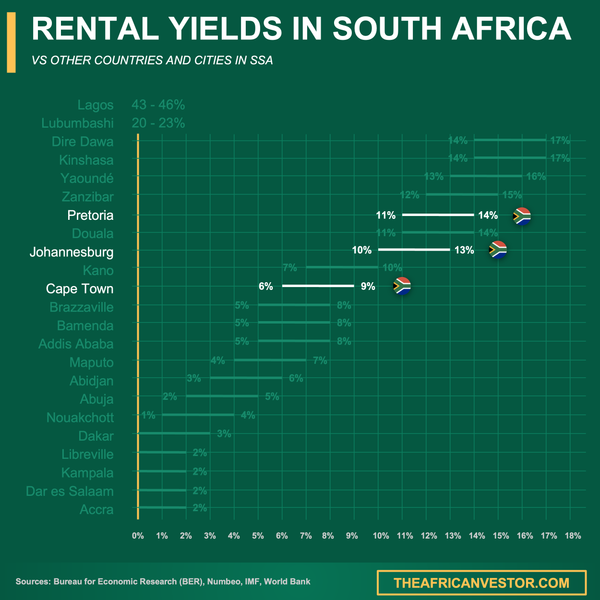
We did some research and made this infographic to help you quickly compare rental yields of the major cities in South Africa versus those in neighboring countries. It provides a clear view of how this country positions itself as a real estate investment destination, which might interest you if you’re planning to invest there.
What are the real numbers I should budget for renting out in South Africa in 2026?
What's the total "all-in" monthly cost to hold a rental in South Africa in 2026?
As of early 2026, the total all-in monthly cost to hold a typical rental property in South Africa runs between R2,500 and R4,000 ($140 to $220 or 125 to 200 EUR), assuming rent around R10,000 and not counting mortgage payments.
The realistic range spans from about R1,800 monthly ($100 or 90 EUR) for a well-priced freehold with low rates, up to R6,000 or more ($330 or 300 EUR) for a sectional title unit with high levies in a premium building.
In South Africa, the largest cost contributor is usually the combination of body corporate levies and municipal rates, which together can easily eat 15% to 25% of your gross rent in cities like Cape Town or Johannesburg.
What's the typical vacancy rate in South Africa in 2026?
As of early 2026, the typical vacancy rate for rental properties in South Africa sits around 5% to 6%, which translates to roughly three weeks of vacancy per year in a stable market.
However, as a foreign owner budgeting conservatively, you should plan for one to two months of vacancy per year to account for tenant changeovers, repairs between tenants, and seasonal slowdowns.
The main factor driving vacancy differences across South African neighborhoods is proximity to employment hubs and universities, with areas near Sandton, the Cape Town CBD, or major campuses filling fastest.
Tenant turnover tends to peak in December and January in South Africa because lease cycles often align with the calendar year and many tenants relocate during the summer holiday period.
We have a whole part covering the best rental strategies in our pack about buying a property in South Africa.
Get fresh and reliable information about the market in South Africa
Don't base significant investment decisions on outdated data. Get updated and accurate information.
Where do rentals perform best in South Africa in 2026?
Which neighborhoods have the highest long-term demand in South Africa in 2026?
As of early 2026, the three neighborhoods with the highest overall long-term rental demand in South Africa are Sandton in Johannesburg (corporate hub), Sea Point in Cape Town (lifestyle and walkability), and Umhlanga in Durban (beachfront appeal with growing business presence).
Families in South Africa gravitate toward neighborhoods like Rondebosch and Newlands in Cape Town, Bryanston and Fourways in Johannesburg, and Waterkloof in Pretoria because of top schools, security estates, and family-friendly amenities.
Students create strong demand in Observatory and Rondebosch near UCT, Braamfontein and Auckland Park near Wits and UJ, and Hatfield near the University of Pretoria.
Expats and international professionals cluster in Sea Point, Green Point, and De Waterkant in Cape Town, plus Rosebank and Sandton in Johannesburg, where walkability, lifestyle, and proximity to corporate offices drive choices.
Which neighborhoods have the best yield in South Africa in 2026?
As of early 2026, the three neighborhoods with the best rental yields in South Africa are select Johannesburg suburbs like Randburg and Bedfordview (around 12% to 14% gross), parts of Cape Town's Southern Suburbs and Century City area (around 9% to 11% gross), and value pockets in Durban outside ultra-prime Umhlanga (around 10% to 12% gross).
These top-yielding neighborhoods typically deliver gross yields in the 11% to 14% range, compared to 7% to 9% in prime lifestyle areas where purchase prices are much higher.
The key characteristic that allows these neighborhoods to achieve higher yields is that purchase prices haven't caught up with rent growth, often because they're one suburb removed from the "headline" locations but still have solid tenant demand from working professionals.
We cover a lot of neighborhoods and provide a lot of updated data in our pack about real estate in South Africa.
Where do tenants pay the highest rents in South Africa in 2026?
As of early 2026, the three neighborhoods where tenants pay the highest rents in South Africa are Cape Town's Atlantic Seaboard (Clifton, Camps Bay, Sea Point), Sandton in Johannesburg, and Umhlanga in Durban.
In these premium neighborhoods, a standard two-bedroom apartment typically rents for R18,000 to R35,000 per month ($990 to $1,925 or 900 to 1,750 EUR), with luxury units exceeding R50,000.
The defining characteristic of these high-rent neighborhoods is the combination of ocean or skyline views, walkable lifestyle amenities, and proximity to major corporate headquarters or tourism infrastructure, features that can't easily be replicated elsewhere.
The typical tenant profile in these areas includes senior corporate executives, foreign diplomats, relocating expats on housing allowances, and high-income professionals willing to pay a premium for security, convenience, and prestige.

We created this infographic to give you a simple idea of how much it costs to buy property in different parts of South Africa. As you can see, it breaks down price ranges and property types for popular cities in the country. We hope this makes it easier to explore your options and understand the market.
What do tenants actually want in South Africa in 2026?
What features increase rent the most in South Africa in 2026?
As of early 2026, the three property features that increase monthly rent the most in South Africa are backup power systems (inverters or generators for load shedding), fibre internet connectivity, and secure parking with access control, reflecting the country's unique infrastructure challenges.
Backup power is the single most valuable feature in South Africa right now, adding an estimated 10% to 20% rent premium because tenants prioritize uninterrupted electricity during load shedding cycles.
One commonly overrated feature that landlords invest in but tenants don't pay much extra for in South Africa is expensive kitchen upgrades, since most renters care more about reliability and security than granite countertops.
An affordable upgrade that provides strong return on investment for South African landlords is installing a basic inverter system with battery backup, which costs R15,000 to R40,000 upfront but can justify R1,000 to R2,000 higher monthly rent.
Do furnished rentals rent faster in South Africa in 2026?
As of early 2026, furnished apartments in South Africa typically rent one to three weeks faster than unfurnished units in expat-heavy areas like Sea Point and Sandton, though the difference shrinks in family-oriented suburbs where tenants prefer bringing their own furniture.
Furnished rentals in South Africa command a rent premium of roughly 15% to 25% over unfurnished equivalents, but this comes with higher wear-and-tear costs, more frequent replacements, and greater management complexity.
Get to know the market before buying a property in South Africa
Better information leads to better decisions. Get all the data you need before investing a large amount of money.
How regulated is long-term renting in South Africa right now?
Can I freely set rent prices in South Africa right now?
South Africa does not have national rent control, so landlords can freely negotiate and set initial rent prices at whatever level the market will bear.
Rent increases during a tenancy are also not capped by law in South Africa, though tenants can challenge increases they consider unfair through the Rental Housing Tribunal, which means extremely aggressive hikes could face pushback.
What's the standard lease length in South Africa right now?
The standard lease length for residential rentals in South Africa is 12 months, though the law allows landlords and tenants to agree on shorter or longer terms as they see fit.
South African law doesn't specify a maximum security deposit amount, but market practice is typically one to two months' rent, meaning R7,000 to R20,000 ($385 to $1,100 or 350 to 1,000 EUR) depending on the property.
The Rental Housing Act requires landlords to hold the deposit in an interest-bearing account, provide proof of interest accrued if the tenant requests it, and return the deposit (minus legitimate deductions for damage) within a reasonable period after move-out.

We made this infographic to show you how property prices in South Africa compare to other big cities across the region. It breaks down the average price per square meter in city centers, so you can see how cities stack up. It’s an easy way to spot where you might get the best value for your money. We hope you like it.
How does short-term renting really work in South Africa in 2026?
Is Airbnb legal in South Africa right now?
Short-term rentals like Airbnb are not banned nationally in South Africa, but their legality depends on local municipal zoning rules, building body corporate restrictions, and compliance with safety by-laws.
There is no single national license required, but cities like Cape Town have introduced planning amendments that may require consent or registration depending on the property's zoning and how many nights you rent per year.
South Africa does not impose uniform national night limits on short-term rentals, though individual municipalities or body corporates can set their own restrictions, so you must check local rules before listing.
The most common consequence for operating a non-compliant short-term rental in South Africa is receiving a notice from the body corporate or municipality, which can escalate to fines or legal action to cease operations.
What's the average short-term occupancy in South Africa in 2026?
As of early 2026, the average annual occupancy rate for short-term rentals in South Africa's main market (Cape Town) sits around 60% to 65%, though individual properties can vary widely based on location and quality.
The realistic range spans from about 45% occupancy for average listings in competitive areas up to 75% or higher for top-performing units in prime tourist locations with excellent reviews.
The highest occupancy months for short-term rentals in South Africa are December through February (summer holiday season) and around Easter, when domestic and international tourists flood coastal destinations.
The lowest occupancy typically hits in May through August (South African winter), particularly in Cape Town where cold and rainy weather reduces tourist demand, though Johannesburg business travel stays steadier year-round.
Finally, please note that you can find much more granular data about this topic in our property pack about South Africa.
What's the average nightly rate in South Africa in 2026?
As of early 2026, the average nightly rate for short-term rentals in Cape Town (South Africa's largest STR market) is around R3,000 ($165 or 150 EUR), though rates vary enormously by neighborhood and property type.
The realistic range runs from about R800 to R1,500 per night ($45 to $85 or 40 to 75 EUR) for basic listings in secondary areas, up to R5,000 to R10,000+ ($275 to $550 or 250 to 500 EUR) for premium properties on the Atlantic Seaboard.
Peak season rates in South Africa (December to February) typically run 30% to 50% higher than off-season rates, meaning a property charging R2,500 per night in winter might command R3,500 to R4,000 in summer.
Is short-term rental supply saturated in South Africa in 2026?
As of early 2026, the short-term rental market in South Africa's key tourism areas (especially Cape Town) shows moderate to high saturation, meaning competition is real and only well-located, well-reviewed properties consistently hit strong occupancy.
The number of active short-term rental listings in Cape Town has stabilized after rapid growth, with new supply roughly balanced by hosts exiting or converting back to long-term rentals due to regulatory pressure and operational challenges.
The most oversaturated neighborhoods for short-term rentals in South Africa include the Cape Town City Bowl, Sea Point, and Green Point, where high listing density means aggressive pricing and marketing are needed to stand out.
Neighborhoods with room for new short-term rental supply include emerging areas like Woodstock and Observatory in Cape Town, parts of Durban's beachfront outside Umhlanga, and niche safari or wine route locations where tourism demand exceeds current listings.
Don't lose money on your property in South Africa
100% of people who have lost money there have spent less than 1 hour researching the market. We have reviewed everything there is to know. Grab our guide now.

What sources have we used to write this blog article?
Whether it's in our blog articles or the market analyses included in our property pack about South Africa, we always rely on the strongest methodology we can and we don't throw out numbers at random.
We also aim to be fully transparent, so below we've listed the authoritative sources we used, and explained how we used them and the methods behind our estimates.
| Source | Why It's Authoritative | How We Used It |
|---|---|---|
| South African Government - Rental Housing Act | Official primary law text setting national landlord-tenant rules. | We confirmed legal requirements for leases, deposits, and dispute mechanisms. We avoided relying on common practice when the law is clearer. |
| SAFLII - Consolidated Rental Housing Act | Go-to public repository for South African legal texts. | We located landlord obligations for deposit handling and written proof. We cross-checked key clauses against the gov.za PDF for consistency. |
| SARS - Tax and Non-Residents | National tax authority's official guidance for non-residents. | We confirmed non-residents are taxed on South African-source rental income. We framed the tax registration requirements section accordingly. |
| SARB Financial Surveillance FAQ | Central bank authority on exchange control processes. | We grounded cross-border money movement guidance and Authorised Dealer requirements. We explained what's needed to repatriate rental income. |
| PayProp Rental Index Q1 2025 | Major rental payments processor with large-scale transaction data. | We used the R9,132 national average rent and 5.6% growth as anchors. We built January 2026 estimates by extrapolating from these figures. |
| TPN Vacancy Survey Q3 2024 | Major credit bureau's long-running property vacancy dataset. | We used the 5.4% national vacancy rate to estimate months empty per year. We built conservative vacancy budgets for foreign owners. |
| Global Property Guide - South Africa Rental Yields | Long-running international dataset with transparent yield methodology. | We triangulated city-level gross yields and rents by unit size. We used it alongside PayProp to avoid relying on one dataset. |
| City of Cape Town - Municipal Planning Amendment 2025 | Official municipal document on planning and zoning rules. | We grounded Airbnb legality explanations in actual local government guidance. We highlighted that short-term rules are municipal, not national. |
| Lightstone - Foreign House Buyers Analysis | Respected property data firm analyzing deeds and market activity. | We contextualized where foreigners tend to buy and at what price bands. We kept foreign ownership framing evidence-based. |
| FNB Property Barometer | Major bank's methodical research on housing trends. | We sanity-checked price growth direction heading into 2026. We avoided assuming prices behave like rents. |
| AirDNA - Cape Town Short-Term Rental Data | Widely used short-term rental dataset with standardized metrics. | We anchored occupancy and nightly rate expectations for short-term rentals. We discussed saturation risk and revenue realities. |
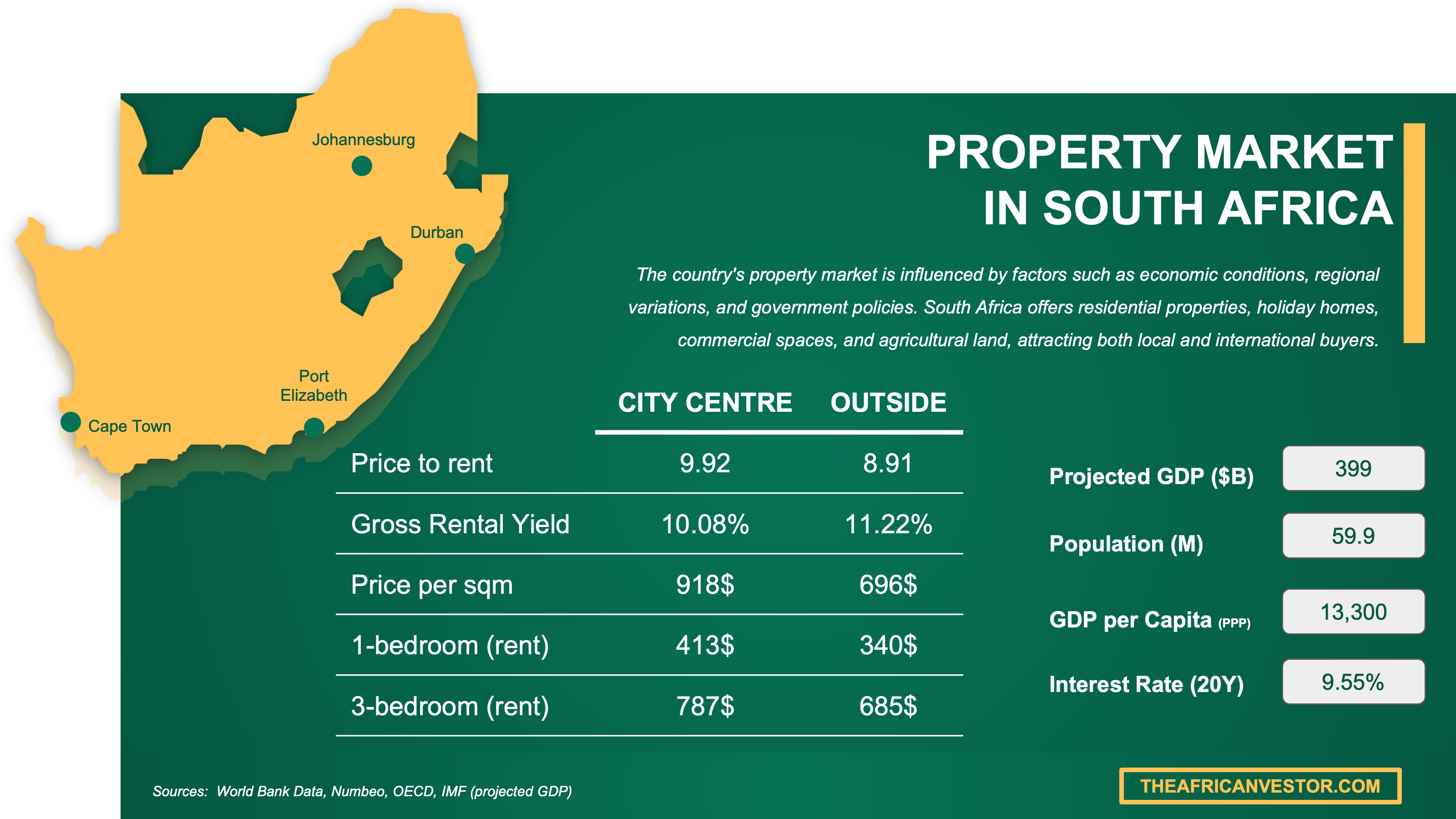
We have made this infographic to give you a quick and clear snapshot of the property market in South Africa. It highlights key facts like rental prices, yields, and property costs both in city centers and outside, so you can easily compare opportunities. We’ve done some research and also included useful insights about the country’s economy, like GDP, population, and interest rates, to help you understand the bigger picture.
