
Authored by the expert who managed and guided the team behind the South Africa Property Pack

Yes, the analysis of Stellenbosch's property market is included in our pack
Everything you need to know about buying land in Stellenbosch as a foreigner, from legal requirements to hidden costs and common scams.
We constantly update this blog post to reflect the latest rules, taxes, and processes affecting foreign property buyers in Stellenbosch.
And if you're planning to buy a property in this place, you may want to download our pack covering the real estate market in Stellenbosch.
Insights
- Foreign buyers in Stellenbosch face no nationality-based ownership bans, but exchange control compliance through the South African Reserve Bank is the real friction point that trips up most overseas purchasers.
- Transfer duty in Stellenbosch starts at 0% for properties under R1.21 million in 2026, but jumps to around 4.6% on a R3.5 million purchase, making budget planning essential before you commit.
- The Western Cape Deeds Registry in Cape Town handles all Stellenbosch property registrations, and the typical transfer process takes 6 to 12 weeks from signed offer to final ownership.
- Municipal rates clearance certificates are mandatory before transfer in Stellenbosch, and buyers often face unexpected advance payments to the municipality that delay registration.
- Stellenbosch zoning schemes vary significantly between areas like Stellenbosch Central, De Zalze, and Paradyskloof, so checking the municipal GIS viewer before signing any offer is critical for vacant land.
- Nominee or "fronting" arrangements where a local holds title on your behalf are the most common grey-area setups that get foreigners into legal trouble in Stellenbosch.
- The Surveyor-General diagram is the only authoritative document for property boundaries in Stellenbosch, and fences or hedges frequently do not match legal boundary lines.
- FICA compliance (passport, proof of address, source of funds) is strictly enforced for foreign buyers in Stellenbosch, and incomplete documentation is the top cause of transfer delays.
Can a foreigner legally own land in Stellenbosch right now?
Can foreigners own land in Stellenbosch in 2026?
As of early 2026, there is no general law preventing a foreign individual from buying and owning residential freehold land in Stellenbosch, and you can have your name registered as the legal owner in the Deeds Registry just like any South African citizen.
South Africa does not impose passport-based restrictions on foreign residential property buyers in Stellenbosch, so whether you hold a European, American, Asian, or any other passport, the legal pathway to ownership is the same.
The real friction for foreigners buying property in Stellenbosch comes from banking requirements, exchange control rules through the South African Reserve Bank, and FICA compliance (proof of identity, address, and source of funds), not from nationality-based ownership bans.
If you encounter any situation where freehold ownership is not possible, the closest alternatives in Stellenbosch are sectional title (where you own a unit plus a share of common property including land) or long-term leasehold, though these are rarely necessary for standard residential purchases.
Can I own a house but not the land in Stellenbosch in 2026?
As of early 2026, owning a house without the underlying land is unusual in mainstream Stellenbosch residential property because most transactions involve either freehold erven (plots) or sectional title units where you automatically own a share of the common property including land.
In sectional title schemes, which are common for apartments and townhouses in areas like Stellenbosch Central, Die Boord, and Welgevonden Estate, you receive a sectional title deed that confirms your ownership of the unit plus your undivided share in the scheme's common property.
Long-term leasehold arrangements where the building and land are separated are rare in Stellenbosch residential, but where they exist, your lease terms will specify what happens when the lease expires, typically requiring negotiation for renewal or reversion of improvements to the landowner.

We created this infographic to give you a simple idea of how much it costs to buy property in different parts of South Africa. As you can see, it breaks down price ranges and property types for popular cities in the country. We hope this makes it easier to explore your options and understand the market.
Do rules differ by region or city for land ownership in Stellenbosch right now?
Foreign ownership rules in South Africa are set at the national level through the Deeds Registry system, SARS tax rules, and SARB exchange controls, so the legal framework for buying property in Stellenbosch is the same as in Cape Town, Johannesburg, or any other South African city.
What does change by location is the municipal layer, and in Stellenbosch specifically this means zoning schemes, heritage and environmental overlays, building restrictions, and local rates that can significantly affect what you can do with your property.
These municipal differences exist because each local government manages its own planning framework, so a vacant plot in Paradyskloof may have different building permissions than one in Jamestown or De Zalze Winelands Golf Estate.
We cover a lot of different regions and cities in our pack about the property market in Stellenbosch.
Can I buy land in Stellenbosch through marriage to a local in 2026?
As of early 2026, marriage to a South African citizen does not unlock any special land ownership rights because foreigners can already buy residential property in Stellenbosch without restrictions, so marriage provides no additional legal advantage for property acquisition.
Where marriage does matter is how the property is registered between spouses, and foreign buyers should understand their marital property regime, whether that is in community of property, out of community of property with an antenuptial contract, or another arrangement recognized under South African law.
If the marriage ends in divorce, the foreign spouse's interest in Stellenbosch property will be determined by the marital regime and any antenuptial contract on file, which is why having proper legal documentation in place before purchase is essential.
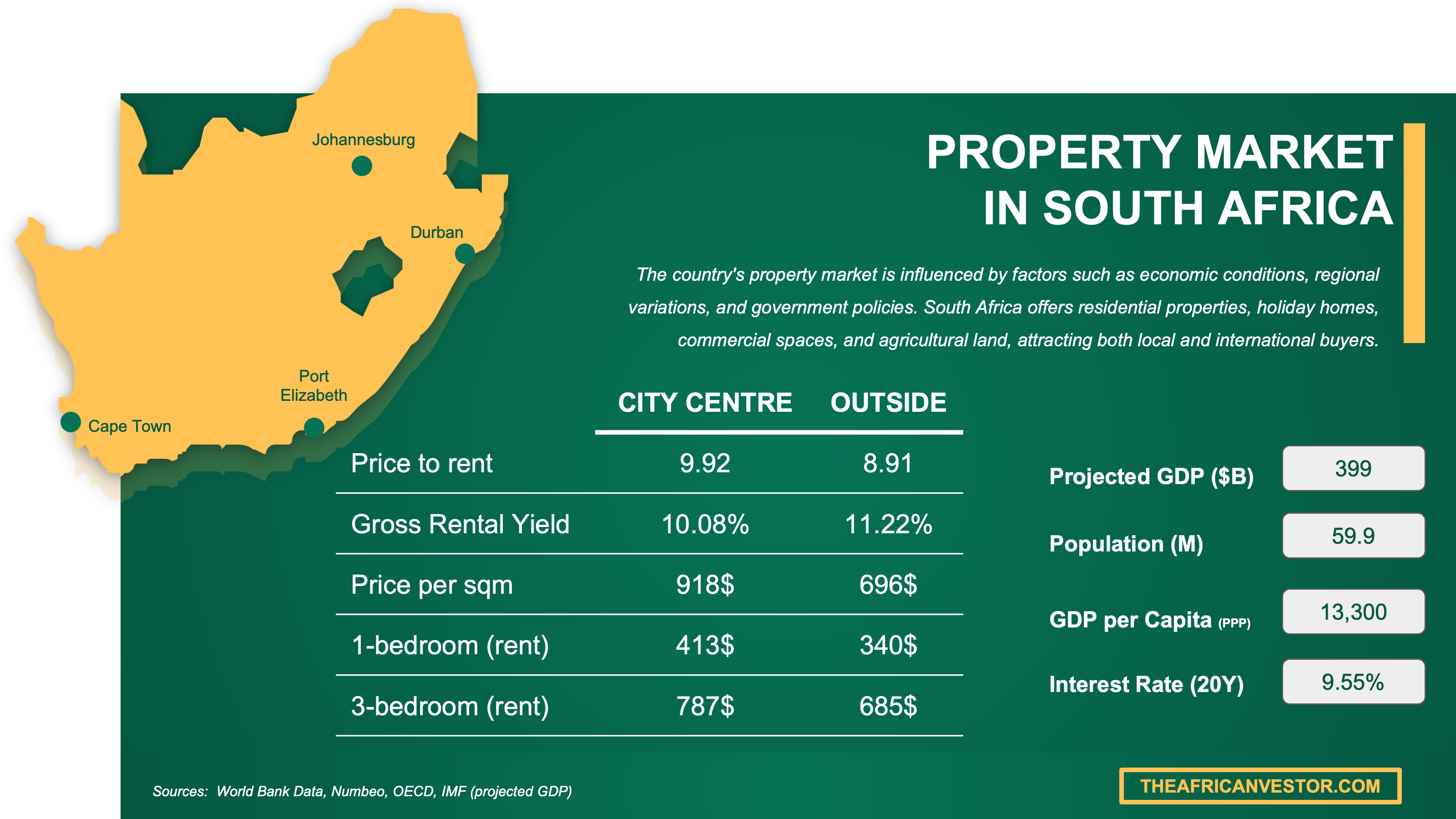
We have made this infographic to give you a quick and clear snapshot of the property market in South Africa. It highlights key facts like rental prices, yields, and property costs both in city centers and outside, so you can easily compare opportunities. We’ve done some research and also included useful insights about the country’s economy, like GDP, population, and interest rates, to help you understand the bigger picture.
What eligibility and status do I need to buy land in Stellenbosch?
Do I need residency to buy land in Stellenbosch in 2026?
As of early 2026, you do not need to be a South African resident to purchase residential property in Stellenbosch, and non-residents can legally buy, own, and register land in their own names.
No specific visa or permit is required to complete a land transaction in Stellenbosch, though if you plan to live in South Africa long-term, that becomes a separate immigration matter unrelated to property ownership.
Foreigners can and often do buy property in Stellenbosch remotely without being physically present, typically by signing documents via power of attorney handled by a conveyancer and completing FICA verification electronically.
Do I need a local tax number to buy lands in Stellenbosch?
While you may not need a South African tax number to sign an Offer to Purchase in Stellenbosch, in practice your conveyancer and bank will often require one for clean administration, especially if you plan to sell, rent out, or repatriate funds later.
The process of obtaining a tax number as a foreigner in South Africa involves registering with SARS, and your conveyancer or a local accountant can typically assist with this within a few weeks.
A local South African bank account is not strictly required for purchasing property in Stellenbosch, but what matters most is that your funds flow through an Authorised Dealer pathway so the transaction is properly recorded for future repatriation of sale proceeds.
Is there a minimum investment to buy land in Stellenbosch as of 2026?
As of early 2026, there is no national minimum property price that foreigners must meet to purchase residential land in Stellenbosch, so you can legally buy at any price point the market offers.
Any "minimum investment" you encounter in Stellenbosch will typically be a developer requirement in estates like De Zalze or Welgevonden, a bank threshold for mortgage lending, or simply the market reality of what property costs in desirable areas like Mostertsdrift or Dalsig.
Are there restricted zones foreigners can't buy in Stellenbosch?
For ordinary residential property in Stellenbosch, there are no standard municipal zones where foreigners are specifically prohibited from purchasing land based on their nationality.
The restrictions you will encounter in Stellenbosch relate to land use rather than passport, including zoning limitations (agricultural versus residential), heritage overlays, environmental protections, and building line setbacks that apply equally to all buyers.
To verify whether a specific plot in Stellenbosch falls within any restricted category, you should check the municipal zoning scheme documents and use the Stellenbosch GIS viewer before making an offer, especially for vacant land.
Can foreigners buy agricultural, coastal or border land in Stellenbosch right now?
Agricultural land in Stellenbosch and the surrounding Western Cape wine region is a more sensitive category for foreign buyers, often requiring extra scrutiny, specialist legal advice, and potentially government oversight depending on the size and nature of the land.
Since Stellenbosch is an inland municipality, coastal restrictions do not directly apply, though any property near rivers, wetlands, or environmental protection areas may have additional constraints regardless of the buyer's nationality.
Border land restrictions are not relevant to Stellenbosch given its location in the heart of the Western Cape, far from any international boundaries.
For a typical foreign buyer looking at residential property in Stellenbosch, the practical advice is to stick to clearly residential-zoned erven or established residential schemes unless you have specialist agricultural or environmental counsel.
Get fresh and reliable information about the market in Stellenbosch
Don't base significant investment decisions on outdated data. Get updated and accurate information.

What are the safest legal structures to control land in Stellenbosch?
Is a long-term lease equivalent to ownership in Stellenbosch right now?
A long-term lease in Stellenbosch gives you use rights over the property, but it is not legally equivalent to freehold ownership because you do not hold registered title in the Deeds Registry and your control is limited by the lease terms.
Lease lengths in South Africa can vary depending on the agreement, and whether a lease right can be renewed, extended, or treated as a registrable real right depends on how the lease is structured and whether it has been registered against the title deed.
Foreigners can typically sell, transfer, or bequeath lease rights in Stellenbosch if the lease agreement permits it, but this requires careful legal review because lease terms vary and not all arrangements provide the same level of protection as full ownership.
Can I buy land in Stellenbosch via a local company?
Foreigners can legally purchase property in Stellenbosch through a locally registered South African company, but this structure is not automatically safer or simpler than personal ownership and comes with additional administrative, tax, and compliance obligations.
There is no specific shareholding structure required for a foreign-owned company to hold residential land in Stellenbosch, but setting up and maintaining a company adds costs and complexity that most individual homebuyers do not need.
What "grey-area" ownership setups get foreigners in trouble in Stellenbosch?
Grey-area ownership arrangements are unfortunately common among foreigners in South Africa who receive bad advice, and these setups frequently lead to legal disputes, financial losses, or unenforceable claims.
The most problematic grey-area structures in Stellenbosch include nominee or "fronting" arrangements where a local South African holds title on your behalf with a side agreement, handshake leases on vacant land without proper registration, and relying on developer promises about zoning without verifying through official channels.
If South African authorities or courts discover that a foreigner is using an illegal ownership structure, the consequences can range from the arrangement being declared void and unenforceable to losing the property entirely, with limited legal recourse available.
By the way, you can avoid most of these bad surprises if you go through our pack covering the property buying process in Stellenbosch.
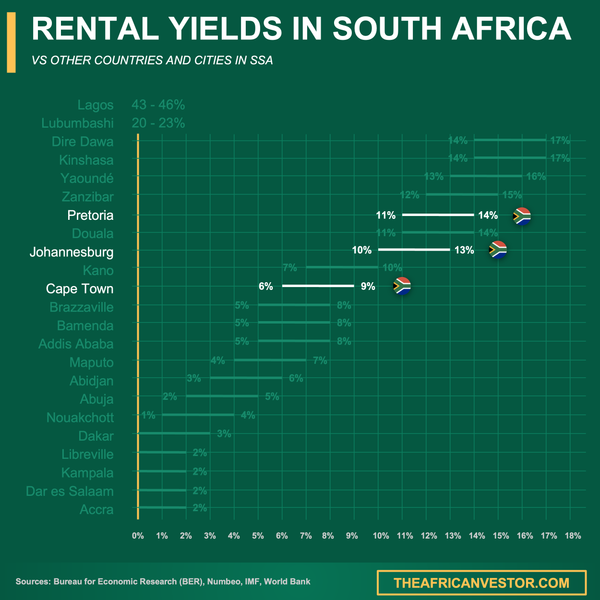
We did some research and made this infographic to help you quickly compare rental yields of the major cities in South Africa versus those in neighboring countries. It provides a clear view of how this country positions itself as a real estate investment destination, which might interest you if you’re planning to invest there.
How does the land purchase process work in Stellenbosch, step-by-step?
What are the exact steps to buy land in Stellenbosch right now?
The typical process for a foreigner to buy residential property in Stellenbosch involves selecting the property, signing an Offer to Purchase with conditions, appointing a conveyancer, completing FICA verification, arranging funds through an Authorised Dealer, obtaining municipal rates clearance, paying transfer duty, and then lodging for registration at the Cape Town Deeds Office.
From signed offer to final registration, the entire land purchase process in Stellenbosch typically takes between 6 and 12 weeks, assuming there are no unusual complications with documentation, municipal clearances, or Deeds Office examination.
The key documents you will sign during a Stellenbosch property purchase include the Offer to Purchase, FICA compliance forms, a power of attorney if buying remotely, transfer duty declarations, and the final deed of transfer that gets registered in your name.
What scams are common when it comes to buying land in Stellenbosch right now?
What scams target foreign land buyers in Stellenbosch right now?
Property scams targeting foreigners do occur in South Africa, and Stellenbosch is not immune, particularly for buyers who bypass regulated channels or rush transactions without proper due diligence.
The most common scams in Stellenbosch include sellers who are not the actual registered owners using forged documents, agents or intermediaries who are not licensed with the PPRA, misrepresentation of zoning or buildability on vacant land, and payment demands to offshore accounts outside of proper attorney trust channels.
The top warning signs of a fraudulent land deal in Stellenbosch are pressure to pay a "reservation fee" quickly before verification, reluctance to provide Deeds Registry documentation, and any request to send funds to a personal account rather than a conveyancer's trust account.
Foreigners who fall victim to property scams in Stellenbosch can pursue legal recourse through the South African courts and may lodge complaints with the PPRA, but recovery is often difficult and expensive, which is why prevention through proper verification is essential.
We cover all these things in length in our pack about the property market in Stellenbosch.
How do I verify the seller is legit in Stellenbosch right now?
The most reliable way to verify a seller in Stellenbosch is to obtain a Deeds Registry search showing the registered owner matches the person claiming to sell, which your conveyancer can arrange or you can request through the Deeds Office.
To confirm the title is clean and free of disputes, your conveyancer will pull a title deed search that shows the property's history, any existing servitudes, conditions, and whether there are any court orders or interdicts registered against it.
Checking for existing liens, mortgages, or municipal debts attached to the property is done through the Deeds Registry search for bonds and through municipal clearance certificates that must be obtained before transfer.
The most essential professional for verifying seller legitimacy in Stellenbosch is a qualified conveyancer (transfer attorney) who is regulated by the Legal Practice Council and can conduct all necessary searches and verify documents on your behalf.
How do I confirm land boundaries in Stellenbosch right now?
The standard procedure for confirming land boundaries in Stellenbosch before purchase is to obtain the Surveyor-General diagram for the erf, which is the authoritative legal document defining the property's exact boundaries.
You should review the SG diagram held by the Chief Surveyor General's office and cross-check it against the Stellenbosch municipal GIS viewer, which shows the erf location, planning overlays, and zoning layers.
Hiring a licensed land surveyor is not legally required but is strongly recommended for vacant land in Stellenbosch, especially when fences, hedges, or walls on the ground do not clearly match the legal boundary.
Common boundary problems foreign buyers encounter in Stellenbosch include discovering after purchase that the existing fence encroaches on a neighbor's land, or conversely that a neighbor's structure encroaches on your property, leading to costly disputes that could have been avoided with a pre-purchase survey.
Buying real estate in Stellenbosch can be risky
An increasing number of foreign investors are showing interest. However, 90% of them will make mistakes. Avoid the pitfalls with our comprehensive guide.

What will it cost me, all-in, to buy and hold land in Stellenbosch?
What purchase taxes and fees apply in Stellenbosch as of 2026?
As of early 2026, the total closing costs for a residential property purchase in Stellenbosch typically range from 5% to 8% of the purchase price for a cash transaction, driven primarily by transfer duty and conveyancing fees.
Transfer duty in South Africa follows a sliding scale that starts at 0% for properties valued up to R1,210,000 (approximately $65,000 or EUR 60,000 at current rates), then increases through brackets up to 13% for the highest-value properties.
The main components of closing costs in Stellenbosch include transfer duty payable to SARS, conveyancing attorney fees based on guideline tariffs, Deeds Office registration fees, municipal rates clearance charges, and various disbursements for searches and certifications.
These taxes and fees apply equally to foreign and local buyers in Stellenbosch, with no additional "foreigner premium" built into the official cost structure, though foreigners may face extra compliance costs for document certification and source-of-funds verification.
What hidden fees surprise foreigners in Stellenbosch most often?
Hidden fees in Stellenbosch property transactions typically add an unexpected R10,000 to R50,000 (roughly $550 to $2,750 or EUR 500 to EUR 2,500) to what buyers initially budget, depending on the property and complexity of the transaction.
The specific fees that catch foreigners off guard in Stellenbosch include municipal rates clearance advance payments, FICA-related document certification and translation costs, unexpected bank charges for international transfers, and delays that trigger additional storage or interest costs.
These hidden costs typically appear at different stages: municipal clearance charges emerge during transfer preparation, FICA compliance costs arise early in the process, and international transfer fees hit when moving funds into South Africa.
The best way to protect yourself from unexpected fees in Stellenbosch is to get a detailed written estimate from your conveyancer upfront, confirm all municipal arrears and advance requirements early, and use an Authorised Dealer bank that provides clear fee schedules for international property transactions.

We made this infographic to show you how property prices in South Africa compare to other big cities across the region. It breaks down the average price per square meter in city centers, so you can see how cities stack up. It’s an easy way to spot where you might get the best value for your money. We hope you like it.
What sources have we used to write this blog article?
Whether it's in our blog articles or the market analyses included in our property pack about Stellenbosch, we always rely on the strongest methodology we can, and we don't throw out numbers at random.
We also aim to be fully transparent, so below we've listed the authoritative sources we used, and explained how we used them and the methods behind our estimates.
| Source | Why it's authoritative | How we used it |
|---|---|---|
| South African Revenue Service (SARS) | Official source for South Africa's property transfer tax brackets and rates | We used SARS to state exactly what transfer duty applies in 2026 and to estimate real all-in purchase costs. We also used it to explain when transfer duty is not payable on VATable new builds. |
| South African Government Deeds Registry | Official government portal explaining what the Deeds Office records | We used this to explain what ownership means in practice in South Africa through registered title. We also used it for practical buyer verification steps including checking owners, bonds, and sectional title rules. |
| South African Reserve Bank (SARB) | Central bank's official guidance on exchange control for foreign transactions | We used SARB to explain how foreign funds should enter South Africa via an Authorised Dealer. We also used it to shape advice on avoiding exchange control mistakes that block future repatriation. |
| Stellenbosch Municipality Zoning Schemes | Official municipal access point to zoning bylaws and maps | We used this to show how to verify whether a plot can legally be used as intended. We also used it to create practical due diligence steps for vacant land purchases. |
| Property Practitioners Regulatory Authority (PPRA) | Regulator that administers the Property Practitioners Act | We used PPRA to explain how to verify whether an agent is properly licensed. We also used it to frame common scam patterns involving unlicensed intermediaries. |
| Chief Surveyor General | National cadastral authority that records property boundary diagrams | We used this to explain what document defines legal boundaries in Stellenbosch. We also used it to build the boundary confirmation section and help buyers avoid fence line disputes. |
| Fairbridges Attorneys | Specialist conveyancing firm explaining Cape Town Deeds Office processes | We used this to outline the real step-by-step of lodgement, examination, and registration. We also used it to explain why delays happen and how to reduce rejection risk. |
| Law Society of South Africa (LSSA) | National guideline document for conveyancing fees and what they cover | We used this to estimate realistic attorney and conveyancing costs as a percentage range. We also used it to list what these fees actually include for foreign buyers. |
| STBB Attorneys | Major property law firm publishing focused non-resident buyer guidance | We used this to confirm that non-residents can legally own property and to frame typical paperwork requirements. We also used it to keep guidance practical and buyer-friendly. |
| Stellenbosch Municipal GIS Viewer | Official municipal mapping tool for public spatial queries | We used this as the fastest way to check erf location, overlays, and planning layers before paying a deposit. We also used it to support boundary and zoning cross-checks. |
Get the full checklist for your due diligence in Stellenbosch
Don't repeat the same mistakes others have made before you. Make sure everything is in order before signing your sales contract.
