
Authored by the expert who managed and guided the team behind the South Africa Property Pack

Yes, the analysis of Stellenbosch's property market is included in our pack
Stellenbosch is one of South Africa's most sought-after property markets, but its popularity also makes it a target for professional scammers who specifically prey on foreign buyers unfamiliar with local processes.
We constantly update this blog post with the latest information on scams, regulatory changes, and insider tips so you always have fresh data when making your purchase decision.
And if you're planning to buy a property in this place, you may want to download our pack covering the real estate market in Stellenbosch.
How risky is buying property in Stellenbosch as a foreigner in 2026?
Can foreigners legally own properties in Stellenbosch in 2026?
As of early 2026, foreigners can legally buy and hold residential property in Stellenbosch with full ownership rights, just like South African citizens, because there are no nationality-based restrictions on property ownership in South Africa.
The main conditions that apply to foreigners buying property in Stellenbosch relate to how you move money into South Africa, since you must route purchase funds through an authorised dealer bank under exchange control rules, and you need to keep proof of these inward transfers for future repatriation of sale proceeds.
Since direct ownership is allowed in Stellenbosch, most foreigners simply buy property in their own name, though some choose to use trusts or companies for estate planning reasons or when purchasing agricultural land over a certain size, which requires additional government approval.
[VARIABLE FOREIGNER-RIGHTS]What buyer rights do foreigners actually have in Stellenbosch in 2026?
As of early 2026, foreigners buying property in Stellenbosch have the same legal buyer rights as South African citizens, meaning you can enforce contracts through the courts, claim damages for breach, and register ownership at the Deeds Office just like any local buyer.
If a seller breaches a contract in Stellenbosch, you can pursue legal remedies including specific performance (forcing the sale to complete) or cancellation with damages, though enforcement can take time through the court system and you should budget for legal costs.
The most common buyer right that foreigners mistakenly assume they have in Stellenbosch is the ability to easily reverse or cancel a signed Offer to Purchase after the cooling-off period, because once both parties sign and conditions are met, you are legally bound and walking away can result in forfeiture of your deposit or a damages claim.
How strong is contract enforcement in Stellenbosch right now?
Contract enforcement for Stellenbosch property transactions is workable but not lightning-fast, placing South Africa somewhere in the middle globally, which means you have legal recourse but disputes can take months or years to resolve, unlike countries like Germany or Singapore where courts move faster.
The main weakness in contract enforcement that foreigners should be aware of in Stellenbosch is the time and cost of litigation, because even if you have a strong case, pursuing a dispute through South African courts can be slow and expensive, making prevention through proper due diligence far more practical than relying on post-transaction legal remedies.
By the way, we detail all the documents you need and what they mean in our property pack covering Stellenbosch.
Buying real estate in Stellenbosch can be risky
An increasing number of foreign investors are showing interest. However, 90% of them will make mistakes. Avoid the pitfalls with our comprehensive guide.

Which scams target foreign buyers in Stellenbosch right now?
Are scams against foreigners common in Stellenbosch right now?
Real estate scams targeting foreigners in Stellenbosch are not everywhere all the time, but they happen often enough that you should treat every transaction with healthy skepticism, especially in a premium market where large sums change hands and fraudsters assume foreigners do not know local verification steps.
The type of property transaction most frequently targeted by scammers in Stellenbosch is the high-value residential purchase, particularly student accommodation investments and lifestyle estate homes, because these attract foreign buyers who are often managing the purchase remotely and may not be able to verify details in person.
The profile of foreign buyer most commonly targeted by scammers in Stellenbosch is someone purchasing remotely from overseas, often drawn by promises of strong rental yields or a dream winelands lifestyle, who trusts emailed documents and banking details without independent verification.
The single biggest warning sign that a deal may be a scam in Stellenbosch is any combination of urgency and secrecy, such as pressure to pay a deposit immediately before another buyer snaps it up, requests to keep the deal quiet, or last-minute changes to banking details sent via email or WhatsApp.
What are the top three scams foreigners face in Stellenbosch right now?
The top three scams that foreigners most commonly face when buying property in Stellenbosch are the fake seller or stolen identity sale (where someone poses as the property owner), the deposit diversion scam (where banking details are changed via hacked email to redirect your payment to criminals), and the non-compliant property trap (where the home has unapproved building work or hidden legal issues).
The most common scam in Stellenbosch, the deposit diversion, typically unfolds when a fraudster compromises the email account of an agent or conveyancer, monitors the conversation until payment is imminent, then sends you new banking details that look legitimate, and once you transfer your deposit to the criminal's account, the money is gone within minutes.
The single most effective way to protect yourself from each of these three scams in Stellenbosch is to never trust document-only proof or emailed banking details, instead verifying seller identity through your conveyancer's independent checks, confirming bank accounts by calling a known phone number (not one in the email), and checking building plan approvals directly with Stellenbosch Municipality before signing.
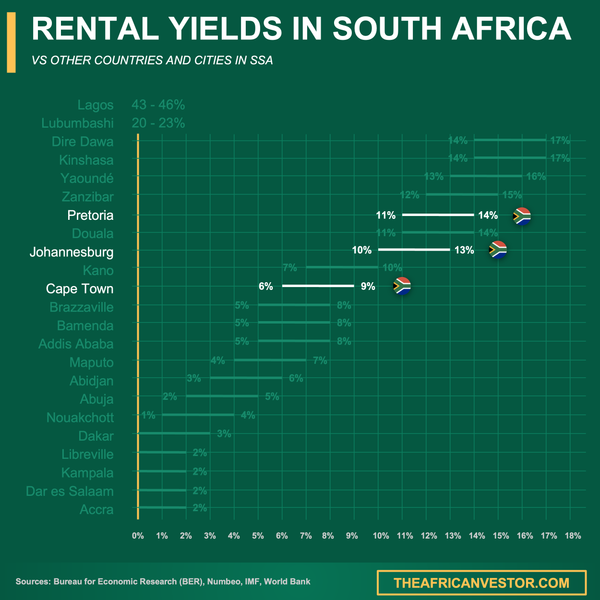
We did some research and made this infographic to help you quickly compare rental yields of the major cities in South Africa versus those in neighboring countries. It provides a clear view of how this country positions itself as a real estate investment destination, which might interest you if you’re planning to invest there.
How do I verify the seller and ownership in Stellenbosch without getting fooled?
How do I confirm the seller is the real owner in Stellenbosch?
The standard verification process to confirm the seller is the real owner in Stellenbosch involves your conveyancing attorney pulling the official title deed records from the Deeds Office and matching the registered owner's details against the seller's identity documents.
The official document foreigners should check to verify ownership in Stellenbosch is the Deeds Office title deed printout, which your conveyancer obtains as a standard part of the transfer process and which shows the registered owner, any bonds or restrictions, and the property description.
The most common trick fake sellers use to appear legitimate in Stellenbosch is presenting convincing copies of ID documents and title deeds, sometimes with a power of attorney claiming they represent the owner, and this happens often enough that you should always insist your conveyancer independently verifies identity rather than just accepting documents provided by the other side.
Where do I check liens or mortgages on a property in Stellenbosch?
The official registry where you check liens or mortgages on a property in Stellenbosch is the Deeds Office (specifically the Cape Town Deeds Registry for Western Cape properties), and your conveyancer will obtain a printout showing all registered bonds and encumbrances as part of the standard transfer process.
When checking for liens in Stellenbosch, you should request not just the bond information but also any servitudes, conditions of title, and any caveats or interdicts that might restrict your use of the property or complicate future sale.
The type of lien or encumbrance most commonly missed by foreign buyers in Stellenbosch is unpaid municipal rates and levies, because while bonds are obvious on the title deed, rates arrears only show up when you request a rates clearance certificate from Stellenbosch Municipality, and these can delay or block your transfer if not resolved.
It's one of the aspects we cover in our pack about the real estate market in Stellenbosch.
How do I spot forged documents in Stellenbosch right now?
The most common type of forged document used in property scams in Stellenbosch is a fake or altered power of attorney or ID document, and this happens often enough that you should never rely on documents provided solely by the counterparty without independent verification.
Specific red flags that indicate a document may be forged in Stellenbosch include inconsistent fonts or formatting, spelling errors in official headings, signatures that look digitally pasted, documents that cannot be verified against official sources, and any pressure to accept scanned copies without seeing originals.
The official verification method you should use to authenticate documents in Stellenbosch is to have your conveyancer independently obtain title deed records from the Deeds Office, verify agent credentials through the PPRA's Fidelity Fund Certificate portal, and confirm seller identity through proper FICA compliance procedures rather than trusting any document handed to you.
Get the full checklist for your due diligence in Stellenbosch
Don't repeat the same mistakes others have made before you. Make sure everything is in order before signing your sales contract.
What "grey-area" practices should I watch for in Stellenbosch?
What hidden costs surprise foreigners when buying a property in Stellenbosch?
The three most common hidden costs that foreigners overlook in Stellenbosch are transfer duty (which can be 3% to 13% of the price above R1,210,000, or roughly $180 to $780 USD per R100,000 above threshold), conveyancing attorney fees (around R20,000 to R50,000 or $1,100 to $2,800 USD for a typical transaction), and estate or sectional title levies (which can run R1,500 to R5,000 per month or $85 to $280 USD).
The hidden cost most often deliberately concealed by sellers or agents in Stellenbosch is special levies or pending body corporate assessments in sectional title or estate properties, and this happens commonly enough that you should always request the last 12 months of levy statements and minutes from body corporate meetings before signing anything.
Are "cash under the table" requests common in Stellenbosch right now?
Cash under the table requests in Stellenbosch property transactions are not the norm, but they do happen sometimes, usually framed as a way to declare a lower purchase price and reduce transfer duty.
The typical reason sellers give for requesting undeclared cash payments in Stellenbosch is to reduce the official purchase price on record, which lowers the buyer's transfer duty and the seller's potential capital gains tax exposure.
The legal risks foreigners face if they agree to an undeclared cash payment in Stellenbosch include potential prosecution for tax evasion, difficulty proving the true purchase price if you later need to sell or dispute the transaction, and problems with exchange control documentation when you try to repatriate funds, since SARS and the Reserve Bank require clean paper trails.
Are side agreements used to bypass rules in Stellenbosch right now?
Side agreements to bypass official rules in Stellenbosch property transactions happen sometimes, particularly in deals involving furniture valuations, occupational rent arrangements, or verbal promises about rental income that are not reflected in the main contract.
The most common type of side agreement used to circumvent regulations in Stellenbosch is an inflated "furniture and fittings" valuation, where part of the purchase price is attributed to movable items to reduce the amount subject to transfer duty.
The legal consequences foreigners face if a side agreement is discovered by authorities in Stellenbosch include reassessment of transfer duty with penalties and interest, potential fraud charges, and the risk that unwritten promises about things like rental yields or development rights have no legal standing and cannot be enforced.

We made this infographic to show you how property prices in South Africa compare to other big cities across the region. It breaks down the average price per square meter in city centers, so you can see how cities stack up. It’s an easy way to spot where you might get the best value for your money. We hope you like it.
Can I trust real estate agents in Stellenbosch in 2026?
Are real estate agents regulated in Stellenbosch in 2026?
As of early 2026, real estate agents in Stellenbosch are regulated by the Property Practitioners Regulatory Authority (PPRA) under the Property Practitioners Act, which means agents must be registered, hold a valid Fidelity Fund Certificate (FFC), and follow specific conduct rules.
The official license a legitimate real estate agent should have in Stellenbosch is a current-year Fidelity Fund Certificate (FFC), which for 2026 should show validity through December 2026 or later, and which proves the agent has met registration, training, and compliance requirements.
Foreigners can verify whether an agent is properly licensed in Stellenbosch by using the online Fidelity Fund Certificate verification portal, where you can enter the agent's details and confirm their certificate status is current, rather than trusting a screenshot or certificate copy they provide.
Please note that we have a list of contacts for you in our property pack about Stellenbosch.
What agent fee percentage is normal in Stellenbosch in 2026?
As of early 2026, the normal agent fee percentage in Stellenbosch is around 5% to 7.5% plus VAT (15%), which means the effective commission is roughly 5.75% to 8.6% of the sale price when VAT is included.
The typical range of agent fees that covers most transactions in Stellenbosch is 5% to 6% plus VAT for standard residential sales, though premium properties or competitive situations may see some negotiation, and higher-value properties sometimes attract lower percentage rates.
In Stellenbosch, the seller typically pays the agent commission, not the buyer, so as a foreign buyer you generally do not pay this cost directly, though it is factored into the overall price negotiations and deal dynamics.
Get the full checklist for your due diligence in Stellenbosch
Don't repeat the same mistakes others have made before you. Make sure everything is in order before signing your sales contract.
What due diligence actually prevents disasters in Stellenbosch?
What structural inspection is standard in Stellenbosch right now?
The standard structural inspection process for property purchases in Stellenbosch involves hiring an independent building inspector to examine the property before you finalize the purchase, though this is not legally required and many buyers skip it, often to their regret.
A qualified inspector in Stellenbosch should check the roof structure and covering, walls for cracks or damp, foundations, electrical compliance, plumbing, drainage, and any additions or alterations to confirm they match approved building plans.
The type of professional qualified to perform structural inspections in Stellenbosch is a registered building inspector, structural engineer, or qualified home inspector with construction industry credentials, and you should ask for their qualifications and insurance before hiring.
The most common structural issues that inspections reveal in Stellenbosch properties specifically are unapproved building additions (especially student flatlets or extra rooms), damp problems in older homes near the mountains, and electrical installations that do not meet current compliance certificate standards.
How do I confirm exact boundaries in Stellenbosch?
The standard process for confirming exact property boundaries in Stellenbosch is to review the survey diagram referenced in your title deed and, if you have any doubts about whether fences or walls match the legal boundaries, hire a land surveyor to verify on the ground.
The official document that shows the legal boundaries of a property in Stellenbosch is the survey diagram (SG diagram) registered with the Surveyor-General's office, which your conveyancer can obtain and which shows the precise measurements and coordinates of your property.
The most common boundary dispute that affects foreign buyers in Stellenbosch involves fences or walls that have been built in the wrong place over time, encroaching on or ceding land to neighbors, which only becomes apparent when you try to build or sell.
The professional you should hire to physically verify boundaries on the ground in Stellenbosch is a registered land surveyor, who can visit the property, take measurements, and confirm whether the physical boundaries match the official survey diagram.
What defects are commonly hidden in Stellenbosch right now?
The top three defects that sellers frequently conceal from buyers in Stellenbosch are unapproved building work (which is common because of student rental demand for extra rooms), electrical and plumbing issues that would fail compliance inspections, and water damage or damp that has been cosmetically covered with fresh paint.
The inspection technique that helps uncover hidden defects in Stellenbosch is a combination of a thorough building inspection by a qualified inspector, a request for all compliance certificates (electrical, gas, electric fence where applicable), and a check with Stellenbosch Municipality to compare approved building plans against what is actually built on site.
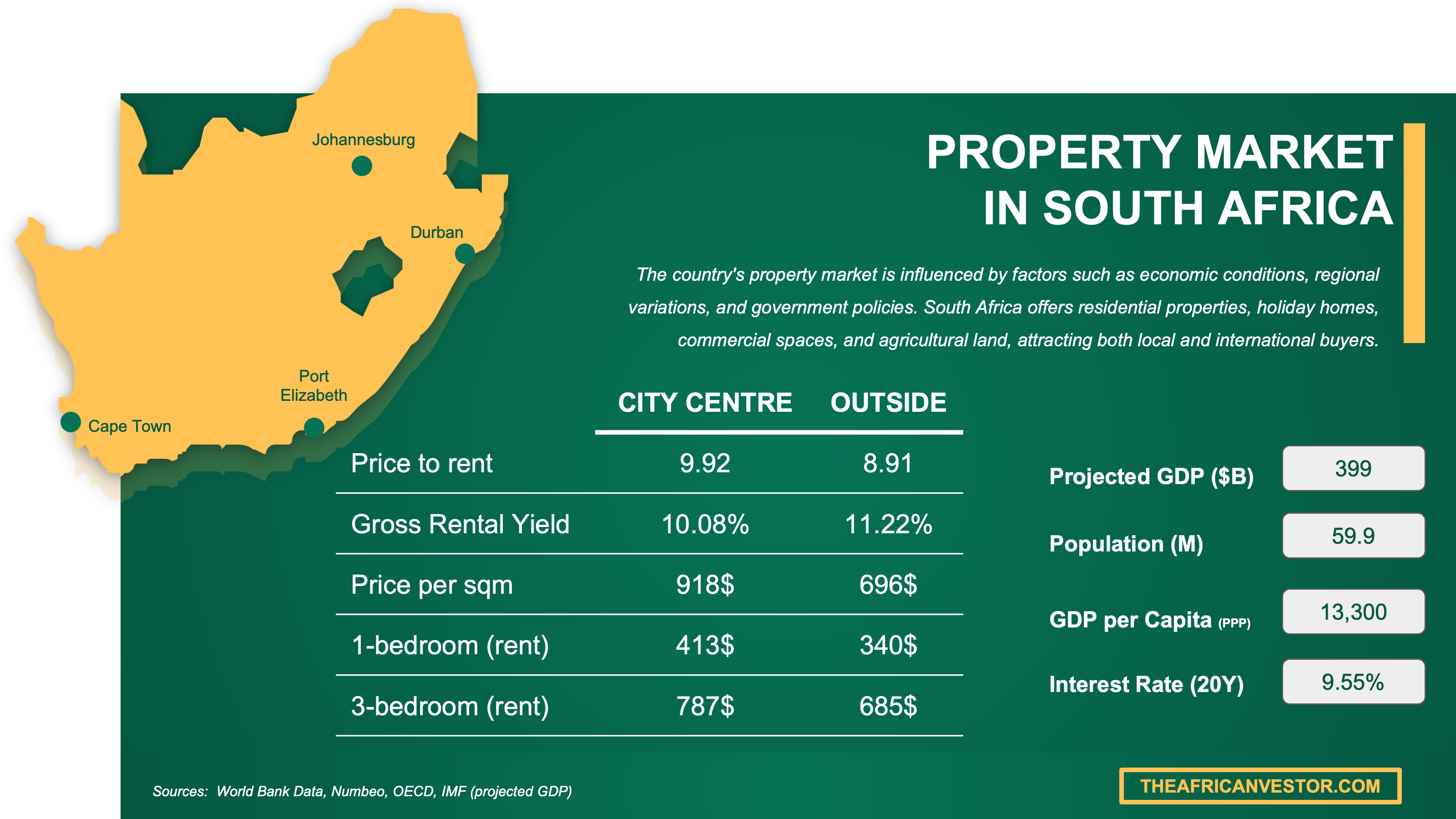
We have made this infographic to give you a quick and clear snapshot of the property market in South Africa. It highlights key facts like rental prices, yields, and property costs both in city centers and outside, so you can easily compare opportunities. We’ve done some research and also included useful insights about the country’s economy, like GDP, population, and interest rates, to help you understand the bigger picture.
What insider lessons do foreigners share after buying in Stellenbosch?
What do foreigners say they did wrong in Stellenbosch right now?
The most common mistake foreigners say they made when buying property in Stellenbosch is trusting the agent's or seller's narrative about the property without independently verifying claims about rental income, building compliance, or the actual condition of the home.
The top three regrets foreigners most frequently mention after buying in Stellenbosch are not checking building plan approvals before purchase, not keeping proper exchange control documentation for future repatriation of funds, and paying deposits to incorrect bank accounts after receiving changed banking details by email.
The single piece of advice experienced foreign buyers most often give to newcomers buying in Stellenbosch is to treat your conveyancer as the central quarterback of the transaction rather than relying on the agent, and to verify everything independently rather than trusting documents or information provided by the other side.
The mistake foreigners say cost them the most money or caused the most stress in Stellenbosch is discovering unapproved building work after purchase, because fixing compliance issues or dealing with municipality enforcement can cost tens of thousands of rands and take months to resolve.
What do locals do differently when buying in Stellenbosch right now?
The key difference in how locals approach buying property in Stellenbosch compared to foreigners is that locals treat the conveyancer as their primary advisor and trust center for the transaction, rather than relying on the estate agent, because locals understand that agents work for the seller and conveyancers handle the legal reality.
The verification step locals routinely take that foreigners often skip in Stellenbosch is checking approved building plans with Stellenbosch Municipality before making an offer, especially for any home with obvious additions, flatlets, or renovations, because locals know that unapproved work is common and can become the buyer's problem.
The local knowledge advantage that helps Stellenbosch residents get better deals is understanding which neighborhoods have municipal infrastructure issues (like water pressure problems in higher areas), which estates have well-run body corporates versus problem ones, and which agents have reputations for pushing deals through versus those who protect buyer interests.
Don't buy the wrong property, in the wrong area of Stellenbosch
Buying real estate is a significant investment. Don't rely solely on your intuition. Gather the right information to make the best decision.

What sources have we used to write this blog article?
Whether it's in our blog articles or the market analyses included in our property pack about Stellenbosch, we always rely on the strongest methodology we can, and we don't throw out numbers at random.
We also aim to be fully transparent, so below we've listed the authoritative sources we used, and explained how we used them and the methods behind our estimates.
| Source | Why It's Authoritative | How We Used It |
|---|---|---|
| South African Revenue Service (SARS) | SARS is the official tax authority, so its tax brackets are the ground truth. | We used it to state the exact transfer duty brackets applicable in early 2026. We also used it to explain a common "under-declare the price" trap and why SARS cares. |
| Property Practitioners Regulatory Authority (PPRA) | PPRA is the national regulator for real estate agents in South Africa. | We used it to explain what regulation exists for agents in 2026. We also used it to show how the regulator frames Fidelity Fund Certificates for 2026. |
| Fidelity Fund Certificate Verification Portal | It's a direct online tool designed to validate agent certificate status. | We used it to provide a practical "don't trust a screenshot" verification step. We used it as the core of the "can I trust this agent" checklist. |
| South African Reserve Bank (SARB) Financial Surveillance | SARB Financial Surveillance is the authority behind exchange control rules. | We used it to anchor the "money in and money out" reality for foreign buyers. We used it to justify why you must keep proof of inward funds for future repatriation. |
| Law Society of South Africa (LSSA) Conveyancing Fee Guidelines | It's the national law society publishing standardized fee guidance. | We used it to ground "hidden costs" in a recognized fee framework. We used it to explain what conveyancers actually do and what they charge. |
| Stellenbosch Municipality Building Documents | It's the local authority explaining its own building plan processes. | We used it to show where building plan compliance should be checked in Stellenbosch. We used it to explain a common pitfall: "approved plans don't match what's built." |
| Property Practitioners Act 2019 (Gov.za) | This is the primary legislation published by the South African government. | We used it to ground what agents are legally required to do. We used it to explain why an agent's compliance status affects your risk. |
| World Justice Project Rule of Law Index 2025 | WJP is a global rule-of-law benchmark used by governments and researchers. | We used it to frame contract enforcement risk in a comparable way. We used it as one of the "jurisdiction strength" signals. |
| Transparency International South Africa CPI | TI's Corruption Perceptions Index is the standard global measure. | We used it to quantify the corruption environment which affects fraud culture. We used the South Africa score to keep discussion factual. |
| STBB Compliance Certificates Guide | STBB is a leading South African conveyancing firm with authoritative guidance. | We used it to explain what compliance certificates are required in transfers. We used it to highlight common defects and inspection requirements. |

We created this infographic to give you a simple idea of how much it costs to buy property in different parts of South Africa. As you can see, it breaks down price ranges and property types for popular cities in the country. We hope this makes it easier to explore your options and understand the market.
