
Authored by the expert who managed and guided the team behind the South Africa Property Pack

Yes, the analysis of Stellenbosch's property market is included in our pack
Everything you need to know about living in Stellenbosch as an expat in 2026 is covered in this guide, from real costs and visa options to safety, schools, and property buying.
We built it by combining official South African government data, local market reports, and our own on-the-ground research so you get a picture that is honest and up to date.
We constantly update this blog post to reflect the latest data and conditions in Stellenbosch, so you can always come back for fresh numbers.
And if you're planning to buy a property in this place, you may want to download our pack covering the real estate market in Stellenbosch.
Is Stellenbosch a good place to live in 2026?
Is quality of life getting better or worse in Stellenbosch in 2026?
As of early 2026, quality of life in Stellenbosch is on a slightly improving trajectory for higher earners, thanks to cooling inflation and a resilient Western Cape job market, though budget-conscious newcomers still feel real cost pressure from the town's housing premium.
The factor that has improved the most is inflation relief: South Africa's 2025 inflation rate was the lowest in 21 years, which means everyday groceries, fuel, and services in Stellenbosch have stopped climbing as aggressively as they did in 2022 and 2023.
On the flip side, the persistent challenge unique to Stellenbosch remains the housing squeeze driven by university demand, wine-tourism appeal, and a growing remote-worker population, which keeps rents and property prices well above the national average even as broader cost pressures ease.
Are hospitals good in Stellenbosch in 2026?
As of early 2026, the private hospitals near Stellenbosch offer care that is broadly comparable to Western European or North American standards, while the public system is functional but stretched, with longer wait times and fewer resources for non-emergency cases.
The two facilities expats most commonly rely on are Mediclinic Stellenbosch, a well-equipped private multidisciplinary hospital right in town, and Stellenbosch Hospital, the main public option managed by the Western Cape Government, which handles emergencies and referrals.
A standard private GP consultation in Stellenbosch in 2026 typically costs between R550 and R900 (about $35 to $55 or 29 to 47 euros), while a specialist visit runs from R1,200 to R2,500 (roughly $75 to $155 or 63 to 130 euros), depending on the practitioner and whether they bill above the base medical tariff.
Private health insurance, called "medical aid" in South Africa, is strongly recommended for any expat in Stellenbosch because out-of-pocket costs at private hospitals can spike fast, and the public system, while decent in the Western Cape, involves longer queues and less predictable scheduling for non-urgent care.
Are there any good international schools in Stellenbosch in 2026?
As of early 2026, Stellenbosch itself has a handful of strong independent schools rather than large international-curriculum campuses, but the broader Cape Winelands area offers several well-regarded options that expat families commonly choose.
The schools most popular with expat families in and around Stellenbosch include Bridge House School, an independent IEB school near Franschhoek with boarding options and a Round Square international network, International School of South Africa (ISSA), which follows an internationally oriented curriculum, and Stellenbosch Waldorf School for families looking for an alternative educational philosophy.
Annual tuition at independent and international-style schools in the Stellenbosch area in 2026 generally ranges from R90,000 to R220,000 per child (about $5,600 to $13,750 or 4,700 to 11,600 euros), with boarding fees and extras like transport and uniforms adding to the total.
Is Stellenbosch a dangerous place in 2026?
As of early 2026, Stellenbosch is noticeably safer than most South African urban areas, but it is not crime-free, and expats should adopt local security habits from day one rather than treating it like a European town.
The most common safety concerns in Stellenbosch are property-related and opportunistic crimes, specifically theft from vehicles, house burglary, and robbery, which show up clearly in the precinct-level crime data, meaning you need to be careful about leaving valuables in your car and securing your home properly.
The neighborhoods generally considered safest for expats in Stellenbosch include Die Boord, Dalsig, Paradyskloof, Mostertsdrift, and security estates like De Zalze and Welgevonden, all of which offer controlled access, good lighting, and an established residential feel that families and solo expats tend to favor.
Many women do live alone safely in Stellenbosch, particularly in secure complexes or well-managed apartment buildings in areas like Stellenbosch Central or Die Boord, but the practical playbook includes choosing a building with proper security, avoiding walking alone late at night after bars close, and never leaving bags or electronics visible in a parked car.
Thinking of buying real estate in Stellenbosch?
Acquiring property in a different country is a complex task. Don't fall into common traps – grab our guide and make better decisions.

How much does everyday life cost in Stellenbosch in 2026?
What monthly budget do I need to live well in Stellenbosch in 2026?
As of early 2026, a single person living comfortably in Stellenbosch, meaning a nice one-bedroom apartment in a central or secure area, regular eating out, and a social life, should budget around R45,000 to R65,000 per month (roughly $2,800 to $4,000 or 2,400 to 3,400 euros).
For a more modest but still decent lifestyle in Stellenbosch, a single person can manage on about R25,000 to R35,000 per month ($1,550 to $2,200 or 1,300 to 1,850 euros), though this means a smaller flat, cooking at home more often, and fewer weekend splurges on wine farms.
A more comfortable or upscale lifestyle in Stellenbosch, such as a couple in a two-bedroom apartment with regular restaurant dinners and weekend trips to Cape Town or Franschhoek, typically runs R80,000 to R120,000 per month ($5,000 to $7,500 or 4,200 to 6,300 euros combined).
Housing is by far the largest budget item in Stellenbosch, and what makes it unusual compared to other South African towns is that rents are inflated by a combination of student demand from Stellenbosch University, lifestyle buyers from Cape Town, and a limited supply of quality rental stock, with even small bachelor units near the center commanding R15,000 or more per month.
What is the average income tax rate in Stellenbosch in 2026?
As of early 2026, a typical middle-income earner in South Africa (and therefore in Stellenbosch) with a gross annual salary around R500,000 to R800,000 pays an effective income tax rate of roughly 20% to 30%, because South Africa uses a progressive tax system where you pay more as your income rises.
South Africa's income tax brackets in 2026 range from 18% on the first R237,100 of taxable income all the way up to 45% on income above roughly R1,817,000, so most expat professionals in Stellenbosch earning in the R600,000 to R1,500,000 range will see effective rates that climb from around 25% toward 35% depending on their deductions and rebates.
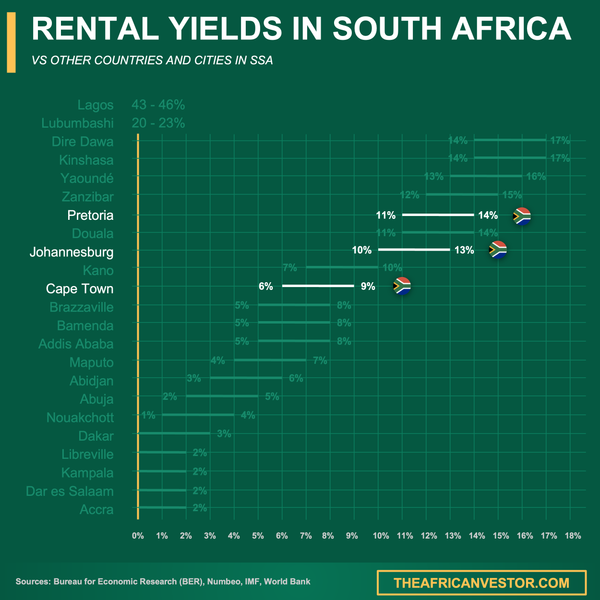
We did some research and made this infographic to help you quickly compare rental yields of the major cities in South Africa versus those in neighboring countries. It provides a clear view of how this country positions itself as a real estate investment destination, which might interest you if you’re planning to invest there.
What kind of foreigners actually live in Stellenbosch in 2026?
Where do most expats live in Stellenbosch in 2026?
As of early 2026, the most popular neighborhoods for expats in Stellenbosch are Stellenbosch Central and Universiteits Oord for walkability, Die Boord and Dalsig for a quieter residential feel, Paradyskloof and Mostertsdrift for families, and security estates like De Zalze, Welgevonden, and Jamestown for those who prioritize gated living and larger homes.
What makes these specific neighborhoods attractive beyond just "nice houses" is that they each offer a slightly different lifestyle fit: Stellenbosch Central puts you within walking distance of cafes, the university, and weekend markets; Die Boord and Dalsig give you tree-lined streets with a neighborhood community feel; and the security estates provide 24-hour access control and often include amenities like golf courses or nature reserves on your doorstep.
An emerging area that is starting to attract more expats is Jamestown and the broader Techno Park corridor on the southern edge of Stellenbosch, where newer developments and proximity to tech companies and business parks are drawing younger professionals who want modern homes at slightly more accessible prices than the historic town center.
Are expats moving in or leaving Stellenbosch in 2026?
As of early 2026, the trend in Stellenbosch is a net inflow of expats, driven by growing demand from remote workers, university-linked internationals, and lifestyle movers who see the Western Cape as one of Africa's most livable regions.
The main factor pulling expats to Stellenbosch right now is the combination of South Africa's new Digital Nomad Visa (which went live in 2025) and the town's reputation as a walkable, scenic, and well-serviced base with fast internet, great food, and easy access to Cape Town International Airport just 40 minutes away.
The main factor pushing some expats away is affordability: Stellenbosch's housing costs keep climbing, and if your income is in rand rather than foreign currency, the gap between "comfortable" and "struggling" is narrower here than in cheaper South African towns like George or Knysna.
Compared to similar destinations in the region, Stellenbosch is holding its own well, as cities like Windhoek in Namibia or Maputo in Mozambique do not offer the same depth of infrastructure, while Cape Town itself, though larger, comes with even higher property prices and more traffic, making Stellenbosch a compelling "Goldilocks" option for many expats in Southern Africa.
Get fresh and reliable information about the market in Stellenbosch
Don't base significant investment decisions on outdated data. Get updated and accurate information.
What paperwork do I need to move to Stellenbosch in 2026?
What visa options are popular in Stellenbosch in 2026?
As of early 2026, the three most popular visa types for expats moving to Stellenbosch are the Critical Skills Work Visa (for professionals in shortage occupations), the General Work Visa (typically employer-sponsored), and the new Remote Work Visa, also known as the Digital Nomad Visa, which launched in March 2025.
For the Critical Skills Work Visa, which is the most commonly used route for skilled professionals, you need to prove that your occupation is on South Africa's official Critical Skills List, have your qualifications evaluated by SAQA (the South African Qualifications Authority), provide a clean police clearance, and submit a medical report, all through the Department of Home Affairs or a VFS Global application center.
South Africa does now offer a Digital Nomad Visa (officially called the Remote Work Visa), which allows you to live in Stellenbosch for up to one year (renewable for up to three years total) as long as you earn at least R650,000 per year (about $40,000 or 34,000 euros) from a foreign employer or international clients and can show proof of health insurance.
The Critical Skills Work Visa is typically granted for up to five years, the General Work Visa matches your employment contract duration, and the Digital Nomad Visa is issued for one year at a time with renewals possible, and all three require you to start the renewal or extension process well before your current visa expires to avoid gaps.
How long does it take to get residency in Stellenbosch in 2026?
As of early 2026, temporary work visa processing in South Africa typically takes anywhere from 5 to 20 working days at the fastest (under the Trusted Employer Scheme) to 2 to 4 months for a standard Critical Skills Work Visa, while permanent residency applications usually require 12 to 24 months of processing time after you submit a complete file.
The most common factors that delay visa and residency applications in Stellenbosch (and South Africa generally) are incomplete documentation, waiting for your SAQA qualification evaluation (which can take months on its own), and the overall workload at the Department of Home Affairs, while having a well-organized application with pre-verified documents and using VFS Global's appointment system properly can speed things up significantly.
To become eligible for permanent residency in South Africa, an expat must typically have lived in the country on a valid work visa for at least five consecutive years, after which they can apply under Section 26(a) of the Immigration Act, and citizenship through naturalization becomes possible after holding permanent residence for an additional five years.

We created this infographic to give you a simple idea of how much it costs to buy property in different parts of South Africa. As you can see, it breaks down price ranges and property types for popular cities in the country. We hope this makes it easier to explore your options and understand the market.
How hard is it to find a job in Stellenbosch in 2026?
Which industries are hiring the most in Stellenbosch in 2026?
As of early 2026, the three industries hiring the most around Stellenbosch are the university and research sector (Stellenbosch University is one of Africa's top research institutions and a major local employer), tech and professional services (several fintech and agri-tech firms have headquarters or satellite offices here), and the wine, hospitality, and tourism cluster, which employs everyone from harvest workers to sommeliers to boutique hotel managers.
Getting hired in Stellenbosch without speaking Afrikaans is realistic in university-linked roles, tech, multinational-facing companies, and tourism, but knowing some Afrikaans is a genuine advantage for locally oriented businesses, administration, and smaller firms where daily communication with staff and suppliers happens in Afrikaans.
The types of roles most accessible to foreign job seekers in Stellenbosch are specialist and senior positions in research, data science, viticulture and winemaking, software development, and English-language teaching, because these are areas where local supply is limited and employers are more willing to navigate the visa sponsorship process.
What salary ranges are common for expats in Stellenbosch in 2026?
As of early 2026, the typical salary range for expats working locally in Stellenbosch (paid in rand) spans from about R400,000 to R1,200,000 per year ($25,000 to $75,000 or 21,000 to 63,000 euros), though many expats who live "comfortably" are either on international packages, remotely paid in foreign currency, or in senior specialist roles at the higher end of that range.
Entry-level and mid-level expat positions in Stellenbosch, such as junior researchers, hospitality managers, or marketing roles, typically pay between R250,000 and R550,000 per year ($15,600 to $34,000 or 13,000 to 29,000 euros), which can feel tight given the town's housing costs unless you share accommodation or live modestly.
Senior or specialized expat roles, such as head of department at the university, lead software engineer, winemaking director, or finance executive, can command R900,000 to R2,000,000 or more per year ($56,000 to $125,000 or 47,000 to 105,000 euros), and these are the salary levels where life in Stellenbosch genuinely starts to feel comfortable.
Employer-sponsored work visas in Stellenbosch do happen, but they are selective: large corporates, the university, and established wine estates are the most likely sponsors, while small businesses and restaurants rarely go through the paperwork unless your role clearly fills a documented skills gap.
Get to know the market before buying a property in Stellenbosch
Better information leads to better decisions. Get all the data you need before investing a large amount of money.
What's daily life really like for expats in Stellenbosch right now?
What do expats love most about living in Stellenbosch right now?
The things expats love most about Stellenbosch are the walkable town center lined with oak trees and outdoor cafes, the world-class wine farms just minutes from home, and the feeling of being in a cosmopolitan bubble that somehow still feels like a small town.
The lifestyle benefit praised most often is the sheer variety of outdoor activities on your doorstep: you can hike Jonkershoek Nature Reserve before work, cycle through vineyards on a Saturday morning, and drive to the beach in Strand or Gordon's Bay in under 30 minutes.
The practical advantage expats appreciate most in Stellenbosch is that it gives you big-city infrastructure (fast fiber internet, good private healthcare, quality restaurants, and reliable services) without the traffic, pollution, or stress of living in central Cape Town, all while Cape Town International Airport is only about 40 minutes away.
Socially, what makes Stellenbosch particularly enjoyable is how easy it is to meet people through the university events, wine tastings, farmers' markets, and a tight-knit international community where newcomers are welcomed quickly, especially compared to larger, more anonymous cities.
What do expats dislike most about life in Stellenbosch right now?
The top complaints from expats in Stellenbosch are the housing sticker shock (rents that feel disproportionate to local salaries), the constant need to think about vehicle security and home alarms, and the seasonal disruption caused by the university calendar, which floods the town with students in term time and empties it during holidays.
The daily inconvenience that frustrates expats the most is the car-dependency combined with vigilance: while the town center is walkable, anything beyond it requires driving, and you have to remember to never leave anything visible in your car, always lock up, and factor in security gate codes and boomed-off streets as part of your daily routine.
The bureaucratic headache that causes the most frustration is the Department of Home Affairs visa process: renewals can take months, documentation requirements shift without clear notice, and the SAQA qualification evaluation needed for many work visas is a slow process that can hold up your entire timeline.
Most expats in Stellenbosch describe these frustrations as manageable rather than deal-breaking, because the lifestyle payoff (beauty, food, wine, outdoor life, community) is strong enough that people adapt to the security routines and learn to plan around the bureaucracy.
What are the biggest culture shocks in Stellenbosch right now?
The biggest culture shocks for newcomers in Stellenbosch are the security infrastructure (electric fences, alarm systems, armed response, and gated neighborhoods are completely normal here), the deep bilingualism where Afrikaans and English switch mid-sentence, and the legacy of load-shedding, where even though power cuts have eased, most homes still have inverters or generators and people still plan around potential outages.
The social norm that surprises newcomers the most is how openly and matter-of-factly South Africans in Stellenbosch discuss security: neighbors casually share tips about which streets to avoid at night, WhatsApp community safety groups are standard, and "braai-and-alarm-chat" is a normal part of social life rather than something people are embarrassed about.
The aspect of daily routines that takes the longest to adjust to is what locals call "Cape time," a relaxed approach to scheduling and punctuality that means service appointments, deliveries, and even social plans often run 20 to 45 minutes behind the agreed time, which can be genuinely frustrating for expats used to Northern European or East Asian precision.

We made this infographic to show you how property prices in South Africa compare to other big cities across the region. It breaks down the average price per square meter in city centers, so you can see how cities stack up. It’s an easy way to spot where you might get the best value for your money. We hope you like it.
Can I buy a home as a foreigner in Stellenbosch in 2026?
Can foreigners legally own property in Stellenbosch in 2026?
As of early 2026, foreign nationals are fully allowed to buy and register residential property in Stellenbosch under South African law, and ownership is handled through the standard conveyancing and Deeds Office process, the same system used by South African citizens.
The main conditions that apply to foreigners buying property in Stellenbosch are compliance with FICA (financial intelligence regulations), exchange control rules managed by the South African Reserve Bank (which affect how you move money into the country), and the requirement to use a registered conveyancer for the transfer, but there is no blanket restriction preventing foreign ownership of residential real estate.
Foreigners in Stellenbosch can own apartments, freehold houses, and sectional-title units without restriction, though agricultural land purchases may face additional scrutiny under evolving land-reform discussions, and it is always wise to get legal advice if you are looking at farmland or very large rural properties.
What is the average price per m² in Stellenbosch in 2026?
As of early 2026, the average price per square meter for residential property in Stellenbosch ranges from about R25,000 to R38,000 per m² for freehold houses ($1,550 to $2,375 or 1,300 to 2,000 euros) and R40,000 to R55,000 per m² for apartments and sectional-title units ($2,500 to $3,450 or 2,100 to 2,900 euros), though premium stock near the university or in top security estates can go significantly higher.
Property prices in Stellenbosch have been on a gradual upward trend over the past two to three years, supported by steady demand from students, lifestyle buyers, and the corporate presence in the area, and while broader South African house-price growth has been moderate, Stellenbosch has consistently outperformed the national average because of its unique demand drivers.
Do banks give mortgages to foreigners in Stellenbosch in 2026?
As of early 2026, mortgages for foreigners in South Africa are available but come with stricter conditions than for citizens, including larger deposit requirements and exchange-control compliance, so it is possible but requires more preparation than a typical local home loan.
The banks most commonly used by foreign buyers in Stellenbosch are First National Bank (FNB), which has a dedicated "Foreign Choice" home loan product, Standard Bank, the country's largest bank with experience in non-resident lending, and Nedbank, which also processes foreign-national mortgage applications through its home loan division.
Typical mortgage conditions for foreigners in Stellenbosch in 2026 include a minimum deposit of 50% of the property value (with that deposit needing to come from foreign funds transferred into South Africa), an interest rate tied to the prime rate (currently around 10.25% as of late January 2026), and a maximum loan term of 20 to 30 years depending on the bank and your visa status.
To qualify, foreign buyers typically need a valid passport, a temporary residence or work permit (for those living in South Africa), proof of income, a clear credit record, exchange control approval from the South African Reserve Bank, and an active South African bank account that has been open for at least six months in the case of FNB.
Buying real estate in Stellenbosch can be risky
An increasing number of foreign investors are showing interest. However, 90% of them will make mistakes. Avoid the pitfalls with our comprehensive guide.

What sources have we used to write this blog article?
Whether it's in our blog articles or the market analyses included in our property pack about Stellenbosch, we always rely on the strongest methodology we can ... and we don't throw out numbers at random.
We also aim to be fully transparent, so below we've listed the authoritative sources we used, and explained how we used them and the methods behind our estimates.
| Source | Why we trust it | How we used it |
|---|---|---|
| Statistics South Africa (Stats SA) | South Africa's official statistics agency for inflation and economic data. | We used it to anchor the inflation backdrop that shapes rents, groceries, and salaries in early 2026. We then adjusted older price points upward using this inflation context. |
| Stats SA - Quarterly Labour Force Survey Q3 2025 | The official nationwide labor market survey covering employment and unemployment. | We used it to ground job-market realism and competition levels for 2026 movers. We cross-checked Western Cape commentary against the national dataset. |
| South African Reserve Bank (SARB) | The central bank and authoritative source for interest rates and monetary policy. | We used it to anchor mortgage-rate reality and affordability calculations in early 2026. We then mapped housing costs to realistic net-salary ranges. |
| South African Revenue Service (SARS) | The tax authority whose rate tables are the legal source of truth. | We used it to estimate effective tax burdens at common expat salary levels. We then translated gross salaries into realistic take-home comfort bands. |
| Department of Home Affairs (DHA) | The issuing authority for all South African visas and residence permits. | We used it to describe visa pathways that actually work for professionals moving to Stellenbosch. We cross-referenced processing timelines with VFS Global guidance. |
| VFS Global | The official outsourced intake channel for DHA visa applications. | We used it to explain the real-world submission route most applicants follow. We paired it with DHA requirements so the paperwork section is practical and actionable. |
| Mediclinic Stellenbosch | A major private hospital group with an official local facility page. | We used it to show what private hospital access looks like for expats in Stellenbosch. We then linked this to the insurance decision between medical aid and cash-pay. |
| South African Police Service (SAPS) | The official publisher of recorded crime statistics in South Africa. | We used it as the framework for crime definitions and data releases. We then checked station-level patterns for Stellenbosch through a SAPS-based aggregator. |
| Crimehub | Compiles SAPS station-level data into easy-to-read local tables. | We used it to identify the most common crime categories specific to Stellenbosch. We then turned those patterns into practical safety guidance for expats. |
| Property24 | A major property portal referencing Deeds Office transaction data. | We used it to anchor overall price levels in Stellenbosch and check market premium claims. We combined it with listing examples to estimate realistic per-m² ranges. |
| Cape Coastal Homes | A local real estate report citing CMAinfo data with per-m² history. | We used it to anchor hard per-m² datapoints for sectional title in Stellenbosch. We then adjusted forward using broader house-price indices and live listings. |
| Discovery Health Medical Scheme | An official price document from South Africa's largest medical scheme. | We used it to translate "do I need private health insurance?" into real monthly numbers. We then used it to set budget ranges for singles and families. |
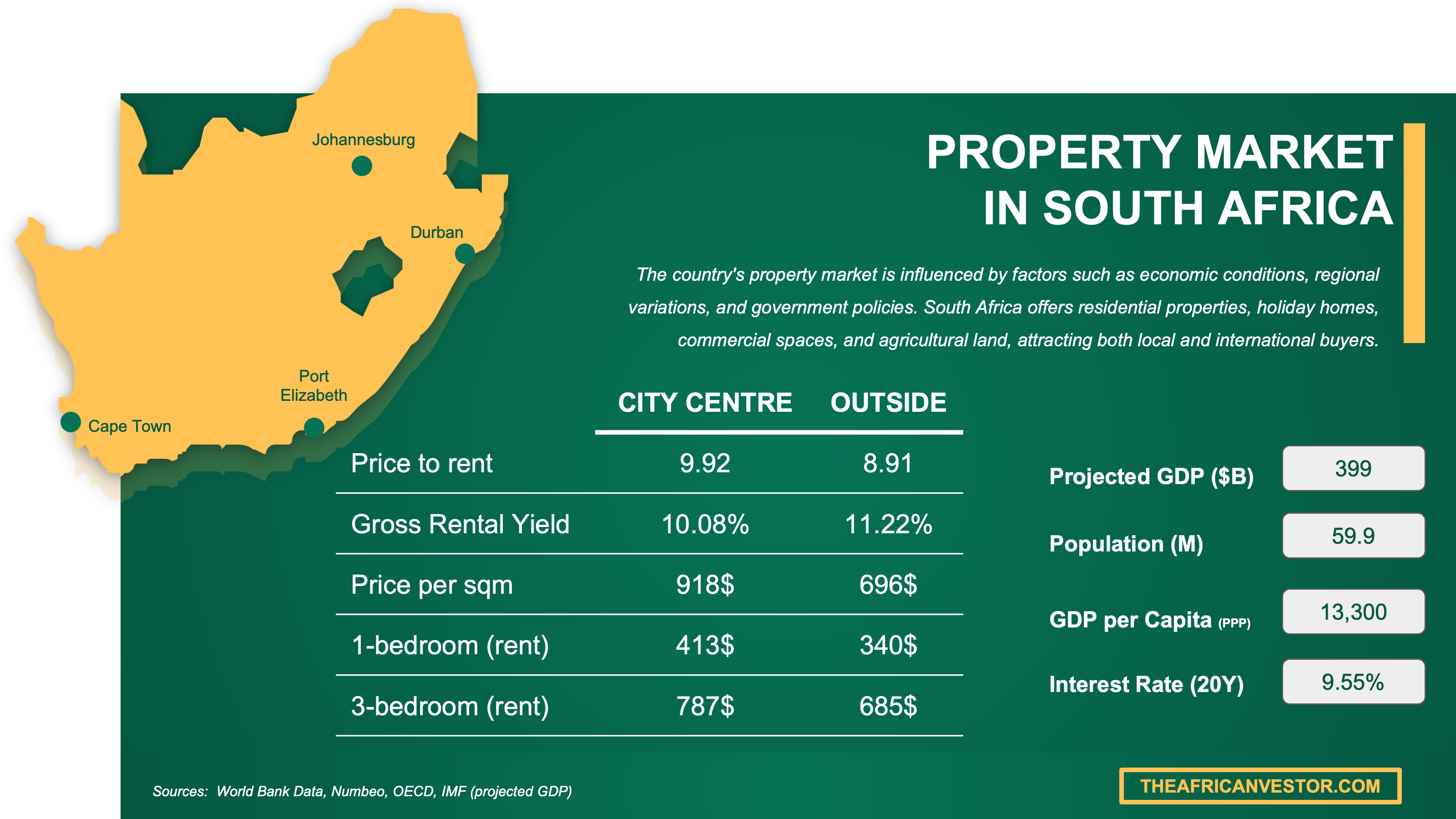
We have made this infographic to give you a quick and clear snapshot of the property market in South Africa. It highlights key facts like rental prices, yields, and property costs both in city centers and outside, so you can easily compare opportunities. We’ve done some research and also included useful insights about the country’s economy, like GDP, population, and interest rates, to help you understand the bigger picture.
