
Authored by the expert who managed and guided the team behind the South Africa Property Pack
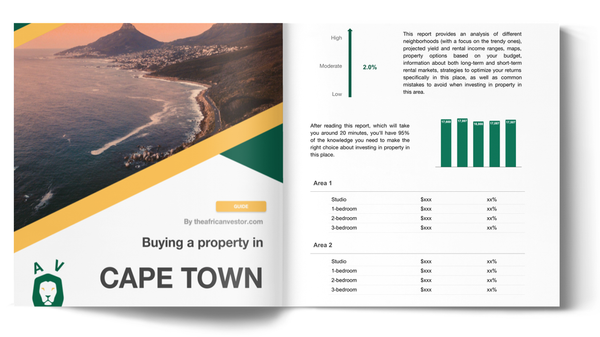
Yes, the analysis of Cape Town's property market is included in our pack
Everything you need to know about moving to Cape Town as a foreigner in 2026, from budgets to visas to neighborhoods, is covered right here in plain language.
We constantly update this blog post with the freshest data we can find, so the numbers and advice you read today reflect Cape Town's reality in early 2026.
Whether you're a remote worker, a family, or just exploring, this guide walks you through costs, safety, healthcare, jobs, and much more.
And if you're planning to buy a property in this place, you may want to download our pack covering the real estate market in Cape Town.
Is Cape Town a good place to live in 2026?
Is quality of life getting better or worse in Cape Town in 2026?
As of early 2026, quality of life in Cape Town is on a gradually improving path for middle-income residents, though rising housing costs are squeezing affordability in the most popular neighborhoods.
The most noticeable improvement over the past two to three years has been Cape Town's dramatic reduction in load shedding (rolling power cuts), with the city leveraging its own energy sources like the Steenbras Dam pumped-storage scheme and new solar procurement to shield residents far better than most other South African metros.
On the other hand, rents in Cape Town's most desirable areas have climbed well above the Western Cape provincial average of R11,300 per month, making affordable housing the one issue that keeps getting harder rather than easier for newcomers.
Are hospitals good in Cape Town in 2026?
As of early 2026, Cape Town's private hospitals are broadly comparable to good Western European or North American facilities in terms of specialist expertise and equipment, while public hospitals offer strong clinical talent but come with longer waiting times and heavier admin.
The hospitals expats most commonly recommend in Cape Town include Netcare Christiaan Barnard Memorial Hospital in the Foreshore, Mediclinic Cape Town in the City Bowl, and Mediclinic Constantiaberg in the southern suburbs.
A standard GP consultation in Cape Town in 2026 typically costs between R500 and R900 (roughly $30 to $55, or around €25 to €45), with specialist visits running higher.
Private health insurance (called "medical aid" in South Africa) is strongly recommended for expats in Cape Town because it makes access predictable, cuts waiting times drastically, and is often required for visa applications.
Are there any good international schools in Cape Town in 2026?
As of early 2026, Cape Town has a solid selection of international schools offering IB, American, and British curricula, plus several excellent local private schools that many expat families also choose.
Two of the most well-regarded international schools among expat families in Cape Town are the American International School of Cape Town (AISCT) in Constantia and the International School of Cape Town (ISCT) in Claremont, both of which publish transparent fee schedules.
Annual tuition fees at Cape Town international schools in 2026 generally range from about R120,000 to R250,000 per year (roughly $7,500 to $15,600, or around €6,300 to €13,200), depending on the grade level, plus once-off enrolment and capital levy fees on top.
Waitlists at the most popular Cape Town international schools can be long, especially for entry-year grades, so planning 6 to 18 months ahead is realistic, and while some public schools in high-performing catchment areas are a viable alternative, most expat families opt for private or international options.
Is Cape Town a dangerous place in 2026?
As of early 2026, Cape Town's safety picture is highly uneven: many expat-friendly neighborhoods feel quite livable with standard city precautions, but parts of the metro carry some of the highest violent-crime rates in South Africa.
The most common safety concerns for expats in Cape Town are opportunistic property crime (like phone snatching in busy areas and car break-ins) and the security overhead of living with alarm systems, electric fencing, and gated access, which is something most newcomers from Europe or North America are not used to budgeting for.
The neighborhoods generally considered safest for expats in Cape Town include Sea Point, Green Point, Camps Bay, Gardens, Oranjezicht, and the southern suburbs belt from Newlands through Constantia, all of which benefit from active security presence and well-maintained infrastructure.
Many women do live alone safely in Cape Town, but locals consistently recommend choosing a secure building, using ride-hailing apps after dark instead of walking alone at night, and staying alert with phones and bags in crowded spots like Long Street or public transport hubs.
Thinking of buying real estate in Cape Town?
Acquiring property in a different country is a complex task. Don't fall into common traps – grab our guide and make better decisions.

How much does everyday life cost in Cape Town in 2026?
What monthly budget do I need to live well in Cape Town in 2026?
As of early 2026, a single person can live comfortably in a good Cape Town neighborhood on a monthly budget of roughly R45,000 to R60,000 (about $2,800 to $3,750, or around €2,400 to €3,150), including rent, private health cover, groceries, and a social life.
For a more modest but still decent lifestyle in Cape Town in 2026, you can get by on around R25,000 to R35,000 per month ($1,550 to $2,200, or about €1,300 to €1,850), though this means a smaller apartment, fewer dinners out, and a basic hospital-plan medical aid.
If you want a more upscale lifestyle in Cape Town in 2026, with a spacious two-bedroom in Sea Point or Camps Bay, a car, and regular dining out, you should plan for R80,000 to R110,000 per month ($5,000 to $6,900, or about €4,200 to €5,800).
In Cape Town specifically, rent takes the biggest bite out of your monthly budget because the neighborhoods most expats gravitate toward (Atlantic Seaboard, City Bowl, southern suburbs) sit well above the Western Cape's average rent of about R11,300, and adding private medical aid on top makes housing-plus-healthcare the dominant cost block.
What is the average income tax rate in Cape Town in 2026?
As of early 2026, a typical middle-income professional earning around R600,000 per year in South Africa pays an effective income tax rate of roughly 22% to 25% after the primary rebate, meaning about three quarters of gross salary reaches your bank account before other deductions.
South Africa's personal income tax brackets in 2026 start at 18% for the first R237,100 of taxable income and climb to a top marginal rate of 45% on income above R1,817,000, so most expat professionals earning between R600,000 and R1,200,000 per year land somewhere in the 22% to 34% effective range.
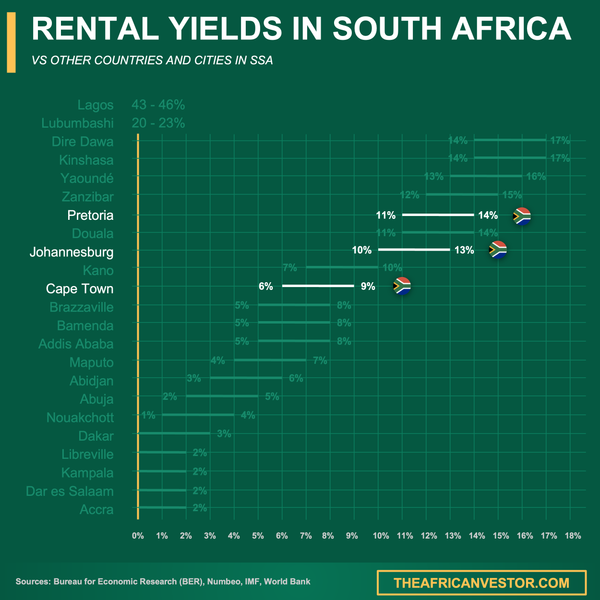
We did some research and made this infographic to help you quickly compare rental yields of the major cities in South Africa versus those in neighboring countries. It provides a clear view of how this country positions itself as a real estate investment destination, which might interest you if you’re planning to invest there.
What kind of foreigners actually live in Cape Town in 2026?
Where do most expats come from in Cape Town in 2026?
As of early 2026, the largest groups of expats in Cape Town come from the United Kingdom, Germany, the Netherlands, the United States, and several other African countries like Zimbabwe and Nigeria.
Cape Town's total foreign-born population remains a relatively small share of the city's roughly 4.8 million residents, but their economic footprint is outsized because they concentrate in high-value rental and property markets, particularly in the Western Cape.
European and British expats are drawn to Cape Town largely by the lifestyle-to-cost ratio: the combination of beaches, mountains, wine country, and a relatively well-run metro at a fraction of what similar quality of life costs in London, Amsterdam, or San Francisco.
The expat community in Cape Town in 2026 is a genuine mix of remote workers and digital nomads (boosted by South Africa's remote work visa), corporate transferees in finance and tech, NGO and academic staff, and lifestyle migrants or retirees settling along the coast or in the winelands.
Where do most expats live in Cape Town in 2026?
As of early 2026, the top neighborhoods where expats concentrate in Cape Town are along the Atlantic Seaboard (Sea Point, Green Point, Mouille Point, Camps Bay), in the City Bowl (Gardens, Oranjezicht, Tamboerskloof, De Waterkant), and in the southern suburbs (Newlands, Claremont, Constantia).
What makes these Cape Town neighborhoods particularly attractive to expats is their walkability and proximity to both the ocean and the city center, combined with relatively reliable municipal services, active neighborhood security, and easy access to international schools and private hospitals.
The emerging neighborhoods in Cape Town that are starting to attract more expats in 2026 include Woodstock and Observatory, which offer a more creative, mixed-use vibe at lower rents, though safety can vary block by block, so doing a walk-through before signing a lease is essential.
Are expats moving in or leaving Cape Town in 2026?
As of early 2026, the overall trend for Cape Town is a net inflow of expats, visible through sustained rental demand pressure in the Western Cape and a growing share of non-resident property purchases in the province.
The main factor drawing expats to Cape Town right now is the lifestyle-to-cost equation: a city where you can live near the ocean with mountains in view, enjoy world-class food and wine, and still pay a fraction of what equivalent neighborhoods cost in major European or American cities.
The main factor causing some expats to leave Cape Town recently has been the bureaucratic friction around visa renewals and work permits at the Department of Home Affairs, which can be slow and unpredictable enough to push people toward countries with more streamlined immigration systems.
Compared to similar lifestyle destinations in the region, Cape Town's expat inflow has been stronger than Nairobi's or Accra's, and the city increasingly competes with places like Lisbon and Bali for the global "remote worker" crowd, partly thanks to its time-zone overlap with Europe.
Get fresh and reliable information about the market in Cape Town
Don't base significant investment decisions on outdated data. Get updated and accurate information.
What paperwork do I need to move to Cape Town in 2026?
What visa options are popular in Cape Town in 2026?
As of early 2026, the three most popular visa types for expats moving to Cape Town are the Remote Work visitor's visa (for people employed by a foreign company), the Critical Skills Work Visa (for professionals in high-demand occupations), and the General Work Visa (for those with a South African employer and a job offer).
The most commonly used route, the Critical Skills Work Visa, requires that your occupation appears on South Africa's official Critical Skills List, that you have relevant qualifications evaluated by SAQA, and that you can show proof of professional registration or a job offer from a South African employer.
South Africa does offer a Remote Work visitor's visa, which lets you live in Cape Town while working for a foreign employer or clients abroad, provided you earn a minimum monthly income (currently around $3,500 equivalent), hold valid medical insurance, and do not take up employment with a South African company.
Most temporary work visas in Cape Town are initially valid for up to four or five years and can be renewed, though renewal timelines vary and the process can involve significant paperwork, so starting your renewal well before your visa expires is a standard piece of advice from immigration specialists.
How long does it take to get residency in Cape Town in 2026?
As of early 2026, temporary work visa processing in South Africa typically takes between 3 and 8 months from submission, while permanent residency applications can take 12 months or longer, with some complex cases stretching to 24 or even 36 months.
The most common factors that delay residency applications in Cape Town are incomplete documentation (especially foreign qualification evaluations and police clearances), the Department of Home Affairs' capacity constraints, and any back-and-forth over employer compliance; having a clean, complete file from day one is the single best way to speed things up.
To become eligible for permanent residency in South Africa, most expats need to have held a valid work visa for at least five consecutive years, and once you hold permanent residency, you can apply for citizenship after an additional five years of ordinary residence in the country.

We created this infographic to give you a simple idea of how much it costs to buy property in different parts of South Africa. As you can see, it breaks down price ranges and property types for popular cities in the country. We hope this makes it easier to explore your options and understand the market.
How hard is it to find a job in Cape Town in 2026?
Which industries are hiring the most in Cape Town in 2026?
As of early 2026, the three industries hiring the most in Cape Town are tech and digital services (the city has become South Africa's leading startup and remote-work hub), renewable energy and related engineering services (driven by the country's massive energy transition push), and financial and professional services (Cape Town hosts a growing cluster of fintech and asset management firms).
Getting hired in Cape Town without speaking Afrikaans or Xhosa is realistic for most professional roles, since English is the dominant language in corporate, tech, and international business settings, though some client-facing positions in local government or community-oriented sectors may prefer multilingual candidates.
The types of roles most accessible to foreign job seekers in Cape Town are software development, data science, UX/product design, renewable energy engineering, and senior finance or consulting positions, because these are the fields where South African employers are most willing to navigate the work-visa process to fill skills gaps.
What salary ranges are common for expats in Cape Town in 2026?
As of early 2026, the typical salary range for expats working professionally in Cape Town falls between R700,000 and R1,500,000 gross per year (about $44,000 to $94,000, or around €37,000 to €79,000), depending heavily on industry, seniority, and whether the role is local or internationally benchmarked.
For entry-level or mid-level expat positions in Cape Town in 2026, salaries generally range from R350,000 to R700,000 per year ($22,000 to $44,000, or about €18,500 to €37,000), which is enough for a decent lifestyle but not much room for luxury in the pricier neighborhoods.
Senior or specialized expat roles in Cape Town in 2026, particularly in tech, finance, or energy, can command R1,200,000 to R2,500,000 or more per year ($75,000 to $156,000, or about €63,000 to €132,000), especially when packages include housing or relocation allowances.
Employer-sponsored work visas in Cape Town are more common at larger companies and in scarce-skill fields, but many mid-size employers prefer candidates who already have the right to work in South Africa, so sorting out your visa status before job-hunting gives you a real advantage.
Get to know the market before buying a property in Cape Town
Better information leads to better decisions. Get all the data you need before investing a large amount of money.
What's daily life really like for expats in Cape Town right now?
What do expats love most about living in Cape Town right now?
The things expats love most about living in Cape Town are the unbeatable combination of ocean and mountain scenery right in the city, the quality of the food and wine scene, and the fact that weekend plans can include hiking Table Mountain, surfing in Muizenberg, and visiting a Stellenbosch wine estate all in the same day.
The lifestyle benefit most frequently praised by expats in Cape Town is the outdoor access: being able to do a sunrise trail run on Lion's Head, work from a coffee shop in Sea Point, and end the day at a sundowner spot in Camps Bay is something few cities in the world can match.
On the practical side, expats in Cape Town appreciate that the city's municipal services (water, waste collection, road maintenance) tend to function better than in most other South African metros, and the internet infrastructure has improved significantly, making it a solid base for remote work.
Socially, Cape Town's expat community is welcoming and surprisingly tight-knit, with regular meetups, co-working spaces, and a culture of weekend get-togethers around food and wine that makes it easy to build a social life within your first few months.
What do expats dislike most about life in Cape Town right now?
The top complaints from expats in Cape Town are the security overhead (paying for alarms, electric fencing, armed response, and always being "security-conscious"), the unpredictability of government admin (especially anything involving the Department of Home Affairs), and the fact that the best neighborhoods keep getting more expensive.
The daily inconvenience that frustrates expats the most in Cape Town is the city's car dependence outside the City Bowl and Atlantic Seaboard: public transport options like MyCiTi buses are limited in route coverage, and without your own car or a generous ride-hailing budget, reaching the southern suburbs or winelands for a weekend feels like a real logistics exercise.
On the bureaucratic side, the single biggest headache for expats in Cape Town is navigating the Department of Home Affairs for visa renewals or status changes, where processing times are unpredictable, documentation requirements shift without clear notice, and a single missing form can send you back to the end of the queue.
Most expats treat these frustrations as manageable trade-offs rather than deal-breakers, because the lifestyle payoff in Cape Town (the nature, the food, the weather, the cost relative to European cities) tends to outweigh the friction once you learn the local workarounds.
What are the biggest culture shocks in Cape Town right now?
The biggest culture shocks for newcomers to Cape Town are how dramatically conditions can change from one neighborhood to the next (two streets apart can feel like two different cities), how much daily life revolves around private security measures, and the visible economic inequality that sits side by side with world-class luxury.
The social norm that surprises newcomers the most in Cape Town is the "braai culture": social life often revolves around outdoor grilling at someone's home rather than meeting at restaurants or bars, and being invited to a braai is a genuine sign of friendship that carries its own unspoken etiquette around what to bring and when to arrive.
The daily-routine aspect that takes the longest for expats to adjust to in Cape Town is planning around potential infrastructure disruptions, from keeping your phone charged and having a backup power source just in case, to the habit of always checking load-shedding schedules (even though outages have been rare recently) and water-usage awareness rooted in the city's memory of the 2018 drought crisis.

We made this infographic to show you how property prices in South Africa compare to other big cities across the region. It breaks down the average price per square meter in city centers, so you can see how cities stack up. It’s an easy way to spot where you might get the best value for your money. We hope you like it.
Can I buy a home as a foreigner in Cape Town in 2026?
Can foreigners legally own property in Cape Town in 2026?
As of early 2026, foreign property ownership in South Africa is fully allowed, meaning non-residents and non-citizens can legally buy and register property in their own name without needing local residency or citizenship.
The main practical conditions that apply to foreigners buying property in Cape Town relate to how you move money into the country: all funds must be routed through an authorized dealer (a South African bank), properly documented with the South African Reserve Bank's Financial Surveillance department, and you will need a valid passport, a South African tax number, and proof of source of funds.
Foreigners in Cape Town can buy apartments, houses, and land with no property-type restrictions, which sets South Africa apart from several other popular expat destinations where land ownership or certain property categories are off-limits to non-citizens.
What is the average price per m² in Cape Town in 2026?
As of early 2026, residential property prices in Cape Town vary enormously by neighborhood, but as a planning anchor, prime areas like the Atlantic Seaboard sit around R45,000 to R70,000 per square meter (about $2,800 to $4,400 per m², or around €2,400 to €3,700 per m²), while more affordable inner-city or suburban pockets can start from R20,000 to R35,000 per m².
Cape Town property prices have been on a steady upward trend over the past two to three years, driven by strong demand from both local buyers migrating from other provinces and international buyers attracted by the lifestyle and the rand's relative weakness, with prime areas seeing the most sustained price growth.
Do banks give mortgages to foreigners in Cape Town in 2026?
As of early 2026, mortgages for foreigners in South Africa are available but come with more conditions than for local buyers, so you should expect a more thorough application process and potentially stricter terms.
The banks in Cape Town that are most known for offering mortgages to foreigners include Absa (which actively markets an international mortgage product), Standard Bank, and Nedbank, all of which have dedicated teams or processes for non-resident applicants.
Typical mortgage conditions for foreigners in Cape Town in 2026 include a deposit of 30% to 50% of the property price (higher than the 10% to 20% locals often get), variable interest rates currently in the 10% to 12% range, and loan terms of up to 20 to 25 years depending on the bank and your profile.
To qualify, foreigners typically need a valid passport, proof of income and source of funds, a South African tax number, a bank statement history, and the funds routed through an authorized dealer as required by the Reserve Bank, and having all of this ready upfront makes the process significantly smoother.
Buying real estate in Cape Town can be risky
An increasing number of foreign investors are showing interest. However, 90% of them will make mistakes. Avoid the pitfalls with our comprehensive guide.

What sources have we used to write this blog article?
Whether it's in our blog articles or the market analyses included in our property pack about Cape Town, we always rely on the strongest methodology we can ... and we don't throw out numbers at random.
We also aim to be fully transparent, so below we've listed the authoritative sources we used, and explained how we used them and the methods behind our estimates.
| Source | Why we trust it | How we used it |
|---|---|---|
| Statistics South Africa (Stats SA) | South Africa's official national statistics agency. | We used their quarterly earnings data to anchor what "typical" formal-sector salaries look like. We then compared those baselines against Cape Town-specific housing and service costs. |
| South African Revenue Service (SARS) | The official tax authority publishing current brackets. | We used the 2026 tax-year tables and rebates to calculate effective tax rates at different salary levels. We then translated gross pay into realistic take-home estimates for expats. |
| City of Cape Town Budget (2025/26) | The municipality's own budget and tariff documentation. | We used it to ground real local costs like rates, utilities, and service charges. We also drew on it for context about infrastructure investment and service delivery capacity. |
| PayProp Rental Index (Q1 2025) | Built from actual rental transactions, not asking prices. | We used Western Cape rent levels and growth trends to set the rental baseline. We then adjusted upward for the specific Cape Town neighborhoods where most expats settle. |
| South African Reserve Bank (SARB) | The central bank overseeing exchange controls. | We used their FinSurv FAQ to explain how foreign money flows and property payments work via authorized dealers. We framed what is "normal" when foreigners buy Cape Town property. |
| South African Police Service (SAPS) | The official producer of recorded crime statistics. | We used SAPS data as the primary source for safety discussions. We then translated national figures into practical neighborhood-level safety advice for Cape Town. |
| Department of Home Affairs (DHA) | South Africa's immigration authority with official checklists. | We used their published requirement documents for the Remote Work visa and Critical Skills Work Visa. We highlighted the constraints and eligibility conditions that matter most for expats. |
| Savills World Cities Index (H1 2025) | A top-tier global real estate consultancy with published methods. | We used their prime residential index to benchmark Cape Town pricing internationally. We then translated those numbers into what buyers actually pay on the Atlantic Seaboard and City Bowl. |
| Lightstone Property Analytics | A leading South African property data firm. | We used their analysis of foreign buyer concentration in the Western Cape. We then mapped those patterns to the specific neighborhoods where expats most commonly buy or rent. |
| Discovery Health Medical Scheme | A major scheme publishing transparent premium tables. | We used their 2025 contribution tables to price-check what private medical cover costs per month. We cross-referenced with the Council for Medical Schemes for regulatory context. |
| International School of Cape Town (ISCT) | A primary-source fee schedule from the school itself. | We used their 2026 fees to anchor a real international-school price point in Cape Town. We then paired it with AISCT's published fees to create a credible tuition range. |
| Absa International Mortgages | A major bank openly offering mortgages to non-residents. | We used their product page to confirm that foreign buyer mortgages exist in practice. We then triangulated the terms with Reserve Bank exchange-control rules. |
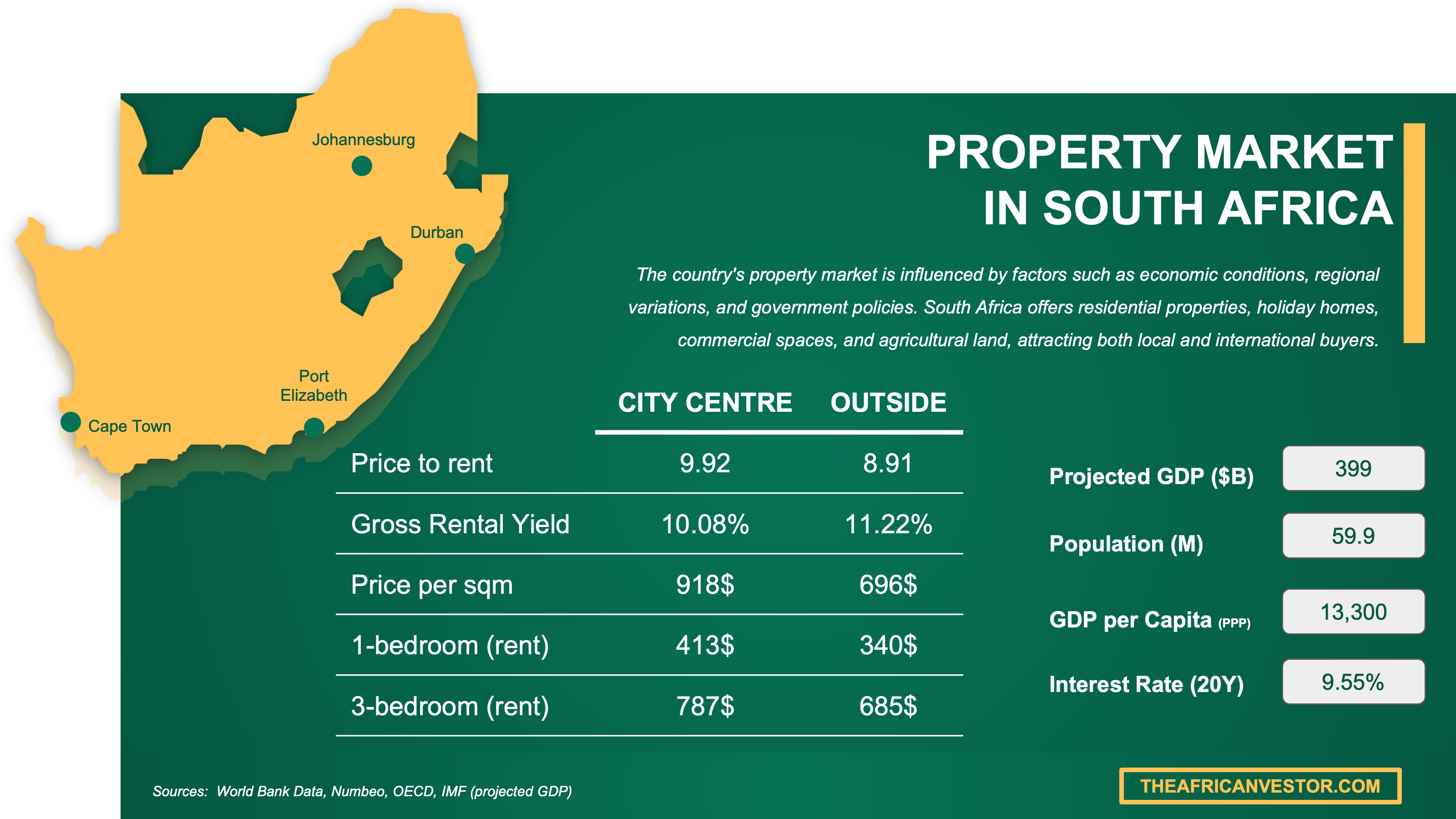
We have made this infographic to give you a quick and clear snapshot of the property market in South Africa. It highlights key facts like rental prices, yields, and property costs both in city centers and outside, so you can easily compare opportunities. We’ve done some research and also included useful insights about the country’s economy, like GDP, population, and interest rates, to help you understand the bigger picture.
