
Authored by the expert who managed and guided the team behind the South Africa Property Pack

Everything you need to know before buying real estate is included in our South Africa Property Pack
Durban is South Africa's warmest major city, offering year-round beach weather, a unique blend of Zulu and Indian cultures, and coastal living that costs far less than Cape Town or most international seaside destinations.
We constantly update this blog post to give you the freshest data and most accurate picture of what expat life in Durban actually looks like in 2026.
And if you're planning to buy a property in this place, you may want to download our pack covering the real estate market in Durban.
Is Durban a good place to live in 2026?
Is quality of life getting better or worse in Durban in 2026?
As of early 2026, quality of life in Durban is stabilizing and showing early signs of improvement, driven by falling inflation (which ended 2025 at just 3.6%) and interest rate relief that has made mortgages and car finance more affordable.
The single biggest improvement over the past two to three years has been the reduction in load-shedding, which means residents now experience far fewer power outages and the constant stress of managing backup systems has eased considerably.
However, the persistent challenge that continues to frustrate Durban residents is inconsistent municipal service delivery, particularly water supply interruptions in certain suburbs and the slow pace of infrastructure repairs after the devastating 2022 floods.
In short, if you choose the right suburb and building in Durban, you can enjoy a comfortable coastal lifestyle, but you still need to factor in backup systems and stay informed about which areas have better municipal responsiveness.
Are hospitals good in Durban in 2026?
As of early 2026, private hospitals in Durban generally meet or exceed Western European and North American standards for equipment, specialist availability, and patient care, while public facilities can be stretched and involve longer wait times.
The private hospitals that expats most commonly recommend in Durban include Netcare uMhlanga Hospital in Durban North for its modern facilities and Life Entabeni Hospital in the Berea area for its central location and strong specialist network.
A standard private GP consultation in Durban in 2026 typically costs between R500 and R900 (around 25 to 50 USD or 23 to 46 EUR), while specialist visits range from R1,200 to R2,500 (65 to 135 USD or 60 to 125 EUR), with after-hours appointments adding R200 to R300 extra.
Private health insurance, known locally as medical aid, is strongly recommended for expats in Durban because it provides faster access to specialists, predictable costs, and avoids the often long queues at public facilities.
Are there any good international schools in Durban in 2026?
As of early 2026, Durban has a smaller selection of international schools compared to Johannesburg or Cape Town, but there are several high-quality private and international-curriculum options that are popular with expat families.
The most reputable schools among expat families in Durban include Deutsche Schule Durban for families seeking a German bilingual education, Crawford International La Lucia for its broad international curriculum and Durban North location, and Durban Girls' College for a prestigious local independent option with strong academics.
Annual tuition fees at private and international schools in Durban in 2026 typically range from R90,000 to R200,000 (4,900 to 10,900 USD or 4,500 to 10,000 EUR), depending on the grade level, with boarding adding significantly more.
Waitlists can be real at the most in-demand Durban North schools, especially for entry years like Grade R/1, Grade 8, and Grade 10, so applying 6 to 12 months ahead is advisable, and while some public schools are strong, quality is very uneven by zone.
Is Durban a dangerous place in 2026?
As of early 2026, Durban is not uniformly dangerous, but safety varies significantly by neighborhood, and expats who choose secure complexes in well-established suburbs and follow basic precautions generally report feeling comfortable.
The most common safety concerns that expats should be aware of in Durban include opportunistic theft, smash-and-grab incidents at traffic lights, house break-ins in less secure buildings, and carjackings in certain hotspots, so vigilance about parking and home security is essential.
The neighborhoods generally considered safest for expats in Durban include Umhlanga, La Lucia, Umdloti, and Durban North along the coast, as well as Morningside and Musgrave closer to the city, and the greener suburbs of Westville, Kloof, and Hillcrest further inland.
Women can live alone safely in Durban provided they choose secure complexes with controlled access, CCTV, and guards, avoid walking alone in unfamiliar areas after dark, and use ride-hailing apps rather than flagging down transport on the street.
Thinking of buying real estate in Durban?
Acquiring property in a different country is a complex task. Don't fall into common traps – grab our guide and make better decisions.

How much does everyday life cost in Durban in 2026?
What monthly budget do I need to live well in Durban in 2026?
As of early 2026, a single person needs approximately R35,000 to R50,000 per month (1,900 to 2,700 USD or 1,750 to 2,500 EUR) to live comfortably in Durban in a secure complex in an expat-popular area like Umhlanga or La Lucia, including rent, medical aid, social life, and some savings.
For a more modest but decent lifestyle in Durban, a single person can manage on R28,000 to R35,000 per month (1,500 to 1,900 USD or 1,400 to 1,750 EUR), though this means making trade-offs like a smaller apartment, fewer restaurant dinners, and tighter savings.
A more comfortable or upscale lifestyle in Durban, including a larger apartment in a premium location, regular dining out, gym membership, and weekend activities, realistically requires R50,000 to R70,000 per month (2,700 to 3,800 USD or 2,500 to 3,500 EUR) for a single person.
The expense category that takes the largest share of a monthly budget in Durban is housing combined with security, because expats typically pay a premium for apartments in secure complexes with backup power and water, which can easily represent 35% to 45% of total monthly costs.
What is the average income tax rate in Durban in 2026?
As of early 2026, a typical middle-income earner in Durban (and across South Africa) faces an effective income tax rate of roughly 18% to 28% of taxable income, depending on salary level and deductions like medical aid and retirement contributions.
South Africa's personal income tax is progressive, with marginal rates starting at 18% for the lowest bracket (up to R237,100 annually) and rising through several brackets to a top marginal rate of 45% for income above R1,817,000 annually, though most expats in professional roles feel rates in the 26% to 36% average range.
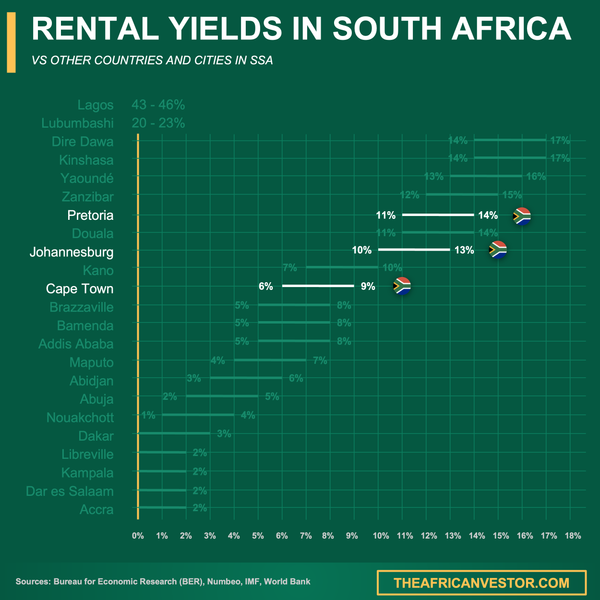
We did some research and made this infographic to help you quickly compare rental yields of the major cities in South Africa versus those in neighboring countries. It provides a clear view of how this country positions itself as a real estate investment destination, which might interest you if you’re planning to invest there.
What kind of foreigners actually live in Durban in 2026?
Where do most expats come from in Durban in 2026?
As of early 2026, the largest groups of expats and foreign residents in Durban come from neighboring SADC countries like Zimbabwe, Mozambique, and Malawi, followed by significant communities from the United Kingdom, Germany, and India due to historic trade and diaspora ties.
Foreign residents make up a relatively small percentage of Durban's total population compared to global gateway cities, but their presence is concentrated in certain suburbs and business sectors, particularly in the Durban North coastal corridor where many expats cluster.
Regional African migrants are drawn to Durban primarily because it is South Africa's busiest port city with strong logistics, manufacturing, and retail job markets, while European expats often arrive through corporate transfers or are attracted by the coastal lifestyle and lower cost of living compared to Cape Town.
The expat population in Durban is a mix of working professionals employed in logistics, healthcare, education, and finance, along with some retirees and a growing number of remote workers drawn by the new digital nomad visa and Durban's affordable beachside living.
Where do most expats live in Durban in 2026?
As of early 2026, expats in Durban concentrate primarily in the northern coastal suburbs of Umhlanga, Umhlanga Ridge, La Lucia, and Umdloti, as well as Morningside and Musgrave closer to the city, and the greener inland suburbs of Westville, Kloof, and Hillcrest.
What makes these Durban neighborhoods attractive to expats is the combination of secure modern complexes with backup power and water, proximity to quality private schools and healthcare facilities, lifestyle amenities like restaurants and gyms, and reliable ride-hailing coverage.
The emerging neighborhoods in Durban that are starting to attract more expats include the Sibaya Precinct north of Umhlanga, which is undergoing massive development, and parts of Ballito further up the coast, which offer a quieter beach lifestyle with newer developments at lower prices than Umhlanga.
Are expats moving in or leaving Durban in 2026?
As of early 2026, expat migration to Durban shows a stable to slightly positive trend, with inflows driven by remote work opportunities and the new digital nomad visa, though some expats continue to leave due to concerns about infrastructure and security.
The main factor drawing expats to Durban right now is the combination of affordable coastal living, the new digital nomad visa that allows remote workers to stay up to three years, and the lower cost of living compared to Cape Town while still offering beaches and good weather.
The main factor causing some expats to leave Durban recently is frustration with municipal service delivery, including water supply issues and slow infrastructure repairs, as well as ongoing security concerns that require constant vigilance and investment in home protection.
Compared to Cape Town, which attracts more digital nomads and international remote workers, Durban's expat growth is steadier but less rapid, though Durban offers significantly better value for money and less competition for housing.
Get fresh and reliable information about the market in Durban
Don't base significant investment decisions on outdated data. Get updated and accurate information.
What paperwork do I need to move to Durban in 2026?
What visa options are popular in Durban in 2026?
As of early 2026, the three most popular visa types for expats moving to Durban and South Africa are the Critical Skills Work Visa for skilled professionals, the General Work Visa for employer-sponsored positions, and the newly implemented Digital Nomad Visa for remote workers.
The Critical Skills Work Visa requires proof of a qualification and experience in an occupation on South Africa's Critical Skills List, professional registration with the relevant South African body where applicable, and a job offer or proof of employment in that field.
South Africa launched its Digital Nomad Visa in March 2025, allowing remote workers to stay up to one year (renewable for up to three years) if they earn at least R650,000 annually (roughly 35,000 USD or 32,500 EUR) from foreign clients or employers and hold comprehensive health insurance.
The Critical Skills Visa is typically valid for up to five years and can be renewed, while the Digital Nomad Visa is initially valid for one year with renewal possible up to a maximum of three years, and work visas generally require renewal before expiry with updated documentation.
How long does it take to get residency in Durban in 2026?
As of early 2026, obtaining temporary residency (a work visa or similar permit) typically takes 4 to 12 weeks if your documentation is complete, while permanent residency applications can take 12 to 24 months or longer depending on the category and Department of Home Affairs workload.
Common factors that can delay residency applications in Durban and South Africa include incomplete documentation, missing police clearance certificates, delays in professional body registration for critical skills applicants, and general administrative backlogs at Home Affairs offices.
To become eligible for permanent residency in South Africa, expats typically need to have held a valid work permit for five consecutive years, though those married to South African citizens or with critical skills may qualify through alternative pathways with different timelines.

We created this infographic to give you a simple idea of how much it costs to buy property in different parts of South Africa. As you can see, it breaks down price ranges and property types for popular cities in the country. We hope this makes it easier to explore your options and understand the market.
How hard is it to find a job in Durban in 2026?
Which industries are hiring the most in Durban in 2026?
As of early 2026, the top three industries currently hiring the most in Durban are logistics and port-related supply chain operations, healthcare including nursing and specialized medical services, and technology including software development and IT services.
It is realistic for expats to get hired in Durban without speaking the local languages because English is the dominant business language, though learning basic isiZulu greetings and etiquette significantly helps with relationship-building and day-to-day interactions.
The types of roles most accessible to foreign job seekers in Durban include specialized logistics and supply chain management positions leveraging Durban's port, healthcare roles where South Africa has skills shortages, IT and software development, and teaching positions at international schools.
What salary ranges are common for expats in Durban in 2026?
As of early 2026, typical salaries for expats working in professional roles in Durban range from R25,000 to R60,000 per month gross (1,350 to 3,250 USD or 1,250 to 3,000 EUR), depending heavily on industry, seniority, and whether the role is locally hired or an international transfer.
Entry-level and mid-level expat positions in Durban typically pay R20,000 to R40,000 per month gross (1,100 to 2,200 USD or 1,000 to 2,000 EUR), which is comparable to what skilled locals earn in similar roles.
Senior or specialized expat roles in Durban, particularly in healthcare, IT, logistics management, or finance, can command R60,000 to R120,000 per month gross (3,250 to 6,500 USD or 3,000 to 6,000 EUR), with international transfers or remote work for foreign employers often paying significantly more.
Employers in Durban do sponsor work visas, but this is most common when the role matches skills on the Critical Skills List or when the employer has an established immigration process, so the Critical Skills route is often smoother than ad-hoc employer sponsorship.
Get to know the market before buying a property in Durban
Better information leads to better decisions. Get all the data you need before investing a large amount of money.
What's daily life really like for expats in Durban right now?
What do expats love most about living in Durban right now?
The top things expats love most about living in Durban are the warm year-round weather that allows beach and outdoor activities in every season, the exceptional food culture blending Zulu, Indian, and international cuisines, and the significantly lower cost of coastal living compared to Cape Town or international beach cities.
The lifestyle benefit most frequently praised by expats in Durban is the outdoor-first culture, where you can go for sunrise swims, surf before work, run along the Golden Mile promenade, and enjoy weekend braais in your garden or at the beach almost any day of the year.
The practical advantage expats appreciate most in Durban is the value for money, where your rand stretches further than in Cape Town, traffic is more manageable than Johannesburg, and you can afford a secure apartment with ocean views for a fraction of what similar accommodation costs in global coastal cities.
The social and cultural aspect that makes Durban particularly enjoyable for expats is the unique fusion of cultures, with Durban's large Indian-South African community creating a food and festival scene unlike anywhere else in the country, from bunny chow to Diwali celebrations.
What do expats dislike most about life in Durban right now?
The top complaints expats have about living in Durban are the need to always think about security, the inconsistent municipal service delivery including water supply issues, and the ongoing need for backup power systems even though load-shedding has improved.
The daily inconvenience that frustrates expats most in Durban is having to factor security into every routine decision, from checking if gates are closed to planning routes that avoid certain areas after dark to installing and maintaining home security systems.
The bureaucratic issue that causes the most headaches for expats in Durban is dealing with Home Affairs for visa renewals and permit issues, where processing times can be unpredictable and the online systems are not always reliable, requiring patience and sometimes professional assistance.
These common frustrations are generally manageable rather than deal-breakers for most expats who stay in Durban, because once you establish routines, choose a secure home, and build a support network, the lifestyle benefits usually outweigh the hassles.
What are the biggest culture shocks in Durban right now?
The biggest culture shocks expats experience when moving to Durban are how quickly your suburb becomes your entire world because the city is so micro-neighborhood focused, the casual way locals discuss backup power and water tanks as normal household necessities, and the rich but unfamiliar cultural mix of Zulu, Indian, and Afrikaner influences.
The social norm that surprises newcomers most in Durban is the strong sense of community within suburbs, where neighbors genuinely look out for each other, WhatsApp security groups are active, and your local coffee shop staff will know your name within weeks.
The aspect of daily routines in Durban that takes the longest for expats to adjust to is planning around security, which means always locking gates, being aware of your surroundings when arriving home, and accepting that spontaneous late-night walks are generally not advisable in most areas.

We made this infographic to show you how property prices in South Africa compare to other big cities across the region. It breaks down the average price per square meter in city centers, so you can see how cities stack up. It’s an easy way to spot where you might get the best value for your money. We hope you like it.
Can I buy a home as a foreigner in Durban in 2026?
Can foreigners legally own property in Durban in 2026?
As of early 2026, foreigners can legally own property in Durban and throughout South Africa without needing residency, citizenship, or a local work permit, making it one of the more accessible property markets in the world for international buyers.
The main restrictions for foreigners buying property in Durban relate to financing and currency controls rather than ownership rights, as non-residents must transfer funds through proper exchange control channels and typically can only borrow up to 50% of the property value from South African banks.
Foreigners in Durban can own all property types including apartments, freestanding houses, land, and commercial property, with no distinction made between property types for foreign ownership purposes.
What is the average price per square meter in Durban in 2026?
As of early 2026, the average price per square meter in Durban ranges from R10,700 to R13,500 (580 to 730 USD or 535 to 675 EUR) for standard properties, while premium coastal areas like Umhlanga and La Lucia command R20,000 to R35,000 per square meter (1,085 to 1,900 USD or 1,000 to 1,750 EUR) for apartments and luxury homes.
Property prices in Durban have shown moderate but steady growth over the past two to three years, with the North Coast areas experiencing 5% to 7% annual appreciation and the broader metro showing around 3.5% to 5% growth, supported by interest rate relief and continued lifestyle migration from Gauteng.
Do banks give mortgages to foreigners in Durban in 2026?
As of early 2026, mortgages for foreigners in Durban are available but come with stricter conditions than for residents, with most major South African banks lending to non-residents but typically limiting loans to 50% of the property value.
The banks in Durban and South Africa known to offer mortgages to foreigners include FNB with their Foreign Choice product, Standard Bank through their non-resident banking services, and Nedbank which actively participates in the foreign buyer mortgage market.
Typical mortgage conditions for foreigners in Durban include a minimum 50% deposit (meaning a maximum 50% loan-to-value), interest rates of prime to prime plus 2% (currently around 10.25% to 12.25%), and loan terms of up to 20 years depending on the borrower's age.
To qualify for a mortgage as a foreigner in Durban, you typically need a valid passport, proof of foreign income and source of funds, three months of bank statements, a South African Reserve Bank approval certificate, and must complete enhanced FICA compliance documentation.
Buying real estate in Durban can be risky
An increasing number of foreign investors are showing interest. However, 90% of them will make mistakes. Avoid the pitfalls with our comprehensive guide.

What sources have we used to write this blog article?
Whether it's in our blog articles or the market analyses included in our property pack about Durban, we always rely on the strongest methodology we can … and we don't throw out numbers at random.
We also aim to be fully transparent, so below we've listed the authoritative sources we used, and explained how we used them and the methods behind our estimates.
| Source | Why it's authoritative | How we used it |
|---|---|---|
| Statistics South Africa | South Africa's official government statistics agency for economic data. | We used Stats SA to anchor inflation rates and economic context for Durban in 2026. We also referenced their migration profile data to understand expat composition. |
| South African Reserve Bank | The country's central bank and authoritative source for interest rates. | We used SARB data to ground mortgage rates and prime lending rates. We referenced this to explain how interest rates affect property affordability in Durban. |
| South African Revenue Service | The official tax authority that publishes binding tax tables. | We used SARS tax tables to explain how income tax works in South Africa. We calculated effective tax rates for typical expat salary levels. |
| Department of Home Affairs | The government regulator that sets all visa and immigration requirements. | We used DHA documentation to describe visa options and requirements accurately. We referenced their published processing guidelines for residency timelines. |
| South African Police Service | The official publisher of national and regional crime statistics. | We used SAPS data to ground our safety discussion in official crime numbers. We referenced station-level data availability for Durban neighborhoods. |
| Council for Medical Schemes | The regulator that oversees private healthcare coverage in South Africa. | We used CMS data to explain why private medical aid is important for expats. We referenced their reporting to contextualize healthcare costs. |
| PayProp Rental Index | A large rental-platform publisher with consistent, repeatable reporting. | We used PayProp data to anchor rent levels and rental inflation for KZN. We cross-checked our budget estimates against their market reporting. |
| FNB Property Barometer | A major bank with a long-running, respected property analytics series. | We used FNB data to describe property price trends in Durban. We referenced their forecasts for 2026 market expectations. |
| Lightstone Property | A widely used deeds-data analytics provider with robust methodology. | We used Lightstone to triangulate price per square meter estimates. We referenced their repeat-sales index approach to validate price trends. |
| Numbeo | A crowdsourced cost of living database with recent Durban data. | We used Numbeo to cross-check everyday expense estimates. We referenced their comparative data to show how Durban costs compare to other cities. |
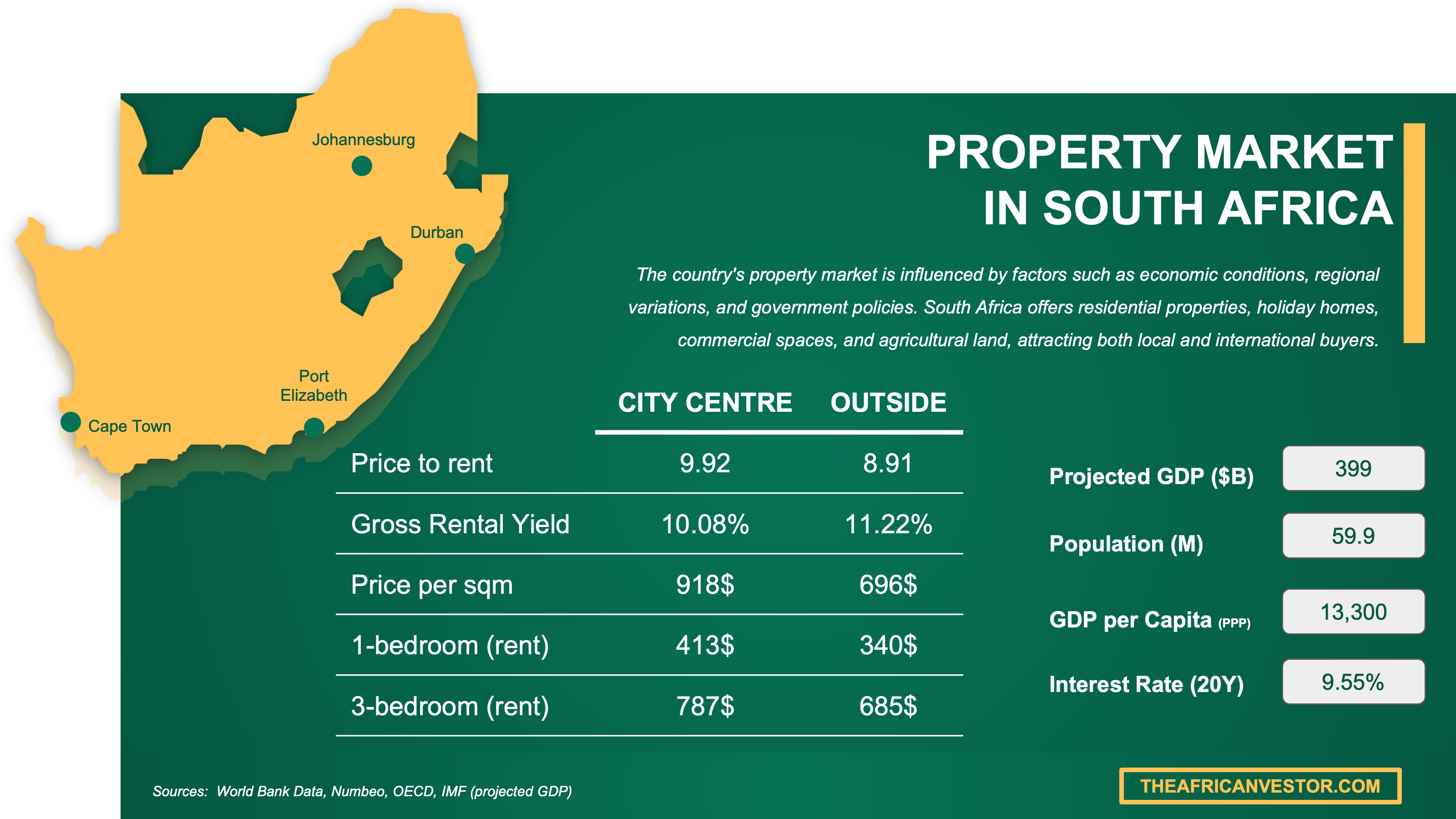
We have made this infographic to give you a quick and clear snapshot of the property market in South Africa. It highlights key facts like rental prices, yields, and property costs both in city centers and outside, so you can easily compare opportunities. We’ve done some research and also included useful insights about the country’s economy, like GDP, population, and interest rates, to help you understand the bigger picture.
