
Authored by the expert who managed and guided the team behind the South Africa Property Pack

Everything you need to know before buying real estate is included in our South Africa Property Pack
Durban is one of South Africa's most affordable major coastal cities, which makes it attractive to foreign buyers looking for value without sacrificing ocean access or urban infrastructure.
In this article, we break down exactly what different USD budgets can buy you in Durban's residential property market in 2026, from entry-level apartments to genuine luxury.
We constantly update this blog post to reflect current Durban housing prices, exchange rates, and market conditions so the numbers you see here are as fresh as possible.
And if you're planning to buy a property in this place, you may want to download our pack covering the real estate market in Durban.
What can I realistically buy with $100k in Durban right now?
Are there any decent properties for $100k in Durban, or is it all scams?
Yes, $100k (roughly R1.64 million in early 2026) can get you a legitimate, decent property in Durban -- most commonly a 1 or 2-bedroom sectional-title apartment in an established suburb like Glenwood, Umbilo, Berea, or Morningside.
The neighborhoods offering the best value and lowest scam risk at this budget are places like Glenwood and Umbilo (close to hospitals and universities, real rental demand), Queensburgh, Pinetown, and Newlands West (more space per Rand, solid townhouse stock), and The Bluff or Montclair (where a house-feel property appears before you'd find anything similar up the north coast).
Buying in upscale Durban nodes like Umhlanga Rocks, La Lucia, or Mount Edgecombe for $100k is extremely rare and almost always comes with a serious catch -- think very small studio, high body corporate levies, a special levy due, or a compromised building position -- so keep your expectations grounded for this budget.
What property types can I afford for $100k in Durban (studio, land, old house)?
At around R1.64 million, the most realistic options in Durban in 2026 are a 1 to 2-bedroom sectional-title apartment (typically 50 to 90 m2 in an older building), a small townhouse or duplex in a middle suburb, or occasionally a freestanding house -- though that last option usually involves a trade-off around security, renovation, or location.
At this price level in Durban, you should typically expect "catch-up maintenance" rather than move-in-ready condition -- things like waterproofing, older plumbing, or electrical compliance work are common, and for houses, budget separately for roof, damp, and perimeter security.
Among the available property types at $100k in Durban, sectional-title apartments in good nodes tend to offer the best long-term value because they carry stronger rental liquidity, lower individual maintenance exposure, and better resale speed compared to isolated houses at this price point.
What's a realistic budget to get a comfortable property in Durban as of 2026?
As of early 2026, the realistic starting point for a "comfortable" property in Durban -- meaning no major renovation surprises, a decent building, and a location you'd actually want to live in -- sits at around R2.2 million (about $135k or roughly 125,000 EUR).
Most buyers chasing a comfortable standard in Durban in 2026 land in the R2.2 million to R3.5 million range (roughly $135k to $215k, or 125,000 to 200,000 EUR), which covers solid 2 to 3-bedroom apartments or townhouses in better-located middle suburbs.
In Durban, "comfortable" for most buyers in 2026 means a property that is move-in ready, in a building with functioning lifts and security, with 2 bedrooms, at least 1 bathroom, and air conditioning -- none of which is guaranteed below R2 million.
That said, how far your budget stretches in Durban depends a lot on which suburb you target -- R2.5 million in Westville or Durban North goes noticeably further than the same amount in Umhlanga Ridge, where you'd be at the very bottom of the market.
Get fresh and reliable information about the market in Durban
Don't base significant investment decisions on outdated data. Get updated and accurate information.

What can I get with a $200k budget in Durban as of 2026?
What "normal" homes become available at $200k in Durban as of 2026?
As of early 2026, $200k (about R3.28 million) is where Durban starts feeling like a normal family-home market -- you can realistically look at a 3-bedroom townhouse in suburbs like Westville or Durban North, a freestanding 3-bedroom house in Glenwood or Queensburgh, or a modern 2-bedroom apartment in Umhlanga Ridge.
At R3.28 million in Durban in 2026, a typical apartment runs roughly 80 to 120 m2 (2 bed, 2 bath in many cases), while a townhouse or house in the middle suburbs tends to offer around 120 to 220 m2 of built area -- with land size varying quite a bit depending on the suburb and era of construction.
By the way, we have much more granular data about housing prices in our property pack about Durban.
What places are the smartest $200k buys in Durban as of 2026?
As of early 2026, the smartest $200k plays in Durban (around R3.28 million) are concentrated in Glenwood for rental yield and lifestyle, Durban North for family-driven resale demand, Westville for suburb reputation and school catchment, and Umhlanga Ridge for lock-up-and-go demand from professionals.
What makes these areas smarter than the rest of the $200k market in Durban is that they combine real rental fallback demand (from tenants who actually want to be there) with stronger resale liquidity -- you are not buying in a value suburb purely on price.
The main driver of appreciation in these Durban nodes is ongoing infrastructure investment and lifestyle demand from young professionals and families relocating from Johannesburg or Cape Town who find Durban's coastal offering more affordable.
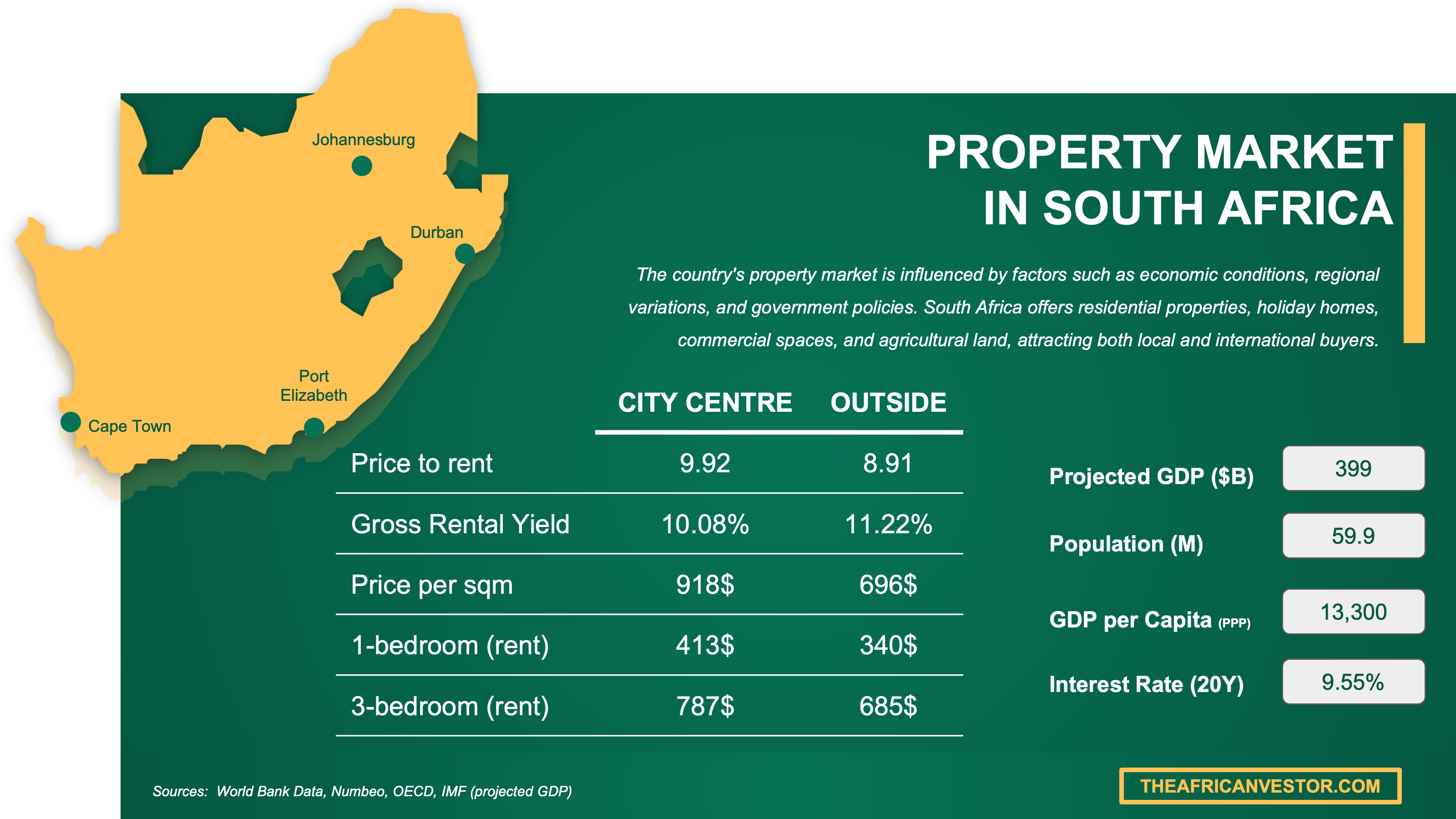
We have made this infographic to give you a quick and clear snapshot of the property market in South Africa. It highlights key facts like rental prices, yields, and property costs both in city centers and outside, so you can easily compare opportunities. We’ve done some research and also included useful insights about the country’s economy, like GDP, population, and interest rates, to help you understand the bigger picture.
What can I buy with $300k in Durban in 2026?
What quality upgrade do I get at $300k in Durban in 2026?
As of early 2026, moving from $200k to $300k in Durban (from about R3.28 million to R4.92 million) typically buys you the bundle of security, condition, and location simultaneously -- rather than having to trade one off against the others as you often do at the lower budget.
Yes, $300k can very often buy a property in a newer building in Durban in 2026, especially in Umhlanga Ridge and similar modern nodes where new-ish sectional-title stock sits comfortably within this range.
At this budget, buyers in Durban start accessing features that are hard to find below R4 million: gated estate access or 24-hour security, modern finishes (granite, underfloor heating in upmarket builds, fibre-ready infrastructure), double garaging, and buildings with no outstanding special levies.
Can $300k buy a 2-bedroom in Durban in 2026 in good areas?
As of early 2026, yes -- $300k (about R4.92 million) very often buys a 2-bedroom, 2-bathroom property in a good Durban area, and in some cases even a well-positioned 3-bedroom depending on the suburb and building.
The specific Durban areas where 2-bedroom options are realistic at this budget include Morningside, Musgrave, Durban North, and Umhlanga Ridge -- all of which offer lifestyle, amenities, and genuine demand rather than just price.
A typical 2-bedroom property at R4.92 million in these Durban areas in 2026 runs roughly 80 to 120 m2, sometimes larger in older Morningside or Musgrave buildings that offer more floorplate for the price.
Which places become "accessible" at $300k in Durban as of 2026?
At $300k (about R4.92 million), the Durban areas that become genuinely accessible include La Lucia (entry-level townhouse and apartment segments), Mount Edgecombe (estate-format townhouses), and a wider slice of Umhlanga Ridge -- these were largely out of reach at the $200k mark.
What makes these newly accessible areas desirable is the combination of managed security, proximity to Umhlanga's retail and lifestyle infrastructure, and strong tenant demand from professionals -- these are areas with real exit options, not just pretty locations.
In these Durban nodes at the $300k price point, buyers can typically expect a 2-bedroom sectional-title apartment or a townhouse within a security complex, often with a small garden or balcony, rather than a large freestanding house.
Get to know the market before buying a property in Durban
Better information leads to better decisions. Get all the data you need before investing a large amount of money.
What does a $500k budget unlock in Durban in 2026?
What's the typical size and location for $500k in Durban in 2026?
As of early 2026, $500k (about R8.2 million) puts you in Durban's premium coastal and family suburb tier, typically a high-quality 3 to 4-bedroom home in Durban North or La Lucia, or a premium apartment with views in Umhlanga Rocks -- we are talking 150 to 300 m2 of well-finished space depending on the format.
Yes, $500k can and regularly does buy a family home with outdoor space in Durban in 2026 -- a pool and garden are a normal expectation at this level, particularly in Durban North, La Lucia, and certain Mount Edgecombe estate formats.
The typical configuration at R8.2 million in Durban in 2026 is 3 to 4 bedrooms and 2 to 3 bathrooms, with a double garage, in a secure complex or estate -- and sometimes a freestanding home in the best-positioned family suburbs.
Which "premium" neighborhoods open up at $500k in Durban in 2026?
At $500k (around R8.2 million), the Durban neighborhoods that open up meaningfully are Umhlanga Rocks (more of the beachfront-adjacent market becomes reachable), La Lucia (top pockets including gated enclave streets), Durban North (larger family homes on proper plots), and Mount Edgecombe (estate lifestyle with golf course proximity).
What makes these Durban neighborhoods genuinely premium is not just price but the combination of direct Indian Ocean access or views, established high-end amenities (Gateway Theatre of Shopping, La Lucia Mall, Umhlanga Village), and some of the lowest crime risk in the greater eThekwini area.
At $500k in these Durban premium nodes, buyers can realistically expect a quality apartment with sea or golf views, a townhouse in a boutique security estate, or a freestanding home in Durban North -- all with modern finishes and at least 3 bedrooms.
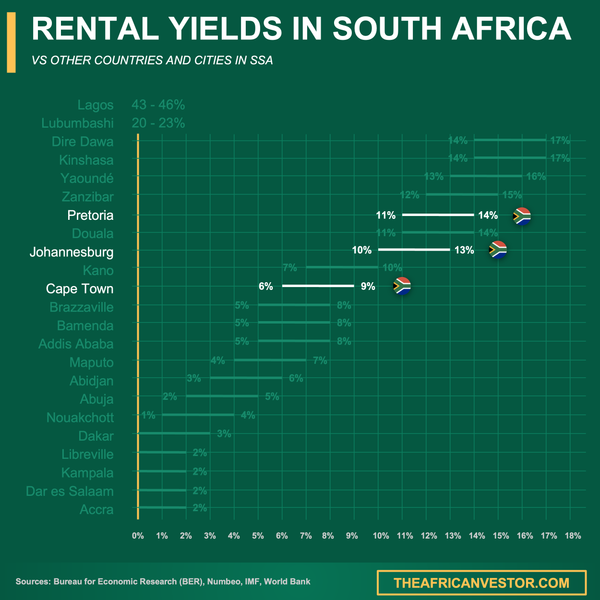
We did some research and made this infographic to help you quickly compare rental yields of the major cities in South Africa versus those in neighboring countries. It provides a clear view of how this country positions itself as a real estate investment destination, which might interest you if you’re planning to invest there.
What counts as "luxury" in Durban in 2026?
At what amount does "luxury" start in Durban right now?
In Durban in 2026, luxury in the residential property market starts at roughly R10 million (about $610k, or around 565,000 EUR) -- below that, you are buying "premium," not luxury.
What defines luxury entry in Durban specifically is the combination of a prime coastal address or estate position, a large floorplate (typically 200 m2 or more), top-finish construction (stone counters, smart home systems, high ceilings, custom joinery), and security infrastructure that goes beyond a standard complex gate.
Mid-tier luxury in Durban runs from roughly R10 million to R20 million ($610k to $1.2 million, or 565,000 to 1.1 million EUR), while trophy properties -- large beachfront homes, penthouse apartments in Umhlanga Rocks, or landmark estate homes -- typically price above R20 million ($1.2 million+).
Which areas are truly high-end in Durban right now?
In Durban in 2026, the genuinely high-end residential areas are Umhlanga Rocks (the prime coastal strip), La Lucia (top gated pockets), Mount Edgecombe (estate lifestyle with golf), and the best pockets of Durban North (large plots, older prestige homes).
What makes these Durban areas truly high-end is not just high listing prices but the combination of direct beachfront or greenbelt positioning, extremely low-density living, private and association-managed security, and proximity to top-tier retail and international school infrastructure -- features that are hard to replicate elsewhere in eThekwini.
The typical buyer in Durban's genuine high-end zones in 2026 is either a South African family relocating from Johannesburg seeking a coastal lifestyle upgrade, or an international buyer (often from Zimbabwe, the UK, or the wider African continent) attracted by Durban's Indian Ocean frontage at price points far below comparable Mediterranean or Southeast Asian coastal property.
Don't buy the wrong property, in the wrong area of Durban
Buying real estate is a significant investment. Don't rely solely on your intuition. Gather the right information to make the best decision.
How much does it really cost to buy, beyond the price, in Durban in 2026?
What are the total closing costs in Durban in 2026 as a percentage?
As of early 2026, buyers purchasing with cash in Durban should budget roughly 3% to 6% of the purchase price in total closing costs, while buyers taking a mortgage bond should budget closer to 5% to 8% because bond registration adds a meaningful additional layer of fees.
The realistic low-to-high range for most standard Durban transactions in 2026 is 3% (clean cash purchase, lower price band, negotiated attorney fees) to 8% (bonded purchase, higher price band, full guideline conveyancing fees) -- so on a R3 million purchase, expect between R90,000 and R240,000 in costs on top of the price.
To avoid hidden costs and bad surprises, you can check our our pack covering the property buying process in Durban.
How much are notary, registration, and legal fees in Durban in 2026?
As of early 2026 in Durban, the legal and registration fees on top of transfer duty typically run between R15,000 and R80,000 depending on the purchase price (roughly $900 to $5,000, or 840 to 4,600 EUR) -- covering conveyancing attorney fees, bond registration costs if applicable, and Deeds Office fees.
As a rough guide, legal and registration fees (excluding transfer duty) represent about 1% to 2% of the purchase price in Durban for most standard transactions in 2026.
Of the three cost buckets, transfer duty (the government tax) is consistently the largest single item for properties above R1 million in Durban -- on a R4.92 million ($300k) purchase, for example, transfer duty alone comes to around R318,000, which is several times the attorney and Deeds fees combined.
What annual property taxes should I expect in Durban in 2026?
As of early 2026, a typical property owner in Durban pays annual municipal rates to eThekwini Municipality that, as a rough order of magnitude, work out to between R15,000 and R50,000 per year (about $900 to $3,000, or 840 to 2,800 EUR) depending on the municipal valuation of the property.
The effective annual rate in Durban in 2026 typically represents roughly 1.5% to 2.5% of the property's municipal valuation -- noting that municipal valuation can be lower or higher than what you actually paid, so your bill may look different from what you'd expect based on the purchase price alone.
Property taxes in Durban vary by category: residential owners pay a different cents-in-the-rand rate than commercial owners, and properties in estates or with sectional-title configurations may have additional levy structures on top of municipal rates.
There are rebates available within eThekwini for qualifying residential owners -- particularly for low-income households and pensioners -- but as a foreign buyer purchasing above R1 million, you are unlikely to qualify for meaningful rebates unless you meet specific local criteria.
Is mortgage a viable option for foreigners in Durban right now?
Yes, foreigners can get a mortgage to buy in Durban in 2026, but the practical reality is that non-residents face tighter underwriting, higher deposit requirements, and more documentation than local South African buyers -- making cash purchases simpler and more common in practice.
Major South African banks do offer mortgage products for non-residents (FNB's Foreign Choice home loan is a publicly available example), but foreign buyers in Durban should typically expect a loan-to-value ratio of around 50% -- meaning a deposit of roughly 50% of the purchase price -- and interest rates aligned with the South African prime rate, which in early 2026 sits in the 11% range.
Foreign buyers applying for a Durban mortgage in 2026 will typically need to provide proof of income in their home country, South African bank account activity, documentation of incoming funds through an authorised dealer under South African Reserve Bank exchange-control rules, a valid passport, and a tax number.

We made this infographic to show you how property prices in South Africa compare to other big cities across the region. It breaks down the average price per square meter in city centers, so you can see how cities stack up. It’s an easy way to spot where you might get the best value for your money. We hope you like it.
What should I predict for resale and growth in Durban in 2026?
What property types resell fastest in Durban in 2026?
As of early 2026, the fastest-reselling property types in Durban are well-priced sectional-title apartments and townhouses in security-focused nodes -- particularly lock-up-and-go units in Umhlanga Ridge, Durban North, and Morningside that appeal to professionals and semigrants.
The typical time on market for a correctly priced property in Durban in 2026 is around 85 days (about 12 weeks), based on FNB's agent survey data -- though properties in high-demand nodes or with no levy complications can move significantly faster.
What makes certain Durban properties sell faster is not just location but "clean title" factors specific to this market -- buildings with no outstanding special levies, no body corporate litigation, up-to-date municipal accounts, and issued electrical and plumbing compliance certificates all accelerate buyer decisions in ways that may seem administrative but genuinely determine deal speed in eThekwini.
The slowest-reselling Durban properties in 2026 tend to be older freestanding houses in suburbs that lack a clear identity (neither upscale nor rental-demand nodes), especially where the asking price reflects seller sentiment rather than recent comparable sales -- these can sit on the market for 6 months or more.
If you're interested, we cover all the best exit strategies in our real estate pack about Durban.
Make a profitable investment in Durban
Better information leads to better decisions. Save time and money. Download our data.
What sources have we used to write this blog article?
Whether it's in our blog articles or the market analyses included in our property pack about Durban, we always rely on the strongest methodology we can ... and we don't throw out numbers at random.
We also aim to be fully transparent, so below we've listed the authoritative sources we used, and explained how we used them and the methods behind our estimates.
| Source | Why it's authoritative | How we used it |
|---|---|---|
| South African Revenue Service (SARS) -- Transfer Duty | SARS is the official national tax authority that legally sets and publishes transfer duty brackets. | We used the 2025/26 brackets to calculate transfer duty for each USD budget scenario. We then converted those amounts into a percentage of purchase price for easy budgeting. |
| Deeds Office (Dept. of Agriculture, Land Reform and Rural Development) -- Fees Schedule | This is the official national schedule for Deeds Registry fees under the Deeds Registries Act. | We used it to ground "registration cost" as a real, official line item. We rolled it into the closing-cost range alongside transfer duty and legal fees. |
| Law Society of South Africa (LSSA) -- Conveyancing Fee Guidelines 2025 | LSSA publishes the national guideline tariff used by conveyancers across South Africa. | We used it to anchor realistic attorney fees and translate the guideline into a simple percentage range by price band, avoiding invented legal-fee numbers. |
| South African Reserve Bank (SARB) -- Financial Surveillance FAQ | SARB is the central bank and the authority behind South Africa's exchange-control administration. | We used it to explain what foreign buyers must do to document incoming funds and why banks ask for specific paperwork. We also used it to frame mortgage feasibility for non-residents. |
| FNB -- Foreign Choice Home Loans | FNB is a major South African bank offering an actual, publicly listed mortgage product for non-residents. | We used it as proof that mortgages for foreigners in Durban exist and to set realistic expectations around deposit requirements and underwriting standards. |
| FNB -- Property Barometer | FNB Economics is a long-running, mainstream source widely cited in South African property analysis. | We used it for the quantitative days-on-market benchmark and to understand broad market velocity. We then adapted those figures to Durban's specific property mix. |
| Statistics South Africa -- Residential Property Price Index (March 2025) | Stats SA is the official government statistics agency; the RPPI is a formal national index publication. | We used it to anchor national nominal price growth as a reality check against portal asking prices. We used it to set a conservative growth baseline for 2026 expectations in Durban. |
| Pam Golding Properties -- Market Commentary | Pam Golding is a major established South African real-estate group with a long-running national property index. | We used it to triangulate market direction and sentiment going into 2026. We also used it to support the view that Durban pricing is recovering rather than declining. |
| Lightstone -- Property Newsletter April 2025 | Lightstone is a major South African property data firm whose commentary is based on large-scale transaction records. | We used it to contextualize foreign buyer behaviour in Durban, including typical spend and which market segments attract international buyers. We also used it to anchor the R10 million luxury threshold. |
| Exchange Rates UK -- USD/ZAR 2026 History | A transparent, independent exchange-rate history source used to cross-check FX conversion accuracy. | We used it to confirm early-2026 USD/ZAR levels and derive the working conversion rate of approximately R16.4 per USD applied throughout this article. |
| eThekwini Municipality -- Property Rates Policy 2025/2026 | This is the official local government policy document governing how municipal rates are applied in Durban. | We used it to explain how Durban's annual property rates are structured, including categories, rebates, and cents-in-the-rand calculation. We used it to produce the annual tax estimates in this article. |
| Fairbridges Attorneys -- Foreign Buyer Mortgage Guide | Fairbridges is an established South African law firm specialising in property transactions and exchange-control advice. | We used their published guidance to source the ~50% own-funds constraint that non-residents commonly face when seeking a South African mortgage. We used it to advise that cash purchases are simpler in practice. |

We created this infographic to give you a simple idea of how much it costs to buy property in different parts of South Africa. As you can see, it breaks down price ranges and property types for popular cities in the country. We hope this makes it easier to explore your options and understand the market.
