
Authored by the expert who managed and guided the team behind the South Africa Property Pack

Everything you need to know before buying real estate is included in our South Africa Property Pack
South Africa's property market in early 2026 is price-stable rather than booming, with interest rates that help affordability but enough fraud risk that you need to buy like a skeptic.
The South African Reserve Bank's repo rate sits at 6.75% as of January 2026, and big-bank price indicators show modest single-digit growth, which reduces panic buying but increases the temptation for sellers to push creative tactics.
We constantly update this blog post to reflect current conditions in the South African real estate market.
And if you're planning to buy a property in this place, you may want to download our pack covering the real estate market in South Africa.
How risky is buying property in South Africa as a foreigner in 2026?
Can foreigners legally own properties in South Africa in 2026?
As of early 2026, foreigners can legally buy and own mainstream residential property in South Africa in their own name, including freehold houses, sectional title apartments, and homes in gated estates.
The main conditions that apply to foreigners buying property in South Africa are not about permission to own, but about compliance with exchange-control rules, banking requirements, and FICA identity checks that verify your source of funds.
Since direct ownership is generally allowed in South Africa, foreigners rarely need special legal structures, though some choose to use trusts or companies for estate planning or privacy reasons rather than to bypass restrictions.
What really matters is that your contract meets South African legal formalities and that you work with a registered conveyancer who can guide the transaction through the Deeds Registry properly.
What buyer rights do foreigners actually have in South Africa in 2026?
As of early 2026, foreigners in South Africa have the same property rights as locals once a transaction is registered, with your strongest protections coming from the Deeds Registry system and regulated practitioner requirements rather than special foreign-buyer laws.
If a seller breaches a contract in South Africa, you can legally enforce your rights through the courts, though the practical reality is that civil cases can take months or longer to resolve, so your best protection is preventing disputes through proper due diligence.
The most common right that foreigners mistakenly assume they have in South Africa is a quick refund if they wire money early, but if you pay before safeguards are in place, recovering your funds can be slow and uncertain.
How strong is contract enforcement in South Africa right now?
Contract enforcement in South Africa is real but not fast, meaning the country has functional courts and legally binding contracts, but civil processes move slower than in places like the UK, Germany, or the United States, where disputes typically resolve more quickly.
The main weakness foreigners should know about in South Africa is that even straightforward matters can drag on due to court postponements and procedural delays, so you should assume any dispute will take months to resolve and focus on prevention rather than relying on legal remedies.
By the way, we detail all the documents you need and what they mean in our property pack covering South Africa.
Buying real estate in South Africa can be risky
An increasing number of foreign investors are showing interest. However, 90% of them will make mistakes. Avoid the pitfalls with our comprehensive guide.

Which scams target foreign buyers in South Africa right now?
Are scams against foreigners common in South Africa right now?
Scams targeting foreigners in South Africa are common enough that you should assume you will encounter at least a few attempts while property shopping, especially when searching online listings or during payment steps.
The type of property transaction most frequently targeted by scammers in South Africa is online-first deals where buyers contact listings remotely, often for rental properties or homes in popular areas like Cape Town's Atlantic Seaboard or Johannesburg's Sandton.
The profile of foreign buyer most commonly targeted in South Africa is someone shopping from overseas who cannot easily verify information in person, particularly those looking for vacation homes or investment properties and willing to pay deposits quickly.
The single biggest warning sign that a deal may be a scam in South Africa is pressure to pay a deposit before you have verified the agent's credentials or confirmed ownership through the Deeds Registry.
What are the top three scams foreigners face in South Africa right now?
The top three scams foreigners face when buying property in South Africa are fake agents using stolen identities who push for holding deposits, payment redirection scams where criminals hijack email threads to send fake banking details, and title misrepresentation where the seller is not the real owner or the property has undisclosed bonds.
The most common scam in South Africa typically unfolds when someone poses as a licensed agent, sometimes using a real agent's name, contacts you about a listing, builds urgency by claiming other buyers are interested, and asks you to wire a deposit to secure the property before you have verified anything.
The single most effective protection against each scam is verification: for fake agents, check their Fidelity Fund Certificate on the official portal before engaging; for payment fraud, always verify banking details by calling a known number rather than trusting email; and for title fraud, confirm ownership through the Deeds Registry before paying anything.
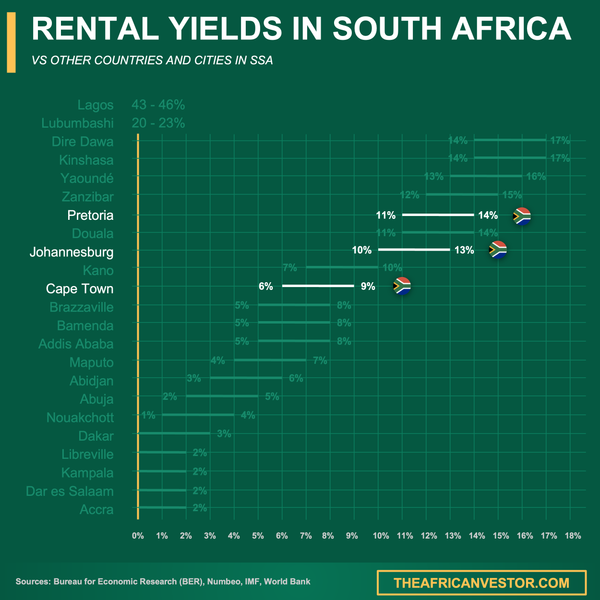
We did some research and made this infographic to help you quickly compare rental yields of the major cities in South Africa versus those in neighboring countries. It provides a clear view of how this country positions itself as a real estate investment destination, which might interest you if you’re planning to invest there.
How do I verify the seller and ownership in South Africa without getting fooled?
How do I confirm the seller is the real owner in South Africa?
The standard verification process to confirm the seller is the real owner in South Africa involves getting the property's exact legal description, then having your conveyancer run a deeds search through the Deeds Office to match the registered owner against the seller's identity.
The official document foreigners should check to verify ownership in South Africa is the title deed held at the Deeds Registry, which shows the registered owner, any mortgage bonds, servitudes, and conditions attached to the property.
The most common trick fake sellers use to appear legitimate in South Africa is presenting themselves as authorized representatives of a company, trust, or deceased estate without proper proof of authority, and this happens often enough that you should always require a resolution or letters of authority before proceeding.
Where do I check liens or mortgages on a property in South Africa?
The official registry where you check liens or mortgages on a property in South Africa is the Deeds Registry, where mortgage bonds are registered against the title, and you can access this through the Deeds Office or DeedsWeb services.
When checking for liens in South Africa, you should request information on any registered mortgage bonds, servitudes, conditions of title, and interdicts, plus separately verify municipal rates and service arrears through the rates clearance process.
The type of encumbrance most commonly missed by foreign buyers in South Africa is municipal rates arrears, because buyers often assume the bank or conveyancer will handle everything, but you need written proof the account is cleared before registration proceeds.
It's one of the aspects we cover in our pack about the real estate market in South Africa.
How do I spot forged documents in South Africa right now?
The most common type of forged document used in property scams in South Africa is the Fidelity Fund Certificate, and this happens often enough that you should never trust a certificate shown to you without verifying it independently on the official portal.
Specific red flags that indicate a document may be forged in South Africa include agents who give excuses about verification systems being down, ID copies that look unusually clean or have inconsistent signatures, and any banking details sent via email with urgency attached.
The official verification method to authenticate documents in South Africa is to use the Fidelity Fund Certificate verification portal for agent credentials and request your conveyancer to independently verify ownership and identity documents through the Deeds Registry.
Get the full checklist for your due diligence in South Africa
Don't repeat the same mistakes others have made before you. Make sure everything is in order before signing your sales contract.
What "grey-area" practices should I watch for in South Africa?
What hidden costs surprise foreigners when buying a property in South Africa?
The three most common hidden costs foreigners overlook in South Africa are transfer duty (which can reach 13% on high-value properties, or around R150,000 to R500,000 / $8,000 to $27,000 / 7,500 to 25,000 EUR on typical purchases), conveyancing and Deeds Office registration fees, and sectional title levies including special levies for deferred maintenance.
The hidden cost most often deliberately concealed by sellers or agents in South Africa is upcoming special levies in sectional title schemes, and this sometimes happens because sellers want to close before the levy is announced, leaving buyers with unexpected bills of R20,000 to R100,000 ($1,100 to $5,500 / 1,000 to 5,000 EUR) or more.
Are "cash under the table" requests common in South Africa right now?
In mainstream urban residential transactions via reputable conveyancers in South Africa, overt cash under the table requests are uncommon at around 2% to 4%, but they spike significantly in informal networks, urgent distressed sales, or when the agent is not properly regulated.
The typical reason sellers give for requesting undeclared cash payments in South Africa is to reduce the official purchase price and thereby lower transfer duty, which can save tens of thousands of rand on higher-value properties.
If you agree to an undeclared cash payment in South Africa, you face serious legal risks including tax fraud charges from SARS, a weakened legal position if any dispute arises, and potential difficulty proving your full investment if you need to sell or claim insurance later.
Are side agreements used to bypass rules in South Africa right now?
Side agreements to bypass official rules sometimes happen in South Africa, particularly in transactions involving informal networks or when buyers and sellers want to work around disclosure requirements or timing constraints.
The most common type of side agreement in South Africa is verbal promises for the seller to fix issues after transfer that are not reflected in the Offer to Purchase, followed by furniture valuations used to reduce the stated property price and informal occupation arrangements that create eviction risk.
If a side agreement is discovered by authorities in South Africa, you face legal consequences including the agreement being unenforceable in court, potential tax fraud implications, and a weakened position if any dispute arises because disputes are slow to resolve and you want everything in writing.

We made this infographic to show you how property prices in South Africa compare to other big cities across the region. It breaks down the average price per square meter in city centers, so you can see how cities stack up. It’s an easy way to spot where you might get the best value for your money. We hope you like it.
Can I trust real estate agents in South Africa in 2026?
Are real estate agents regulated in South Africa in 2026?
As of early 2026, real estate agents in South Africa are regulated under the Property Practitioners Act, which requires them to be registered with the Property Practitioners Regulatory Authority and hold a valid Fidelity Fund Certificate.
A legitimate real estate agent in South Africa should have a current Fidelity Fund Certificate issued by the PPRA, which confirms they are properly registered and that client funds are protected under the Fidelity Fund framework.
Foreigners can verify whether an agent is properly licensed in South Africa by visiting the official Fidelity Fund Certificate verification portal at ffc.fidfund.co.za, entering the agent's name or certificate number, and confirming their status before sharing any documents or discussing deposits.
Please note that we have a list of contacts for you in our property pack about South Africa.
What agent fee percentage is normal in South Africa in 2026?
As of early 2026, the normal agent fee percentage in South Africa is around 5% of the purchase price plus 15% VAT, which works out to approximately 5.75% all-in as a common outcome.
The typical range of agent fee percentages that covers most transactions in South Africa is 3% to 7% plus VAT, depending on the property price, location, and whether you have given a sole mandate to one agent.
In South Africa, the seller typically pays the agent fee, which is deducted from the sale proceeds at transfer, though buyers should be aware that this cost is effectively built into the property price.
Get the full checklist for your due diligence in South Africa
Don't repeat the same mistakes others have made before you. Make sure everything is in order before signing your sales contract.
What due diligence actually prevents disasters in South Africa?
What structural inspection is standard in South Africa right now?
The standard structural inspection process for property purchases in South Africa is not universally mandatory, but sellers are typically required to provide compliance certificates including an Electrical Certificate of Compliance, and buyers are strongly advised to commission an independent building inspection.
A qualified inspector in South Africa should check foundations, roof structure and waterproofing, walls for cracks and damp, drainage systems, and any unapproved building alterations that could create insurance or municipal compliance issues later.
The type of professional qualified to perform structural inspections in South Africa is a registered building inspector or structural engineer, and for electrical compliance, you need a registered electrician to issue the mandatory certificate.
The most common structural issues that inspections reveal in South African properties are damp and waterproofing failures especially in older apartments and coastal areas like Cape Town's Sea Point or Durban's Umhlanga, unapproved building works such as added rooms or flatlets, and electrical non-compliance from quick DIY fixes before show days.
How do I confirm exact boundaries in South Africa?
The standard process for confirming exact property boundaries in South Africa is to obtain the registered diagram or sectional plan from the Deeds Registry, then have a professional surveyor verify the physical beacons on the ground if anything seems unclear.
The official document that shows the legal boundaries of a property in South Africa is the registered diagram for freehold properties or the sectional plan for apartments, both held at the Deeds Registry and referenced in the title deed.
The most common boundary dispute affecting foreign buyers in South Africa involves fences or walls that do not match the registered diagram, plus confusion in sectional title schemes about what is exclusive use versus common property, particularly with parking bays and gardens.
The professional you should hire to physically verify boundaries on the ground in South Africa is a registered land surveyor, who can confirm that beacons match the registered diagram and identify any encroachments.
What defects are commonly hidden in South Africa right now?
The top three defects that sellers frequently conceal from buyers in South Africa are damp and waterproofing failures which are common especially in coastal regions like the Cape Town Atlantic Seaboard and Durban, unapproved building works which happen often because homeowners add rooms without municipal approval, and sectional title financial stress where special levies are imminent but not disclosed.
The inspection technique that helps uncover hidden defects in South Africa is a moisture meter for damp issues, a review of municipal building records for approved plans, and requesting the last 12 months of body corporate financials and minutes for sectional title properties to spot upcoming levies.
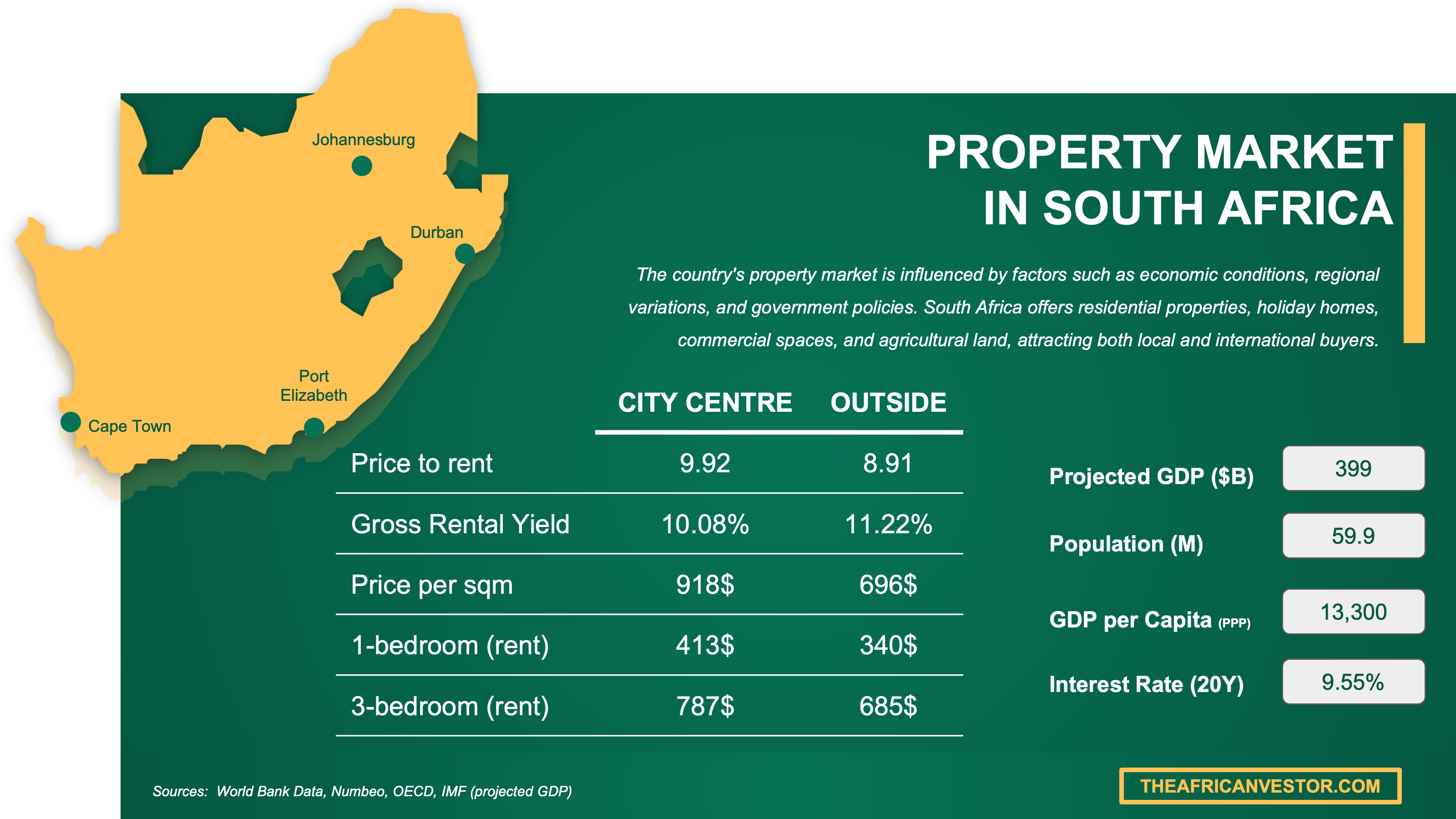
We have made this infographic to give you a quick and clear snapshot of the property market in South Africa. It highlights key facts like rental prices, yields, and property costs both in city centers and outside, so you can easily compare opportunities. We’ve done some research and also included useful insights about the country’s economy, like GDP, population, and interest rates, to help you understand the bigger picture.
What insider lessons do foreigners share after buying in South Africa?
What do foreigners say they did wrong in South Africa right now?
The most common mistake foreigners say they made when buying property in South Africa is trusting an agent's friendly manner instead of verifying their Fidelity Fund Certificate before engaging seriously.
The top three regrets foreigners most frequently mention after buying in South Africa are paying a deposit before ownership verification was complete, underestimating the paperwork friction from FICA source-of-funds requirements, and not understanding sectional title body corporate finances before committing.
The single piece of advice experienced foreign buyers most often give to newcomers in South Africa is to verify the agent's FFC certificate before doing anything else, because it takes two minutes and prevents most scam exposure.
The mistake foreigners say cost them the most money or stress in South Africa is wiring funds based on emailed banking details that turned out to be fraudulent, because international transfers are nearly impossible to reverse once sent.
What do locals do differently when buying in South Africa right now?
The key difference in how locals approach buying property in South Africa compared to foreigners is that locals choose their conveyancer carefully and let the conveyancer drive verification from day one, rather than relying on the agent to manage the process.
The verification step locals routinely take that foreigners often skip in South Africa is treating the Deeds Registry as the truth source early in the process rather than at the end, requesting a deeds search before signing an Offer to Purchase rather than after.
The local knowledge advantage that helps South Africans get better deals is their understanding of which neighborhoods in major cities have strong resale liquidity and services, such as Sea Point, Green Point, and Rondebosch in Cape Town, Sandton, Bryanston, and Rosebank in Johannesburg, Umhlanga Ridge and La Lucia in Durban, and Waterkloof and Menlo Park in Pretoria.
Don't buy the wrong property, in the wrong area of South Africa
Buying real estate is a significant investment. Don't rely solely on your intuition. Gather the right information to make the best decision.

What sources have we used to write this blog article?
Whether it's in our blog articles or the market analyses included in our property pack about South Africa, we always rely on the strongest methodology we can … and we don't throw out numbers at random.
We also aim to be fully transparent, so below we've listed the authoritative sources we used, and explained how we used them and the methods behind our estimates.
| Source | Why It's Authoritative | How We Used It |
|---|---|---|
| South African Reserve Bank | The central bank and official source for interest-rate policy. | We used it to anchor the January 2026 interest-rate environment. We treated SARB as the baseline for macro risk assessment. |
| SARS Transfer Duty | The tax authority and legal source of transfer duty brackets. | We used it to quantify the biggest unavoidable buyer tax. We also flagged under-declaration scams and their consequences. |
| Deeds Registry | The official registry custodian for property ownership records. | We used it to explain where ownership and mortgage bonds are recorded. We grounded the verification steps for checking ownership and liens. |
| Property Practitioners Act | The enacted law governing property practitioners and protections. | We used it to explain what a regulated agent means in South Africa. We highlighted the Fidelity Fund Certificate requirement. |
| Fidelity Fund Certificate Portal | The official verification tool for practitioner certificate status. | We used it as the practical trust-but-verify tool for agent legitimacy. We turned regulation into an actionable step for foreigners. |
| World Justice Project Rule of Law Index | A widely used international benchmark on civil justice. | We used it to frame contract enforcement strength realistically. We avoided hand-wavy statements about rule of law. |
| Transparency International CPI | The primary publisher of corruption perception benchmarks. | We used it to contextualize corruption risk and bureaucratic friction. We cross-checked against purely anecdotal scam narratives. |
| Financial Intelligence Centre | The national AML authority setting compliance expectations. | We used it to explain why foreigners face extra checks on source of funds. We flagged money-laundering-style deal structures as red flags. |
| FNB Property Barometer | A major bank publishing transparent property market indicators. | We used it to describe how the market moved into early 2026. We kept the market vibe section data-led rather than anecdotal. |
| CSOS | The specialized ombud for sectional title disputes. | We used it to explain sectional title risks and dispute pathways. We highlighted body corporate financial stress as a buyer blind spot. |

We created this infographic to give you a simple idea of how much it costs to buy property in different parts of South Africa. As you can see, it breaks down price ranges and property types for popular cities in the country. We hope this makes it easier to explore your options and understand the market.
