
Authored by the expert who managed and guided the team behind the South Africa Property Pack

Everything you need to know before buying real estate is included in our South Africa Property Pack
The South Africa property market in 2026 offers genuine value for foreign buyers, with house prices averaging R1.6 million nationally and interest rates at their lowest since the pandemic.
This guide covers current housing prices in South Africa at every budget level, from $100k starter properties to $500k premium homes, and we update it regularly to reflect market changes.
Whether you want a coastal apartment in Cape Town or a family home in Johannesburg, understanding what your budget actually buys is the first step to making a smart investment.
And if you're planning to buy a property in this place, you may want to download our pack covering the real estate market in South Africa.
What can I realistically buy with $100k in South Africa right now?
Are there any decent properties for $100k in South Africa, or is it all scams?
Yes, you can absolutely find real, livable properties for around $100,000 (approximately R1.65 million at January 2026 exchange rates) in South Africa, and the scam risk is more about how you verify title and handle payments than the price point itself.
The best value neighborhoods in South Africa for a $100k budget in 2026 include Randburg and Roodepoort in Johannesburg, Montana and Sinoville in Pretoria, Glenwood and Umbilo in Durban, and suburbs like Bellville, Parow, and Brackenfell in Cape Town, where your money stretches further than in prime coastal areas.
Buying in popular or upscale areas of South Africa for $100k is extremely difficult, especially in Cape Town's premium zones like the Atlantic Seaboard or City Bowl, where this budget might only cover a parking bay or micro-studio, though the same money buys a proper 2-bedroom apartment in Johannesburg's middle suburbs.
What property types can I afford for $100k in South Africa (studio, land, old house)?
At $100,000 (R1.65 million) in South Africa in 2026, you can typically afford a studio or 1-bedroom apartment in most metro middle suburbs, a 2-bedroom apartment or townhouse in value suburbs of Johannesburg or Durban, or potentially an older freestanding house in smaller cities or outer metro areas.
For a $100k property in South Africa, you should expect to budget an additional 5% to 15% of the purchase price for renovations, with apartments in managed complexes needing mostly cosmetic updates and older houses potentially requiring kitchen, bathroom, or electrical work.
The best long-term value at the $100k level in South Africa tends to be well-priced sectional title apartments and townhouses in commutable, safe nodes, because these properties have the deepest buyer pool when you want to resell and benefit from professional body corporate management.
What's a realistic budget to get a comfortable property in South Africa as of 2026?
As of early 2026, a realistic minimum budget for a comfortable property in South Africa is approximately R2.5 million ($150,000 USD or €140,000 EUR) in Johannesburg or Durban, though Cape Town typically requires R3.5 million ($210,000 USD or €195,000 EUR) or more for comparable quality.
Most buyers seeking a comfortable standard in South Africa in 2026 need a budget range of R2.5 million to R5 million ($150,000 to $300,000 USD), which covers quality townhouses or apartments in safe, well-connected neighborhoods across most metros.
"Comfortable" in South Africa generally means a property of 70 to 120 square meters with two or more bedrooms, good security features, reliable utilities, manageable commute options, and no major structural repairs needed immediately after purchase.
The required budget in South Africa varies dramatically by neighborhood, with Cape Town's Atlantic Seaboard requiring double or triple the budget of Johannesburg's northern suburbs for equivalent space, while emerging areas in both cities offer 20% to 30% savings compared to established nodes.
Get fresh and reliable information about the market in South Africa
Don't base significant investment decisions on outdated data. Get updated and accurate information.

What can I get with a $200k budget in South Africa as of 2026?
What "normal" homes become available at $200k in South Africa as of 2026?
As of early 2026, a $200,000 budget (approximately R3.3 million) unlocks "normal" family homes in South Africa, typically meaning a 2 to 3 bedroom townhouse in a secure complex in Johannesburg or Pretoria, larger apartments in better Durban locations, or decent 2-bedroom apartments and townhouses in Cape Town's Northern Suburbs.
At the $200k price point in South Africa in 2026, you can expect property sizes ranging from 60 to 110 square meters for apartments and 90 to 160 square meters for townhouses, with the larger sizes found in Gauteng and the smaller in Cape Town due to its pricing premium.
By the way, we have much more granular data about housing prices in our property pack about South Africa.
What places are the smartest $200k buys in South Africa as of 2026?
As of early 2026, the smartest $200k buys in South Africa include Durbanville and Burgundy Estate in Cape Town, Randburg suburbs like Bromhof and Boskruin in Johannesburg, Moreleta Park and parts of Centurion in Pretoria, and Morningside or Westville in Durban, where demand remains strong but prices haven't peaked.
These areas are smarter buys because they combine high rental demand, decent school access, established infrastructure, and proximity to employment hubs, which means both faster resale times and better capital protection compared to cheaper but isolated alternatives.
The main growth drivers in these smart-buy South Africa areas are ongoing infrastructure improvements, semigration trends bringing South Africans from other provinces, and the structural undersupply of secure, well-located housing that keeps demand consistently strong.
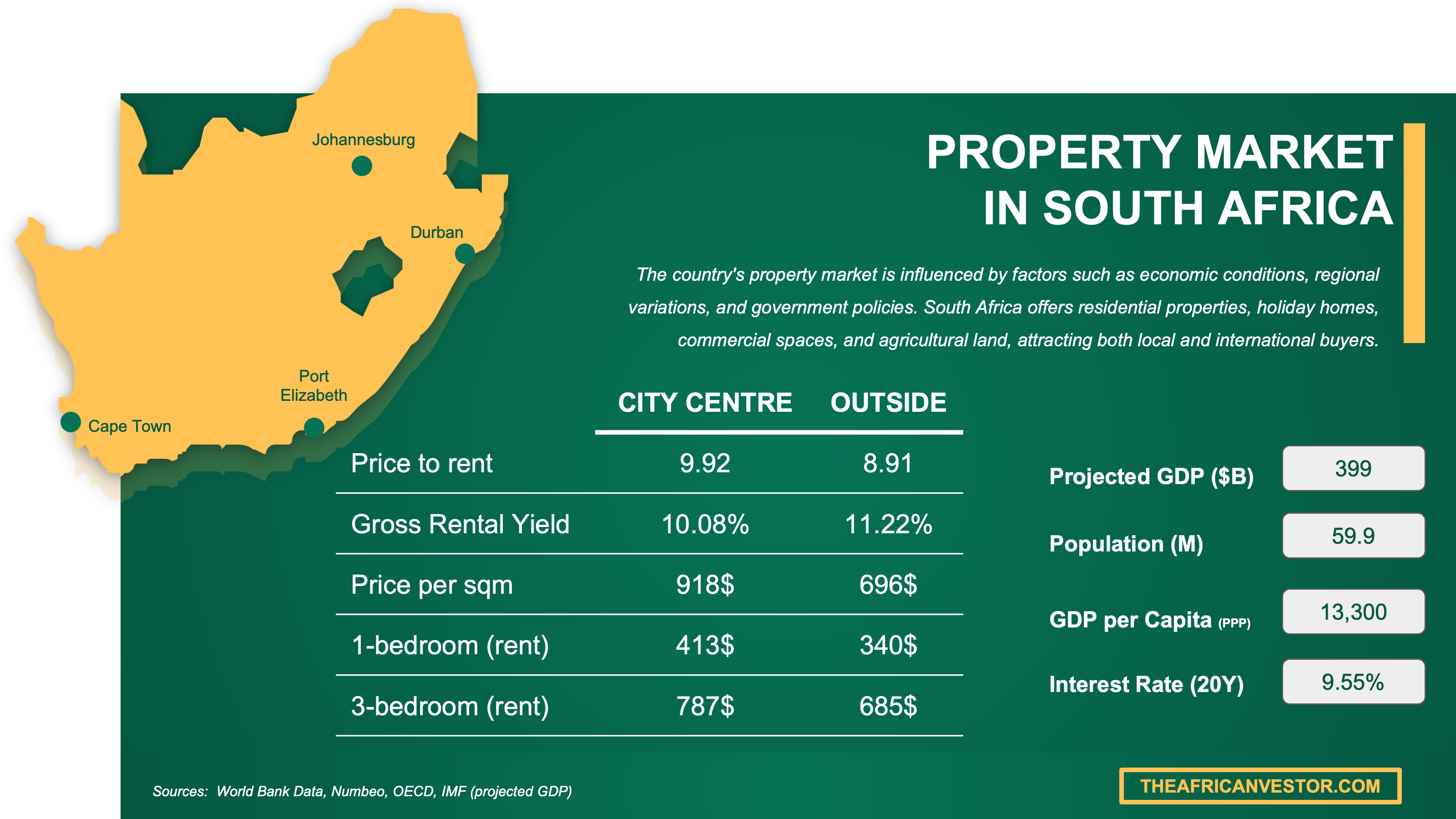
We have made this infographic to give you a quick and clear snapshot of the property market in South Africa. It highlights key facts like rental prices, yields, and property costs both in city centers and outside, so you can easily compare opportunities. We’ve done some research and also included useful insights about the country’s economy, like GDP, population, and interest rates, to help you understand the bigger picture.
What can I buy with $300k in South Africa in 2026?
What quality upgrade do I get at $300k in South Africa in 2026?
As of early 2026, moving from $200k to $300k (approximately R5 million) in South Africa typically upgrades your security model to 24/7 access control, improves your location closer to major job nodes and better schools, and gets you more consistent backup infrastructure like inverter readiness and water tanks in some estates.
Yes, $300k can definitely buy a property in a newer building in South Africa in 2026, especially in Johannesburg and Pretoria where newer sectional title developments and gated estates are accessible at this price, though Cape Town newer stock at this level is more commonly found in suburban nodes rather than prime coastline.
At the $300k budget in South Africa, typical features include modern kitchens with built-in appliances, two full bathrooms, covered parking, access to community facilities like pools or clubhouses, and often fiber internet pre-installation in newer developments.
Can $300k buy a 2-bedroom in South Africa in 2026 in good areas?
As of early 2026, $300k (R5 million) can absolutely buy a 2-bedroom property in good areas across most South African metros, with the biggest caveat being Cape Town's priciest pockets where this budget still won't reach true Atlantic Seaboard or prime City Bowl locations.
Specific good areas in South Africa where $300k buys a solid 2-bedroom in 2026 include Rosebank periphery and Bedfordview in Johannesburg, family-friendly Cape Town Northern Suburbs, much of the Southern Suburbs fringe, and well-regarded Durban nodes like Umhlanga periphery.
A $300k 2-bedroom in South Africa's good areas typically offers 75 to 110 square meters (800 to 1,200 square feet) of living space, which is comfortable for couples or small families and often includes a balcony or small patio area.
Which places become "accessible" at $300k in South Africa as of 2026?
At the $300k (R5 million) price point in South Africa in 2026, buyers gain access to stronger school-linked suburbs in Cape Town, more consistently safe and convenient options closer to major Johannesburg employment nodes, and entry into some KZN North Coast estate-style living options.
These newly accessible areas are desirable because they typically offer better municipal service delivery, lower crime rates with established community security initiatives, shorter commute times to business hubs, and access to quality government or semi-private schools that aren't available at lower budget levels.
In these newly accessible South Africa areas at $300k, buyers can typically expect a well-maintained 2 to 3 bedroom townhouse in a secure complex, sometimes with a small garden, or a spacious apartment in a modern building with professional body corporate management.
Get to know the market before buying a property in South Africa
Better information leads to better decisions. Get all the data you need before investing a large amount of money.
What does a $500k budget unlock in South Africa in 2026?
What's the typical size and location for $500k in South Africa in 2026?
As of early 2026, a $500,000 budget (approximately R8.25 million) in South Africa typically buys 150 to 250 square meters (1,600 to 2,700 square feet) in desirable locations, with Cape Town offering comfortable townhouses or freestanding homes in many good suburbs, Johannesburg and Pretoria offering larger properties in strong neighborhoods, and Durban providing meaningful entry into higher-end coastal or estate options.
Yes, $500k can definitely buy a family home with outdoor space in South Africa in 2026, especially in Gauteng and KZN nodes where freestanding homes with gardens are common at this level, though in Cape Town, outdoor space becomes realistic in many suburbs but not in the "walk to Clifton" locations.
At the $500k price point in South Africa in 2026, buyers typically get 3 to 4 bedrooms and 2 to 3 bathrooms, often with a double garage, domestic quarters or home office space, and a proper garden or entertainment area in freestanding homes.
Which "premium" neighborhoods open up at $500k in South Africa in 2026?
At the $500k (R8.25 million) price point in South Africa in 2026, premium neighborhoods that open up include parts of Rondebosch and Newlands edges in Cape Town, Houghton and Hyde Park periphery in Johannesburg, Durbanville upmarket pockets, and Umhlanga Ridge and La Lucia-adjacent options in Durban.
These neighborhoods are considered premium in South Africa because they offer established security infrastructure with active community involvement, excellent schools within walking or short driving distance, mature gardens and tree-lined streets, and proximity to upmarket shopping and dining without the ultra-high price tags of absolute prime locations.
In these premium South Africa neighborhoods at $500k, buyers can realistically expect a solid 3 to 4 bedroom freestanding home needing minimal work, a spacious townhouse in a well-run estate, or an exceptionally large apartment in a prestige building with concierge services.
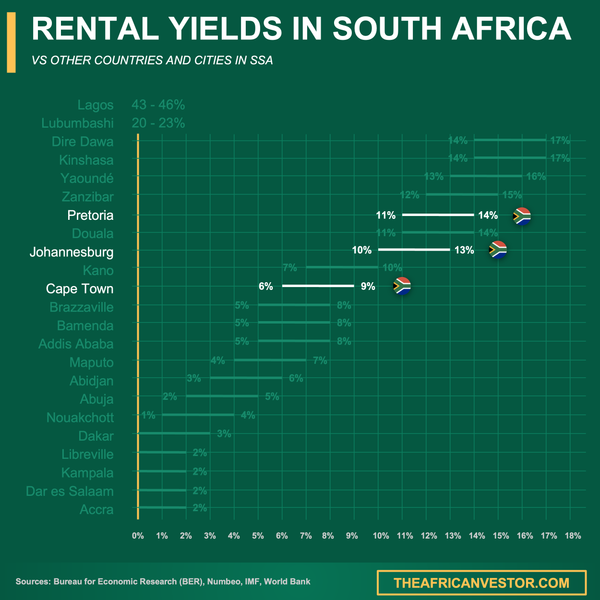
We did some research and made this infographic to help you quickly compare rental yields of the major cities in South Africa versus those in neighboring countries. It provides a clear view of how this country positions itself as a real estate investment destination, which might interest you if you’re planning to invest there.
What counts as "luxury" in South Africa in 2026?
At what amount does "luxury" start in South Africa right now?
In South Africa in 2026, luxury property generally starts at around R10 million ($600,000 USD or €555,000 EUR), though in Cape Town's top coastal and City Bowl pockets, the luxury threshold can be higher due to extreme demand from international buyers and limited supply.
The entry point to luxury real estate in South Africa is defined by features like private swimming pools, high-end security systems with biometric access, imported finishes and appliances, staff quarters, double or triple garages, and location in recognized prestige addresses.
South Africa's luxury threshold is significantly lower than comparable markets like Australia, the UK, or the US, where luxury often starts at $1 million or more, making South African premium property attractive to international investors seeking value.
For mid-tier luxury in South Africa in 2026, expect to pay R15 to R25 million ($900,000 to $1.5 million USD), while top-tier luxury homes in areas like Clifton, Sandhurst, or Bishopscourt regularly exceed R40 million ($2.4 million USD or €2.2 million EUR).
Which areas are truly high-end in South Africa right now?
The truly high-end areas in South Africa in 2026 include Clifton, Camps Bay, Bantry Bay, Fresnaye, and Llandudno on Cape Town's Atlantic Seaboard, Bishopscourt and upper Constantia in the Southern Suburbs, plus Sandhurst, Saxonwold, Hyde Park, and Houghton in Johannesburg, and prime Umhlanga and Zimbali in KwaZulu-Natal.
These areas are considered truly high-end in South Africa because they offer unobstructed ocean or mountain views, exceptionally large properties on coveted land, 24-hour armed response and boomed access, proximity to the country's best private schools, and a concentration of ultra-high-net-worth neighbors who maintain the prestige of the address.
The typical buyer profile for these high-end South Africa areas includes successful business owners and executives, senior professionals in finance and legal sectors, returning expats with foreign currency advantages, international investors seeking rand-denominated assets, and high-profile individuals requiring privacy and security.
Don't buy the wrong property, in the wrong area of South Africa
Buying real estate is a significant investment. Don't rely solely on your intuition. Gather the right information to make the best decision.
How much does it really cost to buy, beyond the price, in South Africa in 2026?
What are the total closing costs in South Africa in 2026 as a percentage?
As of early 2026, total closing costs when buying property in South Africa typically range from 3% to 6% of the purchase price for cash buyers and 5% to 9% for buyers using a mortgage, with the variation depending on the property price and whether transfer duty applies.
The realistic low-to-high percentage range covering most standard South Africa property transactions in 2026 is 3% on the low end for smaller cash purchases below the transfer duty threshold, up to 9% or slightly higher for larger financed purchases where both transfer duty and bond registration costs apply.
The specific fee categories making up total closing costs in South Africa include transfer duty (the largest component for properties above R1.1 million), conveyancing attorney fees, deeds office registration fees, bond registration costs if financing, and various administrative disbursements.
To avoid hidden costs and bad surprises, you can check our our pack covering the property buying process in South Africa.
How much are notary, registration, and legal fees in South Africa in 2026?
As of early 2026, notary, registration, and legal fees in South Africa typically total between R30,000 and R150,000 ($1,800 to $9,000 USD or €1,650 to €8,300 EUR), scaling with the property price and complexity of the transaction.
These fees typically represent 0.7% to 1.5% of the property price in South Africa, with the percentage being higher on lower-priced properties due to minimum fee thresholds and lower on expensive properties where the fee increase doesn't scale proportionally.
Among these three fee types in South Africa, the legal and conveyancing fees are usually the most expensive component, followed by bond registration costs if you're financing, with deeds office registration fees being the smallest line item.
What annual property taxes should I expect in South Africa in 2026?
As of early 2026, annual property taxes (called "rates" in South Africa) for a typical mid-range property run approximately R12,000 to R36,000 per year ($720 to $2,200 USD or €670 to €2,000 EUR), depending on the municipal valuation and location.
Property taxes in South Africa typically represent 0.3% to 0.8% of the property's municipal valuation per year, calculated using a "cent-in-the-rand" formula that varies by municipality and is applied to the municipal valuation, not the market price.
Property taxes in South Africa vary significantly by location, with Cape Town, Johannesburg, and eThekwini (Durban) each setting their own tariffs and valuation methods, meaning two identically-priced properties in different metros can have very different annual rates bills.
Yes, there are exemptions and reductions available in South Africa, including rebates for pensioners, people with disabilities, and indigent households, though eligibility criteria and rebate amounts differ by municipality and require application through local government offices.
Is mortgage a viable option for foreigners in South Africa right now?
Yes, mortgages are viable for foreigners buying property in South Africa in 2026, but you should plan for stricter conditions than local buyers face, with non-residents typically limited to 50% loan-to-value ratios and foreign nationals living in South Africa potentially qualifying for up to 75%.
Typical loan-to-value ratios for foreign buyers in South Africa are 50% for non-residents and up to 75% for foreign nationals with work permits, with interest rates currently ranging from 10.25% to 13% depending on your profile and the bank's risk assessment.
Foreign buyers applying for mortgages in South Africa typically need a valid passport, proof of foreign address, three months of bank statements, proof of income or employment contracts, a South African tax number, and compliance with SARB exchange control regulations that require the deposit to come from abroad through proper channels.

We made this infographic to show you how property prices in South Africa compare to other big cities across the region. It breaks down the average price per square meter in city centers, so you can see how cities stack up. It’s an easy way to spot where you might get the best value for your money. We hope you like it.
What should I predict for resale and growth in South Africa in 2026?
What property types resell fastest in South Africa in 2026?
As of early 2026, the property types that resell fastest in South Africa are well-priced sectional title apartments and townhouses in commutable, secure nodes, because these sit in the affordability sweet spot for the deep pool of local buyers who drive most market activity.
The typical time on market to sell a property in South Africa in 2026 is approximately 12 weeks (85 days) nationally, though correctly-priced properties in high-demand areas can sell in 3 to 5 weeks while overpriced homes can sit for 6 months or longer.
Properties sell faster in South Africa when they offer security features like access control and perimeter fencing, because security remains the dominant demand driver in the market, with homes in secure estates commanding up to 10% premiums and moving significantly quicker than comparable unsecured properties.
The slowest-selling property types in South Africa tend to be oversized freestanding homes on large plots requiring significant maintenance, older buildings in areas with declining infrastructure or service delivery, and anything priced above R3 million that doesn't offer clear value compared to newer stock in the same area.
If you're interested, we cover all the best exit strategies in our real estate pack about South Africa.
Make a profitable investment in South Africa
Better information leads to better decisions. Save time and money. Download our data.
What sources have we used to write this blog article?
Whether it's in our blog articles or the market analyses included in our property pack about South Africa, we always rely on the strongest methodology we can and we don't throw out numbers at random.
We also aim to be fully transparent, so below we've listed the authoritative sources we used, and explained how we used them and the methods behind our estimates.
| Source | Why It's Authoritative | How We Used It |
|---|---|---|
| South African Reserve Bank (SARB) | Central bank's official exchange rate and interest rate records. | We used it to anchor USD to ZAR conversions for January 2026. We also referenced repo and prime rates for mortgage context. |
| Statistics South Africa (Stats SA) | Official national statistics agency for housing price indices. | We used it to verify residential property price trends. We cross-checked private sector data against official RPPI figures. |
| FNB Property Barometer | Major bank's research with repeat-sales house price index. | We used it to gauge recent price growth and market momentum. We also sourced time-on-market figures from their reports. |
| South African Revenue Service (SARS) | Official tax authority and legal source for transfer duty. | We used it to calculate transfer duty at each budget level. We translated closing costs into concrete percentage ranges. |
| Lightstone Property Data | Long-standing property data provider using deeds-based datasets. | We used it to support Cape Town vs Johannesburg pricing comparisons. We explained why the same budget buys less in Cape Town. |
| Law Society of South Africa | Formal guideline document from the legal profession for fees. | We used it to estimate conveyancing cost ranges. We justified why buyer legal fees scale with property price. |
| SA Deeds Registries | Official Deeds Office schedule for registration fees. | We used it to ground registration fee components in official schedules. We avoided made-up admin cost numbers. |
| City of Johannesburg Rates Policy | Primary municipal policy document for property taxes. | We used it to show how rates are calculated by municipality. We supported ongoing cost expectations beyond purchase price. |
| ooba Home Loans | Major bond originator with comprehensive market data. | We used it for current interest rate context and affordability trends. We referenced their suburb guides for neighborhood insights. |
| Global Property Guide | Recognized international aggregator citing underlying sources. | We used it as a sense-check on city-to-city price differences. We did not treat it as single source of truth versus official data. |

We created this infographic to give you a simple idea of how much it costs to buy property in different parts of South Africa. As you can see, it breaks down price ranges and property types for popular cities in the country. We hope this makes it easier to explore your options and understand the market.
