
Authored by the expert who managed and guided the team behind the South Africa Property Pack
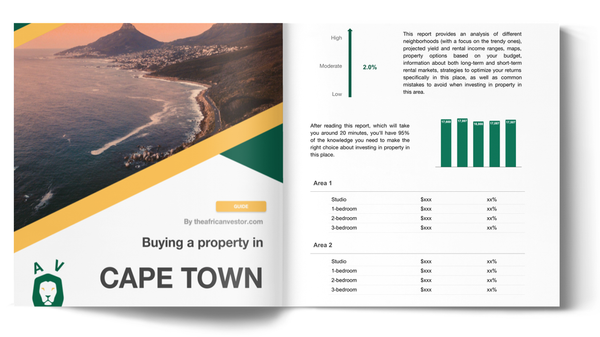
Get all the data you need about the real estate market in Cape Town
This blog post gives a clear view of current housing prices in Cape Town in 2026, using fresh data that we keep updating.
We focus only on residential property in Cape Town, so the numbers below are meant for home buyers, foreign buyers and private investors.
You will see average prices, median prices, price per square metre, neighbourhood differences, taxes, fees and realistic budget examples.
And if you’re planning to buy a property in this place, you may want to download our pack covering the real estate market in Cape Town.
Insights
- The average housing price in Cape Town in 2026 is pulled up by luxury homes in Clifton, Camps Bay, Constantia and Bishopscourt.
- The median housing price in Cape Town in 2026 is around R3.4 million, which is a better guide for normal buyers than the citywide average.
- The average closed-sale housing price in Cape Town in 2026 is around R7.2 million, or about $442,000 and €380,000.
- The average listing price in Cape Town is much higher, close to R10.5 million, because expensive homes stay visible on portals for longer.
- Most Cape Town residential property buyers should expect final sale prices to be about 10% to 18% below initial asking prices.
- Prime coastal areas such as Clifton, Bantry Bay and Camps Bay can reach R100,000 to R180,000 per sqm for the best homes.
- Entry-level Cape Town homes still exist below R1.8 million, but they are mostly older flats or small houses away from the premium coastline.
- New-build homes in Cape Town usually cost 12% to 25% more than similar older homes because buyers pay for security, lower maintenance and modern finishes.
- Buying costs in Cape Town can add 8% to 14% to a normal resale purchase, and more if the property needs renovation.

What is the average housing price in Cape Town in 2026?
The median housing price in Cape Town in 2026 is often more useful than the average housing price because one very expensive villa can make the average look much higher than what most buyers actually pay.
We are writing this as of 2026 with the latest data collected from authoritative sources that we manually double checked.
In 2026, the median housing price in Cape Town is about R3.4 million, which is about $208,500 or €179,200. The average closed-sale housing price in Cape Town is about R7.2 million, which is about $441,500 or €379,600.
For 80% of normal residential property in Cape Town in 2026, a realistic price range is about R1.25 million to R18 million, or about $76,700 to $1.1 million and €65,900 to €948,300.
A realistic entry range in Cape Town in 2026 is about R950,000 to R1.8 million, or about $58,300 to $110,400 and €50,100 to €94,900, and this usually buys an older studio, a small 1-bedroom flat or a compact house in areas such as Maitland, Retreat, Wynberg fringe or parts of the Southern Suburbs fringe.
A typical luxury property in Cape Town in 2026 costs about R15 million to R45 million, or about $920,000 to $2.76 million and €790,700 to €2.37 million, and this can mean a renovated villa in Camps Bay, Clifton, Bantry Bay, Constantia or Bishopscourt.
By the way, you will find much more detailed price ranges in our property pack covering the real estate market in Cape Town.
Are Cape Town property listing prices close to the actual sale price in 2026?
In 2026, Cape Town property listing prices are usually about 10% to 18% above actual sale prices, with our central estimate close to 14%.
This gap exists because Cape Town has many aspirational listings in premium areas, especially the Atlantic Seaboard, City Bowl and Constantia. The gap is usually smallest for well-priced flats in Sea Point, Green Point or Claremont, and largest for stale luxury villas that have been listed for a long time.
Don't buy the wrong property, in the wrong area of Cape Town
Buying real estate is a significant investment. Don't rely solely on your intuition. Gather the right information to make the best decision.

What is the price per sq m or per sq ft for properties in Cape Town in 2026?
As of 2026, the median housing price per sqm in Cape Town is about R42,000, or $2,600 and €2,200, which equals about R3,900 per sqft, or $239 and €206. The average housing price per sqm in Cape Town is about R55,000, or $3,400 and €2,900, which equals about R5,100 per sqft, or $313 and €269.
The highest price per sqm in Cape Town in 2026 is usually found in small luxury apartments, penthouses and view homes near the ocean, while the lowest price per sqm is usually found in older inland homes where demand from foreign buyers is lower.
The highest price per sqm in Cape Town is usually in Clifton, Bantry Bay, Camps Bay, Fresnaye, Mouille Point, the Waterfront and the best parts of Sea Point, with prime homes often around R70,000 to R180,000+ per sqm. The lowest price per sqm is usually in Delft, Mitchells Plain, Nyanga, Belhar, Retreat and similar value areas, where many homes sit around R8,000 to R22,000 per sqm.
How have property prices evolved in Cape Town?
Compared with one year ago, Cape Town property prices in 2026 are about 10% to 11% higher in nominal terms. The main reasons are strong lifestyle demand, semigration from other South African provinces and limited supply in the most wanted areas.
Compared with two years ago, Cape Town property prices in 2026 are roughly 18% to 25% higher in many popular residential areas. Price growth has been strongest where buyers compete for walkability, schools, security, ocean views or short commutes.
By the way, we’ve written a blog article detailing the latest updates on property price variations in South Africa.
Finally, if you want to know whether now is a good time to buy a property there, you can check our pack covering everything there is to know about the housing market in Cape Town.
Make a profitable investment in Cape Town
Better information leads to better decisions. Save time and money. Download our data.
How do prices vary by housing type in Cape Town in 2026?
In 2026, the Cape Town residential market is roughly 43% apartments and sectional title homes, 32% freehold houses, 12% townhouses, 6% luxury villas, 5% new development apartments and 2% affordable older units, because Cape Town combines dense apartment areas with large suburban and coastal freehold markets.
In Cape Town in 2026, apartments average around R3.9 million, or $239,000 and €206,000, while freehold houses average around R6.8 million, or $417,000 and €358,000. Townhouses average around R4.7 million, or $288,000 and €248,000, luxury villas average around R24 million, or $1.47 million and €1.27 million, and new development apartments average around R4.4 million, or $270,000 and €232,000.
If you want to know more, you should read our dedicated analyses:
- How much should you pay for a house in Cape Town?
- How much should you pay for an apartment in Cape Town?
- How much should you pay for a townhouse in Cape Town?
How do property prices compare between existing and new homes in Cape Town in 2026?
In Cape Town in 2026, new-build homes usually cost about 12% to 25% more than similar existing homes, with a central estimate around 18%.
This premium exists because new Cape Town homes often include better security, parking, backup power, modern finishes and lower maintenance, while older homes may need repair budgets after purchase.
Get to know the market before buying a property in Cape Town
Better information leads to better decisions. Get all the data you need before investing a large amount of money.
How do property prices vary by neighborhood in Cape Town in 2026?
Sea Point and Green Point in Cape Town mainly offer apartments, renovated sectional title homes and some luxury penthouses, with many properties around R3 million to R14 million, or about $184,000 to $858,000 and €158,000 to €738,000. Prices are high because these areas are walkable, coastal and close to restaurants, offices, gyms and the promenade.
City Bowl, Gardens and Tamboerskloof in Cape Town offer apartments, older houses, small freehold homes and lifestyle properties, with many homes around R2.5 million to R12 million, or about $153,000 to $736,000 and €132,000 to €633,000. Prices are supported by central location, short commutes, cafés, schools and strong rental demand.
Constantia, Bishopscourt and Newlands in Cape Town mainly offer larger houses, family homes and luxury villas, with many homes around R5 million to R30 million, or about $307,000 to $1.84 million and €264,000 to €1.58 million. Prices are high because buyers pay for land, schools, greenery, privacy and security.
You will find a much more detailed analysis by areas in our property pack about Cape Town. Meanwhile, here is a quick summary table we have made so you can understand how prices change across areas:
| Cape Town area | Market label | Typical home price | Typical price per sqm | Typical price per sqft |
|---|---|---|---|---|
| Clifton | Ultra-luxury coastal | R25m to R80m, or $1.53m to $4.91m | R100k to R180k, or $6,100 to $11,000 | R9,300 to R16,700, or $570 to $1,030 |
| Camps Bay | Luxury lifestyle | R12m to R45m, or $736k to $2.76m | R75k to R130k, or $4,600 to $8,000 | R7,000 to R12,100, or $430 to $740 |
| Bantry Bay and Fresnaye | Prime coastal | R15m to R55m, or $920k to $3.37m | R80k to R160k, or $4,900 to $9,800 | R7,400 to R14,900, or $460 to $910 |
| Sea Point | Expat and walkable | R3m to R12m, or $184k to $736k | R30k to R65k, or $1,800 to $4,000 | R2,800 to R6,000, or $170 to $370 |
| Green Point | Popular and central | R3.5m to R14m, or $215k to $858k | R40k to R75k, or $2,500 to $4,600 | R3,700 to R7,000, or $230 to $430 |
| Cape Town City Centre | Urban rental market | R1.4m to R6m, or $86k to $368k | R32k to R60k, or $2,000 to $3,700 | R3,000 to R5,600, or $180 to $340 |
| Gardens and Tamboerskloof | City Bowl lifestyle | R2.5m to R12m, or $153k to $736k | R35k to R70k, or $2,100 to $4,300 | R3,300 to R6,500, or $200 to $400 |
| Claremont and Rondebosch | Schools and families | R2.2m to R10m, or $135k to $613k | R28k to R55k, or $1,700 to $3,400 | R2,600 to R5,100, or $160 to $310 |
| Newlands | Premium family suburb | R5m to R18m, or $307k to $1.1m | R35k to R65k, or $2,100 to $4,000 | R3,300 to R6,000, or $200 to $370 |
| Woodstock and Observatory | Younger buyer market | R1.6m to R5.5m, or $98k to $337k | R25k to R48k, or $1,500 to $2,900 | R2,300 to R4,500, or $140 to $270 |
| Muizenberg | Beach entry lifestyle | R1.3m to R4.5m, or $80k to $276k | R22k to R40k, or $1,300 to $2,500 | R2,000 to R3,700, or $130 to $230 |
| Retreat and Wynberg fringe | Entry and value | R850k to R2.8m, or $52k to $172k | R12k to R28k, or $740 to $1,700 | R1,100 to R2,600, or $70 to $160 |
How much more do you pay for properties in Cape Town when you include renovation work, taxes, and fees?
In Cape Town in 2026, buyers should usually budget 8% to 14% extra above the purchase price for normal resale costs, and 18% to 35% extra if the home needs meaningful renovation.
If you buy a Cape Town property for about $200,000, or about R3.26 million, you may need about R300,000 to R600,000 extra for transfer duty, lawyers, bond costs, moving and light repairs. That means the full cash impact can land near R3.56 million to R3.86 million, or about $218,000 to $237,000.
If you buy a Cape Town property for about $500,000, or about R8.15 million, you may need about R900,000 to R1.8 million extra if it is a normal resale home. That means the full cash impact can land near R9.05 million to R9.95 million, or about $555,000 to $610,000.
If you buy a Cape Town property for about $1,000,000, or about R16.31 million, you may need about R2.5 million to R5 million extra once transfer duty, professional fees and renovation allowances are included. That means the full cash impact can land near R18.8 million to R21.3 million, or about $1.15 million to $1.31 million.
By the way, we keep updated a blog article detailing the property taxes and fees to factor in the total buying cost in South Africa.
Meanwhile, here is a detailed table of the additional expenses you may have to pay when buying a new property in Cape Town
| Extra cost | Type | Estimated cost in Cape Town in 2026 |
|---|---|---|
| Transfer duty | Tax | Transfer duty is zero below the exemption threshold and then rises through progressive brackets. On higher Cape Town purchases, this can become one of the largest extra costs. A buyer may pay from R0 to more than R1.1 million, or $0 to more than $67,000, depending on the price. |
| Conveyancing attorney | Legal fee | Conveyancing covers the legal transfer of the property. For many Cape Town buyers, this is about R25,000 to R120,000, or about $1,500 to $7,400. The fee usually rises with the property price. |
| Deeds Office and admin | Registration | These are smaller official and administrative costs linked to registration. A common budget is about R3,000 to R15,000, or about $180 to $920. It is not the biggest cost, but it should not be ignored. |
| Bond registration | Finance fee | If you use a mortgage, you normally pay extra bond registration costs. A typical budget is about R20,000 to R90,000, or about $1,200 to $5,500. Cash buyers can avoid this specific cost. |
| Compliance certificates | Inspection and compliance | Electrical, plumbing, gas and beetle certificates may be needed depending on the property. A realistic allowance is about R5,000 to R30,000, or about $300 to $1,800. Older Cape Town homes can need more checks. |
| Light renovation | Renovation | Light renovation can include paint, small repairs, basic flooring updates and minor bathroom or kitchen work. A realistic range is about R2,000 to R6,000 per sqm, or about $120 to $370 per sqm. This suits homes that are livable but tired. |
| Full renovation | Renovation | A full renovation can include kitchens, bathrooms, flooring, services and layout updates. A realistic range is about R7,000 to R18,000 per sqm, or about $430 to $1,100 per sqm. This is common with older homes in well-located Cape Town areas. |
| Luxury renovation | High-end renovation | Luxury renovation can include high-end finishes, structural work, custom joinery and premium outdoor spaces. A realistic range is about R18,000 to R35,000+ per sqm, or about $1,100 to $2,100+ per sqm. This is relevant in areas like Clifton, Camps Bay and Constantia. |

We made this infographic to show you how property prices in South Africa compare to other big cities across the region. It breaks down the average price per square meter in city centers, so you can see how cities stack up. It’s an easy way to spot where you might get the best value for your money. We hope you like it.
What properties can you buy in Cape Town in 2026 with different budgets?
With $100,000, or about R1.63 million, there is a real Cape Town market, but mostly away from the premium coastline: you could look for a 32 to 45 sqm existing studio in Maitland, a 35 to 50 sqm existing 1-bedroom flat in Wynberg or Retreat, or a 55 to 75 sqm older small house around Mitchells Plain or the Grassy Park fringe.
With $200,000, or about R3.26 million, you could look for a 65 to 85 sqm existing 2-bedroom apartment in Observatory or Woodstock, a 45 to 60 sqm existing 1-bedroom apartment in Sea Point upper or the City Centre, or a 90 to 120 sqm existing townhouse in Plumstead or the Kenilworth fringe.
With $300,000, or about R4.89 million, you could look for a 70 to 95 sqm existing 2-bedroom apartment in Green Point or Sea Point, a 110 to 140 sqm existing 3-bedroom townhouse in Claremont or the Rondebosch fringe, or a 90 to 130 sqm renovated cottage in Woodstock or Observatory.
With $500,000, or about R8.15 million, you could look for a 100 to 150 sqm renovated 2 or 3-bedroom apartment in Sea Point or Green Point, a 180 to 240 sqm existing family house in Newlands, Pinelands or Rondebosch, or a 150 to 220 sqm modern townhouse around Claremont or the Constantia fringe.
With $1,000,000, or about R16.31 million, you enter the luxury Cape Town market: you could look for a 150 to 220 sqm premium apartment in Sea Point or Mouille Point, a 250 to 350 sqm existing family house in Constantia or Newlands, or a 220 to 300 sqm smaller villa in Camps Bay.
With $2,000,000, or about R32.61 million, there is a strong luxury market in Cape Town: you could look for a 350 to 500 sqm renovated villa in Camps Bay, a 450 to 700 sqm high-end family estate home in Constantia or Bishopscourt, or a 180 to 300 sqm prime apartment or smaller trophy home in Clifton or Bantry Bay.
If you need a more detailed analysis, we have a blog article detailing what you can buy at different budget levels in South Africa.
What sources have we used to write this blog article?
Whether it’s in our blog articles or the market analyses included in our property pack about Cape Town, we always rely on the strongest methodology we can … and we don’t throw out numbers at random.
We also aim to be fully transparent, so below we’ve listed the authoritative sources we used, and explained how we used them and the methods behind our estimates.
| Source used | Why we trust it | How we used it |
|---|---|---|
| Statistics South Africa Residential Property Price Index, January 2026 | Statistics South Africa is the official national statistics agency, and its RPPI is based on registered residential transactions. | We used it to anchor Cape Town’s official price growth. We also used the split between freehold, sectional title, first-time sales and resales to cross-check our estimates. |
| Property24 Cape Town property values | Property24 is one of South Africa’s largest property portals and states that it uses publicly available Deeds Office data. | We used it to benchmark Cape Town listing prices and current asking-market levels. We did not treat asking prices as perfect closed-sale prices. |
| Property24 Cape Town property trends | This page combines listing counts with Deeds Office-linked sale trend information. | We used it to understand the visible market mix in Cape Town. We also used it to cross-check how asking-market data differs from sale-market behaviour. |
| FNB Property Barometer methodology | FNB is a major South African mortgage lender with access to a large valuations database. | We used it to understand how bank valuation indexes read buyer demand and price growth. We did not use it alone for neighbourhood-level price levels. |
| SARS transfer duty rates | SARS is South Africa’s official tax authority and publishes the legally applicable transfer duty brackets. | We used it to estimate the tax part of the buyer’s total cost. We also used it to explain why higher-value Cape Town purchases need larger cash buffers. |
| Exchange-Rates.org USD to ZAR, June 1, 2026 | Exchange-Rates.org provides dated exchange-rate history for currency conversion. | We used 1 USD = R16.30729 to convert Cape Town property prices into dollars. We kept the same rate across the article for consistency. |
| Exchange-Rates.org EUR to ZAR, June 1, 2026 | Exchange-Rates.org gives a dated euro to rand exchange rate for the same reference date. | We used 1 EUR = R18.96945 to convert Cape Town property prices into euros. We rounded euro values so the article stays easy to read. |
| Numbeo Cape Town property prices | Numbeo is not official, but it is transparent about its crowd-sourced data and is useful as a secondary check. | We used it only to cross-check price per sqft in central and non-central Cape Town. We did not use it as our primary source for average prices. |
| Cape Town Data Sea Point and Cape Town price analysis | Cape Town Data aggregates local Cape Town market data and references sources such as Stats SA, Lightstone and Property24. | We used it to cross-check longer-term Cape Town trends and Sea Point price bands. We treated the figures as indicative local evidence, not as official statistics. |
| Property24 Camps Bay property values | Property24 gives a neighbourhood-level view for one of Cape Town’s best-known luxury markets. | We used it to cross-check our luxury Cape Town price bands. We also used it to keep the Camps Bay examples realistic. |
| Statistics South Africa Consumer Price Index, April 2026 | Statistics South Africa is the official source for South African inflation data. | We used it to compare Cape Town nominal property growth with inflation. This helped us explain the difference between headline growth and real price growth. |
| South African Deeds Registration information | The Deeds system is the legal base for registered property ownership and transfer information in South Africa. | We used it as background for understanding why registered sale data is more reliable than asking prices. We also used it to explain why portal listings and closed sales can differ. |
| City of Cape Town property valuations | The City of Cape Town manages municipal property valuation information for local rates and valuation rolls. | We used it as local context for Cape Town residential property valuation practices. We did not use municipal values as a direct substitute for market sale prices. |
Get the full checklist for your due diligence in Cape Town
Don't repeat the same mistakes others have made before you. Make sure everything is in order before signing your sales contract.

Related blog posts