
Authored by the expert who managed and guided the team behind the South Africa Property Pack

Everything you need to know before buying real estate is included in our South Africa Property Pack
If you're thinking about renting out property in Durban, you probably want to know what tenants are actually paying right now.
We update this blog post regularly so you always have fresh numbers on Durban rental prices in 2026.
Below, you'll find typical rents by unit type, the best neighborhoods for landlords, and what costs to expect.
And if you're planning to buy a property in this place, you may want to download our pack covering the real estate market in Durban.
Insights
- Durban's vacancy rate sits around 5.5% in January 2026, which is tighter than the KwaZulu-Natal provincial average of 7.1%, meaning well-priced Durban rentals get snapped up faster than elsewhere in the province.
- Rentals priced between R7,000 and R12,000 per month in Durban experience the strongest demand, with properties in this band typically letting within two to three weeks.
- Umhlanga consistently commands Durban's highest rents, with 2-bedroom apartments regularly exceeding R18,000 per month, roughly 35% above the city average.
- January and February are peak letting months in Durban because of the post-holiday move cycle and university students arriving, so landlords listing then often secure tenants fastest.
- Backup power readiness has become a top-three tenant priority in Durban, with inverter-ready units commanding rent premiums of R500 to R1,000 per month over comparable properties.
- Durban rents grew by approximately 5% year-over-year from 2025 to 2026, outpacing inflation and continuing a trend of steady mid-single-digit increases since 2023.
- Young professionals in Durban cluster around Umhlanga Ridge, Morningside, and Glenwood, where fibre connectivity and walkable lifestyle amenities drive consistent rental demand.
- Luxury rentals above R25,000 per month in Durban can sit vacant for 45 to 70 days, significantly longer than mid-market units, suggesting affordability limits tenant pools at the top end.

What are typical rents in Durban as of 2026?
What's the average monthly rent for a studio in Durban as of 2026?
As of early 2026, the average monthly rent for a studio apartment in Durban is approximately R7,000 (around $390 USD or €360 EUR).
Most studio rentals in Durban fall within a realistic range of R5,500 to R9,000 per month ($305 to $500 USD, or €280 to €460 EUR), depending on the building and location.
The main factors that cause studio rents to vary in Durban include proximity to the coast or business hubs, the quality of security features, and whether the building offers extras like covered parking or fibre internet.
What's the average monthly rent for a 1-bedroom in Durban as of 2026?
As of early 2026, the average monthly rent for a 1-bedroom apartment in Durban is approximately R9,500 (around $530 USD or €490 EUR).
Most 1-bedroom rentals in Durban fall within a realistic range of R7,000 to R13,000 per month ($390 to $720 USD, or €360 to €670 EUR), covering everything from basic inner-city units to well-appointed coastal apartments.
For the cheapest 1-bedroom rents in Durban, look at Durban Central and parts of the Berea, while the highest 1-bedroom rents are found in Umhlanga, La Lucia, and select parts of Durban North near the coast.
What's the average monthly rent for a 2-bedroom in Durban as of 2026?
As of early 2026, the average monthly rent for a 2-bedroom apartment in Durban is approximately R13,500 (around $750 USD or €690 EUR).
Most 2-bedroom rentals in Durban fall within a realistic range of R10,000 to R18,000 per month ($555 to $1,000 USD, or €510 to €920 EUR), with significant variation based on suburb and building quality.
The cheapest 2-bedroom rents in Durban are typically found in Durban Central, Umbilo, and older parts of the Berea, while the most expensive 2-bedroom rentals are concentrated in Umhlanga Central, Umhlanga Rocks, and La Lucia.
By the way, you will find much more detailed rent ranges in our property pack covering the real estate market in Durban.
What's the average rent per square meter in Durban as of 2026?
As of early 2026, the average rent per square meter in Durban is approximately R150 (around $8.30 USD or €7.70 EUR) for typical apartments.
Across different Durban neighborhoods, rent per square meter ranges from about R100 to R220 ($5.50 to $12.20 USD, or €5.10 to €11.30 EUR), with central areas at the lower end and premium coastal suburbs at the higher end.
Compared to Johannesburg and Cape Town, Durban's rent per square meter is generally 15% to 25% lower, making it one of the more affordable major metros in South Africa for renters.
In Durban, properties that push rent per square meter above average typically feature secure parking, sea views, modern finishes, backup power solutions, and proximity to lifestyle nodes like Gateway or Florida Road.
How much have rents changed year-over-year in Durban in 2026?
As of early 2026, average rents in Durban have increased by approximately 5% compared to January 2025.
The main factors driving rent increases in Durban this year include tight vacancy rates in the mid-market rental band, ongoing demand from young professionals and students, and rising landlord costs for rates and utilities being partially passed on to tenants.
This 5% year-over-year rent growth in Durban is consistent with 2024's trend, when rents also rose in the mid-single digits, suggesting a stable pattern of gradual increases rather than sudden spikes.
What's the outlook for rent growth in Durban in 2026?
As of early 2026, projected rent growth in Durban for the full year is expected to land between 4% and 6%.
Key factors likely to influence Durban rent growth in 2026 include continued migration to coastal lifestyle areas, the student population cycle tied to local universities, and ongoing infrastructure improvements in the north.
Neighborhoods expected to see the strongest rent growth in Durban include Umhlanga Ridge, Durban North, and Westville, where demand from families and young professionals remains robust.
However, risks that could cause Durban rent growth to differ from projections include higher interest rates squeezing tenant affordability, load-shedding disruptions affecting business activity, and potential oversupply in the luxury segment above R20,000 per month.
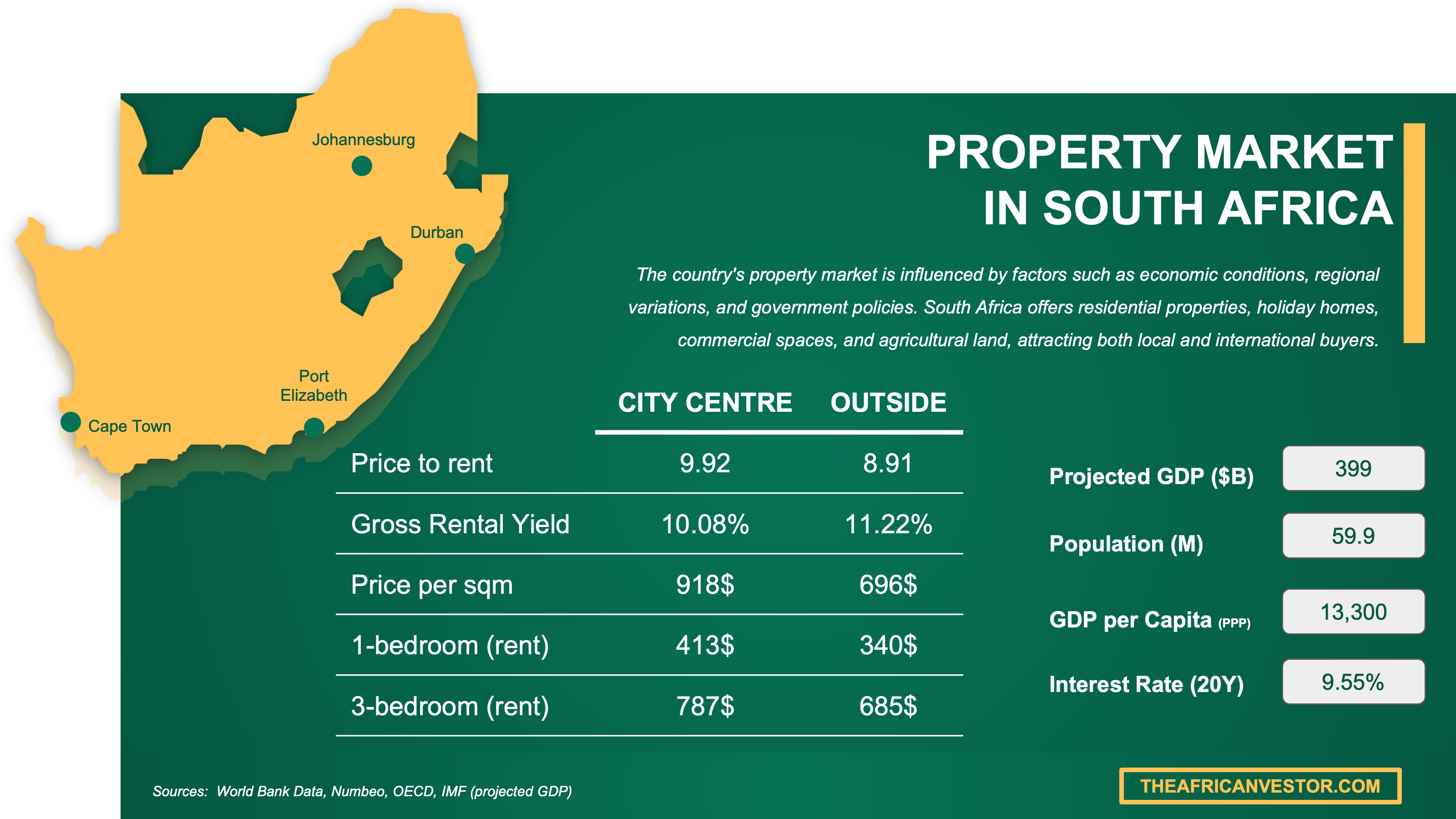
We have made this infographic to give you a quick and clear snapshot of the property market in South Africa. It highlights key facts like rental prices, yields, and property costs both in city centers and outside, so you can easily compare opportunities. We’ve done some research and also included useful insights about the country’s economy, like GDP, population, and interest rates, to help you understand the bigger picture.
Which neighborhoods rent best in Durban as of 2026?
Which neighborhoods have the highest rents in Durban as of 2026?
As of early 2026, the three Durban neighborhoods with the highest average rents are Umhlanga Rocks, La Lucia, and Umhlanga Central, where 2-bedroom apartments typically range from R16,000 to R22,000 per month ($890 to $1,220 USD, or €820 to €1,130 EUR).
These Durban neighborhoods command premium rents because they offer beachfront or near-beach locations, high-end security estates, excellent retail and dining options, and proximity to the Umhlanga business hub.
Tenants who typically rent in these high-rent Durban neighborhoods include corporate professionals, expats on housing allowances, and affluent families seeking top schools and lifestyle amenities.
By the way, we've written a blog article detailing what are the current best areas to invest in property in Durban.
Where do young professionals prefer to rent in Durban right now?
The three Durban neighborhoods where young professionals most prefer to rent are Umhlanga Ridge (near Gateway), Morningside along Florida Road, and Glenwood.
In these young-professional-friendly Durban neighborhoods, typical monthly rents range from R8,000 to R14,000 ($445 to $780 USD, or €410 to €720 EUR) for 1-bedroom and 2-bedroom apartments.
What attracts young professionals to these Durban neighborhoods is the combination of walkable lifestyle amenities, reliable fibre internet, secure apartment complexes, and easy commutes to major employment hubs.
By the way, you will find a detailed tenant analysis in our property pack covering the real estate market in Durban.
Where do families prefer to rent in Durban right now?
The three Durban neighborhoods where families most prefer to rent are Durban North, Westville, and Kloof.
In these family-friendly Durban neighborhoods, typical monthly rents for 2-3 bedroom houses or townhouses range from R14,000 to R22,000 ($780 to $1,220 USD, or €720 to €1,130 EUR).
Families are attracted to these Durban neighborhoods because they offer larger properties with gardens, established communities, good security, and stable municipal service delivery.
Top-rated schools near these family-friendly Durban neighborhoods include Northwood School and Atholton Primary in Durban North, Westville Boys' and Girls' High Schools, and Kloof High School in the Upper Highway area.
Which areas near transit or universities rent faster in Durban in 2026?
As of early 2026, the three Durban areas near transit hubs or universities that rent fastest are Glenwood and Umbilo (near UKZN Howard College), Westville (near UKZN Westville campus), and Berea/Musgrave (central access to multiple routes).
In these high-demand Durban areas, well-priced rental properties typically stay listed for only 10 to 20 days before being let.
The typical rent premium for Durban properties within walking distance of universities or main transit routes is approximately R500 to R1,500 per month ($28 to $83 USD, or €26 to €77 EUR) above comparable units further away.
Which neighborhoods are most popular with expats in Durban right now?
The three Durban neighborhoods most popular with expats are Umhlanga, La Lucia, and Durban North.
In these expat-friendly Durban neighborhoods, typical monthly rents range from R12,000 to R25,000 ($670 to $1,390 USD, or €615 to €1,280 EUR) for quality 2-bedroom apartments or furnished units.
Expats are attracted to these Durban neighborhoods because they offer high security standards, proximity to international schools and corporate offices, furnished rental options, and a coastal lifestyle with modern amenities.
The expat communities most represented in these Durban neighborhoods include professionals from the United Kingdom, other African countries, India, and various European nations working in Durban's finance, healthcare, and logistics sectors.
And if you are also an expat, you may want to read our exhaustive guide for expats in Durban.
Get fresh and reliable information about the market in Durban
Don't base significant investment decisions on outdated data. Get updated and accurate information with our guide.

Who rents, and what do tenants want in Durban right now?
What tenant profiles dominate rentals in Durban?
The three tenant profiles that dominate the Durban rental market are young professionals (working in services, logistics, healthcare, and education), students and early-career renters, and family renters seeking houses or large apartments.
Young professionals make up roughly 35% to 40% of Durban's rental market, students and early-career renters account for about 25% to 30%, and family renters represent approximately 20% to 25%.
Young professionals in Durban typically seek 1-bedroom or 2-bedroom apartments in secure complexes, students look for studios or shared accommodation near universities, and families usually want 3-bedroom houses or townhouses with gardens.
If you want to optimize your cashflow, you can read our complete guide on how to buy and rent out in Durban.
Do tenants prefer furnished or unfurnished in Durban?
In Durban, approximately 80% to 85% of long-term tenants prefer unfurnished rentals, while 15% to 20% actively seek furnished options.
The typical rent premium for furnished apartments in Durban compared to unfurnished is approximately R2,000 to R4,000 per month ($110 to $220 USD, or €100 to €205 EUR), depending on the quality of furnishings and location.
Tenant profiles that tend to prefer furnished rentals in Durban include expats on short-term contracts, corporate relocations, and coastal lifestyle renters who may split time between cities.
Which amenities increase rent the most in Durban?
The top five amenities that increase rent the most in Durban are 24-hour security with access control, reliable fibre internet connectivity, secure covered parking, backup power or inverter readiness, and air conditioning with outdoor space like a balcony.
In terms of typical rent premiums in Durban, security features can add R500 to R1,500 per month ($28 to $83 USD), fibre-ready status adds R300 to R700 ($17 to $39 USD), secure parking adds R500 to R1,000 ($28 to $56 USD), backup power readiness adds R500 to R1,000 ($28 to $56 USD), and aircon with outdoor space adds R400 to R800 ($22 to $44 USD).
In our property pack covering the real estate market in Durban, we cover what are the best investments a landlord can make.
What renovations get the best ROI for rentals in Durban?
The top five renovations that get the best ROI for Durban rental properties are security upgrades (better locks, cameras, gate motors), kitchen modernization (countertops, taps, paint), bathroom refresh (new shower, fixtures, grouting), load-shedding readiness (inverter plug points, DB-board preparation), and durable flooring replacement.
In terms of typical costs and expected rent increases in Durban, security upgrades cost R5,000 to R20,000 ($280 to $1,110 USD) and can justify R500 to R1,000 more rent per month, kitchen touch-ups cost R10,000 to R30,000 ($555 to $1,670 USD) for R500 to R1,500 more rent, bathroom refreshes cost R8,000 to R25,000 ($445 to $1,390 USD) for R400 to R1,000 more rent, inverter readiness costs R5,000 to R15,000 ($280 to $835 USD) for R500 to R1,000 more rent, and flooring costs R15,000 to R40,000 ($835 to $2,220 USD) for R300 to R800 more rent.
Renovations that tend to have poor ROI and should be avoided by Durban landlords include expensive full kitchen gut-renovations, swimming pool installations in apartments, and luxury finishes that exceed what tenants in the area are willing to pay for.
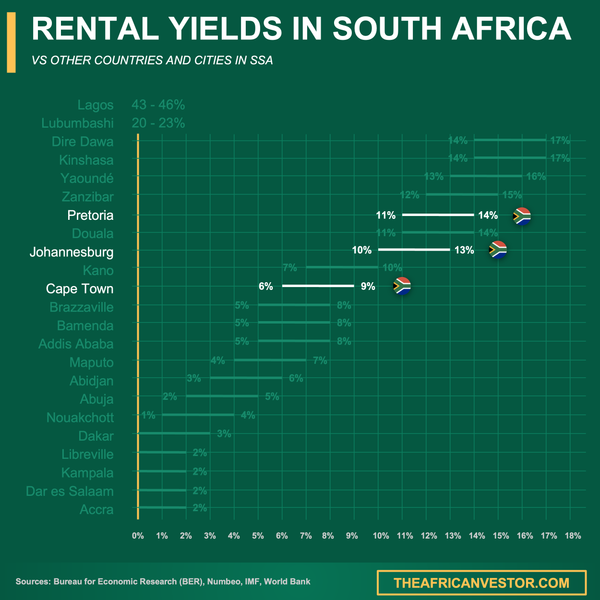
We did some research and made this infographic to help you quickly compare rental yields of the major cities in South Africa versus those in neighboring countries. It provides a clear view of how this country positions itself as a real estate investment destination, which might interest you if you’re planning to invest there.
How strong is rental demand in Durban as of 2026?
What's the vacancy rate for rentals in Durban as of 2026?
As of early 2026, the estimated vacancy rate for rental properties in Durban is approximately 5.5%.
Across different Durban neighborhoods, vacancy rates range from around 3% in high-demand areas like Umhlanga and Glenwood to 8% or higher in parts of the CBD and older inner-city buildings.
Durban's current 5.5% vacancy rate is below the historical average and represents one of the tighter rental markets in recent years, similar to the national trend that saw vacancy fall to its lowest since 2016.
Finally please note that you will have all the indicators you need in our property pack covering the real estate market in Durban.
How many days do rentals stay listed in Durban as of 2026?
As of early 2026, the average number of days rentals stay listed in Durban is approximately 21 days for correctly priced mid-market properties.
Across different property types and Durban neighborhoods, days on market ranges from about 14 days for well-priced apartments under R12,000 per month to 45 to 70 days for luxury rentals above R25,000 per month.
Compared to one year ago, the current days-on-market figure in Durban is similar or slightly improved, reflecting continued strong demand in the mid-market rental bands.
Which months have peak tenant demand in Durban?
The peak months for tenant demand in Durban are January and February, when rental activity is highest.
The specific factors driving seasonal demand in Durban include the post-festive-season move cycle (people relocating after the December holidays), university students arriving for the academic year, and new job starts that often begin in January.
The months with the lowest tenant demand in Durban are typically June and July (mid-winter) and late November to early December, when most people delay moves until after the holidays.
Buying real estate in Durban can be risky
An increasing number of foreign investors are showing interest. However, 90% of them will make mistakes. Avoid the pitfalls with our comprehensive guide.

What will my monthly costs be in Durban as of 2026?
What property taxes should landlords expect in Durban as of 2026?
As of early 2026, landlords in Durban should expect to pay approximately R15,000 to R25,000 per year ($835 to $1,390 USD, or €770 to €1,280 EUR) in municipal rates for a typical rental property valued between R1.2 million and R2 million.
Depending on property value and location in Durban, annual municipal rates can range from about R8,000 for a smaller apartment to R40,000 or more ($445 to $2,220 USD, or €410 to €2,050 EUR) for larger or higher-valued properties.
Property taxes in Durban are calculated using the eThekwini Municipality's residential rate of approximately 1.42 cents in the rand applied to the rateable value (municipal valuation minus a standard residential exclusion of around R120,000).
Please note that, in our property pack covering the real estate market in Durban, we cover what exemptions or deductions may be available to reduce property taxes for landlords.
What maintenance budget per year is realistic in Durban right now?
A realistic annual maintenance budget for a typical Durban rental property is approximately R12,000 to R25,000 ($670 to $1,390 USD, or €615 to €1,280 EUR).
Depending on property age and condition in Durban, annual maintenance costs can range from about R10,000 for newer apartments in well-managed complexes to R35,000 or more ($555 to $1,945 USD, or €510 to €1,795 EUR) for older houses requiring more frequent repairs.
Most Durban landlords typically set aside 8% to 12% of annual rental income for maintenance and small replacements, which covers routine items like plumbing, paint touch-ups, appliance repairs, and minor security fixes.
What utilities do landlords often pay in Durban right now?
The utilities Durban landlords most commonly pay on behalf of tenants include body corporate levies (for sectional title properties), and in some cases, a portion of water or refuse charges that are bundled into the municipal account.
Typical monthly costs for landlord-paid utilities in Durban include levies ranging from R1,500 to R4,000 ($83 to $220 USD, or €77 to €205 EUR) for apartments, while electricity is almost always tenant-paid (often via prepaid meters at rates around 328 cents per kWh including VAT).
The common practice in Durban is for electricity to be the tenant's responsibility (usually prepaid), water and refuse to be recovered from tenants via the lease or included in rent for apartments, and levies to be the landlord's expense that gets factored into the rental price.
How is rental income taxed in Durban as of 2026?
As of early 2026, rental income in Durban is taxed as part of your total personal income under South Africa's progressive tax system, with marginal rates ranging from 18% to 45% depending on your overall taxable income.
The main deductions Durban landlords can claim against rental income include bond interest, municipal rates and levies, agent commissions, insurance premiums, repairs and maintenance, and certain other expenses directly related to earning the rental income.
Common tax mistakes Durban landlords should avoid include failing to declare rental income (SARS actively cross-references property data), claiming capital improvements as deductible repairs, and forgetting that "extra amounts" like lease premiums are also taxable.
We cover these mistakes, among others, in our list of risks and pitfalls people face when buying property in Durban.

We made this infographic to show you how property prices in South Africa compare to other big cities across the region. It breaks down the average price per square meter in city centers, so you can see how cities stack up. It’s an easy way to spot where you might get the best value for your money. We hope you like it.
What sources have we used to write this blog article?
Whether it's in our blog articles or the market analyses included in our property pack about Durban, we always rely on the strongest methodology we can ... and we don't throw out numbers at random.
We also aim to be fully transparent, so below we've listed the authoritative sources we used, and explained how we used them and the methods behind our estimates.
| Source | Why it's authoritative | How we used it |
|---|---|---|
| PayProp Rental Index Q1 2025 | PayProp's Rental Index is one of South Africa's most respected rental datasets with a clear, repeatable methodology based on actual lease transactions. | We used it to anchor the baseline average rent level for KwaZulu-Natal and its year-on-year rent growth rate. We then adjusted to Durban using current asking-rent evidence from major listing portals. |
| TPN Vacancy Survey Q3 2024 | TPN (MRI Software) is a major credit bureau and rental data provider, and this survey is widely cited across the South African property industry. | We used it to pin down vacancy rates (national and KwaZulu-Natal) and to understand how quickly well-priced rentals move in different rent bands. We carried those signals forward into January 2026 estimates. |
| TPN Vacancy Survey Q2 2024 | It's another official TPN release, useful for understanding seasonality and market dynamics in the rental sector. | We used it to explain why demand spikes around Q1 (festive season plus student cycle). We used those patterns to flag Durban's peak letting months. |
| TPN Tenant Survey Report 2024 | It's based on a very large tenant sample and is published by a national rental-sector data provider with decades of experience. | We used it to describe what tenants prioritize (price, security, space) and why people rent (affordability). We translated those findings into practical guidance for Durban landlords. |
| SARS - Tax on Rental Income | SARS is South Africa's official tax authority, so this is the definitive rulebook for rental-income taxation. | We used it to explain how rental income is taxed and which expenses can reduce taxable rental income. We also used it to warn about "extra amounts" (like lease premiums) being taxable. |
| SARS - ITR12 Comprehensive Guide | This is SARS's official guidance on how individuals declare income and deductions on their annual tax return. | We used it to confirm that rental income is declared under "Local Rental Income" and that supporting documents should be kept. We used it to shape a simple landlord paperwork checklist. |
| eThekwini Tariff List (National Treasury Portal) | It's hosted on National Treasury's local government documentation portal and contains official council tariff schedules for Durban. | We used it to get the residential property-rate "cents in the rand" used to calculate municipal rates and the residential exclusions described there. We then built a realistic monthly-cost example for a typical Durban rental property. |
| eThekwini Electricity Tariffs 2025/26 | It compiles the approved local electricity tariff schedule for the 2025/26 period in a structured, accessible format. | We used it to give a practical electricity cost reference point (cents per kWh) for budgeting. We also used it to explain why many Durban landlords prefer prepaid or tenant-billed utilities. |
| Property24 - Umhlanga Central Rentals | Property24 is one of South Africa's biggest listing platforms, so it's a useful real-time view of asking rents by suburb. | We used it to check the top-end of Durban's rental market in a prime coastal node. We then used that to set realistic high-rent neighborhood examples. |
| Property24 - Durban Central Rentals | It's a major portal view of CBD and inner-city stock, which anchors the lower-to-mid rent spectrum for Durban. | We used it to check the entry-level and central-city rent range. We used it to keep our "typical rents" from drifting too luxury-heavy. |
| TPN Residential Rental Monitor Q1 2025 | It's a published TPN product focused on escalations, performance, and provincial trends in the rental market. | We used it as a cross-check that rent growth is being measured consistently by a second major rental data provider. We used it as support for the direction of rent escalations going into 2026. |
| TPN Vacancy Survey Q3 2024 (Summary Page) | It's the official TPN landing page that summarizes headline findings from the PDF report in accessible language. | We used it to confirm the headline national vacancy rate and the "lowest since 2016" claim in plain language. We used it to keep the story consistent for non-professional readers. |
Get the full checklist for your due diligence in Durban
Don't repeat the same mistakes others have made before you. Make sure everything is in order before signing your sales contract.
Related blog posts