
Authored by the expert who managed and guided the team behind the South Africa Property Pack
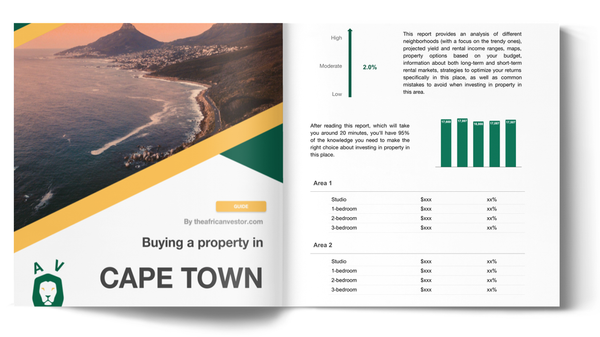
Get all the data you need about the real estate market in Cape Town
Airbnb in Cape Town in 2026 can still be profitable, but the easy-money period is clearly over.
This article explains what a non-professional buyer should know about short-term rental rules, Airbnb income, occupancy, competition and current housing prices in Cape Town.
We constantly update this blog post because Cape Town Airbnb rules, rates and demand patterns are changing quickly in 2026.
And if you’re planning to buy a property in this place, you may want to download our pack covering the real estate market in Cape Town.
Insights
- Cape Town Airbnb is still legal in 2026, but the City is moving commercial short-term rentals into a clearer registration and rates system.
- The most important Cape Town Airbnb rule is not a hard night cap, but the proposed 50% annual room-night test for commercial use.
- A normal Cape Town Airbnb listing in 2026 should not be underwritten at luxury-villa prices, because citywide averages are pulled upward by Camps Bay, Clifton and Bantry Bay.
- A realistic average nightly price for a Cape Town Airbnb in 2026 is around R2,800 to R3,300, but the median listing is usually cheaper than the average.
- Sea Point and Green Point are strong Airbnb areas in Cape Town, but they are also very crowded markets where reviews, parking and power backup matter a lot.
- The best risk-adjusted Airbnb property in Cape Town is usually a one-bedroom or two-bedroom apartment in a walkable node, not a large villa.
- Hosts in Cape Town should expect Airbnb operating costs to take 45% to 65% of gross revenue before mortgage and income tax.
- Backup power, secure parking and fast Wi-Fi are not small details in Cape Town Airbnb performance, because guests now treat them as trust signals.
- Neighborhood bans were not found at City level in 2026, but body corporate rules can still block Airbnb in Cape Town apartment buildings.
Can I legally run an Airbnb in Cape Town in 2026?
Is short-term renting allowed in Cape Town in 2026?
As of early 2026, short-term renting is allowed in Cape Town for residential apartments, houses, villas and townhouses, but the City is drawing a clearer line between occasional home-sharing and commercial Airbnb activity.
The main legal framework is the City of Cape Town Municipal Planning By-Law, while the 2026 short-term letting policy work is mainly about registration, data visibility and municipal rates.
The single most important condition is that a Cape Town Airbnb used mostly as tourist accommodation may be treated as commercial short-term letting for rates purposes.
Body corporates, homeowners associations and lease agreements can still create stricter rules, so a Cape Town apartment can be legal under City rules but banned inside its own building.
The main consequence of ignoring the rules is not only a fine risk, but also rates reclassification, enforcement attention and possible platform-registration problems once the City registration system is introduced.
Are there minimum-stay rules and maximum nights-per-year caps for Airbnbs in Cape Town as of 2026?
As of early 2026, Cape Town has no citywide minimum-stay rule and no hard annual Airbnb night cap for residential short-term rentals.
This means there is no simple 30-night, 60-night or 90-night cap for apartments, houses, villas or townhouses anywhere in Cape Town, whether the host lives there or not.
The important test is the proposed 50% annual room-night threshold, because a property used above that level can be treated as commercial accommodation for rates purposes.
If a host crosses that 50% room-night threshold, the main risk is not an automatic ban, but a possible move from residential rates to commercial accommodation rates.
Do I have to live there, or can I Airbnb a secondary home in Cape Town right now?
You do not have to live in the property to operate an Airbnb in Cape Town, but a non-primary residence is more likely to be treated as a commercial short-term rental.
Owners of secondary homes and investment properties can still operate short-term rentals in Cape Town, provided the property use is legal and building rules allow it.
The main extra condition for a secondary-home Airbnb in Cape Town is expected to be City registration once the new short-term letting by-law process is in place.
The practical difference is simple: occasional rental of a primary home looks like home-sharing, while a full-time Cape Town Airbnb investment property looks like accommodation business activity.
Get fresh and reliable information about the market in Cape Town
Don't base significant investment decisions on outdated data. Get updated and accurate information.

Do I need a short-term rental license or a business registration to host in Cape Town as of 2026?
As of early 2026, Cape Town does not yet have a fully running short-term rental license system, but the City is moving toward mandatory registration for properties listed on booking platforms.
The expected process is that Cape Town hosts will register the property, receive a City registration number and display that number on Airbnb or similar platforms.
The likely documents will include ownership or permission to operate, property details, host details and enough information for the City to identify whether the use is residential or commercial.
The exact registration cost was not clearly published in the official material we reviewed, so a careful Cape Town Airbnb investor should budget for admin cost and possible higher municipal rates rather than a large license fee.
Are there neighborhood bans or restricted zones for Airbnb in Cape Town as of 2026?
As of early 2026, we found no official citywide neighborhood ban on Airbnb in Cape Town for areas such as Sea Point, Green Point, Camps Bay, De Waterkant, the City Bowl, Woodstock, Observatory, Bloubergstrand or the Southern Suburbs.
The stricter rules usually appear at building level, especially in sectional-title apartment blocks in Sea Point, Green Point, the V&A Waterfront and De Waterkant.
The reason is practical: dense Cape Town apartment buildings often worry about noise, security, lifts, parking, party risk and constant guest turnover.
Get to know the market before buying a property in Cape Town
Better information leads to better decisions. Get all the data you need before investing a large amount of money.
How much can an Airbnb earn in Cape Town in 2026?
What's the average and median nightly price on Airbnb in Cape Town in 2026?
As of early 2026, the average nightly price for an Airbnb listing in Cape Town is about R2,800 to R3,300, or about $170 to $200 and €150 to €175, while the median is closer to R2,100 to R2,400, or about $125 to $145 and €110 to €130.
A realistic nightly range covering roughly 80% of Cape Town Airbnb listings is about R1,100 to R6,000, or about $65 to $365 and €60 to €320.
The biggest pricing factor in Cape Town is location quality, especially sea views, walkability, beach access, parking and proximity to the V&A Waterfront, Atlantic Seaboard or City Bowl.
By the way, you will find much more detailed rent ranges in our property pack covering the real estate market in Cape Town.
How much do nightly prices vary by neighborhood in Cape Town in 2026?
As of early 2026, Cape Town Airbnb nightly prices can range from about R1,100 to R2,400 in more affordable areas like Woodstock and Observatory to R4,500 to R12,000 or more in Camps Bay, Clifton and Bantry Bay, or roughly $65 to $725 and €60 to €640.
The three highest-priced Cape Town Airbnb areas are usually Clifton, Camps Bay and Bantry Bay, where strong listings often ask about R4,500 to R12,000 per night, or about $270 to $725 and €240 to €640.
The three lower-priced but still used Airbnb areas are Woodstock, Observatory and parts of Table View, where guests still book because prices are lower and access to the city, beaches or universities can be practical.
What's the typical occupancy rate in Cape Town in 2026?
As of early 2026, a typical Cape Town Airbnb occupancy rate is about 45% to 55% for an ordinary active listing.
Most Cape Town Airbnb listings sit somewhere between 35% and 70% occupancy, depending on price, reviews, location, season and property quality.
Cape Town tends to perform better than many smaller South African short-term rental markets because it has international tourism, domestic holiday demand, business travel and events in the same city.
The single biggest factor behind above-average occupancy in Cape Town is being in a walkable, trusted location with strong reviews, secure parking, backup power and professional cleaning.
Make a profitable investment in Cape Town
Better information leads to better decisions. Save time and money. Download our data.
What's the average monthly revenue per listing in Cape Town in 2026?
As of early 2026, the average monthly revenue per active Airbnb listing in Cape Town is roughly R29,000 to R38,000, or about $1,750 to $2,300 and €1,540 to €2,020.
A realistic range covering roughly 80% of Cape Town Airbnb listings is about R12,000 to R80,000 per month, or about $725 to $4,850 and €640 to €4,250.
Top Cape Town Airbnb listings in Camps Bay, Clifton, Bantry Bay, the V&A Waterfront and premium Sea Point blocks can reach R100,000 to R250,000 per month in strong months, or about $6,000 to $15,100 and €5,300 to €13,300.
A simple example is a R5,000 nightly rate at 65% occupancy, which gives about 20 booked nights and around R100,000 gross monthly revenue before costs.
What's the typical low-season vs high-season monthly revenue in Cape Town in 2026?
As of early 2026, a well-run Cape Town Airbnb might earn about R15,000 to R25,000 per month in low season and R45,000 to R80,000 or more in high season, or about $900 to $4,850 and €800 to €4,250 across that broad seasonal range.
Low season in Cape Town is usually June to August, while high season is usually November to March, with December and January being the strongest months for beach and holiday demand.
What's a realistic Airbnb monthly expense range in Cape Town in 2026?
As of early 2026, a realistic monthly expense range for operating an Airbnb in Cape Town is about R10,000 to R22,000 for an apartment or townhouse and R22,000 to R60,000 or more for a large house or villa, or about $600 to $3,600 and €530 to €3,200.
The largest expense category in Cape Town is usually management and operations, which can cost 15% to 25% of revenue, or about R4,500 to R9,500 per month on a normal R30,000 to R38,000 monthly revenue listing.
Cape Town Airbnb hosts should usually expect operating expenses to take about 45% to 65% of gross revenue before mortgage, income tax and major renovations.
What's realistic monthly net profit and profit per available night for Airbnb in Cape Town in 2026?
As of early 2026, a realistic Cape Town Airbnb can make about R9,000 to R17,000 net operating profit per month for a normal apartment, with profit per available night around R300 to R650, or about $18 to $39 and €16 to €35.
Most Cape Town Airbnb listings should be underwritten at about R5,000 to R30,000 net operating profit per month before mortgage and tax, or about $300 to $1,800 and €265 to €1,600.
A normal net operating margin for a Cape Town Airbnb is often about 35% to 55% after operating costs but before financing and tax.
The break-even occupancy rate for a typical Cape Town Airbnb is usually around 30% to 40%, but it can be higher if levies, management fees, furnishing costs or power backup costs are heavy.
In our property pack covering the real estate market in Cape Town, we explain the best strategies to improve your cashflows.
Don't buy the wrong property, in the wrong area of Cape Town
Buying real estate is a significant investment. Don't rely solely on your intuition. Gather the right information to make the best decision.
How competitive is Airbnb in Cape Town as of 2026?
How many active Airbnb listings are in Cape Town as of 2026?
As of early 2026, a defensible estimate is 13,000 to 18,000 active Airbnb and short-term rental listings in Cape Town, with more than 26,000 visible or recently scraped listings if low-activity listings are included.
Compared with the previous year, the Cape Town Airbnb market still looks large and competitive, and the long trend points toward more professional supply, more data visibility and more pressure from housing affordability debates.
Which neighborhoods are most saturated in Cape Town as of 2026?
As of early 2026, the most saturated Cape Town Airbnb neighborhoods are Sea Point, Green Point, De Waterkant, City Centre, Gardens, Tamboerskloof, Camps Bay, Clifton, the V&A Waterfront, Bloubergstrand, Table View, Woodstock and Observatory.
These Cape Town areas are saturated because guests can understand them quickly: they offer beaches, restaurants, nightlife, views, easy Uber rides, event access and a familiar tourist map.
Relatively undersaturated opportunities may exist in Hout Bay, Muizenberg, Newlands, Claremont, Rondebosch, Milnerton and selected parts of Bloubergstrand, especially for family stays, remote-work stays and parking-friendly homes.
What local events spike demand in Cape Town in 2026?
As of early 2026, Cape Town Airbnb demand spikes around the summer holiday season, Cape Town Cycle Tour, Two Oceans Marathon, Cape Town Marathon, major stadium concerts, school holidays and large cultural events.
During strong event periods in Cape Town, bookings and nightly rates can rise by about 20% to 60%, while the best-located homes near beaches, the stadium, the City Bowl or race routes can move even more.
What occupancy differences exist between top and average hosts in Cape Town in 2026?
As of early 2026, top-performing Cape Town Airbnb hosts in strong areas can reach about 65% to 75% annual occupancy.
An average Cape Town Airbnb host is more likely to get about 45% to 55% occupancy, especially if the listing has average photos, average pricing and no standout amenity.
A new host in Cape Town usually needs 6 to 18 months to reach top-performer occupancy because reviews, ranking, pricing discipline and repeat guest trust take time to build.
We give more details about the different Airbnb strategies to adopt in our property pack covering the real estate market in Cape Town.
Which price points are most crowded, and where's the "white space" for new hosts in Cape Town right now?
The most crowded Cape Town Airbnb price band is roughly R1,800 to R3,500 per night, or about $110 to $210 and €95 to €185, especially for one-bedroom and two-bedroom apartments in Sea Point, Green Point, City Centre, Gardens and De Waterkant.
The better white-space opportunities are not usually cheap listings, but well-equipped R2,800 to R5,500 per night homes, or about $170 to $330 and €150 to €290, with parking, backup power, workspace, family layout or beach access in places like Hout Bay, Bloubergstrand, Muizenberg, Newlands and Claremont.

We made this infographic to show you how property prices in South Africa compare to other big cities across the region. It breaks down the average price per square meter in city centers, so you can see how cities stack up. It’s an easy way to spot where you might get the best value for your money. We hope you like it.
What property works best for Airbnb demand in Cape Town right now?
What bedroom count gets the most bookings in Cape Town as of 2026?
As of early 2026, one-bedroom and two-bedroom Airbnb units get the broadest booking demand in Cape Town because they fit couples, digital workers, small families and short-stay tourists.
A reasonable Cape Town Airbnb booking breakdown is about 15% to 20% for studios, 30% to 35% for one-bedroom units, 30% to 35% for two-bedroom units and 15% to 25% for three-bedroom or larger homes.
This bedroom mix works well in Cape Town because many visitors stay only a few nights, but still want comfort, safe parking, workspace and easy access to beaches or the City Bowl.
What property type performs best in Cape Town in 2026?
As of early 2026, the best risk-adjusted Cape Town Airbnb property type is usually a well-located apartment or townhouse, while villas can produce the highest absolute income but with higher risk and costs.
Good apartments and townhouses in Cape Town can often reach 55% to 70% occupancy, while larger villas may earn more per booking but can be more seasonal and harder to manage.
Apartments and townhouses outperform for many non-professional buyers because Cape Town guests value location, safety, cleaning reliability, easy check-in and predictable pricing more than unused space.
What sources have we used to write this blog article?
Whether it’s in our blog articles or the market analyses included in our property pack about Cape Town, we always rely on the strongest methodology we can, and we don’t throw out numbers at random.
We also aim to be fully transparent, so below we’ve listed the authoritative sources we used, and explained how we used them and the methods behind our estimates.
| Source used | Why this source is credible | How we used it |
|---|---|---|
| City of Cape Town short-term letting FAQ | It is the City’s own explanation of the 2026 short-term letting policy direction. | We used it to understand what Cape Town allows and what is changing. We also used it to explain the 50% room-night test in plain English. |
| City of Cape Town Municipal Planning By-Law | It is the binding planning framework for land use in Cape Town. | We used it to check whether Airbnb is treated as a zoning issue. We cross-checked it against the City FAQ to avoid overreading the by-law. |
| City of Cape Town Planning By-Law portal | It is the official City page that links to current planning rules and amendments. | We used it to confirm the relevant planning source. We treated it as a legal navigation source, not as revenue data. |
| City of Cape Town technical advisories | It is the City’s own page for current land-use guidance. | We used it to check whether new advisories created separate neighborhood Airbnb bans. We did not find a citywide neighborhood ban there. |
| Cape Town Tourism accommodation report | It is a Cape Town Tourism and Horwath HTL accommodation survey. | We used it to compare Airbnb seasonality with formal accommodation demand. We also used it to understand where Cape Town accommodation supply is concentrated. |
| Wesgro Cape Town visitor trends | Wesgro is the official tourism, trade and investment agency for Cape Town and the Western Cape. | We used it to understand visitor length of stay and repeat-visitor behavior. We then connected those patterns with Cape Town Airbnb bedroom demand. |
| AirROI Cape Town STR data portal | It is a specialist short-term rental data provider with 2026 Cape Town metrics. | We used it for active listings, average nightly price, occupancy and annual revenue. We cross-checked it because private STR datasets can vary. |
| AirDNA Cape Town market overview | AirDNA is one of the best-known short-term rental analytics providers globally. | We used it as a second benchmark for occupancy and daily rates. We did not rely on it alone because free overviews can include different platform filters. |
| Airbtics Cape Town Airbnb revenue data | It gives another market estimate for Cape Town Airbnb revenue, listings and occupancy. | We used it to test whether AirROI was too conservative. We treated it as a stronger-performing active-listing benchmark. |
| Inside Airbnb Cape Town | It is a widely used open dataset for Airbnb supply and neighborhood concentration. | We used it to understand listing count, activity and neighborhood saturation. We treated its income estimates cautiously and triangulated them with commercial datasets. |
| Airbnb Cape Town stays | It is the live platform where guests compare Cape Town supply. | We used it to check what guests see in 2026. We also used it to benchmark amenities and competition. |
| Airbnb Sea Point stays | Airbnb’s suburb page gives live supply and amenity signals for a core Cape Town market. | We used it to confirm that Sea Point is both deep in demand and very saturated. We also used it to benchmark Wi-Fi, workspaces and other basic amenities. |
| Airbnb Green Point stays | Airbnb’s suburb page gives a direct view of supply in another prime Cape Town node. | We used it to compare Green Point with Sea Point and the City Bowl. We also used it to understand amenity competition near the stadium and waterfront. |
| South African Reserve Bank selected rates | It is South Africa’s central bank and the strongest source for exchange-rate context. | We used it to convert rand figures into USD and EUR. We rounded the converted amounts so readers can process them quickly. |
| Cape Town Tourism events | It is Cape Town’s official tourism events listing. | We used it to identify event-driven Airbnb demand. We cross-checked event logic with accommodation seasonality before estimating demand spikes. |
| Cape Town Cycle Tour | It is the official source for one of Cape Town’s biggest annual sports events. | We used it to confirm the 2026 event timing. We then connected the event to short-term rental demand around race weekend. |
| Two Oceans Marathon | It is the official event source for another major Cape Town sports-tourism driver. | We used it to identify event-related overnight demand. We treated it as demand context, not as Airbnb revenue data. |
Get fresh and reliable information about the market in Cape Town
Don't base significant investment decisions on outdated data. Get updated and accurate information.


