
Authored by the expert who managed and guided the team behind the South Africa Property Pack

Everything you need to know before buying real estate is included in our South Africa Property Pack
If you are an American thinking about buying a home in South Africa, you probably have a lot of questions about whether it is even possible, what it will cost, and how the process actually works.
This article covers everything from legal rights and buyer taxes to mortgage options and IRS reporting, written specifically for US citizens looking at the South African property market in 2026.
We constantly update this blog post to keep it accurate and relevant, so the information here reflects the latest rules and market conditions.
And if you're planning to buy a property in this place, you may want to download our pack covering the real estate market in South Africa.
Can a US citizen legally buy residential property in South Africa right now?
Can I buy a home in South Africa as a US citizen in 2026?
As of early 2026, US citizens are legally allowed to buy residential property in South Africa, whether it is a freehold house, a townhouse, or a sectional-title apartment, with no nationality-based restrictions blocking the purchase.
The standard buying process involves signing an offer to purchase, appointing a conveyancing attorney who handles the legal transfer, paying the required taxes and fees, and then registering ownership at the South African Deeds Office, which is the official system that proves you own the property.
Being American does not create any legal barrier to owning property in South Africa; the main differences you will experience compared to a local buyer are extra banking paperwork, exchange-control compliance, and sometimes stricter financing requirements from South African banks.
Are there many Americans buying property and living in South Africa in 2026?
As of early 2026, Americans represent a meaningful segment of foreign property buyers in South Africa, and while exact nationality breakdowns are not publicly tracked, industry data from Lightstone shows that non-resident foreign buyers rose from about 3% of transactions in 2019 to nearly 4% in 2024, with foreign buyers accounting for roughly 40% of purchases above R10 million (about $625,000 or €530,000).
American expats and property buyers in South Africa tend to concentrate in the Western Cape, especially Cape Town neighborhoods like Camps Bay, Clifton, Constantia, and the Atlantic Seaboard, as well as lifestyle estates in the Winelands, the Garden Route, and upscale gated communities in Johannesburg areas like Sandton and Fourways.
The top three reasons Americans are choosing to buy property in South Africa are the favorable exchange rate (which gives strong purchasing power compared to US coastal prices), the lifestyle appeal of coastal and wine-country living with good weather year-round, and the growing availability of remote work that allows people to earn in dollars while spending in rand.
The American expat community in South Africa is growing steadily, driven by these factors and by increased awareness of South Africa as both a retirement and lifestyle destination, especially since Cape Town was named one of the world's best cities by Time Out.
Do foreigners have the same buying rights as locals in South Africa?
Foreign buyers, including US citizens, have essentially the same property buying rights as South African residents in 2026, with ownership protected through the same Deeds Registry system and no special taxes or surcharges applied specifically to foreigners at the purchase stage.
There are no property types or residential locations in South Africa that are legally off-limits to American buyers for standard purchases; the only area where restrictions have been discussed (but not enacted as of early 2026) involves large-scale agricultural land, which does not affect typical residential transactions.
We cover all these things in length in our pack about the property market in South Africa.
Can I buy property in South Africa without a residence permit?
You do not need a South African residence permit to buy residential property in South Africa, and there are no visa or immigration requirements tied to the purchase itself.
The process for buying property in South Africa while living abroad works through a local conveyancing attorney who handles the legal transfer on your behalf, and you can sign documents remotely (often notarized at a South African embassy or consulate) without needing to be physically present in the country.
However, buying a home in South Africa does not automatically grant you any visa or residency rights, so you should treat property ownership and immigration status as two completely separate tracks.
The main practical challenge non-resident buyers face when completing a property purchase remotely in South Africa is the exchange-control and banking compliance process, which requires transferring funds through an authorized dealer bank, providing detailed proof of the source of funds, and dealing with time-zone delays in document verification.
Can US citizens own land in South Africa?
Yes, US citizens can own land outright in South Africa, and most residential purchases are either freehold (where you own both the land and the building) or sectional title (where you own your unit plus a share in the common property managed by a body corporate).
Freehold ownership in South Africa means you have full, indefinite ownership of the land and any structures on it, while leasehold (which is less common for residential property) means you hold a long-term lease rather than outright ownership; for most American buyers purchasing houses or apartments in South Africa, freehold or sectional title is what you will encounter.
There are no geographic zones or residential land categories in South Africa where foreign ownership is formally prohibited as of early 2026; the only ongoing political discussions relate to potential restrictions on large-scale agricultural and rural land, but these have not been enacted into law and do not affect standard residential property purchases.
Getting surprised by hidden fees is one of the pitfalls people face when buying real estate in South Africa.
What documents will I need to buy in South Africa?
To purchase property in South Africa as a US citizen, you will typically need your passport (with a certified copy), proof of your address (even a US address works), recent bank statements showing proof of funds, proof of income if applying for a mortgage, your marriage certificate or relationship status documents if applicable, and any additional source-of-funds documentation required under South Africa's FICA compliance rules.
A local South African tax identification number is not always required to sign an offer to purchase, but you may need one depending on your conveyancer's workflow, your bank's requirements, and how funds are being transferred into the country.
A local South African bank account is not strictly mandatory by law to complete a property purchase, but it is highly practical and often necessary if you plan to get a mortgage, pay local costs smoothly, or later repatriate sale proceeds cleanly through the authorized dealer banking system.
Foreign buyers in South Africa are almost always asked to provide detailed proof of funds (bank statements, proof of asset sales, etc.) and some form of address verification, because the Financial Intelligence Centre Act (FICA) requires all parties involved in the transaction to verify your identity and the origin of your money.
We have a whole section dedicated to all the documents you need in our South Africa property pack.
Can a foreign-owned company buy property in South Africa?
Yes, a foreign-owned company (including one registered in South Africa with foreign shareholders) can legally purchase residential property in South Africa, and the process follows the same deeds registration system as personal purchases.
Some Americans do use company structures to hold property in South Africa, but it is not the most common approach for individual buyers; most people buy personally unless they have a specific reason like estate planning, multiple investors, or liability separation, and the typical entity used is a South African-registered private company (Pty Ltd).
Owning property through a company in South Africa does not automatically lower your tax bill and can actually increase complexity and sometimes the overall tax cost, because companies face different tax rates, additional filing requirements, and potential fringe benefit or dividend tax implications.
The main drawback of using a company structure for residential property in South Africa is the added administrative burden, including annual company filings, separate bank accounts, more complex FICA compliance, and higher professional fees, which for a single property often outweighs any potential benefits.
Thinking of buying real estate in South Africa?
Acquiring property in a different country is a complex task. Don't fall into common traps – grab our guide and make better decisions.

What taxes and fees will I pay in South Africa in 2026?
What are buyer taxes in South Africa in 2026?
As of early 2026, the main buyer tax in South Africa is Transfer Duty, which is a progressive tax ranging from 0% to 13% depending on the purchase price; for example, on a R2,500,000 property (about $156,000 or €132,000), the transfer duty works out to roughly R67,000 (about $4,200 or €3,500).
Transfer Duty in South Africa in 2026 is calculated on a sliding scale: the first R1,210,000 is tax-free, then 3% applies on the portion from R1,210,001 to R1,663,800, followed by 6%, 8%, 11%, and 13% on progressively higher slices, so the effective rate on a mid-range property is much lower than the top marginal rate.
Transfer duty rates in South Africa do not differ between foreign buyers and locals, and there is no extra surcharge for non-residents or investment properties at the purchase stage; the same brackets apply to everyone, regardless of nationality or intended use of the property.
What are other closing costs in South Africa in 2026?
As of early 2026, buyers in South Africa should budget approximately 2% to 4% of the purchase price for closing costs if paying cash, or 3% to 6% if financing with a mortgage, which for a R2,500,000 property (about $156,000 or €132,000) means roughly R50,000 to R150,000 (about $3,100 to $9,400 or €2,600 to €7,900) in fees on top of transfer duty.
The main closing cost categories in South Africa include conveyancing (attorney) fees, typically ranging from R30,000 to R60,000 plus VAT ($1,900 to $3,750 or €1,600 to €3,200) for a mid-range property, Deeds Office registration fees of a few thousand rand, and if you are financing, bond registration attorney fees plus bank initiation fees which together can add R20,000 to R45,000 ($1,250 to $2,800 or €1,050 to €2,400).
The most negotiable closing costs in South Africa are the conveyancing attorney fees (since different firms charge differently within published guideline ranges) and some bank-related fees, while Deeds Office fees and transfer duty are fixed by official schedules and cannot be negotiated.
The single closing cost item that tends to surprise foreign buyers the most in South Africa is the exchange-control administration and compliance fees charged by banks when processing cross-border fund transfers, which can add unexpected costs and processing delays that local buyers never encounter.
Are there hidden fees foreigners miss in South Africa right now?
Foreign buyers in South Africa commonly overlook about R15,000 to R40,000 (roughly $950 to $2,500 or €800 to €2,100) in additional fees that do not show up on a typical closing-cost estimate, mostly related to exchange-control compliance and extra documentation requirements.
The top three hidden fees that foreign buyers most often fail to budget for in South Africa are exchange-control administration charges from banks (often R5,000 to R15,000 or $300 to $950 or €260 to €800), certified and apostilled document costs for overseas paperwork (R2,000 to R8,000 or $125 to $500 or €105 to €420), and FICA-related compliance verification fees that some attorneys and banks pass along (R3,000 to R10,000 or $190 to $625 or €160 to €530).
After the purchase, foreign property owners in South Africa often underestimate ongoing annual costs like municipal rates and taxes (which vary by location but can be R10,000 to R40,000 per year or $625 to $2,500 or €530 to €2,100 for a mid-range home), body corporate or homeowners' association levies in estates (sometimes R2,000 to R8,000 per month or $125 to $500 or €105 to €420), and security-related costs that are common across South African neighborhoods.
Getting surprised by hidden fees is one of the pitfalls people face when buying real estate in South Africa.
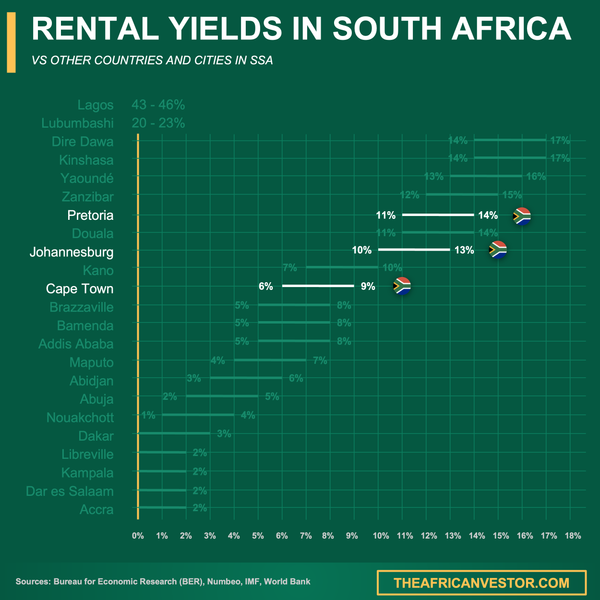
We did some research and made this infographic to help you quickly compare rental yields of the major cities in South Africa versus those in neighboring countries. It provides a clear view of how this country positions itself as a real estate investment destination, which might interest you if you’re planning to invest there.
Can I get a mortgage as a US citizen in South Africa in 2026?
Do banks lend to US citizens in South Africa in 2026?
As of early 2026, several major South African banks actively offer mortgage products to US citizens and other foreign nationals, with dedicated non-resident lending tracks available at banks like FNB, Nedbank, and Standard Bank.
US citizens generally receive similar treatment to other foreign nationals when applying for mortgages in South Africa, with no preferential treatment based on nationality; what matters far more is your deposit size, income documentation, and compliance paperwork.
The main reason some South African banks are cautious with American borrowers specifically is the extra compliance burden created by US tax reporting requirements (like FATCA), which can make the bank's own reporting obligations more complex and costly.
While exact approval rates are not published, US citizens with a strong deposit (50% or more), clean documentation, and verifiable income have a good chance of getting approved at the banks that specialize in non-resident lending, though the process typically takes longer than it would for a local buyer.
There is a full document dedicated to mortgage for foreigners in our pack covering the property buying process in South Africa.
What down payment do American people need in South Africa in 2026?
As of early 2026, the standard minimum down payment for a US citizen buying property in South Africa as a non-resident is 50% of the purchase price, which for a R2,500,000 property (about $156,000 or €132,000) means putting down at least R1,250,000 (about $78,000 or €66,000).
The typical down payment range for foreign buyers in South Africa goes from the 50% minimum required by most banks for bona fide non-residents up to 100% (cash purchase), and in practice many foreign buyers choose to pay cash entirely to avoid the complexity of cross-border mortgage administration.
A larger down payment does improve your mortgage terms in South Africa, because banks view a lower loan-to-value ratio as lower risk, which can move your interest rate closer to the prime rate rather than prime plus a margin, and also speeds up the approval process.
What interest rates do US citizens get in South Africa in 2026?
As of early 2026, US citizens buying property in South Africa can expect mortgage interest rates in the range of roughly 10.25% to 12.25% (variable), based on the current prime lending rate of 10.25% published by the South African Reserve Bank.
Interest rates for foreign buyers in South Africa are typically higher than those offered to local residents, because non-residents usually receive prime rate plus a margin of 0% to 2% depending on their risk profile and deposit size, while well-qualified local buyers can sometimes negotiate rates at or even slightly below prime.
Variable-rate mortgages are by far the most common type of home loan in South Africa for both locals and foreign buyers, and fixed-rate options are limited and usually available only for short terms of up to five years; most non-resident mortgages are offered on variable terms tied to the prime rate.
The single factor that has the biggest impact on the interest rate a US citizen will be offered in South Africa is the size of the deposit, because a larger down payment (50% or more) significantly reduces the bank's risk and typically moves the rate closer to prime, while a smaller deposit (if available) pushes it toward prime plus 2% or higher.
Can I use US income to qualify in South Africa right now?
Most major South African banks that lend to non-residents will accept US-sourced income for mortgage qualification, though the assessment process takes longer because the bank needs to verify foreign earnings and convert them for affordability calculations.
Banks in South Africa typically require American applicants to provide recent US tax returns, pay stubs or employment contracts, three to six months of US bank statements showing consistent income deposits, and sometimes a letter from the employer confirming the role and salary.
If standard US documentation is not sufficient (for example, if you are self-employed or have complex income sources), some South African banks will accept audited financial statements, CPA-prepared income summaries, or proof of rental income from US properties as alternative income verification.
Get fresh and reliable information about the market in South Africa
Don't base significant investment decisions on outdated data. Get updated and accurate information.
How do US taxes interact with owning property in South Africa?
Do I have to declare the property to the IRS from South Africa?
US citizens are required to report worldwide income to the IRS, so if your South African property generates rental income or you sell it at a profit, those amounts must be declared on your US tax return, typically through Schedule E for rental income and Schedule D for capital gains.
In terms of specific IRS forms, rental income from South African property is generally reported on Schedule E, capital gains on sale go on Schedule D and Form 8949, and if you are claiming credit for taxes already paid to South Africa, you would use Form 1116 (Foreign Tax Credit).
Simply owning a property in South Africa does not by itself trigger a special IRS reporting form; the reporting obligations kick in when you earn rental income, sell the property, or hold South African financial accounts above certain thresholds (which is where FBAR and FATCA come in, covered below).
Will I pay tax twice in the US and South Africa in 2026?
As of early 2026, there is a real risk of paying tax in both countries on the same income (for example, rental income or capital gains from a South African property), but the US tax system provides mechanisms specifically designed to reduce or eliminate true double taxation.
The United States and South Africa have a bilateral income tax treaty that provides protections for property owners, and this treaty is published on both the IRS website and the SARS website, confirming that the two countries coordinate to prevent the same income from being fully taxed twice.
The Foreign Tax Credit (claimed via IRS Form 1116) allows you to offset taxes you have already paid to South Africa against your US tax liability on the same income, so if South Africa taxes your rental income or capital gain first, you can generally credit that amount on your US return.
Whether South African property taxes (municipal rates) are deductible on your US federal tax return depends on your individual tax situation, and the US SALT (State and Local Tax) deduction cap can limit this benefit, so this is one of the top reasons to consult a US tax professional before buying in South Africa.
Do I need FATCA reporting when buying in South Africa?
Buying a home in South Africa does not by itself trigger a FATCA reporting requirement, but opening and holding South African bank accounts or financial assets above certain thresholds very likely will, and most foreign property buyers end up opening at least one local bank account.
The key FATCA threshold is IRS Form 8938, which must be filed if your specified foreign financial assets exceed $50,000 at the end of the year (or $75,000 at any point during the year for single filers; higher thresholds apply for joint filers and Americans living abroad), and this can be triggered simply by holding a South African bank account with your property deposit in it.
FATCA reporting (Form 8938, filed with your tax return) is separate from the FBAR requirement (FinCEN Form 114, filed electronically with FinCEN), which kicks in if your aggregate foreign financial accounts exceed $10,000 at any point during the year; many American property buyers in South Africa end up needing to file both forms, and the penalties for missing either can be significant.
Consulting a US CPA or cross-border tax adviser before buying property in South Africa is strongly recommended, and the specific questions to ask are: will I owe US tax on rental income, how will capital gains on resale be treated in both countries, do I need to file FBAR and Form 8938, and can I use the Foreign Tax Credit to offset my South African taxes.

We created this infographic to give you a simple idea of how much it costs to buy property in different parts of South Africa. As you can see, it breaks down price ranges and property types for popular cities in the country. We hope this makes it easier to explore your options and understand the market.
What sources have we used to write this blog article?
Whether it's in our blog articles or the market analyses included in our property pack about South Africa, we always rely on the strongest methodology we can ... and we don't throw out numbers at random.
We also aim to be fully transparent, so below we've listed the authoritative sources we used, and explained how we used them and the methods behind our estimates.
| Source | Why we trust it | How we used it |
|---|---|---|
| SARS - Transfer Duty rates | Official South African tax authority setting duty brackets. | We used it to state the exact 2025/26 transfer duty thresholds and percentages. We also built our example calculations from these published brackets. |
| South African Reserve Bank (SARB) | South Africa's central bank publishing reference interest rates. | We used it to anchor the prime rate (10.25%) and repo rate (6.75%) for early 2026. We then translated these into realistic mortgage-rate ranges for foreign buyers. |
| South African Government - Deeds Registry | Official government portal describing property registration services. | We used it to explain how ownership works through the deeds registry system. We grounded our "how buying works" explanation in official processes. |
| Financial Intelligence Centre (FIC) - FICA Act | Primary legislation driving identity and source-of-funds checks. | We used it to explain why agents, banks, and attorneys request ID and proof of funds. We framed FICA compliance as a legal requirement, not arbitrary hassle. |
| FNB - Foreign Choice | Major South African bank's dedicated non-resident mortgage page. | We used it to confirm that mainstream banks actively lend to non-residents. We referenced it for practical exchange-control and documentation expectations. |
| Nedbank - Non-resident property investment | Major bank's published guidance on non-resident lending policy. | We used it to anchor the 50% loan-to-value expectation for non-residents. We referenced it directly in our down-payment section. |
| Standard Bank - Home Loans Pricing Guide 2026 | Major lender's published fee schedule for home loans. | We used it to support that banks publish structured home-loan fee schedules. We kept our bank-fee discussion grounded in actual published pricing. |
| IRS - South Africa tax treaty documents | Official US tax authority hosting the bilateral treaty. | We used it to confirm the US-South Africa income tax treaty exists. We explained double tax relief at a practical level based on this treaty. |
| FinCEN - FBAR filing requirement | FinCEN administers foreign account reporting for US persons. | We used it to explain when FBAR filing is required (foreign accounts above $10,000). We included it in our US reporting checklist for property buyers. |
| IRS - Form 8938 (FATCA) thresholds | IRS's own threshold guidance for foreign financial assets. | We used it to explain when Form 8938 applies and the $50,000 baseline threshold. We kept FATCA reporting accurate and simple for non-specialist readers. |
| LSSA - Conveyancing Fee Guidelines | Professional guidelines widely used for conveyancing fees. | We used it to ground our conveyancing fee estimates in published scales. We produced realistic fee ranges that a non-professional reader can rely on. |
| Lightstone Property - Foreign buyer data | Reputable property analytics firm tracking South African transactions. | We used it to quantify the share of foreign buyers in South Africa's market. We referenced its 2019-2024 trend data showing rising non-resident activity. |
Get to know the market before buying a property in South Africa
Better information leads to better decisions. Get all the data you need before investing a large amount of money.
