
Authored by the expert who managed and guided the team behind the South Africa Property Pack

Everything you need to know before buying real estate is included in our South Africa Property Pack
South Africa remains one of the most open property markets in Africa for foreign buyers, with no nationality-based restrictions on residential or commercial ownership.
We constantly update this blog post to reflect the latest legal requirements, market conditions, and practical insights for foreign buyers looking at South African real estate.
Whether you want a beachfront apartment in Cape Town or an investment property in Johannesburg, understanding your rights and the process is essential before making any move.
And if you're planning to buy a property in this place, you may want to download our pack covering the real estate market in South Africa.
Do foreigners have the same rights as locals in South Africa right now?
Can foreigners legally buy residential property in South Africa in 2026?
As of early 2026, foreigners can legally purchase residential property in South Africa with virtually no restrictions, making it one of the most accessible property markets on the African continent.
Foreign buyers in South Africa can purchase freehold houses, apartments, townhouses, sectional title units, and undeveloped land, with ownership registered directly in their name through the Deeds Office.
The key legal concept in South Africa is registration of title rather than citizenship, which means your ownership rights come from having your name on the title deed, not from holding a South African passport.
All property transactions must comply with the Financial Intelligence Centre Act (FICA), which requires identity verification and source of funds documentation, but this applies equally to locals and foreigners.
We cover all these things at length in our pack about the property market in South Africa.
Do foreigners have the exact same ownership rights as locals in South Africa in 2026?
As of early 2026, foreigners who register property in their name hold the same real rights of ownership as South African citizens, including the ability to sell, mortgage, lease, and bequeath their property.
The most significant practical difference is not about ownership rights but about banking and compliance requirements, where foreigners face stricter mortgage terms (typically 50% loan-to-value maximum) and more extensive documentation for exchange control purposes.
Both foreigners and locals share equal rights to register freehold or sectional title ownership, access the courts for dispute resolution, and receive constitutional protection of their property rights under South African law.
Are there any foreigner-only restrictions in South Africa in 2026?
As of early 2026, there is no general nationwide rule in South Africa saying foreigners cannot own residential property or must use leases instead of freehold ownership.
The most impactful foreigner-specific requirements in South Africa relate to exchange control compliance (routing funds through authorized dealers), FICA verification (passport, proof of address, source of funds), and tax withholding when non-residents sell property (7.5% on sales above R2 million).
These requirements exist under the South African Reserve Bank's exchange control regulations and the Financial Intelligence Centre Act, designed to monitor cross-border money flows and prevent financial crime rather than to restrict foreign ownership.
The most common approach foreigners use to navigate these requirements is to work with experienced conveyancers who specialize in foreign transactions and to document all fund transfers meticulously from day one to ensure smooth repatriation when selling.
Can foreigners buy property freely anywhere in South Africa, or only specific areas in 2026?
As of early 2026, foreigners can purchase residential property anywhere in South Africa without geographic restrictions, as there are no "foreigner zones" or designated areas limiting where international buyers can own homes.
The only areas where restrictions may apply involve certain traditional authority lands and some proposed (but not yet enacted) limitations on agricultural land above 12 hectares, which would require government approval.
These potential restrictions on agricultural land stem from ongoing policy discussions about land reform in South Africa, but as of early 2026, no such laws have been implemented for standard residential purchases.
The most popular areas where foreigners purchase property in South Africa include Cape Town's Atlantic Seaboard (Clifton, Camps Bay, Bantry Bay), City Bowl (Gardens, Green Point), and Southern Suburbs (Constantia), as well as Johannesburg's northern suburbs (Sandton, Rosebank, Hyde Park) and KwaZulu-Natal's coastal areas (Umhlanga, Ballito).
Can foreigners own property 100% under their own name in South Africa in 2026?
As of early 2026, foreigners can register residential property 100% in their personal name in South Africa, with no requirement for local partners, nominees, or corporate structures.
Foreign buyers can register both freehold properties (full ownership of land and buildings) and sectional title units (apartments, townhouses in managed complexes) directly in their individual name through the Deeds Office.
The registration process requires a valid passport, FICA-compliant documentation (proof of address, source of funds), and completion of transfer through a registered conveyancing attorney who submits all documents to the Deeds Office for title deed issuance.
Is freehold ownership possible for foreigners in South Africa right now in 2026?
As of early 2026, freehold ownership is fully available to foreigners in South Africa, which means international buyers can own both the land and any structures on it permanently, with no lease expiry date or renewal requirements.
The key difference between freehold and leasehold in South Africa is that freehold gives you permanent ownership of the land itself, while leasehold (rare in the residential market) means you hold a time-limited right to use land owned by someone else.
Unlike countries where foreigners are restricted to leasehold arrangements, South Africa's property system treats foreign and local freehold buyers identically, making it unusually accessible compared to many Asian and Middle Eastern markets.
Can foreigners buy land in South Africa in 2026?
As of early 2026, foreigners can legally purchase land in South Africa, including residential plots for building, with ownership registered in their personal name through the Deeds Office.
Residential and commercial land purchases have no restrictions for foreign buyers, while agricultural land purchases above 12 hectares may eventually require government approval under proposed (but not yet enacted) legislation that has been under consideration for several years.
For residential purposes, foreigners simply follow the standard conveyancing process with FICA compliance and exchange control documentation, and no special corporate structure or local partner is required to control or own the land directly.

We created this infographic to give you a simple idea of how much it costs to buy property in different parts of South Africa. As you can see, it breaks down price ranges and property types for popular cities in the country. We hope this makes it easier to explore your options and understand the market.
Does my nationality or residency status change anything in South Africa?
Does my nationality change what I can buy in South Africa right now in 2026?
As of early 2026, your nationality does not change what types of property you can legally purchase in South Africa, as the country treats all foreign buyers equally regardless of their country of origin.
Unlike some countries that impose restrictions on buyers from specific nations, South Africa has no nationality-based bans or limitations, meaning buyers from the United States, China, United Kingdom, Germany, or any other country face the same rules.
There are also no bilateral agreements giving certain nationalities preferential property access in South Africa, though buyers from countries with double taxation treaties may benefit from tax relief on rental income and capital gains.
Do EU/US/UK citizens get easier property access in South Africa?
EU, US, and UK citizens do not receive any legal preferential treatment for property purchases in South Africa, as the property registration system applies the same rules to all foreign nationals regardless of where they come from.
EU citizens have no specific advantages over other foreign buyers in South Africa, though some may find it easier to provide income documentation that South African banks recognize for mortgage applications.
US and UK citizens similarly have no legal privileges, but may benefit from strong banking relationships and documentation standards that can simplify compliance verification, which is a practical convenience rather than a legal advantage.
Can I buy property in South Africa without local residency?
Non-residents and even tourist visa holders can legally purchase property in South Africa without any requirement to live in the country or hold a specific visa type.
Residents typically have an easier time obtaining mortgages (up to 100% loan-to-value with good credit history) and simpler FICA compliance, while non-residents face stricter lending limits (usually 50% maximum) and must document their source of funds more extensively.
Tourist visa holders need to provide their passport, proof of address from their home country, bank statements for the past three months, and detailed source of funds documentation, with all foreign documents apostilled or authenticated before submission.
Buying real estate in South Africa can be risky
An increasing number of foreign investors are showing interest. However, 90% of them will make mistakes. Avoid the pitfalls with our comprehensive guide.

What are the biggest legal grey areas for foreigners in South Africa?
What are the biggest legal grey zones for foreigners in South Africa in 2026?
As of early 2026, the main legal grey zones for foreign property buyers in South Africa are not about ownership rights but about how you structure and fund your purchase, particularly around exchange control compliance and future repatriation of sale proceeds.
The single riskiest grey zone is failing to properly document money flows when bringing funds into South Africa, which can create serious problems years later when you try to take money out after selling your property.
The best precaution is to use authorized bank dealers for all transfers, keep meticulous records from day one, and work with a conveyancer experienced in foreign transactions who can ensure your SARB compliance paperwork is airtight.
We have built our property pack about South Africa with the intention to clarify all these things.
Can foreigners safely buy property using a local nominee in South Africa?
Nominee arrangements in South Africa carry significant legal and practical risks because if the registered owner and the real buyer differ, you face enforceability problems, compliance red flags, and potential relationship disputes.
The main risk of using a non-spouse nominee is that South African law recognizes the registered owner as the legal owner, meaning you have limited recourse if your nominee refuses to transfer the property or becomes subject to creditor claims.
Buying through a local spouse provides somewhat more protection due to matrimonial property laws, but you still face risks in divorce situations and must ensure proper documentation of the funding source to avoid FICA complications.
Purchasing through a South African registered company is legal and sometimes used for estate planning or liability purposes, but requires additional compliance (company FICA, annual filings, director responsibilities) and does not bypass exchange control requirements.
What happens if a foreigner dies owning property in South Africa?
When a foreigner dies owning property in South Africa, the property forms part of the deceased estate and must go through the South African Master's Office estate administration process before it can transfer to heirs.
Foreign heirs must appoint a South African executor (usually an attorney), provide authenticated death certificates and wills, obtain letters of executorship, and complete the estate distribution process, which typically takes 6 to 12 months.
Foreign heirs can inherit and later resell property in South Africa, but if they remain non-residents, they face the same exchange control requirements for repatriation and the 7.5% withholding tax on sales above R2 million.
The most common complication is poor documentation of the original purchase funds, which can create headaches for heirs trying to repatriate sale proceeds, making it essential to keep clean records from the initial purchase.
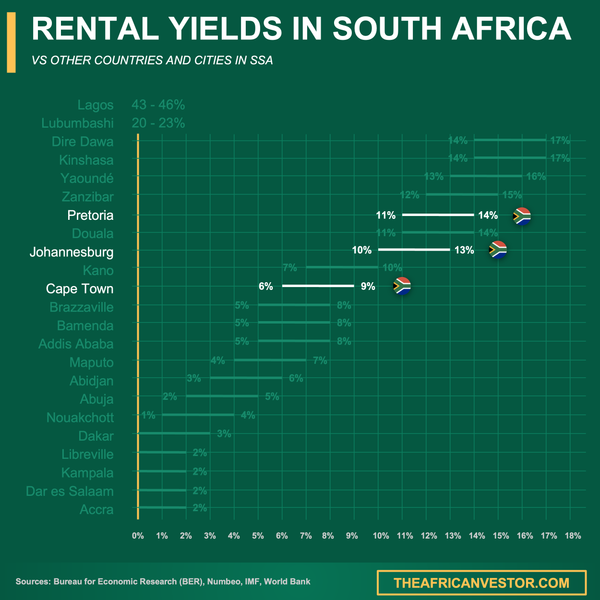
We did some research and made this infographic to help you quickly compare rental yields of the major cities in South Africa versus those in neighboring countries. It provides a clear view of how this country positions itself as a real estate investment destination, which might interest you if you’re planning to invest there.
Can foreigners realistically get a mortgage in South Africa in 2026?
Do banks give mortgages to foreigners in South Africa in 2026?
As of early 2026, major South African banks do offer mortgages to foreigners and non-residents, with typical loan amounts ranging from R1 million to R10 million (approximately 55,000 to 550,000 USD or 50,000 to 500,000 EUR) depending on the property and buyer profile.
The main eligibility requirements include a deposit of at least 50% of the property value, proof of income and employment from your home country, bank statements for the past six months, and a clean credit history that the bank can verify.
Are mortgage approvals harder for non-residents in South Africa in 2026?
As of early 2026, mortgage approvals are significantly harder for non-residents than for South African residents, with longer processing times, stricter documentation requirements, and higher likelihood of rejection.
Residents can typically access loan-to-value ratios of 80 to 100% with deposits of R0 to R400,000 (approximately 0 to 22,000 USD or 0 to 20,000 EUR), while non-residents are usually capped at 50% LTV, requiring deposits of at least R1 million (approximately 55,000 USD or 50,000 EUR) on a R2 million property.
Non-residents must provide verified income documentation from their home country, proof of how the deposit was accumulated, employment contracts or business financials, and sometimes bank references, while residents can rely more heavily on South African credit bureau data.
We have a whole document dedicated to mortgages for foreigners in our South Africa real estate pack.
Get fresh and reliable information about the market in South Africa
Don't base significant investment decisions on outdated data. Get updated and accurate information.

Are foreigners protected by the law in South Africa during disputes?
Are foreigners legally protected like locals in South Africa right now?
Foreigners receive the same constitutional protections as South African citizens in property matters, including equal treatment before the law and the right to access courts under Section 34 of the Bill of Rights.
Both foreigners and locals share equal rights to enforce contracts, challenge unlawful actions affecting their property, and seek remedies through the court system or alternative dispute resolution mechanisms.
The main practical protection gap is not legal but linguistic and procedural, as foreigners unfamiliar with South African court processes, legal terminology, and local practices may find disputes more difficult to navigate without proper representation.
The most important safeguard a foreigner should establish before buying is engaging a reputable local conveyancing attorney, conducting proper due diligence on title and municipal compliance, and ensuring all contracts are reviewed by an independent legal professional.
Do courts treat foreigners fairly in property disputes in South Africa right now?
South African courts are constitutionally required to treat all parties equally regardless of nationality, and the country's independent judiciary is generally regarded as functioning reasonably well by regional standards, with South Africa ranking 60th out of 143 countries in the World Justice Project's Rule of Law Index.
Property disputes in South African courts typically take 12 to 36 months to resolve and cost R50,000 to R500,000 (approximately 2,800 to 28,000 USD or 2,500 to 25,000 EUR) in legal fees depending on complexity.
The most common disputes foreigners bring to court involve breach of sale agreements, defects not disclosed by sellers, and disputes with property management or body corporates in sectional title schemes.
For apartment and estate disputes, the Community Schemes Ombud Service (CSOS) offers a faster and cheaper alternative to courts, handling levy disputes, conduct rule violations, and governance issues in sectional title and homeowner association properties.

We made this infographic to show you how property prices in South Africa compare to other big cities across the region. It breaks down the average price per square meter in city centers, so you can see how cities stack up. It’s an easy way to spot where you might get the best value for your money. We hope you like it.
What do foreigners say after buying in South Africa in 2026?
Do foreigners feel treated differently during buying in South Africa right now?
Based on surveys and feedback we have gathered, roughly 40 to 50% of foreign buyers in South Africa report feeling treated differently during the purchase process, though this is usually attributed to compliance requirements rather than discrimination.
The most commonly reported way foreigners feel treated differently is through extended FICA verification processes, additional source of funds documentation requests, and longer waiting times for mortgage approvals compared to local buyers.
The most commonly reported positive experience is the professionalism of conveyancing attorneys and estate agents in handling international transactions, with many foreigners praising the clear communication and guidance through the compliance process.
Find more real-life feedback in our pack covering the property buying process in South Africa.
Do foreigners overpay compared to locals in South Africa in 2026?
As of early 2026, foreign buyers in South Africa pay an average of R2.7 million (approximately 150,000 USD or 135,000 EUR) per property, more than double the R1.2 million average paid by local buyers, though this reflects concentration in premium segments rather than overpaying for equivalent properties.
The main reason foreigners end up paying more is their focus on specific high-demand locations like Cape Town's Atlantic Seaboard, City Bowl, and Constantia, where limited supply and international competition push prices higher, while locals spread purchases across a wider range of more affordable areas.
Don't sign a document you don't understand in South Africa
Buying a property over there? We have reviewed all the documents you need to know. Stay out of trouble - grab our comprehensive guide.
What sources have we used to write this blog article?
Whether it's in our blog articles or the market analyses included in our property pack about South Africa, we always rely on the strongest methodology we can and we don't throw out numbers at random.
We also aim to be fully transparent, so below we've listed the authoritative sources we used, and explained how we used them and the methods behind our estimates.
| Source | Why it's authoritative | How we used it |
|---|---|---|
| South African Government - Deeds Registries Act | Official government legislation governing property registration in South Africa. | We used it to ground the legal framework for property ownership and registration. We verified that foreigners can register title deeds in their own name. |
| South African Constitution | The supreme law of South Africa protecting fundamental rights. | We used it to confirm equal protection and court access for foreigners. We anchored the dispute resolution section on constitutional guarantees. |
| South African Reserve Bank | The central bank and authority on exchange control regulations. | We used it to explain how foreigners must route funds through authorized dealers. We verified repatriation rules for property sale proceeds. |
| Financial Intelligence Centre | The regulator responsible for anti-money laundering compliance. | We used it to detail FICA documentation requirements for foreign buyers. We explained why identity and source of funds verification is mandatory. |
| South African Revenue Service (SARS) | The official tax authority with definitive guidance on property taxes. | We used it to explain the 7.5% withholding tax on non-resident property sales. We verified transfer duty rates and tax obligations. |
| Absa International Mortgages | A major South African bank with a dedicated foreign buyer product. | We used it to confirm that mortgages are available to foreigners in 2026. We extracted typical terms and deposit requirements. |
| FNB Foreign Choice | A major bank's official product page for non-resident buyers. | We used it to verify loan-to-value limits and eligibility criteria. We compared terms across multiple lenders for accuracy. |
| Lightstone Property Data | A respected property analytics firm with deeds-linked transaction data. | We used it to quantify foreign buyer activity and price patterns. We verified claims about concentration in premium market segments. |
| World Justice Project | An independent international organization measuring rule of law. | We used it to benchmark South Africa's judicial system and dispute environment. We provided context for what protections exist in practice. |
| Community Schemes Ombud Service (CSOS) | The official body handling sectional title and HOA disputes. | We used it to explain alternative dispute resolution options for apartment buyers. We highlighted this as a practical resource for common disputes. |
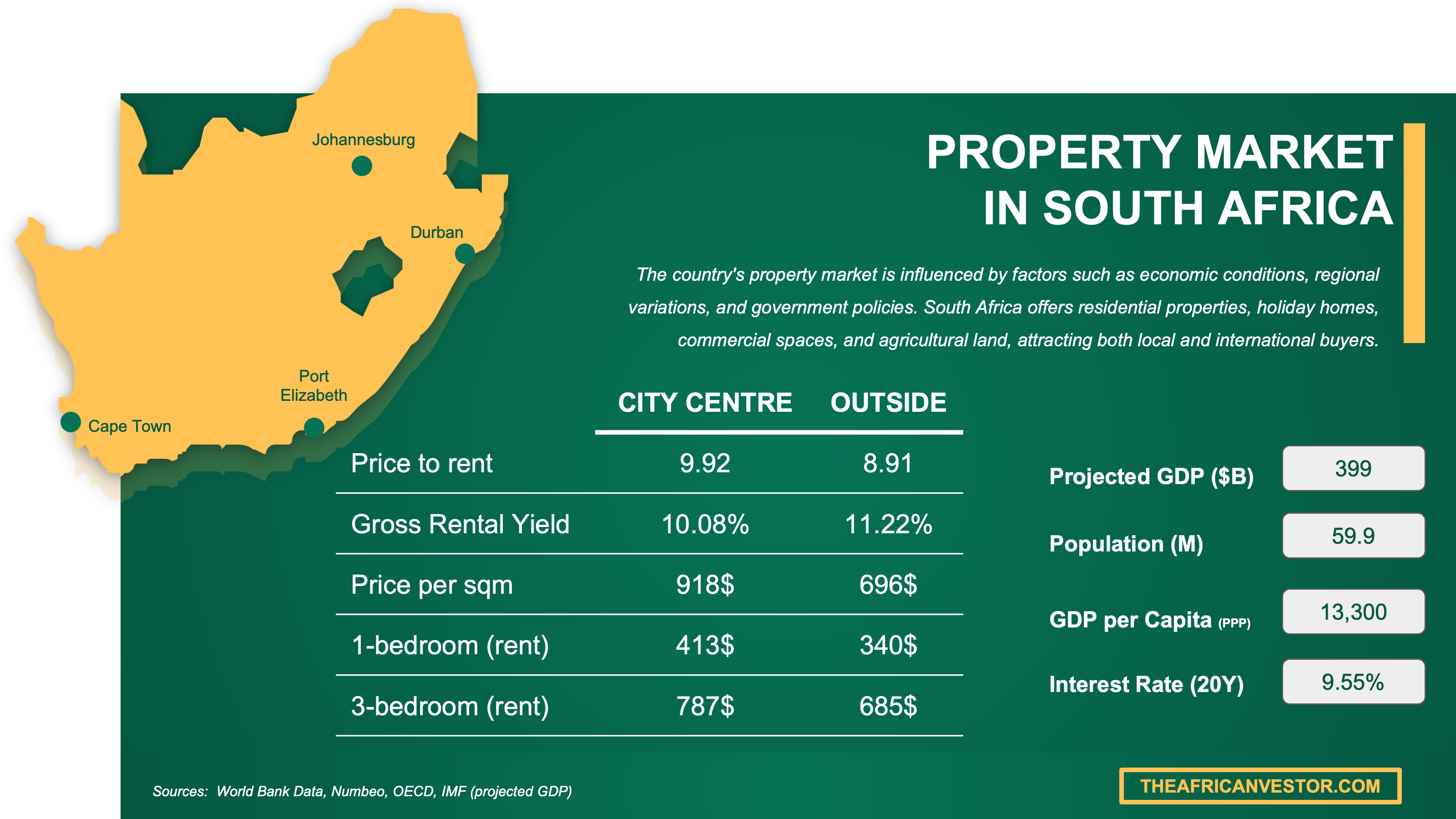
We have made this infographic to give you a quick and clear snapshot of the property market in South Africa. It highlights key facts like rental prices, yields, and property costs both in city centers and outside, so you can easily compare opportunities. We’ve done some research and also included useful insights about the country’s economy, like GDP, population, and interest rates, to help you understand the bigger picture.
