
Authored by the expert who managed and guided the team behind the South Africa Property Pack
Yes, the analysis of Cape Town's property market is included in our pack
Cape Town is one of Africa's most sought-after property markets, and prices in 2026 reflect that demand clearly.
In this article, we walk through what each major budget level, from $100k to $500k and beyond, actually gets you in Cape Town right now, with real neighborhoods, realistic sizes, and honest numbers.
We keep this post updated regularly so the data stays fresh and useful for foreign buyers researching the Cape Town market.
And if you're planning to buy a property in this place, you may want to download our pack covering the real estate market in Cape Town.
What can I realistically buy with $100k in Cape Town right now?
Are there any decent properties for $100k in Cape Town, or is it all scams?
At around $100k (roughly R1.6 million in early 2026), you can find legitimate apartments and small units in Cape Town, but you have to look in the right places and go through proper legal channels, because the scam risk is real when buyers skip the basics.
The best value for a $100k budget in Cape Town tends to be in neighborhoods like Woodstock, Salt River, parts of Observatory, and the Table View and Blouberg corridor along the West Coast, where listings around R1.5 million to R1.65 million do appear for smaller or older units.
Buying something tiny in a popular or upscale area like Sea Point or the Atlantic Seaboard for $100k is not realistic in early 2026, since even the smallest apartments in those neighborhoods routinely list at R3.4 million and up.
What property types can I afford for $100k in Cape Town (studio, land, old house)?
With around $100k (about R1.6 million) in Cape Town in 2026, the realistic options are mostly studios and one-bedroom apartments in inner-fringe suburbs, with the occasional small older townhouse further from the city center.
At this price, expect properties that are livable but likely dated, needing at least a light refresh, and sometimes a medium renovation costing anywhere from R150,000 to R350,000 on top of the purchase price.
Among the available types at $100k in Cape Town, a well-located small apartment in a suburb with strong rental demand, such as Woodstock or Observatory, tends to offer the best long-term value because resale liquidity and rental income are more predictable there than with land or rural old houses.
What's a realistic budget to get a comfortable property in Cape Town as of 2026?
As of early 2026, the minimum budget to get a genuinely comfortable property in Cape Town is around R2.5 million, which is roughly $155,000 or about EUR 145,000.
Most buyers looking for a comfortable outcome, meaning a decent size, a decent area, and a livable condition without major surprises, need to budget somewhere between R2.5 million and R4 million, or around $155,000 to $250,000 (EUR 145,000 to EUR 235,000).
In Cape Town, "comfortable" at this level typically means a 1- to 2-bedroom apartment of 60 to 90 square meters in a reasonably secure complex, ideally with parking and in a suburb with good access to shops and transport.
The required budget can shift considerably depending on the neighborhood: R2.5 million goes much further in Durbanville or Bellville than it does in the City Bowl or near the Atlantic Seaboard, where the same money buys noticeably less space and older stock.
Get fresh and reliable information about the market in Cape Town
Don't base significant investment decisions on outdated data. Get updated and accurate information.

What can I get with a $200k budget in Cape Town as of 2026?
What "normal" homes become available at $200k in Cape Town as of 2026?
As of early 2026, a $200k budget (around R3.24 million) brings you into mainstream Cape Town, where a 2-bedroom apartment or a small townhouse in a decent suburb becomes a realistic option rather than a stretch.
At this price point in Cape Town, a typical apartment will measure around 60 to 90 square meters, while a townhouse can range from 90 to 140 square meters depending on the suburb, with older freehold houses often sitting in a similar range but with more variation in condition.
By the way, we have much more granular data about housing prices in our property pack about Cape Town.
What places are the smartest $200k buys in Cape Town as of 2026?
As of early 2026, the smartest $200k (around R3.24 million) buys in Cape Town tend to be in Table View and the Blouberg corridor, as well as inner-fringe suburbs like Woodstock, where demand from tenants and owner-occupiers stays consistently strong.
What makes these areas smarter than other $200k options is a combination of rental demand from young professionals and students, reasonable resale liquidity, and the fact that you're not paying a trophy premium for the address, so your money goes into actual bricks rather than a postcode.
The main growth factor driving value in areas like Blouberg and Woodstock is Cape Town's structural undersupply of well-located, affordable stock, which means properties priced correctly in these nodes tend to attract quick interest from both buyers and renters.
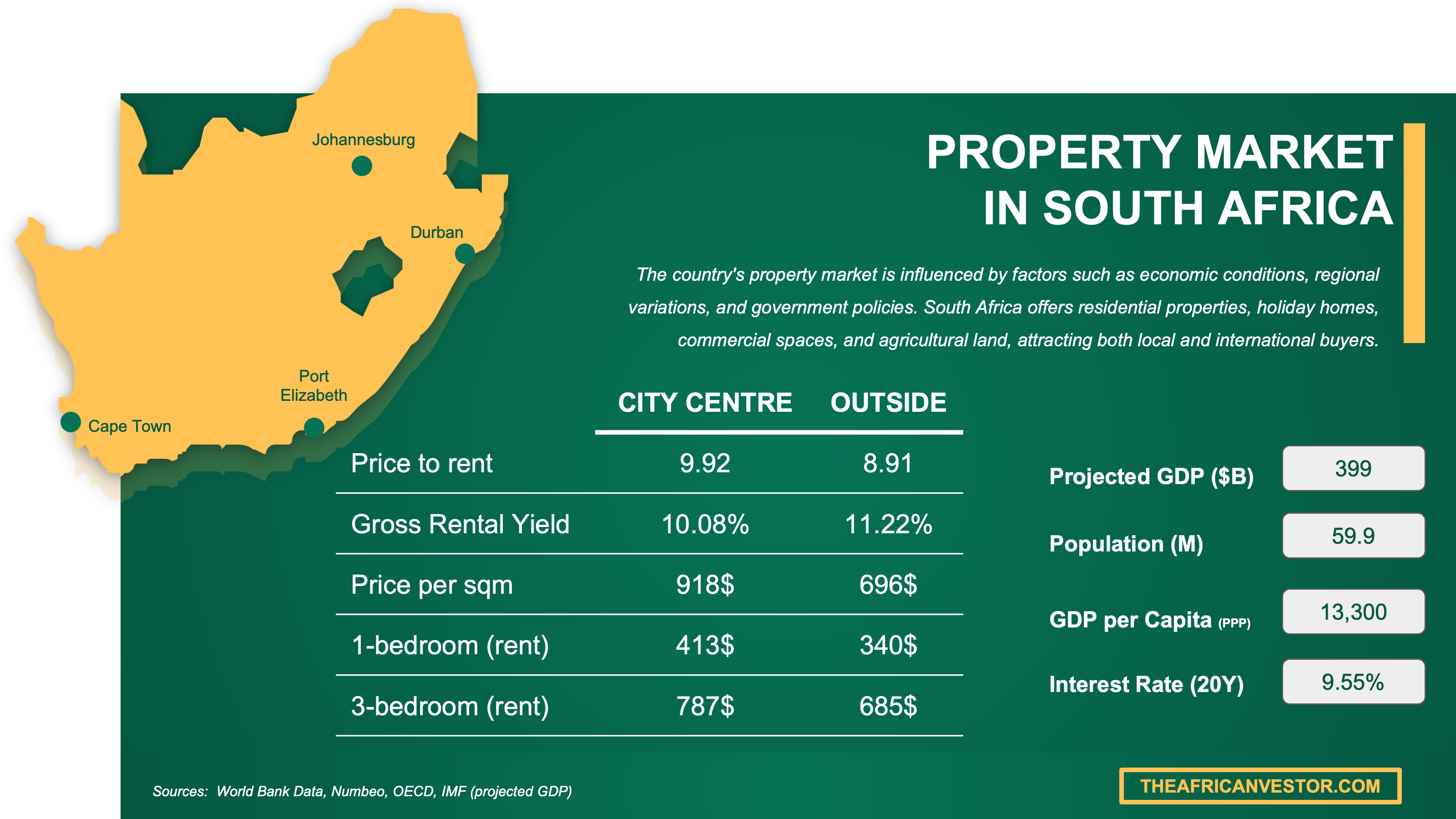
We have made this infographic to give you a quick and clear snapshot of the property market in South Africa. It highlights key facts like rental prices, yields, and property costs both in city centers and outside, so you can easily compare opportunities. We’ve done some research and also included useful insights about the country’s economy, like GDP, population, and interest rates, to help you understand the bigger picture.
What can I buy with $300k in Cape Town in 2026?
What quality upgrade do I get at $300k in Cape Town in 2026?
As of early 2026, moving from $200k to $300k (from about R3.24 million to R4.86 million) in Cape Town typically allows you to upgrade two out of three factors at once: a better location, a better condition, or more space, rather than having to compromise on all three.
At $300k in Cape Town in 2026, you can often find apartments and townhouses in newer complexes, especially in non-prime but desirable suburbs, though in the Atlantic Seaboard newer buildings still start much higher.
At this budget level, features like covered parking, modern kitchen fittings, a sectional title security complex, and a reasonable view or garden access start to become available rather than exceptional.
Can $300k buy a 2-bedroom in Cape Town in 2026 in good areas?
As of early 2026, finding a genuine 2-bedroom property in a good Cape Town area for $300k (around R4.86 million) is realistic, particularly in suburbs that are desirable but not at the trophy end of the market.
Specific areas in Cape Town where a 2-bedroom is accessible at this budget include parts of the City Bowl fringe, selected Southern Suburbs apartment markets, and well-located Northern Suburbs like Durbanville, where this budget puts you in a solidly competitive position.
A typical 2-bedroom apartment at $300k in Cape Town in 2026 will measure around 75 to 110 square meters, with some variation depending on whether you're in an older or newer complex and how close you are to the coastline or CBD.
Which places become "accessible" at $300k in Cape Town as of 2026?
At $300k (around R4.86 million) in Cape Town, areas like the City Bowl fringe, parts of De Waterkant, selected pockets of the Southern Suburbs including Claremont and Rondebosch, and better-positioned Northern Suburbs complexes all start to become realistic options.
What makes these newly accessible areas particularly appealing compared to the inner-fringe or outer-suburban options available at lower budgets is the combination of walkability, established amenities, proximity to top schools, and a genuine sense of Cape Town urban living rather than a compromise location.
In these newly accessible areas, buyers at $300k in Cape Town in 2026 can typically expect a well-maintained 2-bedroom apartment in a secure complex, or a compact townhouse with parking, rather than a standalone freehold home.
Get to know the market before buying a property in Cape Town
Better information leads to better decisions. Get all the data you need before investing a large amount of money.
What does a $500k budget unlock in Cape Town in 2026?
What's the typical size and location for $500k in Cape Town in 2026?
As of early 2026, a $500k budget (around R8.1 million) in Cape Town typically gets you a high-quality 2- to 3-bedroom apartment in a very desirable suburb, or a comfortable freehold home with a garden in a strong mainstream suburb like Constantia, Pinelands, or parts of the Southern Suburbs.
Yes, $500k can buy a family home with outdoor space in Cape Town in 2026, particularly in suburbs that are well-regarded but not at the extreme premium end, where R8 million is a realistic price for a 3-bedroom house with a garden and parking.
At $500k in Cape Town in 2026, a 3-bedroom, 2-bathroom layout is a realistic expectation in most of the mainstream-to-strong suburbs, though in the most trophy Atlantic Seaboard locations you would still be looking at a smaller apartment at this level.
Which "premium" neighborhoods open up at $500k in Cape Town in 2026?
At $500k (around R8.1 million) in Cape Town in 2026, areas like parts of Sea Point, Green Point, Tamboerskloof, Oranjezicht, and selected pockets of the Southern Suburbs such as Newlands and Claremont start to feel genuinely accessible rather than aspirational.
What makes these neighborhoods feel premium in Cape Town is a specific mix of things: walkable streets, mountain or sea views (depending on the exact location), proximity to quality restaurants and schools, and a level of architectural character that you simply don't find in newer outer suburban complexes.
At $500k in Cape Town's premium neighborhoods in 2026, buyers can realistically expect a well-presented 2- to 3-bedroom apartment with good finishes, secure parking, and often a communal pool or garden, though a full standalone house with a large garden in these specific areas would typically require a noticeably higher budget.
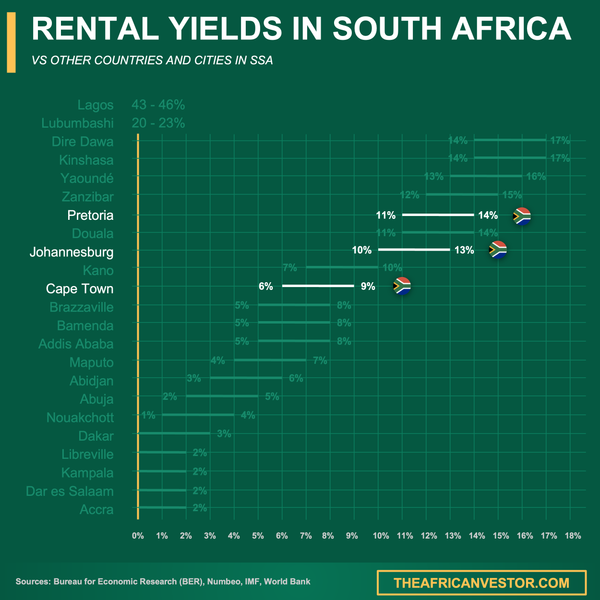
We did some research and made this infographic to help you quickly compare rental yields of the major cities in South Africa versus those in neighboring countries. It provides a clear view of how this country positions itself as a real estate investment destination, which might interest you if you’re planning to invest there.
What counts as "luxury" in Cape Town in 2026?
At what amount does "luxury" start in Cape Town right now?
In Cape Town in 2026, properties that genuinely qualify as luxury, in the sense that a global buyer would recognize them as such, typically start at around R10 million, which is roughly $620,000 or about EUR 580,000.
At this entry point, what defines luxury in Cape Town specifically is a combination of things like ocean or mountain views from a sought-after address, high-specification finishes including stone worktops and smart home systems, secure 24-hour access, and a building or estate that has been maintained to an international standard.
Mid-tier luxury in Cape Town sits in the R10 million to R20 million range (roughly $620,000 to $1.25 million, or EUR 580,000 to EUR 1.17 million), while top-tier trophy properties on the Atlantic Seaboard regularly trade above R30 million, or over $1.85 million.
Which areas are truly high-end in Cape Town right now?
The truly high-end residential areas in Cape Town in 2026 are concentrated on the Atlantic Seaboard, particularly Clifton, Camps Bay, Bantry Bay, and the upper parts of Sea Point, along with prime Southern Suburbs pockets like Bishopscourt and Upper Constantia.
What sets these areas apart in Cape Town specifically is the scarcity of large plots or well-positioned buildings with uninterrupted views of the Atlantic Ocean or Table Mountain, combined with strictly limited new supply, which means prices hold up well even in softer economic conditions.
Buyers in these high-end Cape Town areas in 2026 tend to be affluent South Africans relocating from Johannesburg, international buyers using Cape Town as a second home destination (particularly from Europe), and a smaller group of semigration buyers who have sold a large suburban home elsewhere in the country and are consolidating into a premium apartment or villa.
Don't buy the wrong property, in the wrong area of Cape Town
Buying real estate is a significant investment. Don't rely solely on your intuition. Gather the right information to make the best decision.
How much does it really cost to buy, beyond the price, in Cape Town in 2026?
What are the total closing costs in Cape Town in 2026 as a percentage?
As of early 2026, the total closing costs when buying property in Cape Town typically range from around 2% to 4% of the purchase price at the lower end (below roughly R1.2 million, where no transfer duty applies), rising to about 6% to 10% or more for properties priced above R3 million.
For most foreign buyers in Cape Town in 2026, a realistic low-to-high range to plan around is 5% to 9% of the purchase price, covering transfer duty, conveyancing attorney fees, Deeds Office charges, and related disbursements, with the percentage rising as the purchase price climbs.
To avoid hidden costs and bad surprises, you can check our our pack covering the property buying process in Cape Town.
How much are notary, registration, and legal fees in Cape Town in 2026?
As of early 2026, the combined conveyancing attorney fees and Deeds Office registration charges in Cape Town for a R3 million to R5 million property typically come to somewhere between R40,000 and R90,000 (roughly $2,500 to $5,500, or EUR 2,300 to EUR 5,200), depending on the exact purchase price and attorneys involved.
These fees together usually represent around 1% to 2% of the purchase price in Cape Town, though the percentage tapers slightly as the property value increases because the fee schedules are set in steps rather than a straight percentage.
In Cape Town property transactions in 2026, the conveyancing attorney fee (the legal fee for transferring ownership) is typically the largest single component of the legal cost stack, with the Deeds Office registration fee being a more modest but non-negotiable addition on top.
What annual property taxes should I expect in Cape Town in 2026?
As of early 2026, a typical Cape Town residential property valued at R3 million (around $185,000 or EUR 174,000) will attract annual municipal property rates of roughly R21,000 to R23,000 per year (about $1,300 to $1,400), based on the City's current rate-in-the-rand of approximately 0.7159% of municipal valuation.
In Cape Town in 2026, annual property rates for residential properties represent around 0.7% of the municipal valuation before any applicable relief, which makes them moderate compared to many international property markets.
Property rates in Cape Town vary primarily based on property value and category: a R1.6 million apartment pays around R11,500 per year, while a R8 million property attracts around R57,000 per year, with commercial and multi-unit properties taxed at different rate-in-the-rand figures.
Cape Town's residential rate schedule includes a built-in relief mechanism that reduces the effective bill for lower-value properties, and certain categories of owner, including qualifying pensioners, may be eligible for additional rebates that can meaningfully reduce the annual tax burden.
Is mortgage a viable option for foreigners in Cape Town right now?
Getting a mortgage as a foreigner in Cape Town in 2026 is technically possible through South African banks, but it is significantly more complex and paperwork-heavy than it would be for a local buyer, making a cash purchase the simpler path for most foreign buyers at lower budget levels.
South African banks typically offer foreign buyers a loan-to-value ratio of around 50% to 70% at most, meaning a substantial deposit is required, and interest rates on home loans in South Africa in early 2026 remain elevated, with the prime lending rate having only recently begun to ease from recent highs.
Foreign buyers applying for a mortgage in Cape Town in 2026 will typically need to provide FICA-compliant documentation, proof of income in their home country, a South African bank account, evidence of source of funds, and full exchange-control compliance through an authorised dealer bank, all of which adds meaningful time and cost to the process.

We made this infographic to show you how property prices in South Africa compare to other big cities across the region. It breaks down the average price per square meter in city centers, so you can see how cities stack up. It’s an easy way to spot where you might get the best value for your money. We hope you like it.
What should I predict for resale and growth in Cape Town in 2026?
What property types resell fastest in Cape Town in 2026?
As of early 2026, the property types that resell fastest in Cape Town are well-priced 1- to 2-bedroom apartments in secure complexes in high-demand nodes like the City Bowl fringe, Woodstock, and the Atlantic Seaboard, because these are the easiest to finance for the largest pool of local buyers.
A credible baseline from FNB-referenced data puts the average time from listing to signed contract at around 12 weeks in the current market, though correctly priced Cape Town stock in popular areas can move faster, with 6 to 10 weeks not unusual, followed by a further 8 to 12 weeks for transfer registration through the Deeds Office.
In Cape Town specifically, what makes certain properties sell faster is less about size and more about sectional title security, proximity to the N1 or N2 highway corridors, and being in a suburb with a strong rental market backstop, because buyers feel more confident knowing they have an exit if they need to rent rather than sell.
The slowest property types to resell in Cape Town in 2026 tend to be large older freehold houses on big plots in the outer Northern Suburbs or on the Cape Flats, where the buyer pool is thinner, the price points are harder to finance, and ongoing maintenance costs tend to put off buyers who have become accustomed to low-maintenance sectional title living.
If you're interested, we cover all the best exit strategies in our real estate pack about Cape Town.
Make a profitable investment in Cape Town
Better information leads to better decisions. Save time and money. Download our data.
What sources have we used to write this blog article?
Whether it's in our blog articles or the market analyses included in our property pack about Cape Town, we always rely on the strongest methodology we can ... and we don't throw out numbers at random.
We also aim to be fully transparent, so below we've listed the authoritative sources we used, and explained how we used them and the methods behind our estimates.
| Source | Why it's authoritative | How we used it |
|---|---|---|
| ExchangeRates.org.uk - USD/ZAR 2026 | Transparent, date-stamped exchange rate history you can verify day by day. | We used it to convert USD budgets into realistic Cape Town rand figures for early 2026. We then set a conservative working rate to avoid overestimating buying power. |
| City of Cape Town - Property Rates 2025/26 | The City's own budget document setting the official rate-in-the-rand for property taxes. | We used it to calculate annual municipal property rates across different property values. We also explained the built-in residential relief mechanism and how it affects the final bill. |
| SARS - Non-resident seller withholding guide | SARS' official guide to the withholding regime that applies when foreigners sell South African property. | We used it to flag the key resale friction that foreign buyers should know about before committing to a purchase. We also used it to explain why clean paperwork matters for repatriating funds later. |
| LSSA - Conveyancing Fee Guidelines (May 2024) | The national law society's published fee guideline used by conveyancers across South Africa. | We used it to estimate realistic transfer attorney fees by price bracket. We also used it to explain what conveyancing attorneys actually do and why using one is not optional. |
| Cape Town Lawyer - Deeds Office fee schedule | Cites the Government Gazette basis and reflects the current official Deeds Office fee periods. | We used it to include Deeds Office charges in the total cost stack for buyers. We also used it to explain why these fees move in steps tied to transaction value. |
| SARB - Financial Surveillance FAQs | SARB's own public guidance on exchange-control rules administered through authorised dealer banks. | We used it to explain how cross-border money flows work for foreign buyers in South Africa. We also used it to outline the paper trail requirements non-residents should prepare for. |
| Property24 - Legal guide for foreign buyers | A major national portal with a tightly focused guide on process and compliance for non-residents. | We used it to map the step-by-step foreign buyer journey including FICA, banking and compliance. We then cross-checked the exchange-control framing against SARB's own guidance. |
| FNB - Property Barometer (August 2025) | Published by a major South African bank using an established house price index and lending market data. | We used it to support the point that the Western Cape has been a consistent price-growth leader nationally. We also used it to set realistic buyer expectations about competition for well-priced Cape Town stock. |
| Pam Golding - Residential Property Index | From one of South Africa's best-known residential agencies, referencing its long-running price index. | We used it to cross-check Western Cape price outperformance against FNB's regional narrative. We also used it to set resale liquidity expectations in strong Cape Town nodes. |
| Lightstone - Property Newsletter (December 2025) | A well-known South African property data firm that publishes market analytics used across the industry. | We used it to support the big-picture point that the Western Cape dominates both value and demand nationally. We then used it to explain why genuinely good-value stock is scarce in prime Cape Town areas. |
| Global Property Guide - South Africa price history | Compiles and cites mainstream datasets including FNB and publishes time-on-market context. | We used it to anchor a credible baseline for how long it typically takes to sell a property in South Africa. We then adjusted that baseline for Cape Town's faster-moving good-area submarkets. |

We created this infographic to give you a simple idea of how much it costs to buy property in different parts of South Africa. As you can see, it breaks down price ranges and property types for popular cities in the country. We hope this makes it easier to explore your options and understand the market.
