
Authored by the expert who managed and guided the team behind the South Africa Property Pack

Get all the data you need about the real estate market in Pretoria
We constantly update this blog post, so the Pretoria rent figures below reflect the latest data we had for June 2026.
Pretoria rents in 2026 are shaped by students, government workers, embassy staff, families and young professionals, which makes the city more balanced than many South African rental markets.
In simple terms, Pretoria is not the most expensive rental city in South Africa, but the right Pretoria neighborhoods can still give landlords steady demand.
And if you’re planning to buy a property in this place, you may want to download our pack covering the real estate market in Pretoria.

What are typical rents in Pretoria as of 2026?
What's the average monthly rent for a studio in Pretoria as of 2026?
As of 2026, the average monthly rent for a studio in Pretoria is about R5,800, which is roughly $320 or €290.
In practice, most studio rents in Pretoria in 2026 fall between R4,300 and R8,000 per month, or about $240 to $445 and €215 to €400.
The cheaper Pretoria studios are usually in Pretoria Central, Sunnyside and older Arcadia blocks, while higher studio rents are common in Hatfield, Brooklyn, Menlyn and secure student-focused buildings.
What's the average monthly rent for a 1-bedroom in Pretoria as of 2026?
As of 2026, the average monthly rent for a 1-bedroom apartment in Pretoria is about R7,300, which is roughly $405 or €365.
Most 1-bedroom apartments in Pretoria in 2026 rent between R5,500 and R9,500 per month, or about $305 to $530 and €275 to €475.
The cheapest 1-bedroom rents in Pretoria are often found in Pretoria Central, Sunnyside, Pretoria North and parts of Arcadia, while the highest 1-bedroom rents are more common in Brooklyn, Hatfield, Menlyn, Waterkloof and Lynnwood.
What's the average monthly rent for a 2-bedroom in Pretoria as of 2026?
As of 2026, the average monthly rent for a 2-bedroom apartment in Pretoria is about R9,800, which is roughly $545 or €490.
Most 2-bedroom apartments in Pretoria in 2026 rent between R6,800 and R15,000 per month, or about $380 to $835 and €340 to €750.
Cheaper 2-bedroom rents are more common in Pretoria North, Pretoria Central, Sunnyside, Montana and some older east-side blocks, while the most expensive 2-bedroom apartments are usually in Brooklyn, Waterkloof, Menlyn, Lynnwood, Silver Lakes and The Blyde Riverwalk Estate.
By the way, you will find much more detailed rent ranges in our property pack covering the real estate market in Pretoria.
What's the average rent per square meter in Pretoria as of 2026?
As of 2026, the average apartment rent in Pretoria is about R115 per square meter per month, which is roughly $6.40 or €5.75 per square meter.
A realistic Pretoria rent-per-square-meter range in 2026 is about R90 to R180 per square meter, or about $5 to $10 and €4.50 to €9 per square meter, depending on suburb and building quality.
Pretoria rents per square meter are generally lower than Cape Town and many premium Johannesburg nodes, but Pretoria East, Brooklyn, Waterkloof, Menlyn and The Blyde can still price like strong urban rental pockets.
The Pretoria apartments that go above the average are usually small, secure, modern, furnished, near the University of Pretoria or Gautrain, or located in estates with lifestyle facilities and backup power.
How much have rents changed year-over-year in Pretoria in 2026?
As of 2026, average rents in Pretoria are estimated to be about 4% higher than one year earlier.
The main reasons Pretoria rents increased in 2026 are steady student demand, government employment, embassy-related demand, better-performing Pretoria East suburbs and the fact that well-located secure apartments remain easier to rent out.
This 2026 rent increase is slightly stronger than Gauteng’s 2.9% rental growth reported in early 2025, but Pretoria still looks more controlled than the faster-growing Cape Town rental market.
What's the outlook for rent growth in Pretoria in 2026?
As of 2026, Pretoria rents are projected to grow by about 4% to 6% over the full year.
The key forces behind Pretoria rent growth are student intake around Hatfield, professional demand around Menlyn and Lynnwood, embassy and diplomatic demand around Waterkloof and Brooklyn, and family demand in Pretoria East.
The Pretoria neighborhoods most likely to see the strongest rent growth are Hatfield, Brooklyn, Menlyn, Lynnwood, Silver Lakes, Faerie Glen and secure Pretoria East estates.
The main risk is affordability, because many Gauteng tenants are still price-sensitive, so landlords who overprice older or poorly maintained Pretoria units may wait longer for tenants.
Get fresh and reliable information about the market in Pretoria
Don't base significant investment decisions on outdated data. Get updated and accurate information.

Which neighborhoods rent best in Pretoria as of 2026?
Which neighborhoods have the highest rents in Pretoria as of 2026?
As of 2026, the top three high-rent Pretoria areas are Waterkloof, Brooklyn and Menlyn, where many good 2-bedroom rentals sit around R13,000 to R20,000 per month, or about $720 to $1,110 and €650 to €1,000.
These Pretoria neighborhoods command premium rents because they offer security, embassies, good schools, restaurants, offices, malls, easy commuting and a stronger supply of modern or furnished units.
The typical tenants in these high-rent Pretoria areas are diplomats, embassy staff, consultants, senior professionals, relocating families and higher-income young professionals.
By the way, we’ve written a blog article detailing Sources and methodology: we ranked high-rent suburbs using Private Property, Property24 and Gauteng rent benchmarks from PayProp. We focused on rents that appeared repeatedly, not isolated luxury listings. We then checked whether each area had a clear tenant base.
Where do young professionals prefer to rent in Pretoria right now?
The top Pretoria neighborhoods for young professionals in 2026 are Menlyn, Lynnwood and Hatfield, with Brooklyn, Faerie Glen, Garsfontein and The Blyde also very active.
Young professionals in these Pretoria neighborhoods usually pay about R7,500 to R14,000 per month, or about $415 to $780 and €375 to €700, depending on size, security and building quality.
These areas attract young professionals because Pretoria tenants can reach offices, malls, gyms, restaurants, the N1 and N4, the University of Pretoria and the Gautrain more easily from these nodes.
By the way, you will find a detailed tenant analysis in our property pack covering the real estate market in Pretoria.
Where do families prefer to rent in Pretoria right now?
The top Pretoria neighborhoods for families in 2026 are Faerie Glen, Garsfontein and Moreleta Park, with Equestria, Montana, Lynnwood, Waterkloof Ridge and Silver Lakes also popular.
Families renting 2- to 3-bedroom apartments or townhouses in these Pretoria areas usually pay about R9,000 to R18,000 per month, or about $500 to $1,000 and €450 to €900.
These Pretoria family areas work because they offer larger homes, garages, security, schools, shopping centers, easier east-side commuting and more space than the student-heavy inner city.
Strong education options near these family-friendly Pretoria neighborhoods include Pretoria Boys High School, Pretoria High School for Girls, Waterkloof House Preparatory School, Lynnwood Ridge Primary School and several private schools around Pretoria East.
Which areas near transit or universities rent faster in Pretoria in 2026?
As of 2026, the three Pretoria areas near transit or universities that rent fastest are Hatfield, Arcadia and Brooklyn, with Sunnyside, Hillcrest, Prinshof and Pretoria Central also active.
Well-priced Pretoria rentals in these fast-moving areas often stay listed for about 10 to 18 days, while slower or overpriced stock can take 30 days or more.
A Pretoria rental within walking distance of the University of Pretoria, Hatfield Gautrain station or a strong bus route can often earn a premium of about R500 to R2,000 per month, or about $30 to $110 and €25 to €100.
Which neighborhoods are most popular with expats in Pretoria right now?
The top Pretoria neighborhoods for expats in 2026 are Waterkloof, Brooklyn and Groenkloof, with Menlo Park, Lynnwood, Arcadia and Hatfield also common choices.
Expats in these Pretoria neighborhoods usually pay about R10,000 to R25,000 per month, or about $555 to $1,390 and €500 to €1,250, depending on whether the property is furnished, secure and close to embassies or schools.
These Pretoria areas attract expats because they offer security, diplomatic access, good roads, shops, restaurants, schools, hospitals and a smoother landing for people who do not yet know the city.
The most visible expat demand in these Pretoria neighborhoods comes from diplomats, NGO staff, academics, international students, consultants and families linked to embassies and international organizations.
And if you are also an expat, you may want to read our Sources and methodology: we used live premium listings from Private Property, neighborhood stock on Property24 and campus context from the University of Pretoria. We used embassy geography as a practical signal, not as official expat data. We also reviewed our own Pretoria tenant notes for furnished and secure rentals.
Get to know the market before buying a property in Pretoria
Better information leads to better decisions. Get all the data you need before investing a large amount of money.
Who rents, and what do tenants want in Pretoria right now?
What tenant profiles dominate rentals in Pretoria?
The top three Pretoria tenant profiles in 2026 are students, young professionals and families, followed by civil servants, medical workers, embassy staff and diplomats.
A practical split for Pretoria rentals is about 25% students, 30% young professionals and 25% families, with the remaining 20% made up of government, embassy, medical and relocation tenants.
Students usually seek studios and shared flats around Hatfield, Arcadia and Sunnyside, young professionals want 1- and 2-bedroom secure apartments near Menlyn and Lynnwood, and families want 2- to 4-bedroom townhouses in Pretoria East and Montana.
If you want to optimize your cashflow, you can read our Sources and methodology: we used renter context from Stats SA, city context from City of Tshwane Open Data and demand signals from University of Pretoria. We treated the profile split as an estimate, not an official count. We then checked the split against live rental stock and our own Pretoria analysis.
Do tenants prefer furnished or unfurnished in Pretoria?
In Pretoria in 2026, about 70% of long-term tenants prefer unfurnished or partly furnished rentals, while about 30% prefer furnished rentals.
A furnished Pretoria apartment usually earns about R800 to R2,500 more per month than a similar unfurnished unit, or about $45 to $140 and €40 to €125, when the furniture is modern and the location fits the tenant.
Furnished rentals are most popular with Pretoria students, diplomats, consultants, relocating professionals and expats in Hatfield, Brooklyn, Menlyn, Arcadia and Waterkloof.
Which amenities increase rent the most in Pretoria?
The five Pretoria amenities that increase rent the most in 2026 are backup power, strong security, covered parking, fibre internet and modern finishes.
In practical terms, backup power can add R500 to R1,500 per month, strong security R400 to R1,200, covered parking R300 to R800, fibre readiness R200 to R500 and modern kitchens or bathrooms R500 to R2,000, or about $10 to $110 and €10 to €100 depending on the amenity.
In our property pack covering the real estate market in Pretoria, we cover what are the best investments a landlord can make.
What renovations get the best ROI for rentals in Pretoria?
The five Pretoria rental renovations with the best ROI in 2026 are repainting, LED lighting, bathroom refreshes, prepaid electricity or metering improvements, and inverter-ready wiring.
Simple repainting may cost R8,000 to R20,000 and add R300 to R800 per month, bathroom refreshes may cost R20,000 to R60,000 and add R500 to R1,500, while inverter-ready upgrades may cost R15,000 to R50,000 and add R500 to R1,500, or about $445 to $3,335 in cost and €400 to €3,000 in cost for these common upgrades.
Pretoria landlords should usually avoid luxury finishes in low-ceiling areas like older Sunnyside or Pretoria Central flats, because tenants there may like the upgrade but still cannot pay Brooklyn or Menlyn rents.
Make a profitable investment in Pretoria
Better information leads to better decisions. Save time and money. Download our data.
How strong is rental demand in Pretoria as of 2026?
What's the vacancy rate for rentals in Pretoria as of 2026?
As of 2026, the estimated vacancy rate for Pretoria residential rentals is about 5.5%.
A realistic Pretoria vacancy range is about 3% to 5% in strong areas like Hatfield, Brooklyn, Menlyn and Lynnwood, and about 6% to 9% in older, weaker or overpriced stock in parts of the inner city.
Pretoria vacancy in 2026 looks close to normal, because demand is solid but not overheated, and affordability still limits how far landlords can push rents.
Finally please note that you will have all the indicators you need in our property pack covering the real estate market in Pretoria.
How many days do rentals stay listed in Pretoria as of 2026?
As of 2026, a well-priced Pretoria rental usually stays listed for about 18 to 28 days.
Fast Pretoria rentals in Hatfield, Brooklyn, Menlyn and near the University of Pretoria can move in 10 to 18 days, while overpriced luxury units or older poorly maintained flats can take 30 to 45 days.
Compared with one year earlier, Pretoria days on market in 2026 look slightly better in the best suburbs, but not dramatically better across the whole city.
Which months have peak tenant demand in Pretoria?
The peak months for Pretoria tenant demand are January, February, June, July, November and December.
January and February are strong because of University of Pretoria intake and job relocations, while June and July bring mid-year moves and November and December bring tenants trying to secure homes before the new year.
The quieter months for Pretoria rentals are usually April, May, August and September, unless a property is very well priced or close to a major tenant node.
Don't buy the wrong property, in the wrong area of Pretoria
Buying real estate is a significant investment. Don't rely solely on your intuition. Gather the right information to make the best decision.
What will my monthly costs be in Pretoria as of 2026?
What property taxes should landlords expect in Pretoria as of 2026?
As of 2026, a typical Pretoria landlord with an apartment or townhouse may pay about R7,000 to R15,000 per year in municipal property rates, or about $390 to $835 and €350 to €750.
A realistic annual property-rates range in Pretoria is about R4,000 to R25,000, or about $220 to $1,390 and €200 to €1,250, depending on the municipal value, property type, rebates and location.
Pretoria property rates are calculated from the City of Tshwane municipal valuation roll, so the key number is the official municipal value, not the rent you charge.
Please note that, in our property pack covering the real estate market in Pretoria, we cover what exemptions or deductions may be available to reduce property taxes for landlords.
What utilities do landlords often pay in Pretoria right now?
Pretoria landlords most often pay rates, levies, building insurance, refuse charges, fixed municipal charges and maintenance-related costs, while tenants usually pay metered electricity and water.
For a typical Pretoria apartment, landlord-paid monthly costs may include R600 to R1,300 for rates, R800 to R2,000 for levies, R150 to R400 for insurance and R100 to R300 for refuse or fixed municipal charges, or about $5 to $110 and €5 to €100 per item.
The common Pretoria practice is simple: the landlord pays fixed ownership costs, while the tenant pays daily consumption when the unit has prepaid electricity, separate water metering or clear utility billing.
How is rental income taxed in Pretoria as of 2026?
As of 2026, Pretoria rental income is taxed as normal South African income, so the rate depends on the landlord’s personal tax bracket rather than a special Pretoria rental tax.
Pretoria landlords can usually deduct income-producing expenses such as rates, levies, repairs, insurance, agent fees, bond interest and some maintenance costs, but capital improvements are treated differently.
The common Pretoria-specific mistakes are forgetting City of Tshwane fixed charges, mixing repairs with improvements, ignoring body corporate levies, and assuming a low inner-city rent still means low taxable income.
We cover these mistakes, among others, in our Sources and methodology: we used the official SARS rental income page, municipal cost context from City of Tshwane tariffs and rent benchmarks from PayProp. We kept the tax section practical for individual landlords. We also used our own Pretoria cost checks to flag local mistakes.
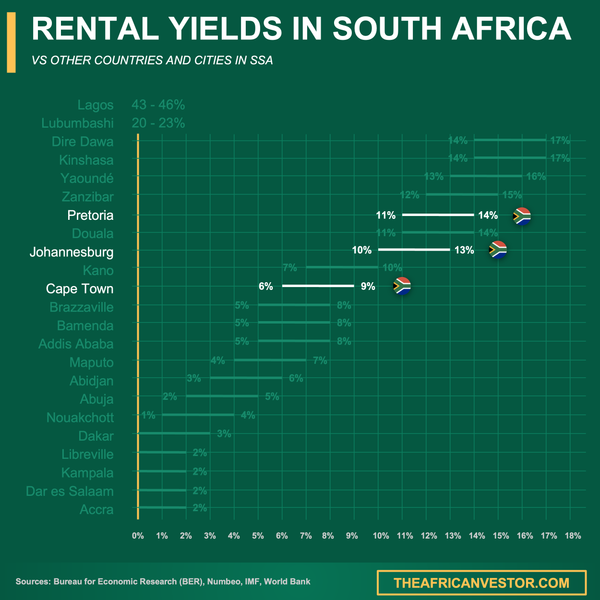
We did some research and made this infographic to help you quickly compare rental yields of the major cities in South Africa versus those in neighboring countries. It provides a clear view of how this country positions itself as a real estate investment destination, which might interest you if you’re planning to invest there.
What sources have we used to write this blog article?
Whether it’s in our blog articles or the market analyses included in our property pack about Pretoria, we always rely on the strongest methodology we can … and we don’t throw out numbers at random.
We also aim to be fully transparent, so below we’ve listed the authoritative sources we used, and explained how we used them and the methods behind our estimates.
| Source we used | Why this source is useful | How we used this source |
|---|---|---|
| PayProp Rental Index Q1 2025 | PayProp is useful because it works with actual rental payments, not only advertised rents. | We used it as the main benchmark for Gauteng achieved rents. We then adjusted the figures for Pretoria’s cheaper inner-city areas and more expensive eastern suburbs. |
| MRI Software and TPN Residential Rental Monitor Q3 2025 | TPN is useful because it tracks tenant payment behavior in the South African rental market. | We used it to understand tenant risk, arrears and rent-escalation pressure. We treated it as a provincial and national cross-check, not as a Pretoria-only source. |
| TPN Residential Rental Monitor Q1 2025 | This report is useful because it gives another tenant-payment view from a specialist rental data provider. | We used it to check vacancy pressure and tenant quality. We used it carefully because Pretoria-specific detail is more limited than Gauteng-level detail. |
| Rode Report Q1 2025 | Rode is useful because South African valuers and property professionals have used its market research for many years. | We used it to cross-check vacancy and residential market direction. We did not use it alone because survey-based data needs support from live listings. |
| Statistics South Africa General Household Survey 2024 | Stats SA is useful because it is South Africa’s official statistics agency. | We used it for household and renter-profile context. We applied the broader patterns carefully to Pretoria because not every table is city-specific. |
| Stats SA Census 2022 | The census is useful because it is the official baseline for population and households. | We used it to frame Tshwane’s population base and housing demand. We checked it against Tshwane’s own open data where possible. |
| City of Tshwane Open Data | This source is useful because it keeps the analysis tied to Pretoria and the wider Tshwane metro. | We used it for the metro-level population anchor. We used it to avoid relying only on national or provincial averages. |
| City of Tshwane Promulgated Tariffs | This source is useful because it is the official municipal source for tariffs and local charges. | We used it to estimate landlord running costs. We separated fixed owner costs from electricity and water consumption paid by tenants. |
| City of Tshwane Valuation Roll notice | This source is useful because property rates depend on the official municipal valuation cycle. | We used it to explain why Pretoria property rates are linked to municipal value. We also used it to time rate changes from the 2025 to 2029 valuation cycle. |
| SARS rental income page | SARS is useful because it is the official tax authority for South African rental income. | We used it to explain rental income tax in plain language. We kept the explanation focused on individual landlords rather than complex company structures. |
| SARB Monetary Policy Review April 2026 | SARB is useful because it sets the inflation and interest-rate backdrop for South Africa. | We used it to understand the 2026 affordability environment. We linked rent-growth expectations to inflation, interest rates and tenant budgets. |
| University of Pretoria transport page | This source is useful because it shows direct campus and transport access around key Pretoria rental nodes. | We used it to identify demand around Hatfield, Prinshof and nearby student areas. We checked those areas against live rental listings. |
| Gautrain Hatfield station | Gautrain is useful because it is the official rapid-rail operator for the Hatfield transit node. | We used it to support the rent premium near Hatfield station. We also used it to explain why transit access matters for Pretoria tenants. |
| Property24 Pretoria rentals | Property24 is useful because it is one of the biggest South African property listing portals. | We used it to sample current Pretoria asking rents and active supply. We did not treat asking rents as the same thing as signed rents. |
| Private Property Pretoria apartments | Private Property is useful because it gives another large view of Pretoria rental listings. | We used it to cross-check rent ranges by bedroom count and suburb. We also used it to identify furnished, secure and estate-style premiums. |
| Numbeo Pretoria property prices | Numbeo is useful as a weak cross-check because it publishes transparent user-input ranges. | We used it only to sense-check 1-bedroom rent levels. We gave more weight to PayProp, TPN, Property24 and Private Property. |
Get fresh and reliable information about the market in Pretoria
Don't base significant investment decisions on outdated data. Get updated and accurate information.
Related blog posts