
As of June 2026, the median apartment price in Cape Town is about R2.15 million, which is around $132,000 or €114,000, but the real cost depends heavily on whether you buy in Parklands, Observatory, Sea Point, Green Point, Clifton or the Waterfront.
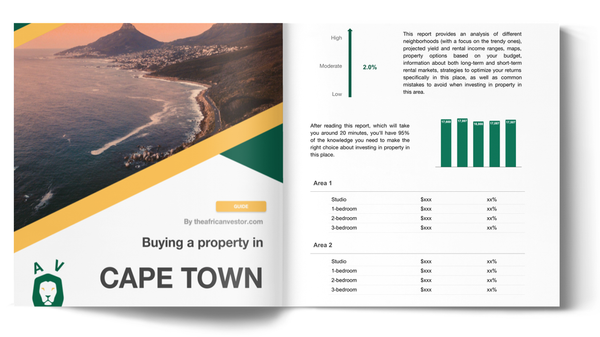
Get all the data you need about the real estate market in Cape Town
We constantly update this Cape Town apartment cost guide so buyers can work with fresh 2026 numbers, not old property-market averages.
Cape Town is a very uneven apartment market, because the Atlantic Seaboard, City Bowl, Southern Suburbs and northern coastal suburbs can feel like separate cities.
That is why this guide focuses on real apartment budgets, buyer costs, levies, municipal rates, utilities and the neighborhoods where prices change the most.
And if you’re planning to buy a property in this place, you may want to download our pack covering the real estate market in Cape Town.
Insights
- The median apartment price in Cape Town in 2026 is much lower than the average, because Clifton, Bantry Bay, Waterfront and Sea Point pull the citywide average upward.
- A foreign non-resident buyer should not only think about the purchase price in Cape Town, because the cash needed can reach 55% to 65% of the apartment price when financed locally.
- Entry-level Cape Town apartments are still available below R1.5 million in Parklands, Bellville, Maitland and parts of Table View, but not in the main Atlantic Seaboard areas.
- Sea Point and Green Point are expensive, but they remain liquid because buyers pay for walkability, the promenade, short-stay demand and limited new land.
- Two-bedroom apartments in Cape Town have a wide price gap, from about R1.25 million in cheaper commuter nodes to more than R8 million in prime coastal buildings.
- Body corporate levies matter more in Cape Town than many foreign buyers expect, especially in older coastal blocks with lifts, waterproofing needs and sea-air corrosion.
- New-build apartments in Cape Town often look attractive because of “no transfer duty” marketing, but the VAT-inclusive price can still be higher per square meter than resale stock.
- For yield-focused buyers, Parklands, Bellville, Observatory, Woodstock and parts of Table View often make more sense than ultra-prime coastal apartments.
- Municipal costs in Cape Town are not small, because owners must budget for property rates, electricity, water, sanitation, refuse and sometimes fixed electricity charges.
- The most important Cape Town rule is simple: two apartments with the same size can have completely different prices if one has views, secure parking, backup power and short-stay permission.
How much do apartments really cost in Cape Town in 2026?
What's the average and median apartment price in Cape Town in 2026?
As of June 2026, the estimated median apartment price in Cape Town is about R2.15 million, or roughly $132,000 and €114,000, while the average apartment price in Cape Town is closer to R3.25 million, or about $200,000 and €173,000.
This difference makes sense because the median price per square meter in Cape Town is about R34,000/m², or around $2,100/m² and €1,800/m², while the average is closer to R42,000/m², or about $2,600/m² and €2,200/m², which equals about R3,200 to R3,900 per sq ft, or roughly $195 to $240 and €170 to €210 per sq ft.
For most standard apartments in Cape Town in 2026, a realistic buying range is about R1.05 million to R4.5 million, or roughly $65,000 to $277,000 and €56,000 to €239,000, before the buyer adds transfer duty, attorney costs, bond costs and municipal adjustments.
We used FNB housing research to check 2026 market direction.
We then adjusted the citywide estimate with our own Cape Town apartment sample and neighborhood weighting.
How much is a studio apartment in Cape Town in 2026?
As of June 2026, a typical studio apartment in Cape Town costs about R1.35 million, or roughly $83,000 and €72,000, if the buyer is looking outside the most expensive Atlantic Seaboard buildings.
That means entry-level to mid-range studios in Cape Town usually sit between R950,000 and R1.8 million, or about $58,000 to $111,000 and €50,000 to €96,000, while luxury studios in Sea Point, Bantry Bay, Clifton or the Waterfront can reach R3.5 million or more, which is about $215,000 and €186,000.
In practical terms, most studio apartments in Cape Town are around 28 m² to 45 m², with smaller city-center investor units at the low end and older Atlantic Seaboard studios often feeling larger.
We compared asking prices with Property24 trend pages where public trend data was available.
We used our own apartment-size filters to separate true studios from small one-bedroom units.
How much is a one-bedroom apartment in Cape Town in 2026?
As of June 2026, a typical one-bedroom apartment in Cape Town costs about R1.65 million, or roughly $101,000 and €88,000, but the same property type can cost far more in Sea Point, Green Point or the Waterfront.
A realistic Cape Town one-bedroom range is about R950,000 to R2.6 million, or around $58,000 to $160,000 and €50,000 to €138,000, while high-end one-bedroom apartments in Sea Point, Green Point, Clifton, Bantry Bay and the Waterfront often run from R3 million to R8 million, or about $184,000 to $492,000 and €159,000 to €425,000.
Most one-bedroom apartments in Cape Town are around 42 m² to 65 m², although newer investor units in the CBD can be smaller and older coastal apartments can be larger.
We checked ooba data to keep budgets realistic for financed buyers.
We then grouped Cape Town one-bedroom stock by suburb, building age and likely buyer demand.
How much is a two-bedroom apartment in Cape Town in 2026?
As of June 2026, a typical two-bedroom apartment in Cape Town costs about R2.65 million, or roughly $163,000 and €141,000, which is a useful central benchmark for a normal buyer.
Entry-level to mid-range two-bedroom apartments in Cape Town usually cost about R1.25 million to R4.5 million, or around $77,000 to $277,000 and €66,000 to €239,000, while high-end two-bedroom apartments in Sea Point, Green Point, Mouille Point, Clifton, Bantry Bay and the Waterfront often cost R6 million to R15 million, or about $369,000 to $922,000 and €319,000 to €797,000.
By the way, you will find much more detailed price ranges for apartments in our property pack covering the property market in Cape Town.
We treated active listings as asking prices, not final sale prices.
We used our own Cape Town apartment model to smooth the gap between cheaper inland stock and prime coastal stock.
How much is a three-bedroom apartment in Cape Town in 2026?
As of June 2026, a typical three-bedroom apartment in Cape Town costs about R4.8 million, or roughly $295,000 and €255,000, because family-sized apartments are much scarcer in central and coastal areas.
A realistic range for entry-level to mid-range three-bedroom apartments in Cape Town is about R1.8 million to R7 million, or around $111,000 to $430,000 and €96,000 to €372,000, while luxury three-bedroom apartments in Clifton, Bantry Bay, the Waterfront, Mouille Point and prime Sea Point often cost R10 million to R40 million, or about $615,000 to $2.46 million and €531,000 to €2.12 million.
Most three-bedroom apartments in Cape Town are around 95 m² to 160 m², but luxury coastal units can be much larger when they include terraces, sea views, staff rooms or multiple parking bays.
We separated family-sized apartments from townhouse and house listings.
We also adjusted for Cape Town’s scarcity premium in secure coastal and City Bowl buildings.
What's the price gap between new and resale apartments in Cape Town in 2026?
As of June 2026, new-build apartments in Cape Town are typically about 15% to 25% more expensive per square meter than comparable resale apartments in the same area.
For new-build apartments in Cape Town, a realistic average is about R50,000/m², or around $3,100/m² and €2,700/m², although premium Atlantic Seaboard projects can sit far above that.
For resale apartments in Cape Town, a realistic average is closer to R40,000/m², or around $2,500/m² and €2,100/m², with cheaper resale stock in Bellville, Maitland, Parklands and Table View pulling the number down.
We treated VAT-inclusive developer pricing separately from resale transfer-duty pricing.
We also used our own comparable-building checks in Sea Point, Green Point, the CBD and Parklands.
Get to know the market before buying a property in Cape Town
Better information leads to better decisions. Get all the data you need before investing a large amount of money.

Can I afford to buy in Cape Town in 2026?
What's the typical total budget (all-in) to buy an apartment in Cape Town in 2026?
As of June 2026, a foreign buyer should budget about R2.9 million to R3 million all-in, or roughly $178,000 to $184,000 and €154,000 to €159,000, to buy a normal R2.7 million apartment in Cape Town as a cash purchase.
This all-in budget usually includes the apartment price, transfer duty where applicable, transfer attorney fees, deeds-office fees, bond costs if financed, pro-rata rates, pro-rata levies, bank charges, moving costs and a small repair buffer.
We go deeper and try to understand what costs can be avoided or minimized (and how) in our Cape Town property pack.
We estimated cash and financed scenarios separately because foreign non-resident buyers often need much larger deposits.
We also cross-checked buyer-cost totals with South African conveyancing cost norms.
What down payment is typical to buy in Cape Town in 2026?
As of June 2026, a foreign non-resident buying a R2.7 million apartment in Cape Town should expect a down payment of about 50%, or roughly R1.35 million, $83,000 and €72,000, before adding buyer costs.
For local South African buyers, some banks may approve low-deposit or zero-deposit home loans, but for foreign non-residents, banks commonly limit lending to about half of the property value.
For better mortgage terms in Cape Town, a foreign buyer should plan for at least 50% cash, while a resident buyer is usually in a stronger position with 10% to 20% down.
We treated local buyers and foreign non-resident buyers differently because their bank rules are not the same.
We used our own affordability checks to avoid making Cape Town mortgage budgets look too easy.
Buying real estate in Cape Town can be risky
An increasing number of foreign investors are showing interest. However, 90% of them will make mistakes. Avoid the pitfalls with our comprehensive guide.

Which neighborhoods are cheapest or priciest in Cape Town in 2026?
How much does the price per m² for apartments vary by neighborhood in Cape Town in 2026?
As of June 2026, apartment prices in Cape Town range from about R18,000/m² to more than R130,000/m², or roughly $1,100 to $8,000/m² and €960 to €6,900/m², depending on the neighborhood, view, building quality and rental rules.
In the most affordable apartment neighborhoods of Cape Town, such as Bellville, Maitland, Parklands, Sandown, Goodwood and parts of Table View, buyers often see prices around R18,000 to R34,000/m², or about $1,100 to $2,100/m² and €960 to €1,800/m².
In the most expensive apartment neighborhoods of Cape Town, such as the Waterfront, Clifton, Bantry Bay, Camps Bay, Mouille Point, Sea Point and Green Point, prices often range from R55,000 to R130,000/m², or about $3,400 to $8,000/m² and €2,900 to €6,900/m².
We grouped suburbs by real buyer behavior, not only by municipal boundaries.
We then checked whether each neighborhood range made sense against current apartment listings.
What neighborhoods are best for first-time buyers on a budget in Cape Town in 2026?
As of June 2026, the top three budget-friendly apartment areas in Cape Town are Parklands, Bellville and Maitland, because each offers lower entry prices, enough apartment stock and practical rental demand.
In these budget-friendly Cape Town neighborhoods, a realistic apartment price range is about R950,000 to R2 million, or roughly $58,000 to $123,000 and €50,000 to €106,000, depending on size, parking, building condition and distance from transport.
Parklands gives buyers newer sectional-title stock, Bellville offers jobs, universities and hospitals, and Maitland gives buyers a closer-to-CBD location at a lower price than Woodstock or Observatory.
The trade-off is that these areas do not offer the same walkability, sea views, short-stay demand or resale prestige as Sea Point, Green Point, Gardens or the Waterfront.
We focused on apartment stock that a normal first-time buyer might actually finance.
We also checked rental logic using PayProp provincial rental evidence.
Which neighborhoods have the fastest-rising apartment prices in Cape Town in 2026?
As of June 2026, the three strongest apartment-price momentum areas in Cape Town are Sea Point, Green Point and the Newlands-Claremont corridor, with Woodstock and Salt River also worth watching closely.
A reasonable 2025 to mid-2026 price-growth estimate is about 8% to 12% for Sea Point, 7% to 11% for Green Point and 7% to 11% for Newlands and Claremont, although each building still needs its own check.
The main driver is that Cape Town buyers are paying more for scarce walkable neighborhoods with lifestyle appeal, rental demand, strong amenities, school or university access and limited new land.
We treated growth ranges as estimates, not guaranteed forecasts.
We used our own neighborhood scoring to separate broad Cape Town momentum from building-level overpricing.
Don't lose money on your property in Cape Town
100% of people who have lost money there have spent less than 1 hour researching the market. We have reviewed everything there is to know. Grab our guide now.
What extra costs will I pay on top of the apartment price in Cape Town in 2026?
What are all the buyer closing costs when you buy an apartment in Cape Town?
For a typical R2.7 million apartment in Cape Town in 2026, buyer closing costs are about R220,000 to R245,000 if financed, or roughly $13,500 to $15,100 and €11,700 to €13,000.
The main buyer costs in Cape Town are transfer duty, transfer attorney fees, deeds-office fees, bond registration attorney fees, bond initiation fees, bank valuation costs and pro-rata municipal rates and levies.
The largest closing cost is usually SARS transfer duty, unless the apartment is a new VAT-inclusive developer sale where transfer duty is normally not payable.
Some costs can vary between Cape Town transactions, especially attorney fees, bond costs, bank charges, occupational rent, levy clearance costs and the timing of municipal adjustments.
We separated transfer duty from VAT-inclusive new-build purchases.
We then tested the results against common Cape Town apartment price points.
On average, how much are buyer closing costs as a percentage of the purchase price for an apartment in Cape Town?
In Cape Town in 2026, buyers should usually budget about 6% to 9% of the apartment price for closing costs on a standard financed resale apartment.
For most standard Cape Town apartment transactions, the realistic low-to-high range is about 3.5% to 11%, with the percentage rising as transfer duty becomes larger on more expensive properties.
We actually cover all these costs and strategies to minimize them in our pack about the real estate market in Cape Town.
We modeled cash and financed transactions separately.
We rounded costs so a non-professional buyer can use the numbers without reading a legal fee schedule.
Thinking of buying real estate in Cape Town?
Acquiring property in a different country is a complex task. Don't fall into common traps – grab our guide and make better decisions.
What are the ongoing monthly and yearly costs of an apartment in Cape Town in 2026?
What are typical HOA fees in Cape Town right now?
In Cape Town, apartment HOA fees are usually called body corporate levies, and a normal owner should expect about R1,800 to R3,800 per month, or roughly $110 to $235 and €95 to €200, for a standard one-bedroom or two-bedroom sectional-title apartment.
The realistic Cape Town levy range is about R900 to R18,000 or more per month, or around $55 to $1,100 and €48 to €960, from basic walk-up buildings to luxury coastal blocks with lifts, security, pools, generators, staff and large reserve funds.
We checked levies separately from municipal rates and utilities.
We gave higher ranges for coastal and high-rise buildings because Cape Town maintenance risk is not evenly spread.
What utilities should I budget monthly in Cape Town right now?
For a typical Cape Town apartment in June 2026, a realistic monthly utility budget is about R2,350 to R4,350, or roughly $145 to $267 and €125 to €231, before body corporate levies.
The realistic monthly range is about R1,630 to R5,950, or around $100 to $366 and €87 to €316, depending on apartment size, electricity use, water use, internet package and whether the apartment has prepaid or billed services.
This Cape Town utility budget usually includes electricity, water, sanitation, refuse, municipal service charges and fibre internet.
Electricity is normally the biggest utility cost for Cape Town apartment owners, especially when heating, cooling, laundry, geyser use or backup-power costs are included.
We separated utilities from levies because many foreign buyers mix them together.
We rounded monthly amounts to useful owner-budget ranges.
How much is property tax on apartments in Cape Town?
For a normal R2.7 million apartment in Cape Town in 2026, annual municipal property rates are roughly R16,000 to R19,000, or about $980 to $1,170 and €850 to €1,010.
Cape Town property rates are calculated by applying the residential rate-in-the-rand to the municipal valuation, after any residential reduction, exemption or rebate that applies to the property.
For most standard apartments in Cape Town, annual property rates can range from about R7,600 to R47,000, or roughly $470 to $2,900 and €400 to €2,500, depending mainly on municipal value and rebate treatment.
We used municipal value, not asking price, as the calculation base.
We made conservative estimates because rebate treatment can differ by account and property use.
What's the yearly building maintenance cost in Cape Town?
For a typical Cape Town apartment owner, the long-run yearly building maintenance cost is about 0.5% to 1% of the apartment value, which is about R13,500 to R27,000 per year, or roughly $830 to $1,660 and €720 to €1,430, on a R2.7 million apartment.
A realistic annual maintenance range is about R8,000 to R60,000, or around $490 to $3,700 and €425 to €3,200, depending on building age, lift condition, waterproofing, façade work, roof repairs, plumbing and coastal exposure.
These costs usually cover common-area repairs, long-term maintenance plans, reserve-fund contributions, insurance-related building items, lift servicing, security systems and major building works.
In Cape Town sectional-title buildings, much of this maintenance is included in the monthly body corporate levy, but special levies can still appear when the reserve fund is too weak.
We treated routine levy spending and long-term maintenance exposure as related but not identical.
We raised the allowance for older Atlantic Seaboard and City Bowl buildings with lifts or façade risk.
How much does home insurance cost in Cape Town?
For a typical Cape Town apartment, annual home insurance paid directly by the owner is often about R2,400 to R9,600, or roughly $150 to $590 and €130 to €510, if the owner mainly needs contents and landlord cover.
A realistic annual insurance range is about R2,400 to R18,000, or around $150 to $1,100 and €130 to €960, depending on contents value, landlord use, vacancy periods, water damage cover, short-stay letting and the apartment’s location.
Building insurance is usually included in the body corporate levy for sectional-title apartments in Cape Town, but contents insurance, liability cover and landlord cover are normally separate owner choices unless a bank or rental arrangement requires them.
We separated building insurance from contents insurance because apartment buyers often confuse them.
We adjusted the higher range for coastal, furnished and short-term-let apartments in Cape Town.
Get the full checklist for your due diligence in Cape Town
Don't repeat the same mistakes others have made before you. Make sure everything is in order before signing your sales contract.
What sources have we used to write this blog article?
Whether it’s in our blog articles or the market analyses included in our property pack about Cape Town, we always rely on the strongest methodology we can, and we don’t throw out numbers at random.
We also aim to be fully transparent, so below we’ve listed the authoritative sources we used, and explained how we used them and the methods behind our estimates.
| Source | Why we trust it | How we used it |
|---|---|---|
| SARS transfer duty table | SARS is South Africa’s official tax authority. | We used it to calculate transfer duty for 2026 apartment purchases. We applied the brackets to common Cape Town budgets. |
| South African Reserve Bank MPC data | SARB is the official source for monetary-policy rates. | We used it to frame mortgage affordability in June 2026. We also used SARB exchange rates for simple currency conversions. |
| City of Cape Town property rates | The City directly bills property owners. | We used it to explain how Cape Town property rates are calculated. We checked the logic against official tariff documents. |
| City of Cape Town 2025/26 approved tariff notice | It is the official tariff notice for municipal charges. | We used it for property rates, fixed charges and service tariffs. We used it to estimate monthly owner costs. |
| City of Cape Town residential electricity guide | It explains the City’s household electricity tariffs. | We used it to separate electricity costs from other municipal services. We also checked prepaid and billed-use assumptions. |
| FNB Housing Market Outlook 2026 | FNB is a major South African mortgage lender. | We used it for 2026 market direction and affordability context. We did not use it as a suburb-level price list. |
| oobarometer Q1 2026 | ooba has large live mortgage-application data. | We used it for deposit and approval assumptions. We adjusted the numbers for foreign non-resident buyers. |
| Property Wheel summary of ooba Q1 2026 data | It reports fresh mortgage-market data in plain language. | We used it to cross-check deposit percentages. We treated it as a secondary source behind ooba. |
| Property24 Cape Town suburb trend pages | Property24 is a major public listings portal. | We used it to benchmark suburb pricing and listing depth. We cross-checked it with active listings and our own apartment filters. |
| Private Property Cape Town listings | Private Property is a major South African portal. | We used it to test current asking-price ranges. We used listing volume to avoid relying on one unusual apartment. |
| Lightstone residential property information | Lightstone is a major deeds-based data provider. | We used it as a transaction-data methodology anchor. We did not copy paywalled figures without public support. |
| World Bank and CAHF Cape Town residential report | It combines serious institutional housing-market analysis. | We used it to understand Cape Town’s structural segmentation. We avoided treating the whole metro as one uniform market. |
| PayProp Rental Index | PayProp tracks real rental-payment data. | We used it to sanity-check rental pressure and yield logic. We treated it as provincial context, not exact suburb yield data. |
| Sectional Title Solutions reserve-fund guidance | It explains sectional-title reserve-fund mechanics clearly. | We used it to explain levies and long-term maintenance. We used the logic for apartment-owner cost estimates. |
| ooba transfer-duty guide | It gives buyer-friendly transfer-duty explanations. | We used it to cross-check buyer-cost explanations. We still treated SARS as the primary transfer-duty source. |
| SA Property Tools transfer-cost calculator | It helps test South African transfer-cost scenarios. | We used it to check modeled buyer-cost ranges. We did not rely on it instead of official SARS brackets. |
| The Guardian Cape Town housing and Airbnb report | It gives recent context on Cape Town housing pressure. | We used it for short-stay and affordability context. We did not use it to set apartment price estimates. |
Get fresh and reliable information about the market in Cape Town
Don't base significant investment decisions on outdated data. Get updated and accurate information.
