
As of 2026, a realistic median house price in Cape Town is around R3.4 million, about $184,000 or €170,000, but Cape Town house prices move very differently by neighborhood, because a small house in Mitchells Plain and a large home in Constantia are not part of the same buyer market.
Get all the data you need about the real estate market in Cape Town
We constantly update this blog post so foreign buyers can follow Cape Town house prices with fresh 2026 data.
This guide focuses only on houses in Cape Town, not apartments, plots, farms or commercial property.
The goal is to make Cape Town house prices simple to understand before you visit, negotiate or make an offer.
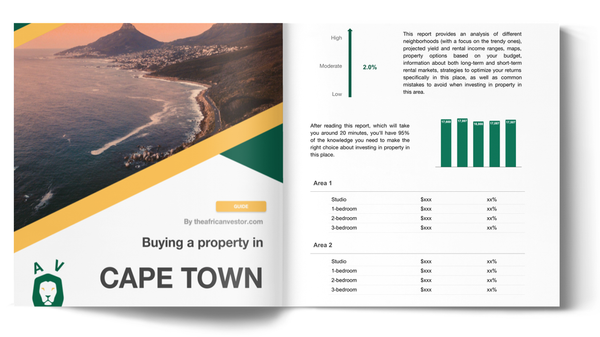
And if you’re planning to buy a property in this place, you may want to download our pack covering the real estate market in Cape Town.
How much do houses cost in Cape Town as of 2026?
What's the median and average house price in Cape Town as of 2026?
As of 2026, our best estimate is that the median house price in Cape Town is around R3.2 million to R3.6 million, about $173,000 to $195,000 or €160,000 to €180,000, while the average transacted house price is closer to R4.8 million to R5.5 million, about $259,000 to $297,000 or €240,000 to €275,000.
In practice, roughly 80% of ordinary house sales in Cape Town in 2026 sit between about R1.2 million and R8 million, or about $65,000 to $432,000 and €60,000 to €400,000, because Cape Town has both large affordable areas and very expensive coastal suburbs.
The median and average house prices in Cape Town differ because luxury houses in Camps Bay, Clifton, Bishopscourt and Constantia pull the average upward, while the median better reflects the price paid by a normal family buyer.
At the median house price in Cape Town in 2026, a buyer can usually expect a 3-bedroom freehold house in areas such as Table View, Parklands, Kraaifontein, Brackenfell, Plumstead or parts of Durbanville, but not a large sea-view house or a prime Southern Suburbs school-belt home.
What's the cheapest livable house budget in Cape Town as of 2026?
As of 2026, the cheapest realistic livable house budget in Cape Town is about R1.1 million to R1.4 million, or about $59,000 to $76,000 and €55,000 to €70,000.
At this entry price, livable usually means a small 2-bedroom or 3-bedroom house with basic finishes, working services, modest security and possible repair needs, rather than a renovated family home with a garage, garden and modern kitchen.
These cheapest livable houses in Cape Town are usually found in Mitchells Plain, Blue Downs, Eerste River, Delft edges, Belhar, Bishop Lavis, Scottsdene, Atlantis and older Kraaifontein pockets.
The key point is that a foreign buyer can enter the Cape Town house market near R1.2 million, but the buyer should expect a working-class location and should budget separately for inspections, security and small upgrades.
How much do 2 and 3-bedroom houses cost in Cape Town as of 2026?
As of 2026, a typical 2-bedroom house in Cape Town costs about R1.2 million to R2.8 million, or about $65,000 to $151,000 and €60,000 to €140,000, while a typical 3-bedroom house costs about R1.6 million to R4.5 million, or about $86,000 to $243,000 and €80,000 to €225,000.
A realistic 2-bedroom house range in Cape Town is R1.1 million to R2.2 million in Mitchells Plain, Blue Downs and Eerste River, R2.4 million to R3.5 million in Table View, Parklands and Plumstead, and R6 million or more in Atlantic Seaboard or City Bowl areas.
A realistic 3-bedroom house range in Cape Town is R1.4 million to R2.2 million in Mitchells Plain, R2.6 million to R4.2 million in Parklands, Table View, Kraaifontein and Durbanville edges, R4.5 million to R7 million in stronger Southern Suburbs, and R9 million or more in Camps Bay or Constantia.
The move from a 2-bedroom to a 3-bedroom house in Cape Town usually adds about 25% to 45%, because the third bedroom often comes with better parking, more land and stronger family-buyer demand.
How much do 4-bedroom houses cost in Cape Town as of 2026?
As of 2026, a typical 4-bedroom house in Cape Town costs about R3.5 million to R8 million, or about $189,000 to $432,000 and €175,000 to €400,000, but the same bedroom count can cost far more in luxury areas.
A realistic 5-bedroom house range in Cape Town is about R3 million to R5 million in lower-cost suburbs, R6 million to R10 million in Durbanville, Blouberg and Plumstead-style family areas, and R12 million to R25 million in Constantia and upper Southern Suburbs.
A realistic 6-bedroom house range in Cape Town is about R5 million to R10 million in ordinary suburban locations, R12 million to R30 million in large-plot family areas, and R30 million to R60 million or more in Bishopscourt, Clifton, Bantry Bay and prime Camps Bay.
Please note that we give much more detailed data in our pack about the property market in Cape Town.
How much do new-build houses cost in Cape Town as of 2026?
As of 2026, a new-build house in Cape Town usually costs about R2.6 million to R5.5 million in Sandown, Blouberg and similar growth nodes, about R3.1 million to R3.5 million in Pinehurst and Durbanville projects, and R40 million or more in luxury house developments.
Compared with older resale houses in the same Cape Town outer suburbs, new-build houses usually carry a premium of about 10% to 25%, while luxury new-build houses can carry a premium of 30% or more because buyers pay for design, security, views, energy systems and lower renovation risk.
How much do houses with land cost in Cape Town as of 2026?
As of 2026, a Cape Town house with a meaningful plot usually costs about R3 million to R6 million in outer family suburbs, R7 million to R14 million in leafy Southern Suburbs, and R15 million to R40 million or more in Constantia, Bishopscourt and Camps Bay.
In Cape Town, a house with land usually means a freehold plot of at least 500 to 700 square meters in normal suburbs, or 1,500 square meters and more in Constantia, Bishopscourt, Tokai edges, Durbanville smallholding areas and Cape Farms.
This matters because Cape Town is hemmed in by mountains, coastline and protected land, so a large plot inside the city often carries a scarcity premium that can be bigger than the value of the house itself.
Thinking of buying real estate in Cape Town?
Acquiring property in a different country is a complex task. Don't fall into common traps – grab our guide and make better decisions.

Where are houses cheapest and most expensive in Cape Town as of 2026?
Which neighborhoods have the lowest house prices in Cape Town as of 2026?
As of 2026, the Cape Town neighborhoods with the lowest house prices are Mitchells Plain, Delft, Blue Downs, Eerste River, Belhar, Bishop Lavis, Scottsdene, Atlantis and parts of Kraaifontein.
In these cheaper Cape Town neighborhoods, typical house prices usually run from about R1.1 million to R2.2 million, or about $59,000 to $119,000 and €55,000 to €110,000, with the lowest livable homes often in smaller and older stock.
The main reason these neighborhoods stay cheaper is that they sit farther from the Atlantic Seaboard, top school belts and major white-collar job nodes, while some areas also have weaker public transport, smaller homes and higher perceived security risk.
Which neighborhoods have the highest house prices in Cape Town as of 2026?
As of 2026, the top three Cape Town house markets by price are Clifton, Bishopscourt and prime Constantia, with Camps Bay, Bantry Bay, Fresnaye and Llandudno also sitting near the top.
In these most expensive Cape Town neighborhoods, ordinary standalone houses often start around R10 million to R15 million, or about $541,000 to $811,000 and €500,000 to €750,000, while prime homes can reach R40 million to R100 million or more.
These neighborhoods command the highest house prices because Cape Town buyers are paying for scarce sea views, large protected plots, school access, mountain setting, privacy, security and international lifestyle value in the same purchase.
The typical buyer in these premium Cape Town neighborhoods is a wealthy local family, a South African semigrant from Gauteng, a returning South African, or a foreign buyer who wants lifestyle, privacy and a hard-to-replace location.
How much do houses cost near the city center in Cape Town as of 2026?
As of 2026, houses near the Cape Town city center, mainly Gardens, Oranjezicht, Vredehoek, Tamboerskloof, Bo-Kaap and De Waterkant, usually cost about R6 million to R15 million, or about $324,000 to $811,000 and €300,000 to €750,000.
Near major Cape Town transit routes, especially the Southern Line corridor around Plumstead, Diep River, Kenilworth, Claremont, Rondebosch and Newlands, houses usually cost from about R2.8 million to R8 million, or about $151,000 to $432,000 and €140,000 to €400,000.
Near top Cape Town schools such as Rondebosch Boys’, Bishops, Rustenburg Girls’, SACS, Westerford and Herschel, family houses usually cost about R5 million to R12 million, or about $270,000 to $649,000 and €250,000 to €600,000, with Bishopscourt and Newlands often higher.
In expat-popular Cape Town areas such as Camps Bay, Fresnaye, Sea Point edges, Constantia, Hout Bay, Noordhoek, Tamboerskloof, Gardens, Claremont and Newlands, a practical house budget is about R6 million to R18 million, or about $324,000 to $973,000 and €300,000 to €900,000.
How much do houses cost in the suburbs in Cape Town as of 2026?
As of 2026, a normal suburban house in Cape Town usually costs about R2.5 million to R6.5 million, or about $135,000 to $351,000 and €125,000 to €325,000, depending on whether the suburb is an outer growth node or a stronger family area.
Suburban houses in Cape Town are often 25% to 50% cheaper than comparable houses near the City Bowl, because buyers trade central access and scarcity for more space, newer stock and easier parking.
The most popular Cape Town suburbs for house buyers include Durbanville, Brackenfell, Kraaifontein, Parklands, Table View, Blouberg, Plumstead, Bergvliet, Tokai, Rondebosch, Claremont, Newlands and Constantia edges.
What areas in Cape Town are improving and still affordable as of 2026?
As of 2026, the most useful improving but still affordable Cape Town areas for house buyers are Sandown, Sunningdale, Parklands, Table View, Kraaifontein, Brackenfell, Burgundy Estate, Eerste River and parts of Plumstead and Diep River.
In these improving Cape Town areas, current typical house prices usually sit around R2 million to R5.5 million, or about $108,000 to $297,000 and €100,000 to €275,000, depending on whether the buyer wants an older resale house or a new-build house.
The clearest sign of improvement is not just rising prices, but new house developments, better retail nodes, more family services and stronger semigration demand from South Africans moving toward the Western Cape.
Get fresh and reliable information about the market in Cape Town
Don't base significant investment decisions on outdated data. Get updated and accurate information.
What extra costs should I budget for a house in Cape Town right now?
What are typical buyer closing costs for houses in Cape Town right now?
For a resale house in Cape Town right now, a buyer should usually budget about 6% to 9% of the purchase price in cash for transfer duty, conveyancing, bond registration, deeds fees and smaller administration costs.
On a R3.5 million Cape Town house, this often means about R220,000 to R260,000, or $12,000 to $14,000 and €11,000 to €13,000, while a R5 million house can require about R430,000 to R480,000, or $23,000 to $26,000 and €22,000 to €24,000.
The largest closing cost for most Cape Town house buyers is transfer duty, except for new developer homes where VAT may be included and transfer duty may not apply.
We cover all these costs and the strategies to minimize them in our property pack about Cape Town.
How much are property taxes on houses in Cape Town right now?
A typical annual municipal property-rates bill for a Cape Town house right now is about R18,000 to R72,000, or about $970 to $3,900 and €900 to €3,600, before any personal rebates or exemptions.
Cape Town property tax is calculated by multiplying the municipal valuation by the residential rate-in-the-rand, then applying the City of Cape Town rebates, exemptions and any extra fixed municipal charges that apply to that property.
As a simple 2025/26 working guide, annual rates before rebates are about R17,900 on a R2.5 million valuation, R25,100 on R3.5 million, R35,800 on R5 million and R71,600 on R10 million.
How much is home insurance for a house in Cape Town right now?
A typical annual building-insurance cost for a Cape Town house right now is about R6,000 to R21,600, or about $325 to $1,170 and €300 to €1,080, with luxury coastal or large-plot houses costing more.
The main factors that affect Cape Town home insurance premiums are rebuild value, roof type, coastal exposure, security, fire risk near mountain edges, retaining walls, old plumbing, thatch, pool structures and whether the house has recent electrical and compliance certificates.
What are typical utility costs for a house in Cape Town right now?
A normal Cape Town family house right now usually costs about R3,500 to R6,500 per month in utilities, or about $190 to $350 and €175 to €325, while large houses with pools, irrigation or weak solar can run R7,000 to R12,000 or more.
A simple Cape Town monthly utility breakdown is often R1,800 to R4,500 for electricity, R600 to R1,500 for water and sanitation, R250 to R600 for refuse, and several hundred to several thousand rand for fixed city charges linked to property value and usage.
What are common hidden costs when buying a house in Cape Town right now?
Cape Town house buyers should often keep about R100,000 to R300,000, or about $5,400 to $16,200 and €5,000 to €15,000, for common hidden costs after purchase, while luxury or older homes may need R500,000 or more.
Typical inspection fees for a Cape Town house are about R2,000 to R4,500, or about $110 to $245 and €100 to €225, with higher fees for large homes or specialist damp, roof, pool and structural checks.
Beyond inspections, the common hidden costs are roof repairs, damp, boundary walls, electrical compliance, beetle certificates, plumbing fixes, pool equipment, security upgrades, inverter batteries, solar repairs and water-system problems.
The hidden cost that surprises first-time Cape Town house buyers the most is usually the cost of making an older house safe, dry and compliant before the buyer can live comfortably in it.
Get to know the market before buying a property in Cape Town
Better information leads to better decisions. Get all the data you need before investing a large amount of money.
What do locals and expats say about the market in Cape Town as of 2026?
Do people think houses are overpriced in Cape Town as of 2026?
As of 2026, many locals and expats think Cape Town houses feel expensive, especially in the Atlantic Seaboard, City Bowl, Constantia and top school-belt suburbs, but many still see value in safer, well-located freehold homes because supply is tight.
Correctly priced family houses in good Cape Town areas often sell in about 45 to 90 days, while overpriced luxury houses above R20 million can sit much longer because the buyer pool is much smaller.
The main reason people feel Cape Town house prices are high is that demand has grown faster than good freehold supply, especially from semigration, foreign lifestyle buyers, school-driven families and buyers seeking better-managed municipal services.
Compared with one or two years ago, Cape Town sentiment is firmer in 2026 because official price growth, Western Cape outperformance and weak new house supply have made buyers more worried about being priced out.
Are prices still rising or cooling in Cape Town as of 2026?
As of 2026, Cape Town house prices are still rising rather than cooling, especially for freehold homes in scarce family areas and lifestyle suburbs.
The best official anchor is that City of Cape Town residential prices were up 11.5% year over year in January 2026, while the Western Cape was up about 11.0%, and national freehold growth was also strong.
Over the next 6 to 12 months, most experts and local market watchers expect Cape Town house prices to keep rising, but at a more uneven pace, with the strongest demand in well-located family suburbs and the slowest movement in overpriced luxury listings.
Don't lose money on your property in Cape Town
100% of people who have lost money there have spent less than 1 hour researching the market. We have reviewed everything there is to know. Grab our guide now.

What sources have we used to write this blog article?
Whether it’s in our blog articles or the market analyses included in our property pack about Cape Town, we always rely on the strongest methodology we can … and we don’t throw out numbers at random.
We also aim to be fully transparent, so below we’ve listed the authoritative sources we used, and explained how we used them and the methods behind our estimates.
| Source | Why this source matters | How we used it |
|---|---|---|
| Statistics South Africa RPPI, January 2026 | It is South Africa’s official residential price index. | We used it as the official Cape Town price-growth anchor. We treated it as stronger than portal asking prices for trend direction. |
| Lightstone Property Newsletter, March 2026 | Lightstone uses deeds and property-market data. | We used it to cross-check Western Cape outperformance. We used it cautiously because it is not a suburb-level house-price table. |
| FNB Property Barometer | FNB is a major lender with long-running property data. | We used it to understand demand, credit and supply pressure. We did not use it as the only price source. |
| Property24 Cape Town values | It shows live asking-market evidence. | We used it to check current listing-market skew. We did not treat its average asking price as the true selling price. |
| Property24 Mitchells Plain values | It gives a useful low-end suburb benchmark. | We used it to estimate the cheapest livable house budget. We cross-checked it with Cape Town-wide price growth. |
| Private Property Cape Town house listings | It is another major South African property portal. | We used it to cross-check live house stock and bedroom ranges. We treated listings as examples, not perfect averages. |
| Property24 Cape Town new developments | It shows live developer stock and quoted prices. | We used it to price new-build houses. We separated house projects from apartment-heavy developments. |
| SARS transfer duty rates | SARS is the official South African tax authority. | We used it for buyer transfer-duty bands. We calculated cash closing-cost examples from these brackets. |
| City of Cape Town 2025/26 tariff notice | It is the official municipal tariff source. | We used it for rates, utilities and city charges. We converted the tariff structure into practical monthly buyer estimates. |
| HouseCheck inspection fees | It gives real inspection-fee guidance. | We used it to estimate inspection costs for buyers. We adjusted the warning for larger and older Cape Town houses. |
| King Price building-insurance guide | It gives current South African insurance-cost ranges. | We used it for building-insurance guidance. We adjusted the range for Cape Town coastal and fire-edge risks. |
| Exchange-rates.org 2026 USD/ZAR history | It helps convert rand prices for foreign readers. | We used rounded 2026 working exchange rates. We rounded all conversions to keep the article easy to read. |
Buying real estate in Cape Town can be risky
An increasing number of foreign investors are showing interest. However, 90% of them will make mistakes. Avoid the pitfalls with our comprehensive guide.
